What the Conscientious Objector Definition Really Means
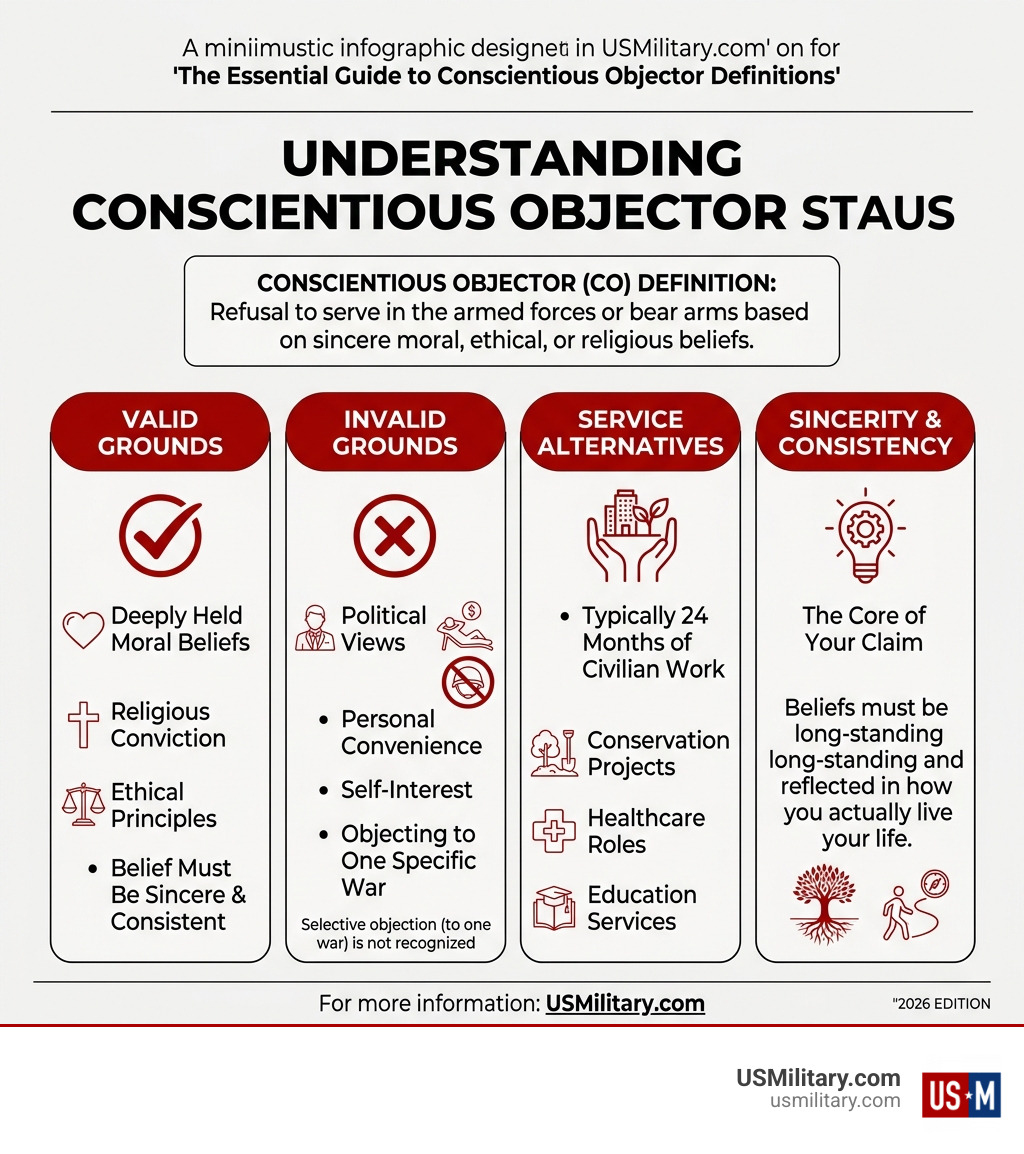
The conscientious objector definition is straightforward: a conscientious objector (CO) is a person who refuses to serve in the armed forces or bear arms based on sincere moral, ethical, or religious beliefs.
Quick answer:
| Term | Meaning |
|---|---|
| Conscientious objector (CO) | A person who refuses military service due to moral, ethical, or religious beliefs |
| Valid grounds | Religious conviction, deeply held moral or ethical principles |
| Invalid grounds | Political views, personal convenience, self-interest |
| Selective objection | Objecting to one specific war — not recognized under U.S. law |
| Alternative service | Civilian work (conservation, healthcare, education) for typically 24 months |
So what separates a CO from someone who simply doesn’t want to serve? The difference comes down to sincerity and consistency. Your beliefs must be deeply held, long-standing, and reflected in how you actually live your life.
The term itself only dates to 1916 — born directly out of the mass conscription of World War I. In the UK alone, around 16,000 men registered as conscientious objectors during that conflict. Their experiences — ranging from civilian work exemptions to imprisonment — shaped how governments around the world approach CO claims today.
Muhammad Ali put it plainly when he refused induction in 1967: “I ain’t got no quarrel with them Viet Cong.” His case, later upheld unanimously by the U.S. Supreme Court, became one of the most visible examples of how moral conviction can clash with military obligation.
I’m Larry Fowler, publisher of USMilitary.com and a longtime advocate for clear, reliable military information — including navigating the conscientious objector definition and what it means for those weighing their service options. Understanding your rights before a draft situation arises is one of the most important steps you can take.
Conscientious objector definition terms you need:
- Can you refuse to go to war if drafted?
- What Disqualifies You From A Military Draft?
- How To Get A Certificate of Incompetency To Avoid The Military Draft
Understanding the Conscientious Objector Definition and Legal Framework

When we look at the legal landscape, the conscientious objector definition isn’t just a dictionary entry; it’s a protected status under specific legal criteria. In the United States, the conscientious objector legal definition centers on an individual who refuses to bear arms or serve in the military based on a “matter of conscience.”
Historically, this was strictly tied to organized religion—specifically “Peace Churches” like the Quakers. However, legal milestones have broadened this scope. A pivotal moment came with the case of United States v. Seeger. In 1965, the Supreme Court ruled that a person does not need to believe in a traditional “Supreme Being” to qualify as a CO. Instead, the test is whether a given belief is “sincere and meaningful” and occupies a place in the life of its possessor parallel to that filled by the orthodox belief in God.
The Conscientious Objector Definition in the United States
If a draft were ever reinstated, the Selective Service System (SSS) would manage the process. We must understand that currently, all men in the U.S. are required to register with the SSS, including those who consider themselves conscientious objectors. You don’t “check a box” for CO status when you register; rather, you make your claim only after you receive an induction notice.
The SSS guidelines require a claimant to appear before a local board. You can’t just say “I’m a pacifist” and go home. You must provide:
- Written statements explaining how you arrived at your beliefs.
- Character witnesses who can testify to your sincerity.
- Evidence of lifestyle consistency, showing that your daily actions align with your stated refusal to use violence.
International Law and the Right to Refuse
On the global stage, the right to object is increasingly viewed as a fundamental human right. Article 18 of the Universal Declaration of Human Rights guarantees freedom of thought, conscience, and religion. The UN Commission on Human Rights has reinforced this, stating that the right to conscientious objection is a legitimate exercise of these freedoms.
Interestingly, recognition varies wildly. While many European nations have robust systems for alternative service, only a few countries, such as Germany and the Netherlands, officially recognize the right to conscientious objection for professional soldiers and objection rights who are already under contract.
Valid Grounds vs. Exclusions for Objection
Not every reason for wanting to avoid the military fits the conscientious objector definition. The law is very specific about what counts as a “conscience-based” objection.
| Valid Grounds (Accepted) | Invalid Grounds (Rejected) |
|---|---|
| Religious training and belief | Political disagreement with a specific administration |
| Deeply held moral principles | Personal expediency or “it’s inconvenient” |
| Ethical opposition to all war | Self-interest or fear of personal danger |
| Consistent pacifist lifestyle | Selective objection to a specific war |
In the case of Welsh v. United States, the Supreme Court further clarified that purely ethical and moral beliefs qualify, even if the objector explicitly denies that their beliefs are “religious” in the traditional sense. If your conscience tells you that killing another human being is wrong, and that belief is as strong as a religious person’s faith, you have a valid claim.
Why Political Beliefs Fall Outside the Conscientious Objector Definition
One of the hardest pills for some to swallow is that political opposition is not a valid ground for CO status. If you believe a specific war is “unjust” or “imperialist,” but you aren’t opposed to all war, the law generally views you as a political dissenter, not a conscientious objector.
This was solidified in Gillette v. United States, where the court ruled against “selective conscientious objection.” The law requires an objection to participation in war “in any form.” You cannot pick and choose which conflicts to attend based on the current policy or the “Just War” theory.
Lifestyle Alignment and Evidence of Sincerity
The burden of proof lies squarely on the objector. The local SSS board will look for “lifestyle alignment.” If you claim to be a pacifist but have a history of violent behavior or work in a job that promotes the “military-industrial complex,” your claim may be viewed with skepticism. Documentation, community testimony, and a history of consistent behavior are your best tools to prove that your beliefs are sincere and not just a way to avoid the draft.
Types of Service and Alternatives for Objectors
Being a conscientious objector doesn’t mean you simply get a “pass” from serving your country. If your claim is approved, you will likely fall into one of two categories of service.
- Noncombatant Military Roles (Class 1-A-O): These individuals serve in the military but do not carry weapons. They often serve in the medical corps or other support roles. A famous example is Desmond Doss, a Seventh-day Adventist who won the Medal of Honor as a medic without ever firing a shot.
- Alternative Civilian Service (Class 1-O): These individuals are completely separated from the military and perform civilian work that contributes to the national health, safety, or interest.
During World War II, many objectors were sent to Civilian Public Service (CPS) camps, such as the WWII Patapsco Camp history location, where they performed vital conservation and forestry work.
Alternative Civilian Service Requirements
If assigned to the Selective Service Alternative Service Program, the length of service is typically 24 months—the same amount of time a draftee would spend in the military. Jobs are matched by the SSS and can include:
- Conservation (forestry, soil erosion control)
- Education (tutoring or support in underserved areas)
- Healthcare (working in public hospitals or mental health facilities)
- Caregiving (working with the very young or the elderly)
For those looking for other ways to navigate draft eligibility, we have resources on the military draft disqualification list and how to obtain a certificate of incompetency.
Consequences of Denied Claims and Non-Compliance
Refusing to serve after a CO claim is denied is a federal felony. The consequences are severe, often involving up to five years in prison and heavy fines. Beyond the legalities, there is often social ostracization.
In some countries, the pressure is even higher. For instance, Amnesty International reports on objectors in places like South Korea have highlighted the struggles of young men, mostly Jehovah’s Witnesses, who have faced repeated imprisonment for their refusal to serve. In the U.S., while the law provides a pathway for objection, the process is rigorous and the penalties for non-compliance are absolute.
Historical Evolution of Conscientious Objection
The roots of conscientious objection go back centuries, primarily within the “Historic Peace Churches.” Groups like the Quakers, Mennonites, and Brethren have long held that the biblical basis of Isaiah 2:4—which speaks of beating swords into plowshares—forbids Christians from participating in war.
In the early American colonies, some states recognized these religious exemptions. The Pennsylvania Constitution of 1790, for example, allowed those “conscientiously scrupulous to bear arms” to pay a fee instead of serving in the militia.
Conscientious Objection in Global Conflicts
- World War I: This was the first time the modern conscientious objector definition was tested on a mass scale. In the UK, those who refused any form of service were often imprisoned or subjected to harsh “Field Punishment.” You can find many of these stories in the UK Peace Pledge Union records.
- World War II: The U.S. improved the process, creating the Civilian Public Service. In Canada, over 10,000 objectors were recorded, with Mennonites making up the vast majority.
- Vietnam War: This era saw a surge in “selective” objection and political resistance. Muhammad Ali’s refusal brought the issue to the forefront of the Civil Rights movement, arguing that it was hypocritical to fight for freedom abroad while being denied it at home.
Modern Recognition and Professional Military Objection
Today, the conversation has shifted toward the rights of those already in uniform. While the U.S. military allows service members to apply for CO status if their beliefs change after they enlist, it is a difficult administrative process.
Nations like Germany and the Netherlands are leaders in this area, allowing professional contract personnel to exit service due to a crisis of conscience. Organizations like the European Bureau for Conscientious Objection continue to lobby for these rights to be recognized as standard across all volunteer forces.
Frequently Asked Questions about Conscientious Objection
Can I object to just one specific war?
No. Under current U.S. law and the Gillette ruling, you must oppose participation in war “in any form.” Selective conscientious objection—where you might fight in a defensive war but not an offensive one—is not recognized for CO status. You must show a universal moral opposition to the use of lethal force in organized conflict.
What happens if my CO claim is denied?
If your local board denies your claim, you have the right to appeal. You can take your case to a district appeal board. If the district board’s decision is not unanimous, you can further appeal to a National Appeal Board. During this time, it is highly recommended to seek legal counsel or support from organizations dedicated to conscience and war. If all appeals fail, you are legally required to report for induction or face criminal charges.
Do I still have to register for the draft?
Yes. All male U.S. citizens and male immigrants living in the U.S., aged 18 through 25, are required to register with the Selective Service. Registering is a legal obligation and does not mean you are waiving your right to claim CO status later. You only make the official claim for classification after you have been called for induction.
Conclusion
Understanding the conscientious objector definition is about recognizing the delicate balance between a citizen’s duty to the state and their duty to their own conscience. Whether rooted in ancient religious tradition or modern ethical philosophy, the right to object remains a vital part of our legal framework.
At USMilitary.com, we believe in providing you with all the facts so you can make the best decisions for your life and career. If you are navigating these complex waters, rights come with responsibilities—including the responsibility to be sincere, consistent, and prepared. To dive deeper into how the system works, learn more about the US Military Draft today.
Free for Service Members & Veterans
Get the military benefits intel no one tells you about.
Weekly updates on VA benefits, pay changes, and money tips — free for service members and veterans.
No spam. Unsubscribe anytime. Your info is never shared.


