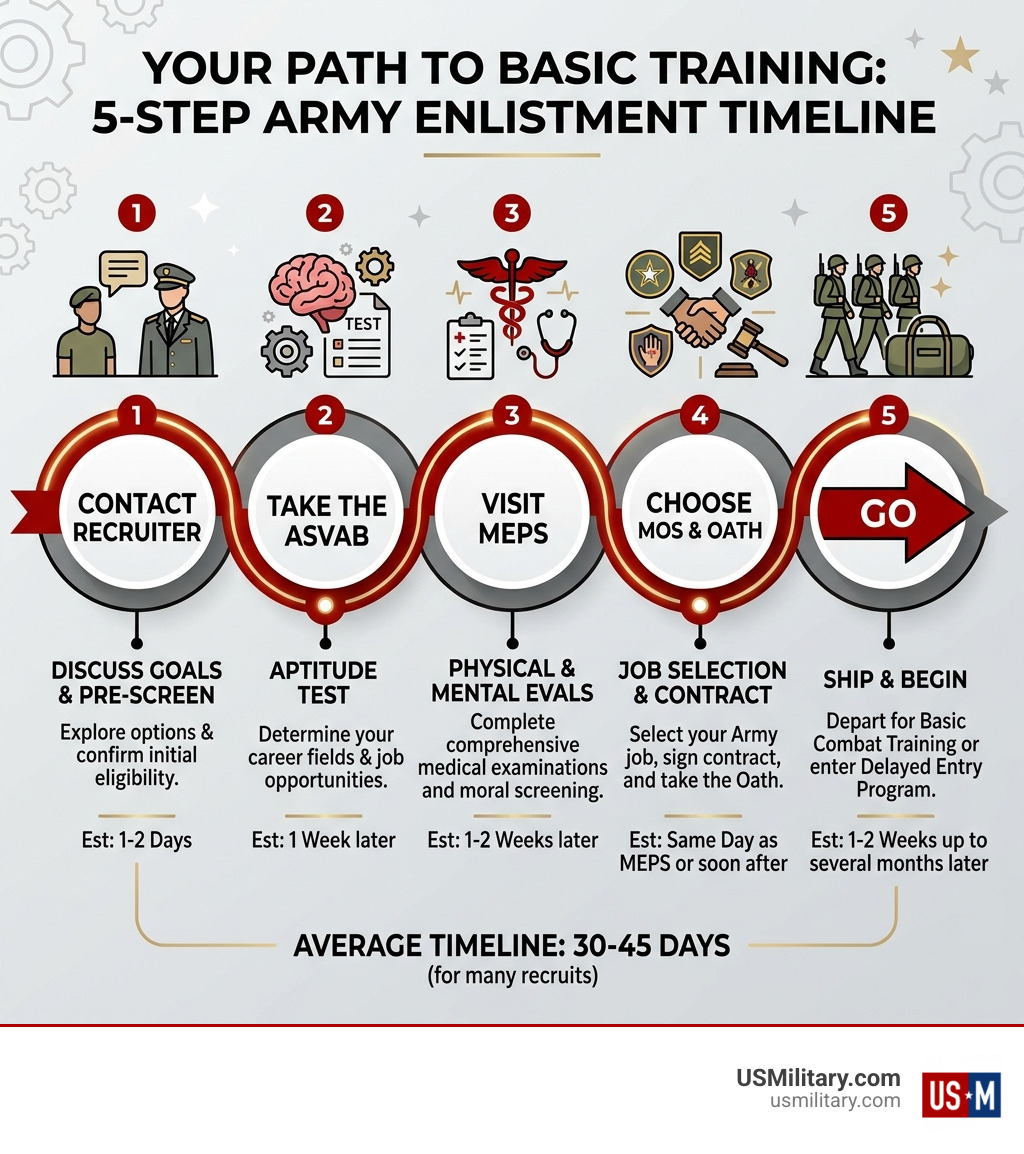
The army process of enlisting follows these key steps:
- Meet basic eligibility requirements – age, citizenship, education, and moral standards
- Contact a recruiter – discuss your goals and get pre-screened
- Take the ASVAB – an aptitude test that determines your career options
- Visit MEPS – complete your physical, mental, and moral evaluations
- Choose your MOS – select your Army job with a career counselor
- Sign your contract and take the Oath of Enlistment – make it official
- Ship to Basic Training – or enter the Delayed Entry Program (DEP) for up to one year
Joining the Army is one of the biggest decisions you’ll ever make. It shapes your career, your lifestyle, and your future. Yet for most people, the path from “I’m interested” to “I’m in” feels unclear and even intimidating.
The good news? The process is more straightforward than you might think. Most enlisted recruits go from their first recruiter meeting to Basic Training in 30 to 45 days on average. And with over 200 Army jobs available, there’s a path for almost every background and skill set.
Whether you’re 17 and fresh out of high school or 34 and ready for a career change, this guide walks you through every stage – no guesswork required.
I’m Larry Fowler, publisher of USMilitary.com and a trusted resource for military information since 2007 – I’ve helped thousands of recruits understand the army process of enlisting and connect with the right opportunities. Let’s break it all down, step by step.
Basic Eligibility and Requirements to Join the Army
Before we dive into the paperwork, we need to make sure you check the “must-have” boxes. The Army has specific Requirements to join the Army that ensure every Soldier is ready for the rigors of service.
Age Limits
For enlisted Soldiers, you must be between the ages of 17 and 34. If you are 17, you’ll need a “permission slip” (parental consent) to sign the dotted line. If you’re looking at the Officer path, the window is slightly narrower: you must be at least 17 but under 31 in the year you receive your commission. For those eyeing West Point, you must be under 27.
Citizenship and Residency
You don’t necessarily have to be a U.S. citizen to join, but you do need to be a “lawful permanent resident” (Green Card holder). One of the most incredible perks of the army process of enlisting for Green Card holders is that serving can reduce the residency requirement for U.S. citizenship from five years to as little as one day.
Education
The Army prefers a high school diploma, but we also accept GED holders. However, keep in mind that there are fewer slots for GED applicants, and your chances improve significantly if you have at least 15 college credits or a higher score on the ASVAB. If you want to be an Officer, a four-year college degree is a non-negotiable requirement by the time you are commissioned.
| Requirement | Enlisted Soldier | Commissioned Officer |
|---|---|---|
| Age Range | 17–34 | 17–31 (varies by path) |
| Education | High School Diploma or GED | 4-Year College Degree |
| Citizenship | U.S. Citizen or Green Card | U.S. Citizen |
| Testing | ASVAB (Min. 31) | OAR/ASTB or SAT/ACT |
| Initial Training | Basic Combat Training (10 weeks) | OCS, ROTC, or West Point |
The Army Process of Enlisting: From Recruiter to MEPS

Once you’ve decided to take the leap, your first mission is to find an Army Recruiting office. Think of your recruiter as your guide through the bureaucratic jungle. They aren’t there to yell at you; they are there to help you find a career path that fits.
The Initial Interview
In your first meeting, the recruiter will ask about your health, your education, and your legal background. This is “pre-screening.” It’s vital to be honest here. If you have a tattoo of a taco on your ankle, tell them. If you had asthma when you were 10, tell them. We want to avoid surprises later at the processing station.
Knowing How to effectively communicate with an Army recruiter is key. Ask questions! Ask about bonuses, duty stations, and what a Day in the Life of an Army Recruiter is like to get a sense of their perspective.
Gathering Your Paperwork
You’ll need to act like a professional archivist for a few days. The Steps to Join | U.S. Army require several original documents:
- Social Security card
- Birth certificate
- High school diploma (or GED)
- Driver’s license or state ID
- Marriage certificate or divorce decree (if applicable)
- Medical records for any major surgeries or conditions
Navigating the Army process of enlisting at MEPS
After the recruiter clears you, you’ll head to the Military Entrance Processing Stations (MEPS) | U.S. Army. This is where the “rubber meets the road.”
MEPS is typically a two-day process. The Army provides your lodging and meals at a nearby hotel, so you don’t have to worry about the bill. On day one, you’ll likely take the ASVAB (if you haven’t already) and start your background check and fingerprinting. On day two, you’ll undergo the full medical evaluation.
Many recruits feel nervous at MEPS, but as the saying goes, “if you’re nervous, you care.” It’s a long day of waiting in lines and following instructions, but it’s the final gateway to your new life.
Mastering the ASVAB and Choosing Your Career
The Armed Services Vocational Aptitude Battery (ASVAB) is not an IQ test. It’s a tool used to see where your natural talents lie. Whether you are a math whiz or a mechanical genius, the ASVAB will find it.
The Scores That Matter
The most important number is your AFQT (Armed Forces Qualification Test) score. This is a percentile from 1 to 99. To enlist in the Army, you generally need a minimum score of 31. However, if you want the “cool” jobs—like Intelligence or Medical—you’ll want to aim much higher.
If you’re a tech-savvy recruit, you might have the option to take the PiCAT. This is an untimed, unmonitored online version of the ASVAB you can take at home, though you’ll have to “verify” your score with a short test at MEPS to make sure you didn’t have your smart cousin helping you.
How the ASVAB impacts the Army process of enlisting
Your scores determine your Military Occupational Specialty (MOS). The Army has over 200 jobs, ranging from Infantry and Tank Crew to Cyber Security and Culinary Specialist.
You can see Army jobs based on ASVAB scores to get an idea of where you might land. After your physical, you’ll sit down with a job counselor. This is the moment you’ve been waiting for! They will show you a list of jobs you qualify for that are currently open.
This is also when you discuss a Military Enlistment Bonus Benefits. Depending on the job you choose and how soon you can ship to training, you might Qualify for a Military Enlistment Incentive that could put thousands of dollars in your pocket.
Medical Standards and Physical Fitness Requirements
The Army needs to know you’re “Fit for Duty.” The medical exam at MEPS is thorough. You’ll have your vision and hearing checked, provide blood and urine samples (yes, there is a drug test), and undergo a physical exam that looks like a very detailed version of your annual checkup.
Height and Weight Standards
We have strict Army height and weight standards. For example, a male recruit aged 17–20 has a maximum weight of 234 lbs if he’s between 58 and 80 inches tall. If you’re a bit over the limit, don’t panic. The Army now offers the Future Soldier Preparatory Course, which helps recruits meet academic or fitness standards before they start Basic Training.
Medical Waivers and Policies
- Asthma: This is only a deal-breaker if you were diagnosed after your 13th birthday.
- ADHD: You can usually join if you haven’t needed medication for at least one year and can demonstrate you can function without it.
- Tattoos: The Army is much more relaxed now. Tattoos on the arms and legs are fine. There are limits on the neck and hands, and absolutely no extremist, racist, or sexist ink is allowed.
If you have a minor medical issue, your recruiter can help you apply for a waiver. It’s a case-by-case process, but it’s worth the effort.
Finalizing Your Commitment: The Oath and Shipping Out
Once the counselor helps you pick a job and you’ve passed your physical, you’ll sign your enlistment contract. This document outlines your pay, your MOS, and your years of service (usually a 4-year active-duty commitment).
The Oath of Enlistment
The most solemn part of the army process of enlisting is the Oath of Enlistment. You’ll stand before a commissioned Officer and swear to support and defend the Constitution of the United States. It’s a powerful moment that marks your transition from civilian to Soldier.
Delayed Entry Program (DEP)
Most recruits don’t leave for Basic Training the very next day. You’ll likely enter the Standard Enlistment Programs known as the Delayed Entry Program (DEP).
- DEP Duration: You can stay in the DEP for up to a year, which is perfect for high school seniors.
- Direct Ship: If you’re ready to go now, you might “Direct Ship” in as little as 5 to 10 days.
- Average Wait: Most recruits ship out within 30 to 45 days of their MEPS visit.
While in the DEP, you’ll meet with your recruiter regularly to stay fit and start learning basic Soldier skills.
What to Expect During Army Basic Training
Basic Combat Training (BCT) is a 10-week journey that turns “me” into “we.” It’s held at locations like Fort Jackson, SC, or Fort Moore, GA. You can check the Army Boot Camp Requirements and Locations for more details.
The Three Phases of BCT
- Red Phase (Weeks 1-3): This is the “shakedown.” You’ll get your haircut, your uniforms, and meet your Drill Sergeants. Expect a lot of physical activity and very little sleep.
- White Phase (Weeks 4-6): This is the “Gunfighter” phase. You’ll spend most of your time on the rifle range learning to master the M4 carbine.
- Blue Phase (Weeks 7-10): The final stretch. You’ll engage in field training exercises (FTX) and complete the “Forge,” a grueling multi-day mission that tests everything you’ve learned.
After graduation, you’ll move on to Advanced Individual Training (AIT), where you learn the specifics of your MOS. Whether you’re training to be a combat medic or a drone operator, AIT is where you become a professional.
Frequently Asked Questions about Enlisting
How long does the entire enlistment process typically take?
On average, the army process of enlisting takes about 30 to 45 days from the time you first walk into a recruiting office to the day you ship out. However, if you need medical waivers or are waiting for a specific job to open up, it can take several months.
Can I join the Army with a criminal record or felony?
It depends. While the Army holds high moral standards, we do offer “moral waivers” for some offenses. However, Can felons join the military today is a complex question. Serious crimes like drug trafficking, sexual assault, or multiple DUIs are generally non-waivable. If you have a past mistake, check out From DUI to Duty Securing Your Army Waiver for guidance.
What happens if I fail the medical exam at MEPS?
If you are disqualified, it’s not always the end of the road. You may be “temporarily disqualified” and asked to provide more medical records or see a specialist. Your recruiter will work with you to submit a waiver to the Surgeon General for review.
What are the benefits of enlisting?
The Benefits to Army Enlistment are unmatched in the civilian world. You get:
- Full healthcare for you and your family (Tricare)
- 30 days of paid vacation per year
- Housing and food allowances
- Us Army Enlisted Special Benefits like the GI Bill for college
- Professional training in over 200 trades
Conclusion
The army process of enlisting is a journey of self-discovery. It’s about finding out what you’re truly capable of and committing to something greater than yourself. From that first nervous handshake with a recruiter to the proud moment you graduate Basic Training, every step is designed to build you into a leader.
At USMilitary.com, we are dedicated to providing the resources you need to succeed. Whether you’re looking for info on Army National Guard Recruiter options or want to know What is the Army Officer Candidate School, we’ve got your back.
Are you ready to take the first step? The Army is waiting for its next great Soldier. Is it you?
Start your military enlistment journey today and see where the Army can take you.
Free for Service Members & Veterans
Get the military benefits intel no one tells you about.
Weekly updates on VA benefits, pay changes, and money tips — free for service members and veterans.
No spam. Unsubscribe anytime. Your info is never shared.


