Why Pension Eligibility Age Limits Determine When You Can Retire
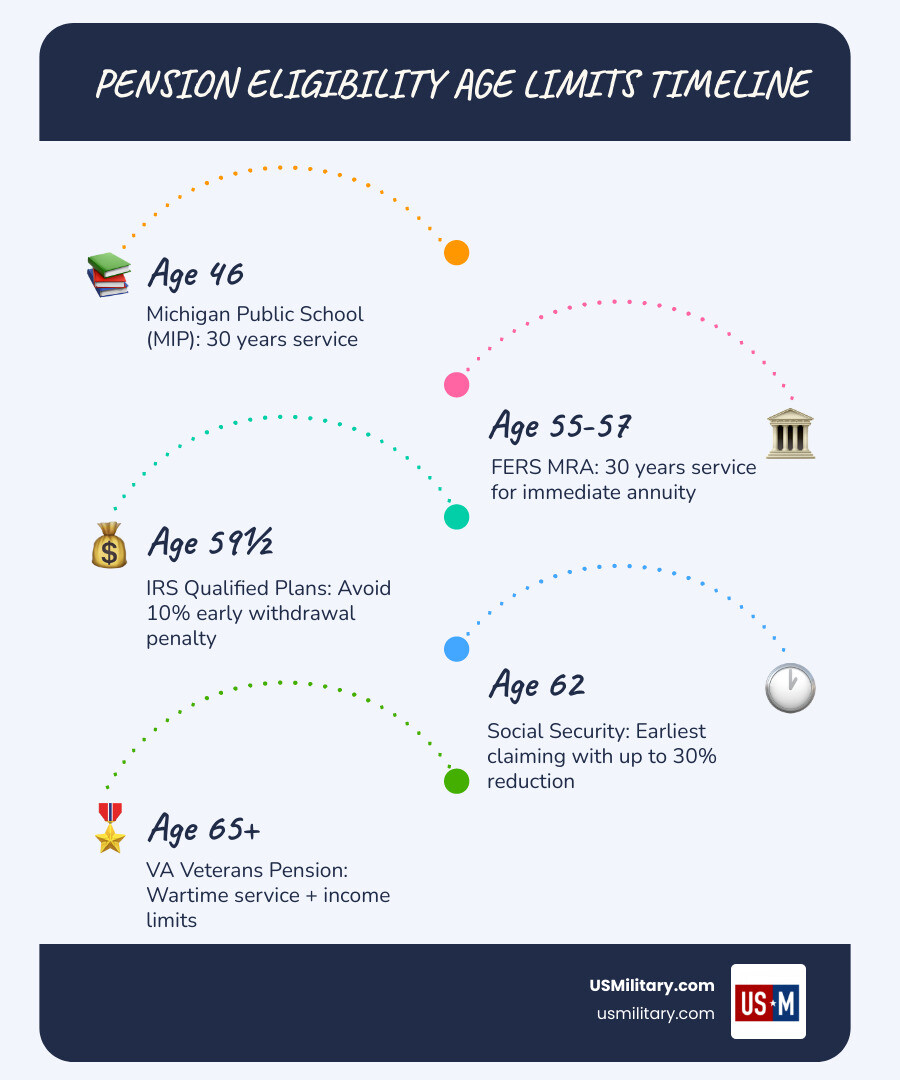
Pension eligibility age limits are the specific ages — and service year combinations — that determine when you can start collecting retirement income. Here’s a quick-reference summary:
| Pension System | Earliest Eligible Age | Key Requirement |
|---|---|---|
| Social Security | 62 | 40 credits (10 years work) |
| Social Security (Full) | 66–67 (by birth year) | Full benefit, no reduction |
| FERS Federal | 55–57 (MRA by birth year) | 30 years service at MRA |
| CSRS Federal | 55 | 30 years service |
| VA Veterans Pension | 65 | Wartime service + income limits |
| IRS Qualified Plans (401k, etc.) | 59½ | No 10% early withdrawal penalty |
| Michigan Public School (MIP) | 46 | 30 years service |
Miss a deadline or claim too early, and you could permanently reduce your monthly payment by up to 30%. Wait too long, and you leave money on the table.
The rules differ significantly depending on which retirement system applies to you — Social Security, a federal civilian system like FERS or CSRS, a VA pension, or an employer-sponsored plan. Each has its own age thresholds, service requirements, and financial trade-offs.
I’m Larry Fowler, publisher of USMilitary.com, and since 2007 I’ve helped active-duty members and veterans navigate complex topics like pension eligibility age limits across military and federal benefit systems. Let’s break down exactly what applies to you.
Similar topics to Pension eligibility age limits:
Social Security Retirement and Pension Eligibility Age Limits

When we talk about Social Security, the most famous of all pension eligibility age limits is age 62. This is the earliest point at which most American workers can begin drawing retirement benefits. However, just because you can doesn’t always mean you should.
The Social Security Administration (SSA) uses a “Full Retirement Age” (FRA) to determine when you are entitled to 100% of your primary insurance amount. If you were born between 1943 and 1954, your FRA is 66. For those born in 1960 or later, the FRA has moved to 67. If your birthday falls in between (1955–1959), your FRA increases by two months for every year. For example, if you were born in 1956, your full retirement age is 66 and 4 months.
Claiming at age 62 results in a permanent reduction in your monthly check. For someone born in 1960 or later, taking benefits at 62 means a 30% reduction compared to waiting until 67. That’s a significant haircut that lasts for the rest of your life. You can explore more about how these dates align with your savings in our guide on Retirement Savings And The Calendar.
To qualify for any benefit at all, you generally need 40 “credits,” which translates to roughly 10 years of work covered by Social Security. You can find more official details on Retirement Age and Benefit Reduction – Social Security Administration or check out the What is full retirement age? | Frequently Asked Questions | SSA.
Claiming Early vs. Delaying Benefits and Pension Eligibility Age Limits
If age 62 is the “early bird” special and age 67 is the standard, age 70 is the “grand prize.” For every year you delay claiming Social Security past your Full Retirement Age, your benefit increases by approximately 8% per year through “delayed retirement credits.”
By the time you hit age 70, your monthly payment could be 24% to 32% higher than it would have been at your FRA. There is no incentive to wait past age 70, as the credits stop accruing then.
The math is a tug-of-war:
- Claiming at 62: You get more checks over a longer period, but each check is smaller (up to 30% smaller).
- Claiming at 70: You get fewer checks, but each one is significantly larger.
We often tell our readers that if you are in good health and have other income sources, waiting can provide a powerful “longevity insurance” policy.
Spousal Benefits and Marital Status Impact
Your marital status can shift your pension eligibility age limits strategy. A spouse can receive up to 50% of the worker’s full retirement benefit. If the spouse claims this benefit at their own FRA, they get the full 50%. If they claim at age 62, that amount is reduced to as little as 32.5% to 35% of the worker’s benefit.
Divorced spouses aren’t left out, either. If you were married for at least 10 years and have been divorced for at least two years, you may be eligible to claim benefits based on your ex-spouse’s record (even if they haven’t retired yet, provided they are at least 62).
Survivor benefits have even lower age limits. A widow or widower can start receiving survivor benefits as early as age 60 (or age 50 if disabled). While these are also reduced if taken early, they provide a critical safety net. For a detailed breakdown, see this Full Retirement Age Chart: When Can You Begin Receiving Social Security.
Federal Employee Retirement Systems (FERS and CSRS)
For those of us who transitioned into federal civil service after the military, understanding the Federal Employees Retirement System (FERS) or the older Civil Service Retirement System (CSRS) is vital. These systems rely heavily on a “Minimum Retirement Age” (MRA) and years of creditable service.
Under FERS, your MRA depends on your birth year. If you were born before 1948, your MRA is 55. For those born in 1970 or later, the MRA is 57.
To receive an “immediate” unreduced annuity under FERS, you generally need one of the following:
- Age 62 with 5 years of service.
- Age 60 with 20 years of service.
- MRA with 30 years of service.
If you reach your MRA and have at least 10 years of service but fewer than 30, you can still retire, but your benefit will be reduced by 5% for every year you are under age 62. You can dig into the official FERS Eligibility or CSRS Eligibility pages for more.
Immediate and Early Retirement Qualifications
Early retirement in the federal world usually happens during “RIFs” (Reductions in Force) or major reorganizations. In these cases, the pension eligibility age limits drop to:
- Age 50 with 20 years of service.
- Any age with 25 years of service.
For our military community, it’s important to note how your military time can be “bought back” to count toward these service years. This can drastically accelerate your path to retirement. We cover these intersections in our Overview Of Military Pay.
Deferred and Disability Retirement Rules
If you leave federal service before you are eligible for an immediate annuity, don’t worry—you don’t lose your pension. As long as you have at least 5 years of creditable civilian service, you can claim a “deferred” annuity later, typically at age 62.
Disability retirement is another path. Under FERS, you only need 18 months of creditable civilian service to qualify if you become disabled and your agency cannot accommodate your condition. For CSRS, the requirement is 5 years. Special rules also apply to public safety officers, such as law enforcement and firefighters, who can often retire at age 50 with 20 years of service. Some specific groups even saw unique offers, like the Early Retirement Benefits Offered To Active Reserve Staff Sergeants During Fy 15.
Veterans Pension and Military Retirement Age Requirements
Many people confuse “Military Retirement Pay” with the “VA Veterans Pension.” Military retirement is based on your years of service (usually 20+ years), whereas the VA Pension is a needs-based program for wartime veterans who are either age 65 or older OR permanently and totally disabled.
For the VA Pension, the pension eligibility age limits are clear: you must be 65 to qualify based on age alone. If you are younger than 65, you must have a permanent disability that is not related to your service (service-connected disabilities are handled through VA Disability Compensation).
To be eligible, you must have served at least 90 days of active duty, with at least one day during a recognized wartime period. For those who enlisted after September 7, 1980, the requirement is generally 24 months of service. You can read more about this in The Ultimate Guide To Army Pension Eligibility And Retirement Pay.
VA Pension Eligibility Age Limits for Wartime Veterans
The VA recognizes several wartime periods, including the Gulf War (from August 2, 1990, through a date yet to be set). In addition to the age 65 threshold, your “net worth” must be below a certain limit ($159,240 through November 2025).
The VA also looks at a 3-year “look-back” period. If you gave away assets or sold them for less than fair market value to get under the limit, you might face a penalty period of up to five years. For more on navigating these options, see The Golden Years Navigating Your Active Duty Retirement Options and the official Eligibility For Veterans Pension | Veterans Affairs.
Aid and Attendance and Housebound Benefits
If you qualify for a VA Pension and require the “Aid and Attendance” of another person to perform daily activities (like bathing, dressing, or eating), you may be eligible for an increased monthly payment. This also applies if you are bedridden or in a nursing home.
Similarly, “Housebound” benefits are available if you are permanently confined to your immediate premises due to a disability. These clinical-evidence-based additions can significantly boost the base pension amount, providing much-needed financial relief for senior veterans.
IRS Rules for Qualified Plans and State Systems
Beyond government pensions, your personal retirement accounts (401ks, IRAs, 403bs) have their own strict pension eligibility age limits.
The “magic number” for most is 59½. This is the age at which you can generally take distributions from your qualified retirement plans without paying the 10% early withdrawal penalty. You’ll still owe income tax on the money (unless it’s a Roth account), but the extra penalty disappears.
There is a notable “Rule of 55” for employer-sponsored plans like 401(k)s. If you leave your job (voluntarily or involuntarily) in or after the year you turn 55, you may be able to take penalty-free withdrawals from that specific employer’s plan. Public safety employees can sometimes access this as early as age 50.
You can find a full list of these milestones at Retirement topics – Significant ages for retirement plan participants | Internal Revenue Service and Retirement topics – Eligibility and participation | Internal Revenue Service.
Required Minimum Distributions (RMDs) and Participation
The government eventually wants its tax money. Under the SECURE Act, the age for Required Minimum Distributions (RMDs) was raised to 72. This means you must start taking a certain amount of money out of your traditional IRAs and 401(k)s by April 1 of the year following the year you turn 72.
Regarding participation, federal law states that an employer generally cannot exclude you from a retirement plan if you are at least 21 years old and have one year of service. Interestingly, SIMPLE IRAs have no minimum age requirement at all! For those who have worked abroad, you might also be interested in how other systems handle this, such as The new State Pension: Eligibility – GOV.UK.
Michigan Public School Employees Retirement System (MIP)
Some state systems have very generous pension eligibility age limits. In the Michigan Public School Employees Retirement System (specifically the MIP plan), a member can retire as early as age 46 if they have 30 years of service.
Other MIP milestones include:
- Age 60 with 10 years of service.
- Age 60 with 5 years of service (under specific conditions).
- Early reduced retirement at age 55 with 15–29 years of service (with a 6% annual reduction in benefits).
A unique feature here is the “Summer Birthday Provision,” which helps teachers born in July, August, or September retire effectively at the end of the school year without losing eligibility.
Choosing Your Optimal Retirement Age
Deciding when to pull the trigger on retirement is a deeply personal choice. You have to weigh your immediate cash flow needs against your long-term health and life expectancy.
| Age | Social Security Benefit % (Born 1960+) | Pros | Cons |
|---|---|---|---|
| 62 | 70% | More years of income | Permanent 30% reduction |
| 67 | 100% | Full benefit amount | Must wait 5 more years |
| 70 | 124% | Maximum possible check | Fewer years to collect |
Key factors to consider:
- Health Status: If your health is declining, claiming earlier might be wiser. If you expect to live into your 90s, delaying is almost always better.
- Employment Status: If you work while receiving Social Security before your FRA, your benefits may be temporarily reduced if you earn over the annual limit ($23,400 in 2025).
- Medicare Enrollment: Regardless of when you claim Social Security, you should generally sign up for Medicare at age 65 to avoid late-enrollment penalties.
- HSA Contributions: Be careful—once you enroll in any part of Medicare, you can no longer contribute to a Health Savings Account (HSA). You should stop HSA contributions at least six months before applying for Medicare.
Frequently Asked Questions about Pension Eligibility
What is the earliest age to claim Social Security retirement benefits?
The earliest age is 62. However, claiming at this age results in a permanent reduction in your monthly benefit. For those born in 1960 or later, this results in a 30% reduction compared to waiting until the full retirement age of 67.
What is the Minimum Retirement Age (MRA) for federal employees?
For federal employees under FERS, the MRA is based on your birth year. It ranges from 55 (for those born before 1948) to 57 (for those born in 1970 or later). Reaching the MRA with 30 years of service allows for an immediate, unreduced pension.
When can a veteran qualify for a VA pension based on age?
A veteran can qualify for a VA Veterans Pension at age 65, provided they meet the wartime service requirements and their income and net worth fall within the limits set by Congress. They must also have a discharge that is “other than dishonorable.”
Conclusion
Navigating pension eligibility age limits can feel like a full-time job, but getting it right is the difference between a stressful retirement and a comfortable one. Whether you are looking at Social Security, FERS, or a VA pension, the “Golden Years” are most golden when you have a plan in place.
At USMilitary.com, we are dedicated to providing you with the tools to maximize your benefits. Take the time to review your service years, check your Social Security statement, and consult with a financial advisor to ensure your strategy matches your goals.
Secure your future with military retirement benefits
Free for Service Members & Veterans
Get the military benefits intel no one tells you about.
Weekly updates on VA benefits, pay changes, and money tips — free for service members and veterans.
No spam. Unsubscribe anytime. Your info is never shared.


