Understanding the Elite Navy SEAL Mindset
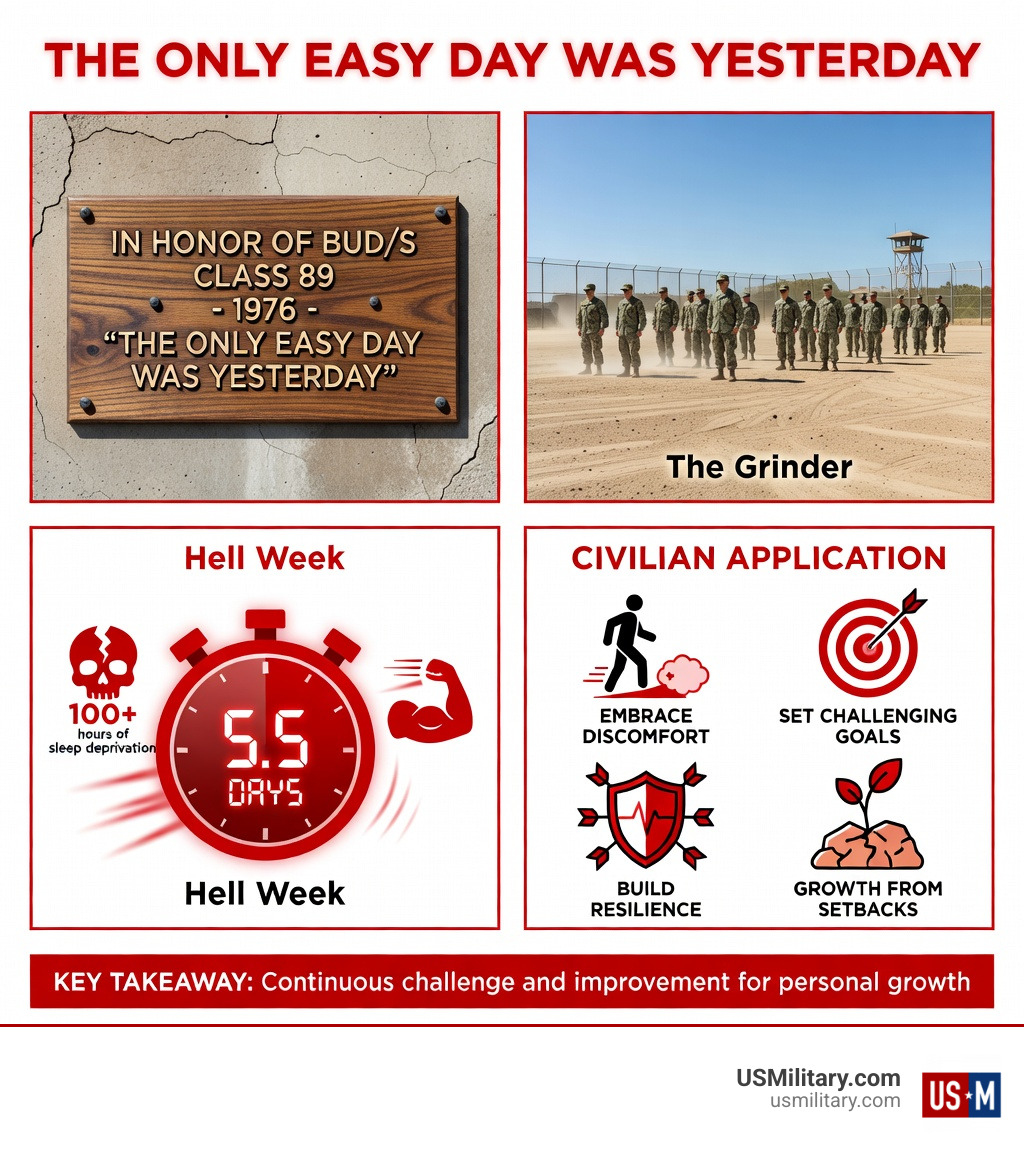
The only easy day was yesterday is the official motto of the United States Navy SEALs, originating from BUD/S (Basic Underwater Demolition/SEAL) Class 89 in 1976. This phrase embodies a philosophy of continuous improvement and mental toughness that has become central to Navy SEAL training and culture.
Quick Facts:
- Origin: Created by BUD/S Class 89 as a parting gift plaque in 1976
- Location: Displayed above “The Grinder” at the BUD/S training compound in Coronado, California
- Meaning: Each new day brings fresh challenges that make yesterday’s hardships seem easier by comparison
- Purpose: Instills resilience, discourages complacency, and promotes relentless self-improvement
- Application: Used during Hell Week (5.5 days of constant physical and mental stress) and throughout SEAL careers
This motto isn’t just military jargon. It represents a mindset that pushes individuals beyond their perceived limits, reminding them that growth only happens when you step outside your comfort zone. The phrase acknowledges past accomplishments while simultaneously demanding more effort today than yesterday.
For those considering military service, understanding this philosophy provides insight into the mental framework that separates elite special operations forces from conventional military training. The 24-week BUD/S program maintains attrition rates often exceeding 75-80%, largely because it tests mental fortitude as much as physical capability.
I’m Larry Fowler, publisher of the USMilitary.com Network since 2007, where we’ve supported active duty service members and veterans through their military journeys. Throughout my years covering military culture and special operations, the only easy day was yesterday has consistently emerged as one of the most powerful philosophies for understanding SEAL training and the broader military mindset.
Important the only easy day was yesterday terms:
- Navy SEALs
- Navy SEAL Training
- SEAL Team Six
The Origin of “The Only Easy Day Was Yesterday”
To truly understand the only easy day was yesterday, we have to go back to the mid-1970s. While many military mottos are handed down by top brass or marketing departments, this one came from the “deck plates”—the trainees themselves. It was born in the crucible of BUD/S training, specifically within Class 89.
In 1976, BUD/S Class 89 decided to leave a permanent mark on the Naval Special Warfare Center. As a parting gift upon their graduation, they commissioned and donated a plaque featuring the now-legendary phrase. This wasn’t just a decorative gesture; it was a warning and a promise to every “tadpole” (SEAL candidate) who would follow in their footsteps.
The Class 89 Legacy
The legacy of Class 89 is etched into the very concrete of the BUD/S compound. By gifting this plaque, they provided a semantic bridge between the grueling physical evolution of the 1970s military and the psychological warfare required for modern special operations. In the historical context of the post-Vietnam era, the SEAL teams were refining their identity, moving toward the elite status they hold today.
You can actually view the original motto plaque here to see the simple, stark lettering that has greeted thousands of trainees. It represents the transition from a mere student to a warrior who understands that the “easy” times are always behind them, and the path forward is paved with increasing difficulty.
Placement at the BUD/S Compound
The plaque is strategically placed above “The Grinder” at the BUD/S compound in Coronado. The Grinder is a large asphalt courtyard where trainees spend countless hours performing “calisthenics on steroids” while being sprayed with cold water and yelled at by instructors.
Placing the motto here serves as a psychological anchor. Every time a trainee looks up while their muscles are screaming and their lungs are burning, they see that reminder: the only easy day was yesterday. It forces them to realize that if they are waiting for things to get easier, they are in the wrong place. This environment is designed to weed out those who seek comfort. If you want to learn about the path to becoming a SEAL, you must first accept that your comfort zone is a thing of the past.
Mindset and Training: Hell Week Realities
If BUD/S is the crucible, Hell Week is the white-hot center of the flame. Lasting approximately 5.5 days, Hell Week is the ultimate test of the motto. Trainees are subjected to over 100 hours of continuous physical activity with less than four hours of sleep total.
The attrition rate during this period is staggering, often seeing more than 75% of a class “ring the bell” (the signal for quitting). The motto provides the mental framework to survive. When a trainee is shivering in the surf zone at 3:00 AM on Wednesday, thinking about how hard Tuesday was, the motto reminds them that Tuesday was actually “easy” compared to the cold reality of right now.
| Demand Category | Physical Training Aspect | Mental Training Aspect |
|---|---|---|
| Duration | 24 weeks of intense cardio/strength | Constant 24/7 psychological pressure |
| Recovery | Minimal; constant “wet and sandy” | Sleep deprivation (under 4 hours in Hell Week) |
| Goal | Peak physical performance | Breaking the “quit” reflex |
| Philosophy | Pushing beyond muscle failure | The only easy day was yesterday |
Pushing Personal Limits
The physical toll of living by this motto is immense. Trainees frequently suffer from stress fractures, pneumonia, and “Samba” (a state of near-hypothermia). They endure “drown-proofing,” where they must swim with their hands and feet tied, and “log PT,” where teams carry 200-pound logs for hours.
These aren’t just exercises; they are lessons in survival instincts. To succeed, a candidate must possess specific qualities needed for SEAL success, including an almost irrational level of perseverance. The motto tells them that their current pain is simply the price of entry for a harder tomorrow.
The Pleasure Principle in Hardship
One of the most interesting veteran perspectives on the motto is the idea of finding pleasure in the struggle. A decorated veteran once noted that it’s about “finding pleasure in accomplishing something difficult.”
This is a form of mental management. Instead of focusing on the pain of the current evolution, successful SEALs focus on the satisfaction of completion. They “settle in” to the hardship. By accepting that today will be harder than yesterday, they remove the “hope” for an easy day, which is often what causes people to quit when things stay difficult.
Applying the Philosophy to Everyday Life
You don’t have to be a special operator to benefit from the the only easy day was yesterday mindset. In civilian life, this philosophy is a blueprint for personal growth. Most people spend their lives trying to make things easier, but the SEAL mindset suggests that we should instead strive to become more capable of handling the difficult.
By setting goals that lie just outside our comfort zones, we build the same kind of resilience found on The Grinder. Whether it’s starting a business, training for a marathon, or learning a new skill, the principle remains: if you aren’t pushing harder today than you did yesterday, you are stagnating.
Embracing Discomfort for Growth
In our daily lives, we often confuse “easy” with “good.” The SEAL motto flips this. It suggests that “easy” is a state of the past—it’s something you’ve already mastered. To grow, you must seek out the “hard.” This might mean taking on a difficult project at work or having a tough conversation you’ve been avoiding.
When comparing Navy SEAL training vs civilian life, the stakes are different, but the biology of stress is the same. Building mental toughness requires a daily effort to choose the harder path. As David Goggins, a retired SEAL and endurance athlete, often says, you have to “callous your mind” by doing things that suck.
Transforming Setbacks into Fuel
Living by this motto means viewing setbacks not as failures, but as necessary data points. If today was a disaster, that’s fine—it just became an “easy” day compared to how you’re going to bounce back tomorrow. This level of persistence is what allows people to form lasting habits and achieve professional development.
To build elite resilience, you must stop wishing for fewer problems and start wishing for more skills. When you embrace the fact that challenges are never-ending, you stop being surprised when they show up. You simply “settle in for more rough road ahead.”
Pop Culture and Modern Influence
The phrase the only easy day was yesterday has transcended the military and exploded into popular culture. It has become a shorthand for “extreme toughness” and “no-excuses” motivation. You’ll see it on t-shirts, gym walls, and even in video games.
One of the most famous references is in Call of Duty: Modern Warfare 2, which features a mission titled “The Only Easy Day… Was Yesterday.” In the game, players participate in a submarine-launched assault on an oil rig, mirroring real-world SEAL tactics like using SEAL Delivery Vehicles (SDVs). This media exposure has helped the motto achieve global recognition.
The Endurance Athlete Connection
The motto is a favorite among ultra-marathoners and endurance athletes. Perhaps the most notable figure associated with this mindset is David Goggins. Goggins is the only member of the U.S. Armed Forces to complete SEAL training (enduring three Hell Weeks to do it), U.S. Army Ranger School, and Air Force Tactical Air Controller training.
His biography as a notable endurance athlete is a testament to the motto. He used the “easy day” philosophy to overcome childhood trauma, obesity, and physical injuries to set world records, including performing 4,030 pull-ups in 17 hours. His story shows that the motto is a tool for anyone willing to “schedule suffering” to reach their potential.
Media Portrayals and Public Perception
From movies like Lone Survivor and American Sniper to documentaries about BUD/S, the public perception of SEALs is inextricably linked to this motto. It frames the SEAL as a modern-day Spartan—someone who is always training, always improving, and never satisfied with past glory.
While media portrayals sometimes exaggerate the “invincibility” of SEALs, they correctly identify the core of the ethos: a relentless drive to move “further, faster, and fight harder.” This has spawned a whole “motivational culture” where people use the motto to push through their own personal “Hell Weeks” in business or fitness.
Frequently Asked Questions about “The Only Easy Day Was Yesterday”
Why is the motto “the only easy day was yesterday” displayed above the grinder?
It serves as a constant reminder to trainees that the path they have chosen only gets steeper. The Grinder is where the most grueling physical conditioning happens, and the motto is there to provide psychological preparation. It tells the students that if they are looking for a break, they won’t find it today. This builds the “grit” necessary for the missions a Navy SEAL performs, which are often far more stressful than training.
Who created the motto “the only easy day was yesterday”?
The motto was created by the members of BUD/S Class 89 in 1976. It was not an official Navy slogan at first; it was a graduation gift from the class to the training command. Over the decades, it became so synonymous with the SEAL identity that it was adopted as an official motto alongside “It Pays to be a Winner.” Understanding this history helps clarify how many SEAL teams there are and how they all share this unified culture.
How does “the only easy day was yesterday” help in overcoming challenges?
It helps by shifting your perspective on difficulty. Instead of viewing a challenge as an obstacle to be avoided, you view it as the “new normal.” It encourages you to anticipate difficulty rather than hope for ease. This mental fortitude allows for continuous growth because you are never resting on your laurels. When you understand what S.E.A.L. stands for (Sea, Air, and Land), you realize they must be proficient in every environment—and that proficiency only comes from the constant struggle the motto describes.
Conclusion
At USMilitary.com, we believe that the lessons learned in the military have profound value in the civilian world. The only easy day was yesterday is more than just a quote for a locker room wall; it is a philosophy of lifelong growth and elite standards.
Whether you are a veteran transitioning to civilian life, an active-duty member looking for veteran resources, or someone simply looking to improve themselves, embracing this mindset can be transformative. It teaches us that while we cannot control the challenges the world throws at us, we can control our response to them. We can choose to get better, get stronger, and move forward, knowing that our best days aren’t the easy ones, but the ones that tested us the most.
For a deeper dive into Naval Special Warfare, check out our Navy SEALs Complete Guide. Remember: settle in, work hard, and make today count—because tomorrow, today will be the “easy” day.
Free for Service Members & Veterans
Get the military benefits intel no one tells you about.
Weekly updates on VA benefits, pay changes, and money tips — free for service members and veterans.
No spam. Unsubscribe anytime. Your info is never shared.


