What Are Military Benefits? A Complete Overview
Military benefits make up one of the most comprehensive compensation packages available to any workforce in the United States. Whether you’re considering enlistment, currently serving, or transitioning out of the military, understanding what you’re entitled to can make a major difference in your financial future.
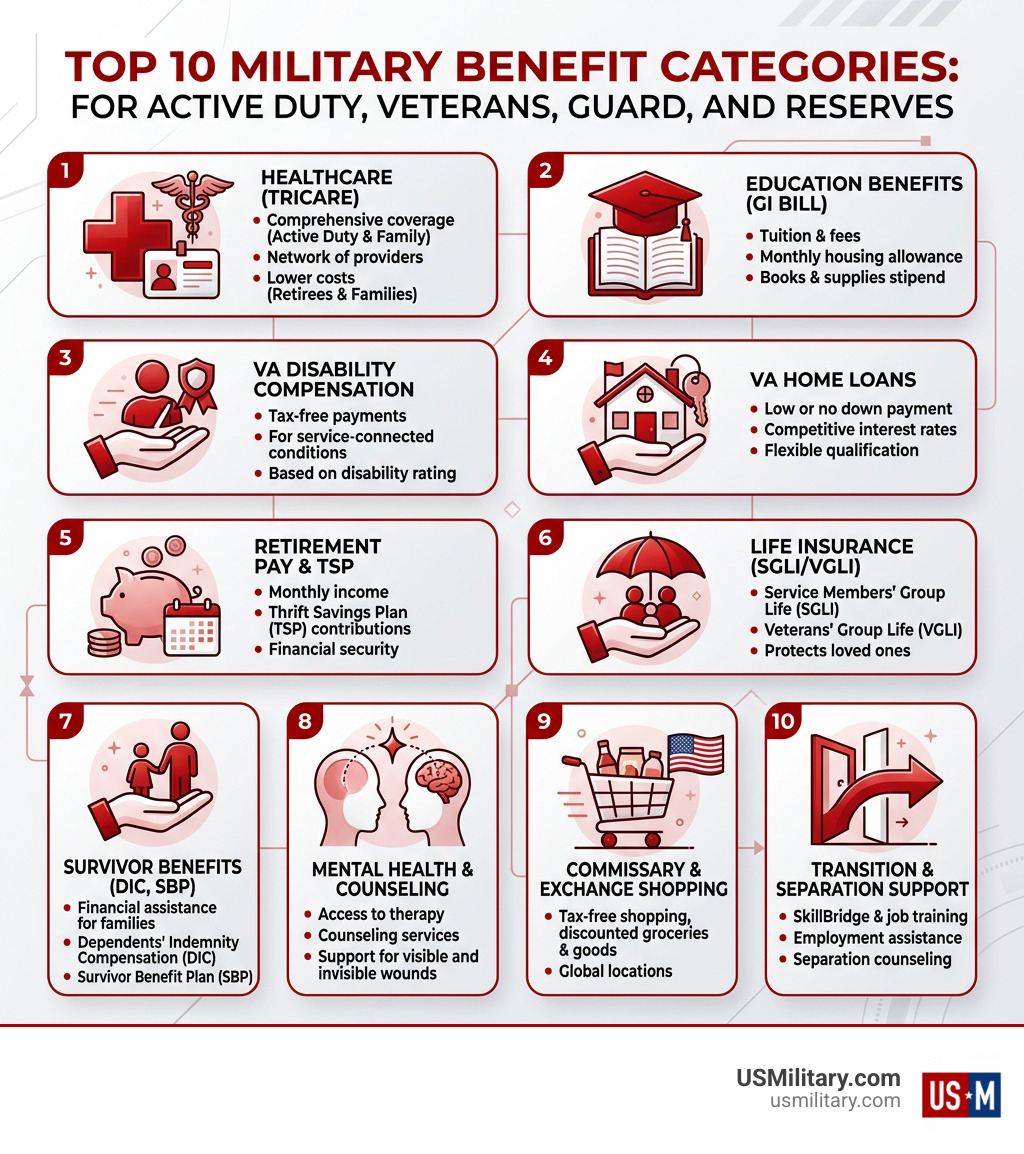
Here’s a quick look at the main categories of military benefits:
| Benefit Category | Who It Covers |
|---|---|
| Healthcare (TRICARE) | Active duty, retirees, families |
| GI Bill education benefits | Veterans, active duty, Guard/Reserve |
| VA disability compensation | Veterans with service-connected conditions |
| VA home loans | Veterans, active duty, surviving spouses |
| Retirement pay & TSP | Active duty, some Reserve/Guard |
| Life insurance (SGLI/VGLI) | Service members, veterans, families |
| Survivor benefits (DIC, SBP) | Surviving spouses and dependents |
| Mental health & counseling | All military community members |
| Commissary & exchange shopping | Active duty, retirees, some veterans |
| Transition & separation support | Separating and retiring service members |
According to a Government Accountability Office (GAO) review, the military offers all core benefits provided by most private sector employers — including retirement pay, health care, life insurance, and paid time off — and in several cases, military benefits exceed what private employers offer.
That’s a powerful package. But navigating it can feel overwhelming, especially when your eligibility shifts based on your service status, years served, and discharge type.
I’m Larry Fowler, publisher of the USMilitary.com Network since 2007 and a longtime resource for active duty members and veterans tracking military benefits, VA disability trends, and Aid and Attendance. This guide brings together everything I’ve learned to help you cut through the complexity and claim what you’ve earned.
Military benefits definitions:
Core Compensation and Financial Perks

When we talk about military benefits, the conversation usually starts with the paycheck. However, military compensation is unique because it combines base pay with various tax-advantaged allowances and special incentives that often result in a higher take-home pay than a comparable civilian salary.
For those planning their financial future, there is good news on the horizon: military service members are scheduled to receive a 3.8% pay raise in 2026. While some senior officers might see slightly smaller percentage increases, this bump helps keep military pay competitive with the private sector. Additionally, keep an eye out for “Warrior Dividend” payments. In December 2025, payments of $1,776 were made to service members, and notably, these funds are not subject to taxes.
A GAO review found that military core benefits—including retirement, healthcare, and life insurance—often exceed those found in the private sector. To see how these stack up, look at the comparison below:
| Feature | Military Benefits | Typical Private Sector |
|---|---|---|
| Health Insurance | $0 premiums for active duty | Monthly premiums + deductibles |
| Retirement | Pension + 401(k) equivalent (TSP) | Usually 401(k) only |
| Housing | Tax-free allowance (BAH) | Paid from after-tax salary |
| Vacation | 30 days paid leave per year | 10–20 days average |
Understanding Core Military Benefits
The military “salary” is actually a combination of several components. Beyond base pay, service members receive essential allowances. The Basic Allowance for Housing (BAH) is a tax-free sum provided to members to cover the cost of living off-base, while the Basic Allowance for Subsistence (BAS) is meant to offset the cost of meals.
There are also 4 Cool Allowances the Army Gives that many people overlook, such as clothing allowances and family separation pay. For a detailed breakdown of what you can expect to earn, check out the 2026 Military Pay Chart. We also see Special Pay Military Enlisted Benefits for those in high-demand or hazardous roles, ensuring that the most challenging jobs are rewarded appropriately.
Financial Readiness and Savings
One of the most immediate military benefits is the ability to save on daily expenses. Shopping at the Commissary (grocery store) and the Exchange (department store) can save families thousands of dollars annually due to tax-free status and discounted pricing.
For long-term wealth building, the Thrift Savings Plan (TSP) is the military’s version of a 401(k). Under the Blended Retirement System (BRS), the government matches your contributions up to 5%, which is a foundational piece of Benefits Saving in the TSP Program. If you are deployed to a combat zone, you can also take advantage of the Savings Deposit Program (SDP), which offers a guaranteed 10% interest rate on deposits up to $10,000. Exploring these 5 Financial Perks That Come With Military Jobs is essential for any service member looking to maximize their earnings.
Healthcare, Life Insurance, and Wellness
Healthcare is arguably the most valuable of all military benefits. TRICARE provides comprehensive medical coverage for active duty members, retirees, and their families. For active duty members, there are generally no out-of-pocket costs, a perk that is virtually unheard of in the private sector.
Retirees also benefit from Tricare: A Primary Source of Military Retirement Health Care Benefits, though they may have small enrollment fees or co-pays depending on the specific plan. We encourage everyone to review the Medical Tricare Resource Benefits to understand the nuances between Prime, Select, and For Life options. Furthermore, the Army Health and Wellness Support Benefits program emphasizes preventative care and fitness, ensuring the force remains ready.
Life Insurance Options for Service Members
The military provides peace of mind through low-cost life insurance. Servicemembers’ Group Life Insurance (SGLI) offers up to $500,000 in coverage for a very small monthly premium. This coverage is automatic for most, but you should always double-check your Servicemember SGLI Support Benefits to ensure your beneficiaries are correctly listed.
Once you separate from service, you can convert this to Veterans’ Group Life Insurance (VGLI). There is also Family SGLI (FSGLI) available to cover spouses and children. Proper beneficiary planning is a critical step in using these military benefits to protect your family’s financial future.
Mental Health and Specialized Support
We recognize that the stresses of military life require specialized care. Programs like Military OneSource offer 24/7 support, including confidential counseling that does not go into your official military record. You can access Secure Live Chat 800-342-9647 for immediate assistance with everything from relationship issues to financial stress.
For those dealing with the invisible wounds of war, Post-Traumatic Stress Treatment Benefits are more robust than ever. The VA and DoD provide integrated care for PTSD and TBI, including Medical Post Traumatic Stress Support and innovative therapies designed specifically for the veteran community.
Education and Housing Benefits
The GI Bill has transformed the lives of millions by providing a pathway to debt-free education. The Post-9/11 GI Bill is the most common version used today, offering full tuition at public schools, a monthly housing allowance (MHA), and a stipend for books.
If you are currently serving, you can utilize Tuition Assistance (TA) to pay for classes while on active duty, preserving your GI Bill for later use or even for your dependents. We have seen many sailors thrive using Navy College Benefits, and similar programs exist across all branches. For a broader look at what is available, see our guide on Educational Benefits Available for Veterans.
VA Home Loans and Housing Grants
The VA Home Loan is often cited as the “gold standard” of military benefits. It allows eligible veterans and active duty members to purchase a home with no down payment and no private mortgage insurance (PMI). While there is a VA funding fee, it is often waived for veterans with service-connected disabilities.
For those with significant disabilities, the VA offers adapted housing grants to modify a home for independent living (such as adding ramps or widening doorways). You can learn more about these life-changing options through our VA Home Loan Benefits resource and the Home Guaranteed Veteran Loan Program.
Support for Military Families and Spouses
Military families are the backbone of the service, and their benefits reflect that. The My Career Advancement Account (MyCAA) scholarship provides up to $4,000 for eligible military spouses to pursue licenses, certifications, or associate degrees in portable career fields.
We also prioritize the next generation through Children of Veterans Scholarships. Education is a family affair in the military, and Education Benefits for Military Spouses ensure that the entire household can grow together.
VA Disability and Retirement Systems
VA disability compensation is a tax-free monthly payment made to veterans for injuries or illnesses that occurred or were aggravated during military service. This is not “welfare”; it is a benefit you earned through your service. Ratings range from 0% to 100%, and the amount you receive depends on that rating.
To get an idea of what your compensation might look like, use a VA Disability Calculator. For those with severe disabilities, VA 100 Disability Pay 2026 rates provide a significant financial safety net.
Applying for VA Military Benefits
Applying for benefits can be a long process, but there are ways to speed it up. The “Fully Developed Claim” (FDC) process allows you to submit all your evidence at once, certifying that you have no more records to provide, which often leads to a faster decision.
If you are still on active duty, the Benefits Delivery at Discharge (BDD) program allows you to file your claim up to 180 days before you leave the service. This often results in receiving your first check shortly after your separation date. For more tips on successful filing, see our guide on Guaranteed VA Disability Claims and stay updated on the 2026 VA Disability Rates.
Survivor and Burial Benefits
The military takes care of its own, even after they have passed. Dependency and Indemnity Compensation (DIC) is a tax-free benefit for surviving spouses and children of service members who died on active duty or from service-connected disabilities.
The Survivor Benefit Plan (SBP) is another tool that allows retirees to give up a portion of their retirement pay to ensure their spouse continues to receive an income after the veteran passes away. We’ve put together a resource on Who Qualifies for VA Survivor Benefits? to help families navigate these difficult times. Additionally, most veterans are eligible for burial in a National Cemetery, which includes a gravesite, headstone, and perpetual care at no cost to the family.
Maximizing Your Military Benefits and Transitioning
Transitioning from the military to civilian life is a major milestone. The Transition Assistance Program (TAP) is mandatory for all separating members, providing workshops on resume writing, job hunting, and using your military benefits.
If you are involuntarily separated, you may be eligible for separation pay or Unemployment Compensation for Ex-servicemembers (UCX). Our A Complete Annual Benefits Guide for Troops, Vets, and Families is a great starting point for anyone within two years of separation. Once you’re out, we can help you find the 7 Best Paying Jobs for Military Veterans to start your second career on the right foot.
State-Specific Perks and Discounts
While federal military benefits get most of the attention, don’t ignore what your state offers. Many states provide property tax exemptions for disabled veterans, free hunting and fishing licenses, and even state-funded college tuition for veterans and their children.
On the retail side, your military ID is a “golden ticket.” From the Home Depot Veterans Discount Changes Guide to the fact that Applebees Offers Free Meals every Veterans Day, the private sector’s appreciation for your service can add up to significant annual savings.
Reserve and National Guard Eligibility
Members of the Guard and Reserve earn benefits differently. While they receive drill pay and access to TRICARE Reserve Select, many of their veteran benefits (like the GI Bill) are tied to the amount of “active” time they have served.
However, there are unique 5 Benefits of Joining the Navy Reserve and similar perks for other branches, including job protection under USERRA. For a deep dive into how these part-time roles earn full-time rewards, check out our section on Benefits and the National Guard.
Frequently Asked Questions about Military Benefits
How do military benefits compare to the private sector?
As noted by the GAO, military benefits are generally superior to private-sector offerings. The combination of tax-free housing allowances, $0-premium healthcare for active duty, and a guaranteed pension after 20 years of service creates a level of financial security that is rare in civilian corporations.
What is the difference between the Post-9/11 and Montgomery GI Bill?
The Post-9/11 GI Bill (Chapter 33) generally pays tuition directly to the school and provides a monthly housing allowance based on the school’s zip code. The Montgomery GI Bill (Chapter 30) pays a flat monthly rate directly to the student, who must then pay the school. Most modern service members find the Post-9/11 version more financially advantageous.
Who is eligible for VA disability compensation?
Eligibility requires that you have a current physical or mental condition, an event or injury that occurred during your service, and a “nexus” (link) connecting the two. You must also have a discharge that is “other than dishonorable.”
Conclusion
Navigating military benefits can be complex, but you don’t have to do it alone. At USMilitary.com, we are dedicated to being your central hub for guidance, news, and financial planning. Whether you are looking for the latest pay charts, trying to understand your disability rating, or planning for retirement, our mission is to ensure you maximize the rewards of your service.
Your service to this nation has earned you these advantages. Take the time to research, ask questions, and apply for the programs that will secure your future and that of your family. Explore all available military benefits today and start making the most of what you’ve earned.
Free for Service Members & Veterans
Get the military benefits intel no one tells you about.
Weekly updates on VA benefits, pay changes, and money tips — free for service members and veterans.
No spam. Unsubscribe anytime. Your info is never shared.


