What Trump’s Naval Blockade of the Strait of Hormuz Actually Means
Trump Announces Naval Blockade Strait of Hormuz — and here is what you need to know right now:
- What happened: After 21 hours of US-Iran talks in Islamabad collapsed in April 2026, President Trump signaled a naval blockade of the Strait of Hormuz and announced US forces had begun clearing Iranian-laid mines from the waterway.
- Key trigger: Iran refused to commit to abandoning nuclear weapons development, which the US called its “final and best offer.”
- Naval assets involved: USS Frank E. Peterson and USS Michael Murphy transited the strait for mine clearance. USS Gerald R. Ford and USS Abraham Lincoln are positioned in the region.
- Iran’s response: The IRGC threatened to use lethal force against any unauthorized vessels attempting to pass.
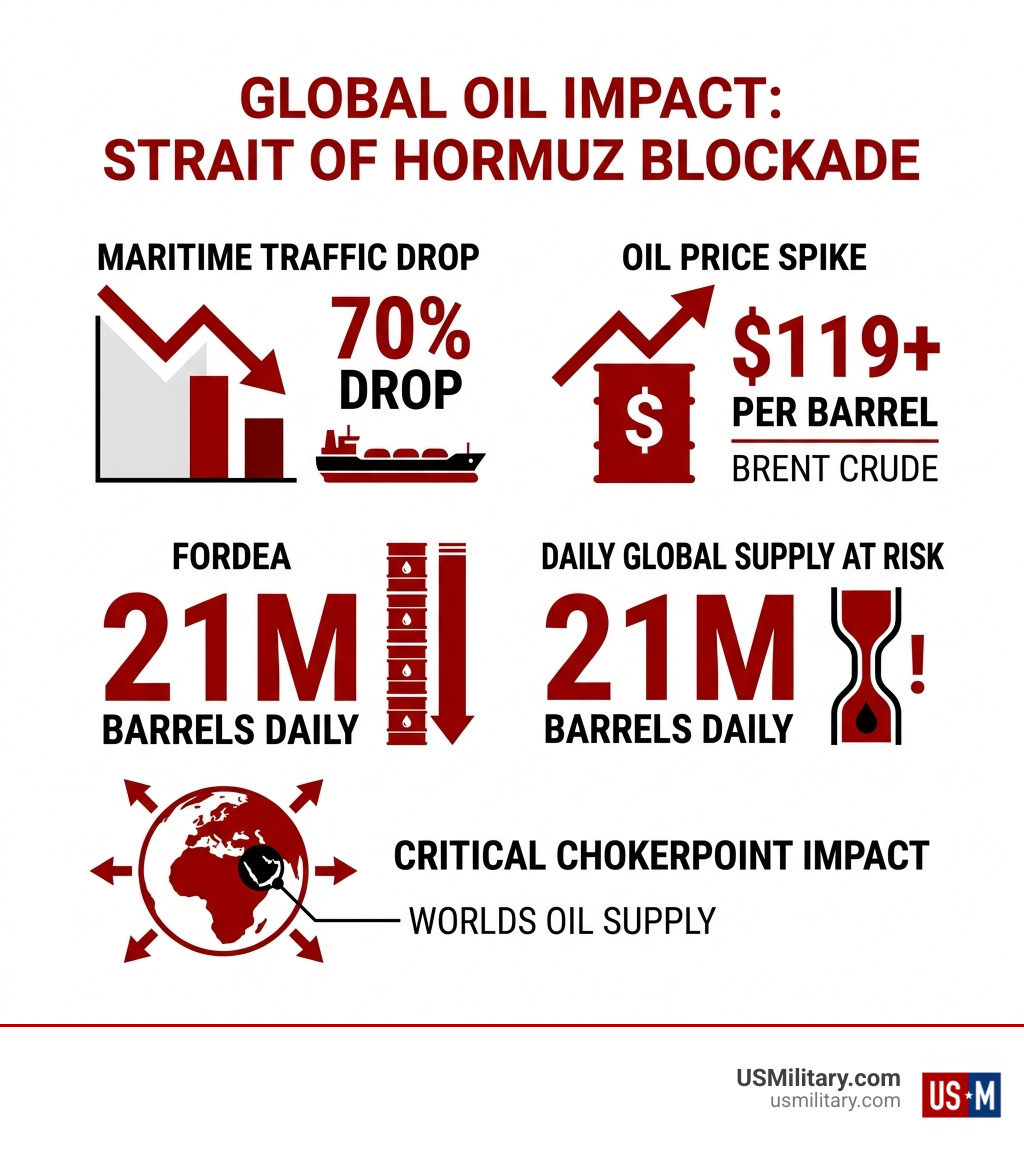
- Economic impact: Maritime traffic through the strait dropped 70%. Brent crude spiked above $119 per barrel.
- Trump’s stated goal: Clear the strait, which carries roughly one-fifth of the world’s oil supply, as a “favor” to dependent nations.
The Strait of Hormuz is one of the most critical chokepoints on the planet. When Iran closed it on February 28, 2026, following US-Israeli airstrikes, the ripple effects hit oil markets, gas prices, and global trade almost immediately.
Trump responded with escalating pressure — first warnings, then mine-clearing operations, then open talk of a full naval blockade. Vice President Vance made the US position clear after the Islamabad talks fell apart, saying the negotiation failure was “worse for the Iranians” than for America.
This guide breaks down exactly what was announced, what military actions are underway, and what it means for the region and the world.
I’m Larry Fowler, author of Dare To Live Greatly and publisher of USMilitary.com, where I’ve covered US military strategy, active-duty developments, and veteran affairs since 2007. My work tracking major US military operations — including escalating conflicts like the Trump Announces Naval Blockade Strait of Hormuz situation — gives me a grounded perspective on what these decisions mean for service members and their families. Read on for a complete breakdown of every key development in this fast-moving story.
Trump Announces Naval Blockade Strait of Hormuz glossary:
- Trump Signe 2 Week Cease Fire With Iran
- US moves airborne troops, Marines as Iran rejects ceasefire, raising ground war potential
- Latest Update Operation Epic Fury Including Three American Deaths
The Islamabad Collapse: Why Trump Announces Naval Blockade Strait of Hormuz
The road to the current naval standoff began in Islamabad, Pakistan. In early April 2026, high-level delegations from the United States and Iran met for what many hoped would be a breakthrough in the ongoing conflict. Instead, the meeting became the catalyst for further escalation.
The negotiations lasted a grueling 21 hours. We’ve learned that the atmosphere was incredibly tense, with reports suggesting that Iranian Foreign Minister Abbas Aragchi and US envoy Steve Witkoff nearly came to blows over the management of the Strait. The US presented what Vice President Vance described as a “final and best offer.” The core demand was simple but non-negotiable: Iran must completely abandon its nuclear weapons development.
When Tehran characterized these conditions as “excessive” and refused to commit, the talks collapsed. This failure directly led to the moment where Trump Announces Naval Blockade Strait of Hormuz as a primary strategic option. For more on how the US handles these nuclear escalations, see How America Responds If Iran Goes Nuclear Key Moves.
Escalation After Failed Diplomacy
The collapse of diplomacy left a vacuum that was quickly filled by military posturing. The deep mistrust between the two nations reached a fever pitch. Following the Islamabad exit, President Trump took to social media to warn Iran against any further attempts to block oil shipments. He made it clear that the US would no longer wait for a diplomatic “maybe.”
The strategy shifted from the table to the sea. Trump hinted that a naval blockade was the next logical step to ensure that Iran could not hold the world’s energy supply hostage. You can read more about the initial hints of this strategy in this report: Donald Trump Hints at Naval Blockade Against Iran As Peace Talks Fail.
Strategic Shift to Maritime Pressure
We are seeing a shift toward a strategy that mirrors past maritime pressure campaigns, such as those used against Venezuela. By leveraging a naval blockade, the US aims to “out-blockade” Iran’s own closure of the Strait.
The goal is to control all traffic in the waterway, ensuring that friendly vessels can pass while Iranian oil exports are completely choked off. Trump has even suggested that the US Navy could begin escorting tankers directly to ensure they reach their destinations safely. This move is designed to provide economic leverage that the 21 hours of talking failed to achieve. Further details on the escort proposal can be found here: Trump says US Navy could escort ships through Strait of Hormuz.
US Naval Operations and Mine Clearance in the Strait
While the blockade is the broader strategic goal, the immediate tactical hurdle is the presence of Iranian-laid mines. On April 11, 2026, the situation transitioned from threats to action.
Two US Navy guided-missile destroyers, the USS Frank E. Peterson and the USS Michael Murphy, made a historic transit through the Strait. This was the first time US warships had entered the waterway since the war began in February. Their mission is critical: clearing the “mine threat” that has paralyzed commercial shipping. Trump announced that the US military is starting this process as a “favor” to other nations that lack the “courage or will” to do it themselves.
For a deeper look at the military’s broader objectives in this conflict, check out Trump Acts On Vow No Nuclear Bombs In Iran 14 Mop Bombs.
Countering the IRGC Mine Threat
The Iranian Revolutionary Guard Corps (IRGC) has historically relied on small “mine dropper” boats to harass and block the Strait. However, US Central Command (CENTCOM) reports that the US military has already sunk all 28 of Iran’s known mine-laying vessels.
Despite these successes, the threat of tethered or drifting mines remains. The US is reportedly deploying advanced underwater drones to assist the destroyers in sweeping the channel. This operation is part of what some officials describe as the Boldest Epic Attack On Iran Regrime For Lasting World Peace. Even as Iran denies that US ships have successfully entered the Strait, the physical presence of these warships tells a different story.
Deployment of Carrier Strike Groups
The blockade is backed by massive firepower. The USS Gerald R. Ford and the USS Abraham Lincoln carrier strike groups are currently positioned to enforce “freedom of navigation” in the region. These assets provide the air cover and surveillance necessary to monitor every inch of the Strait.
The presence of these carriers serves as a deterrent against Iranian shore-based missile batteries and remaining naval assets. Understanding the sheer scale of this deployment is essential when Assessing The Military Capabilities Of Russia And The Us and how the US maintains dominance in contested waters.
Strategic Targets: From Kharg Island to Global Oil Supplies
When Trump Announces Naval Blockade Strait of Hormuz, it isn’t just about ships in the water; it’s about the infrastructure on the land. The US has identified several high-value targets that could be “obliterated” if Iran continues to obstruct the waterway.
At the top of that list is Kharg Island, Iran’s primary oil export hub. By targeting this facility, the US could effectively end Iran’s ability to fund its war effort. Trump has warned that the US could destroy targets that would be impossible to rebuild, including electric plants and desalinization facilities. This “maximum pressure” 2.0 is designed to force a reopening of the Strait, which normally handles 21 million barrels of oil per day.
You can read about the specific threats to these facilities here: Trump vows to reopen Strait of Hormuz as oil prices soar. Interestingly, there have been moments of restraint, as seen in Trump Orders Pause On Iran Power Attacks, though that pause seems to be expiring as the blockade takes shape.
Economic Consequences of the Blockade
The impact on your wallet has been immediate. Since the conflict began and the Strait was closed, Brent crude oil prices have skyrocketed, at one point hitting $119.50 per barrel. For Americans, this has translated to a sharp rise in gas prices, with some areas seeing jumps of 50 cents in a single week.
Trump has described these rising fuel costs as a “very small price to pay” for the long-term security of neutralizing Iran’s nuclear threat. He has also threatened that if Iran attempts to stop the flow of oil entirely, the US will hit them “twenty times harder.” For more on the shipping industry’s perspective, see Trump threatens US will hit Iran ‘20 times harder’ if Strait of Hormuz oil flow blocked.
Impact on Global Trade Partners
The blockade doesn’t just affect the US and Iran; it’s a global crisis. Nations like China, Japan, and South Korea rely heavily on the oil flowing through this passage. Trump has been vocal in his criticism of these countries, suggesting they should contribute more to the security of the region.
To help mitigate the economic damage, the US has proposed risk insurance via the Development Finance Corporation to encourage tankers to keep moving. However, with maritime traffic down 70%, many companies are waiting for the US Navy to fully clear the path. This global tension is further complicated by other regional conflicts, as noted in our analysis of China Warning The World Against Providing Military Aid To Taiwan.
Geopolitical Risks and the 2026 Iran War Context
We must look at the Trump Announces Naval Blockade Strait of Hormuz news within the broader context of the 2026 Iran War. President Trump has stated that the “war is very complete,” claiming that the US has already struck over 3,000 Iranian targets, effectively neutralizing their air force and traditional navy.
The conflict has also seen a major shift in Iranian leadership. Following the death of Supreme Leader Ali Khamenei, his son, Mojtaba Khamenei, has taken the reins. This regime change has not yet led to a ceasefire, as Trump insists that any halt in fighting is conditioned on the Strait being “open, free, and clear.” For an update on the likelihood of further strikes, visit Will Us Military Strike Iran.
Iranian Retaliation and Regional Threats
Iran has not taken these moves sitting down. The IRGC has warned that any ship attempting to cross the Strait without their permission will be met with “lethal force” and set ablaze. There are also concerns about Iranian proxies, such as the Houthis in Yemen, becoming more involved in attacking maritime traffic.
The risk of a wider regional war remains high. We see similarities in how these tensions boil over in other areas, such as The Syrian Conflict. Iran’s strategy appears to be making the cost of the blockade so high — through both kinetic attacks and economic disruption — that the US and its allies lose their resolve.
International Reactions and NATO Stance
The international community is deeply divided. While the UAE has shown some willingness to support US efforts, many NATO allies have been hesitant. The German Defense Minister famously stated, “this is not our war,” leading Trump to label some European allies as “cowards.”
Meanwhile, at the UN, Russia and China have used their veto power to block resolutions that would authorize international military action to reopen the Strait. This unilateral path taken by the US has led to discussions about domestic military readiness, including All About Can Trump Bring Back The Military Draft Amid Iran War.
Frequently Asked Questions about Trump Announces Naval Blockade Strait of Hormuz
What triggered the 2026 naval blockade announcement?
The primary trigger was the collapse of the 21-hour negotiations in Islamabad. When Iran refused to abandon its nuclear weapons program, the US shifted from diplomacy to maritime pressure. The blockade is intended to serve as the ultimate economic lever to force Iran back to the table or collapse its war-fighting capability.
Which US warships are currently in the Strait of Hormuz?
As of mid-April 2026, the USS Frank E. Peterson and the USS Michael Murphy are the primary surface combatants involved in active mine-clearing operations within the Strait. They are supported by the USS Gerald R. Ford and USS Abraham Lincoln carrier strike groups positioned nearby in the North Arabian Sea and Gulf of Oman.
How has the blockade affected global oil prices?
The blockade and the preceding closure of the Strait have caused a massive supply shock. Brent crude prices spiked to nearly $120 per barrel, and maritime traffic through the region has plummeted by 70%. This has led to significantly higher gas and diesel prices for American consumers.
Conclusion
The situation surrounding the Trump Announces Naval Blockade Strait of Hormuz remains fluid and high-stakes. As US Navy destroyers work to clear Iranian mines and carrier groups stand ready to enforce the blockade, the global economy hangs in the balance. At USMilitary.com, we are committed to providing you with the most accurate and up-to-date information on these developments.
Whether you are an active-duty sailor on the USS Frank E. Peterson, a veteran concerned about regional stability, or a military family member tracking the news, we are your central hub for guidance and analysis. Stay tuned for more updates on the 2026 Iran War and its impact on our armed forces.
If you’re looking to serve or want to learn more about the roles our sailors play in these critical missions, Explore career opportunities and Navy Jobs today.
Free for Service Members & Veterans
Get the military benefits intel no one tells you about.
Weekly updates on VA benefits, pay changes, and money tips — free for service members and veterans.
No spam. Unsubscribe anytime. Your info is never shared.


