Why Your 2026 TSP Decisions Can Make or Break Military Retirement

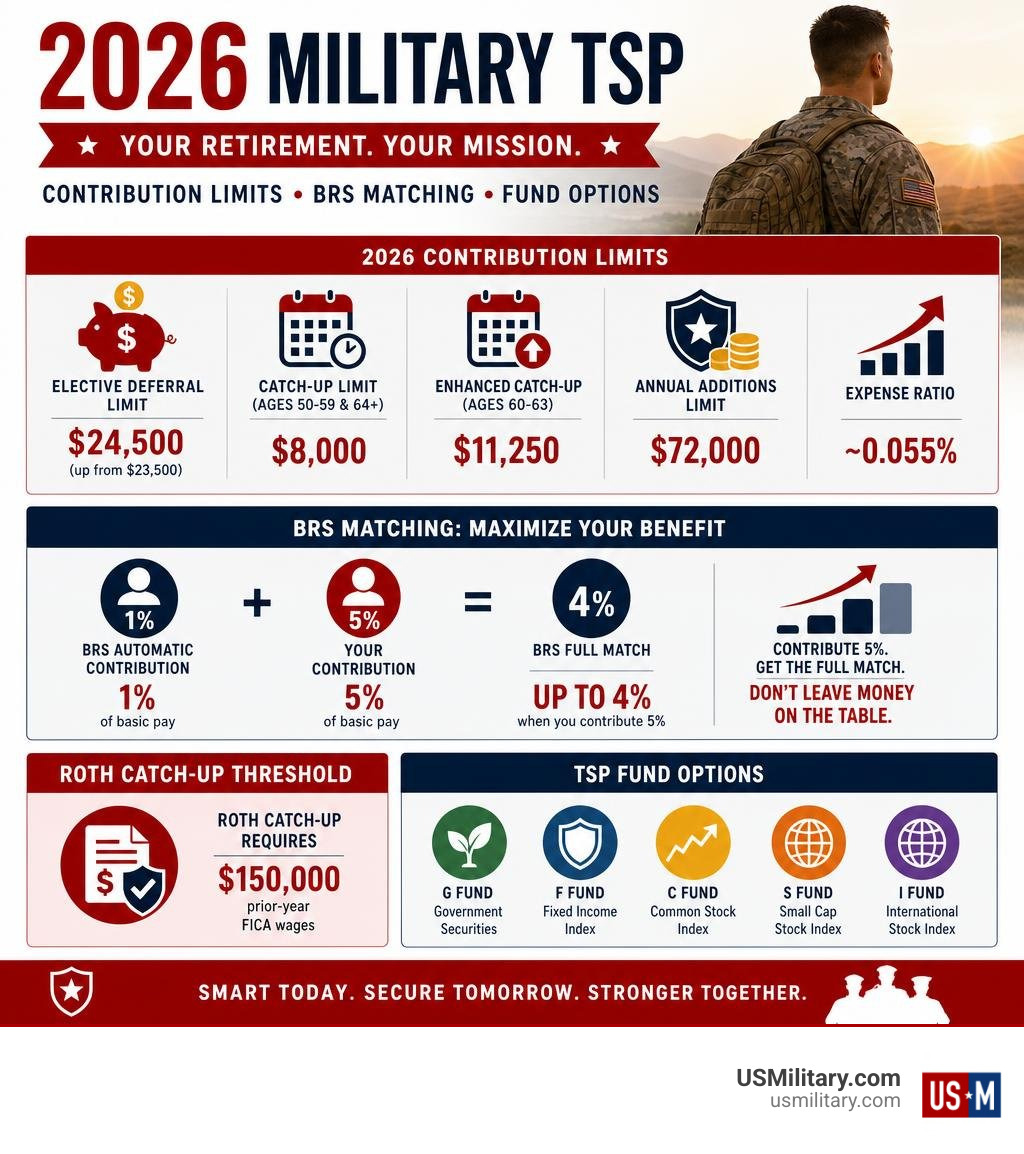
This military TSP guide for 2026: funds, contribution limits & BRS matching covers everything you need in one place. Here’s a fast-reference summary:
| Topic | 2026 Key Number |
|---|---|
| Elective Deferral Limit | $24,500 (up from $23,500) |
| Catch-Up Limit (ages 50-59 & 64+) | $8,000 |
| Enhanced Catch-Up (ages 60-63) | $11,250 |
| Annual Additions Limit | $72,000 |
| BRS Automatic Contribution | 1% of basic pay |
| BRS Full Match | Up to 4% (when you contribute 5%) |
| Expense Ratio | ~0.055% |
| Roth Catch-Up Threshold | $150,000 prior-year FICA wages |
The Thrift Savings Plan is one of the most powerful retirement tools available to service members — yet over 80% of military members will never reach 20 years of service and earn a full pension. That makes TSP matching under the Blended Retirement System (BRS) the retirement safety net for most who serve.
The 2026 updates raise the contribution ceiling, introduce new SECURE 2.0 rules for catch-up contributions, and create real planning decisions around Roth vs. Traditional contributions — especially for deployed service members who can unlock a triple tax advantage almost no civilian retirement account can match.
I’m Larry Fowler, publisher of the USMilitary.com Network since 2007 and a longtime advocate for helping service members understand their financial benefits. I’ve spent years covering military pay, VA benefits, and retirement planning — including every update to the military TSP guide for 2026: funds, contribution limits & BRS matching — so you can make confident, informed decisions about your financial future.
Basic military TSP guide 2026: funds, contribution limits & BRS matching glossary:
- active duty military benefits
- New Military Pay Chart For Enlisted and Officers 2026
- active duty retirement
Military TSP Guide 2026: Funds, Contribution Limits & BRS Matching
Understanding the mechanics of the Thrift Savings Plan is essential to securing your financial future. As we navigate the year 2026, the IRS has adjusted contribution limits upward, and the rules of the Blended Retirement System (BRS) continue to reward service members who plan their contributions carefully.

2026 TSP Contribution Limits and SECURE 2.0 Rules
For 2026, the IRS has announced key increases to the Thrift Savings Plan contribution ceilings. Keeping track of these numbers ensures you do not miss out on matching funds or face tax penalties. You can review the official parameters outlined in the 2026 TSP Contribution Limits | The Thrift Savings Plan (TSP) .
The core limits for 2026 are:
- Elective Deferral Limit (IRC Section 402(g)): This is the maximum amount of basic pay you can contribute from your paycheck. For 2026, it is $24,500, up $1,000 from $23,500 in 2025.
- Standard Catch-Up Limit (Ages 50-59 and 64+): If you are age 50 or older, you can contribute an additional $8,000 (up from $7,500 in 2025), bringing your total potential contribution to $32,500.
- Enhanced Catch-Up Limit (Ages 60-63): Under SECURE 2.0 Section 109, participants in this specific age bracket receive a higher catch-up limit of $11,250 in 2026, allowing a total contribution of $35,750.
- Annual Additions Limit (IRC Section 415(c)): This is the absolute ceiling on all contributions to your account in a calendar year, including your elective deferrals, government matching, automatic contributions, and any tax-exempt combat zone contributions. In 2026, this limit rises to $72,000 (up from $70,000 in 2025).
A major SECURE 2.0 change taking full effect in 2026 is the mandatory Roth catch-up rule (Section 603). If your prior-year (2025) FICA wages exceeded $150,000, any catch-up contributions you make in 2026 must be designated as Roth (after-tax). If your income is below this threshold, you retain the choice between Traditional and Roth catch-ups. Keeping an eye on your earnings is crucial, especially when evaluating How Much You Will Earn On Active Duty In 2026.
Blended Retirement System (BRS) Matching Mechanics
The Blended Retirement System relies heavily on your active participation. If you are covered by the BRS, the Department of Defense (DoD) provides automatic and matching contributions to help build your nest egg. Understanding the exact matching formula is the key to capturing “free money.”
Under the BRS, the matching structure works as follows:
- Automatic 1% Contribution: The military automatically contributes 1% of your basic pay to your TSP account, even if you contribute 0%. This begins after 60 days of service.
- Matching Contributions: The military matches your personal contributions dollar-for-dollar on the first 3% of basic pay you contribute. On the next 2% of basic pay you contribute, the military matches 50 cents on the dollar.
- The 5% Rule: To receive the maximum matching contribution of 4% (which, combined with the 1% automatic contribution, equals a 5% total agency contribution), you must personally contribute at least 5% of your basic pay every single month.
For more details on how these matching tiers function, check out the official resource on Contribution Types | The Thrift Savings Plan (TSP) . Matching contributions begin after two years of service for those who entered on or after January 1, 2018, and they always go into your Traditional TSP account, even if your personal contributions are made to the Roth TSP.
Traditional vs. Roth TSP: Tax Strategies for Service Members
One of the most critical decisions we make when setting up our retirement accounts is choosing between Traditional and Roth tax treatments. This choice directly impacts your take-home pay today and your tax burden decades from now.

Choosing Your Tax Treatment: Traditional vs. Roth TSP
The difference between Traditional and Roth TSP comes down to when you pay taxes on your money:
- Traditional TSP: Contributions are made with pre-tax money. This lowers your taxable income today, but your contributions and all of their investment earnings are taxed as ordinary income when you withdraw them in retirement.
- Roth TSP: Contributions are made with after-tax money. This means you do not get a tax break today, but your contributions and all of their investment earnings grow tax-free and can be withdrawn completely tax-free in retirement (provided you are at least 59½ and the account has been open for at least five years).
When should you choose Roth?
Roth is generally the superior choice for junior enlisted members, mid-grade NCOs, and junior officers. Because military compensation includes tax-free allowances like BAH (Basic Allowance for Housing) and BAS (Basic Allowance for Subsistence), your taxable income is typically much lower than your civilian peers. This places you in a very low tax bracket. Paying taxes now at a low rate to enjoy tax-free growth and withdrawals later is an incredible deal.
When should you choose Traditional?
Traditional TSP may make sense if you are a senior officer or senior NCO in a high tax bracket today and you expect your tax bracket to drop significantly in retirement. Additionally, some service members choose a 50/50 split to build “tax diversification,” giving them flexibility to manage their tax brackets in retirement. You can analyze your current pay rates using the Military Pay Chart 2026 to see where you land on the tax spectrum.
Combat Zone Tax-Exempt Contributions and the Triple Tax Advantage
Deploying to a designated Combat Zone Tax Exclusion (CZTE) area unlocks what is arguably the single greatest tax loophole in the entire U.S. tax code: the triple tax advantage of the Roth TSP.
When you serve in a combat zone, your basic pay is excluded from federal income tax. If you contribute this tax-exempt pay to a Roth TSP:
- The money goes into the account tax-free (because it was earned in a combat zone).
- The money grows completely tax-free while invested in your choice of TSP funds.
- The money comes out completely tax-free in retirement.
This means you will never pay a single dime of income tax on either the principal or the decades of compounding growth.
Furthermore, when deployed in a combat zone, your elective deferral limit of $24,500 no longer acts as your absolute ceiling. You can contribute tax-exempt pay up to the $72,000 annual additions limit for 2026. However, any contributions you make above the standard $24,500 elective deferral limit must go into a Traditional TSP account (where the contributions will be tax-free, but the earnings will be taxable upon withdrawal). For a deeper dive into these deployment rules, refer to Traditional and Roth Contributions | The Thrift Savings Plan (TSP) .
TSP Investment Funds and Allocation Strategies
Once your money is in the TSP, it needs to go to work. The TSP keeps things simple by offering five core individual index funds and ten diversified Lifecycle (L) Funds.
The Core Individual Funds (G, F, C, S, and I Funds)
The five core individual funds represent different asset classes, ranging from ultra-safe government debt to aggressive international stocks:
- G Fund (Government Securities Investment Fund): Invested in short-term U.S. Treasury securities specially issued to the TSP. It has zero risk of loss of principal, but its returns are low, typically only keeping pace with inflation.
- F Fund (Fixed Income Index Fund): Tracks a broad index of U.S. government and corporate bonds. It offers moderate risk and return, though it can lose value when interest rates rise.
- C Fund (Common Stock Index Fund): Tracks the S&P 500 index, representing the 500 largest publicly traded companies in the United States. It offers high long-term return potential with matching stock market volatility.
- S Fund (Small Cap Stock Index Fund): Tracks the Wilshire 4500 index, representing small to mid-sized U.S. companies. It is more volatile than the C Fund but can offer higher growth potential.
- I Fund (International Stock Index Fund): Tracks international equity markets. It provides global diversification, though returns can fluctuate based on currency changes and foreign market conditions.
Portfolio Allocation Strategies for the Military TSP Guide 2026: Funds, Contribution Limits & BRS Matching
Choosing how to split your money among these funds depends heavily on your age, retirement timeline, and risk tolerance. You can find detailed descriptions of each option at TSP Fund Options | The Thrift Savings Plan (TSP) .
Here are three common allocation strategies:
- The Lifecycle (L) Fund Strategy (Hands-Off): If you do not want to manage your own investments, pick the L Fund closest to the year you plan to retire (e.g., L 2055 or L 2060). The TSP will automatically allocate your money across the core funds, starting aggressive when you are young and gradually shifting to a conservative mix as you approach retirement.
- The Aggressive Stock Strategy (Young Investors): If you are in your 20s or 30s and have decades of compounding ahead, a stock-heavy portfolio is generally recommended. A common mix is 80% C Fund / 20% S Fund or 70% C Fund / 20% S Fund / 10% I Fund. This ignores short-term market drops in favor of capturing long-term market growth.
- The Balanced Strategy (Mid-Career): As you get closer to retirement, you may want to protect your gains by introducing bonds. A mix of 60% C Fund / 15% S Fund / 10% I Fund / 15% F Fund offers a smoother ride while still maintaining solid growth potential.
Maximizing Your TSP: Calculations, Mistakes, and Separation
To get the most out of your TSP, you need to understand the calendar math, avoid a few classic pitfalls, and know what to do with your account when you hang up the uniform.
| Feature | Traditional TSP | Roth TSP |
|---|---|---|
| Tax Treatment Today | Pre-tax (reduces taxable income) | After-tax (no immediate tax break) |
| Tax Treatment in Retirement | Withdrawals taxed as ordinary income | Withdrawals are 100% tax-free |
| BRS Matching Destination | Always deposited into Traditional TSP | Always deposited into Traditional TSP |
| RMD Requirements | Required starting at age 73 | No RMDs (starting in 2024 due to SECURE 2.0) |
| Best For | High earners seeking immediate tax relief | Junior/mid-career members in lower tax brackets |
How to Maximize Your Military TSP Guide 2026: Funds, Contribution Limits & BRS Matching
One of the most dangerous traps in the BRS is front-loading your contributions. Because the military matches your contributions on a monthly basis rather than performing an end-of-year “true-up,” you must contribute at least 5% of your basic pay in every single calendar month to receive the full match.
If you increase your contribution percentage too high early in the year and hit the $24,500 elective deferral limit in October, your contributions will automatically stop for November and December. Because you are contributing 0% in those final two months, you will lose the 5% military match for those periods.
To avoid this, you must calculate your contributions so that you reach the $24,500 limit exactly in December. To do this, divide the annual limit by your basic pay:
$$\text{Annual Contribution Percentage} = \frac{\$24,500}{\text{Annual Basic Pay}}$$
For example, if you are an O-3 with over 4 years of service making approximately $84,000 in basic pay annually, you would need to set your myPay contribution to approximately 29% to max out perfectly in December. For detailed tools on how to calculate this by rank, refer to TSP Max Contribution 2026 | Military BRS Match Per Pay Period Percentage and the 2026 Max BRS TSP Contributions Monthly Match | Military Money Manual .
Common TSP Mistakes to Avoid
- Leaving Money in the G Fund Default: Historically, new service members had their contributions defaulted into the G Fund. While this is safe, it barely beats inflation and can cost you hundreds of thousands of dollars in lost growth over a 20-year career. (Note: Since 2018, new members default into an age-appropriate L Fund, but if you joined before then, check your allocation!).
- Under-Contributing (Not Getting the Match): If you contribute less than 5% under the BRS, you are literally turning down free money. It is an instant 100% return on your investment.
- Cashing Out at Separation: When leaving the military, many young service members cash out their TSP accounts. This triggers immediate income taxes and a 10% early withdrawal penalty, destroying years of progress.
Managing Your TSP After Separation from Service
When you separate from the military, you have three primary options for your TSP account:
- Leave it in the TSP: You can keep your money right where it is. While you can no longer make new payroll contributions, you can still manage your allocations and execute interfund transfers. The TSP’s ultra-low expense ratio (around 0.055%) makes this a highly attractive option.
- Roll it over into an IRA: You can move your balance into a Traditional or Roth IRA with a commercial brokerage. This gives you access to a much wider variety of investment options, though you should watch out for higher fees.
- Roll it over into a New Employer’s 401(k): If your new civilian job offers a high-quality retirement plan, you can consolidate your accounts by rolling your TSP balance into their plan.
To explore how these choices fit into your broader post-military transition, review the Benefits Of Joining The Military and check out the TSP Guide 2026: Federal Thrift Savings Plan | RothRoom .
How Your TSP Affects VA Loans and Home Buying
Your TSP is not just a tool for retirement; it is also a vital piece of your overall financial profile that can help you secure a home while on active duty or as a veteran.
TSP Assets and VA Loan Qualification
When you apply for a VA home loan, mortgage underwriters look closely at your debt-to-income (DTI) ratio, credit score, and assets. While VA loans do not typically require “reserves” (cash left over after closing), having a healthy balance in your TSP acts as a powerful compensating factor.
Underwriters view your TSP as verified, liquid assets (usually discounting the balance by 30% to account for potential market fluctuations and early withdrawal penalties). A solid TSP balance can help secure an automated underwriting approval, offsetting a higher DTI ratio or a lower credit score on your mortgage application.
The Risks of TSP Loans for Home Purchases
The TSP allows you to take out a residential loan of up to $50,000 (or 50% of your vested balance, whichever is less) to purchase a primary residence. While borrowing from yourself at a low interest rate (the G Fund rate) sounds appealing, it carries massive hidden risks:
- Opportunity Cost: The money you borrow is taken out of your investment funds. It stops earning compound interest in the market, which can severely stunt your long-term retirement growth.
- Separation Risk: If you leave the military with an outstanding TSP loan, you must repay the entire balance within 90 days. If you cannot, the remaining loan is classified as a taxable distribution, triggering immediate income taxes and a 10% early withdrawal penalty.
- DTI Impact: The monthly payment to repay your TSP loan counts as a recurring debt, which increases your debt-to-income ratio and can actually reduce the amount of home you qualify to buy.
Given that VA loans offer a zero-down-payment benefit, keeping your TSP intact and utilizing the VA loan program as designed is almost always the smarter financial move.
Frequently Asked Questions about the Military TSP
Can I contribute special pay or bonuses to my TSP?
Yes! You can contribute up to 100% of your special pay, incentive pay, and retention bonuses to your TSP, provided you do not exceed the annual elective deferral limit ($24,500 in 2026) or the annual additions limit ($72,000 in 2026) if you are in a combat zone. You must log into myPay and adjust your “Bonus” and “Special Pay” contribution percentages separately from your regular basic pay settings.
What is the “Year You Turn 64” catch-up trap?
Under SECURE 2.0, the enhanced catch-up limit of $11,250 only applies to participants who are ages 60, 61, 62, and 63. The calendar year you turn 64, your catch-up contribution limit drops back down to the standard catch-up limit ($8,000 in 2026). If you do not adjust your contributions in myPay at the start of that year, you risk over-contributing and facing IRS administrative penalties.
How do I perform an in-plan Roth conversion in 2026?
Starting January 28, 2026, the TSP officially supports in-plan Roth conversions. This allows you to convert existing Traditional TSP balances into Roth TSP balances. That the amount you convert is treated as taxable income in the year of the conversion, so you must plan carefully to avoid pushing yourself into a higher tax bracket. The conversion requires a $500 minimum transaction and can be executed up to 26 times per year via the TSP portal.
Conclusion
The Thrift Savings Plan remains the single most effective wealth-building tool available to the men and women of our armed forces. By understanding the 2026 limits, avoiding the monthly matching traps of the BRS, choosing the right tax treatments, and selecting diversified investment funds, you can build a secure financial foundation that lasts long after your service ends.
At USMilitary.com, we are dedicated to helping you navigate every step of your military career and financial journey. To learn more about how to make the most of your service, Explore the Benefits of Military Service or visit USMilitary.com for updated pay charts, VA loan resources, and career guidance.
Free for Service Members & Veterans
Get the military benefits intel no one tells you about.
Weekly updates on VA benefits, pay changes, and money tips — free for service members and veterans.
No spam. Unsubscribe anytime. Your info is never shared.


