Understanding the Military Suicide Crisis and Occupational Risk

Top 10 military jobs that have the highest suicide rates include Infantry (Code 101), Ordnance Disposal and Diving (Code 143), Combat Engineers (Code 103), Armor and Amphibious Crew (Code 102), Medical Care Specialists (Code 130), Missile Guidance Systems (Code 112), Radio and Code Communications (Code 120), Artillery and Gunnery Crews, Navy Electrical/Mechanical Repairers, and Air Force Service and Supply Handlers.
Quick Reference: Highest-Risk Military Occupations (2011-2022)
| Rank | Occupation Code | Occupation | Suicide Rate per 100,000 |
|---|---|---|---|
| 1 | 143 | Ordnance Disposal and Diving | 34.77 |
| 2 | 101 | Infantry | 31.28 |
| 3 | 112 | Missile Guidance Systems | 30.84 |
| 4 | 102 | Armor and Amphibious Crew | 30.61 |
| 5 | 120 | Radio and Code Communications | 30.06 |
| 6 | 103 | Combat Engineers | ~30+ |
| 7 | 130 | Medical Care Specialists | ~25-30 |
| 8 | – | Artillery and Gunnery Crews | ~25-30 |
| 9 | – | Navy Electrical/Mechanical Repairers | 19.4% of Navy suicides |
| 10 | – | Air Force Service and Supply Handlers | 20.8% of Air Force suicides |
Source: DoD Report on Military Suicides by Job Code, 2024
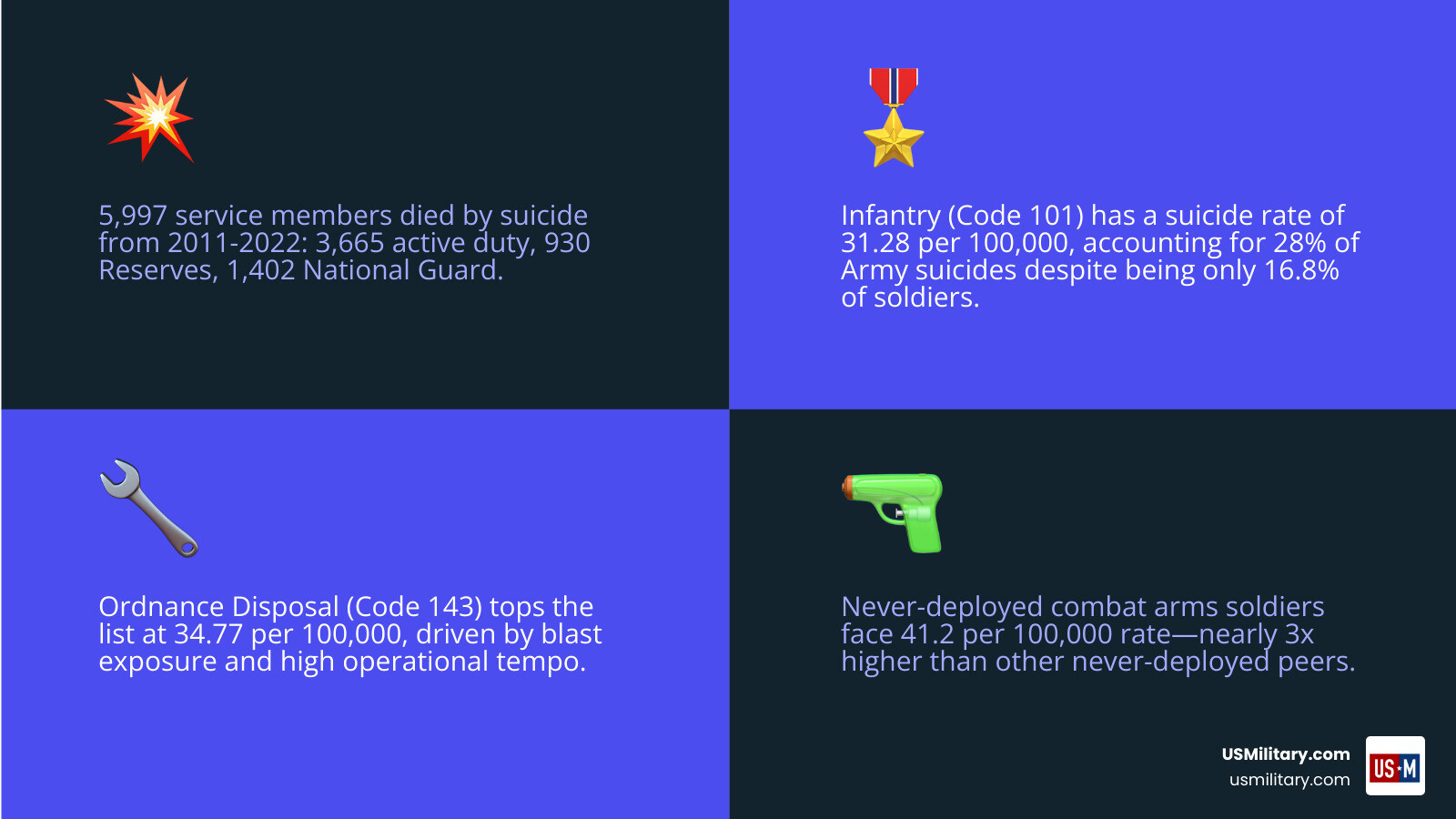
Between 2011 and 2022, 5,997 service members died by suicide—3,665 on active duty, 930 in the Reserves, and 1,402 in the National Guard. These numbers represent more than statistics. They’re sons and daughters, spouses and parents, who served their country.
The Pentagon’s 2024 report revealed something troubling: certain military jobs carry significantly higher suicide risk than others. Combat arms occupations like infantry and combat engineers show suicide rates nearly twice as high as other military jobs. All of the top enlisted specialties had rates at least 50% higher than the general U.S. population.
What makes these jobs so dangerous for mental health? The data points to several factors: high deployment tempo, repeated blast exposure from explosives and artillery, limited access to mental health care during operations, and ready access to firearms. Infantrymen accounted for 28% of all Army suicides while making up only 16.8% of soldiers.
The crisis extends beyond active duty. In 2023, 6,398 veterans died by suicide—an average of 17.5 per day. Veterans face a 58% higher risk of suicide compared to the general population, with 73.3% involving firearms.
Understanding which military jobs carry the highest risk is the first step toward targeted prevention. The data shows that never-deployed soldiers in combat arms roles face surprisingly elevated risk, with infantrymen and combat engineers who’ve never deployed showing suicide rates of 41.2 per 100,000—nearly three times higher than other never-deployed soldiers.
I’m Larry Fowler, publisher of the USMilitary.com Network since 2007, where I’ve worked with thousands of active-duty service members and veterans to provide critical information about military life, benefits, and mental health resources related to top 10 military jobs that have the highest suicide rates. Through this work, I’ve seen how access to accurate information can save lives.
This article breaks down the official Department of Defense data, examines why certain military occupations face elevated risk, and provides actionable resources for service members, veterans, and their families.
Basic top 10 military jobs that have the highest suicide rates glossary:
Ranking the top 10 military jobs that have the highest suicide rates
When we look at the top 10 military jobs that have the highest suicide rates, we aren’t just looking at numbers; we are looking at the frontline of a mental health battle. For years, the Department of Defense (DoD) kept this data largely aggregated, but recent congressional mandates, specifically the FY2023 National Defense Authorization Act (NDAA), have forced a deeper dive into which Military Occupational Specialties (MOS) are most at risk.

The following list represents the occupations identified in recent reports, including the 2024 Report on Incidence of Military Suicides by Job Code, as having the highest suicide mortality rates.
- Ordnance Disposal and Diving (Code 143): Often referred to as EOD (Explosive Ordnance Disposal), these technicians face extreme pressure, dealing with improvised explosive devices and underwater hazards. The combination of high-stakes work and repeated blast exposure puts them at the top of the list.
- Infantry (Code 101): The backbone of the combat arms, infantrymen across the Army and Marine Corps consistently show elevated rates. They represent a disproportionate number of total military suicides relative to their population size.
- Combat Engineers (Code 103): These specialists handle explosives, build defenses, and breach obstacles. Like infantry, they are often on the front lines and exposed to significant trauma and physical blast waves.
- Armor and Amphibious Crew (Code 102): Tankers and amphibious vehicle operators face high operational tempos and grueling maintenance schedules. In the Army, armor community suicide rates have been reported at nearly double the active-duty average in recent years.
- Medical Care Specialists (Code 130): This includes combat medics and corpsmen. The secondary trauma of treating casualties, combined with long hours and high-stress environments, contributes to their inclusion in the top 10.
- Missile Guidance Systems (Code 112): Technicians in this field work with highly technical, sensitive, and high-consequence equipment. The isolation and pressure of maintaining nuclear or strategic deterrents are significant stressors.
- Radio and Code Communications (Code 120): Communications specialists often operate in small, isolated teams or are attached to high-risk combat units, carrying both the physical load of their gear and the mental load of maintaining critical lifelines.
- Artillery and Gunnery Crews: These service members are routinely subjected to “low-level” blast overpressure every time a heavy weapon is fired. This physical jarring is increasingly linked to brain health issues.
- Navy Electrical/Mechanical Repairers: In 2018, this group accounted for nearly 20% of all Navy suicides. Life at sea, combined with the technical demands of maintaining a vessel’s core systems, creates a unique pressure cooker.
- Air Force Service and Supply Handlers: Often overlooked, those in logistics and supply roles in the Air Force showed a surprising spike in 2018, accounting for over 20% of that branch’s suicides.
For those interested in the deeper epidemiological factors, Scientific research on occupational suicide risk provides a technical look at how these roles differ from support functions.
Suicide rates for the top 10 military jobs that have the highest suicide rates
To understand the severity, we have to look at the per capita rates—the number of suicides per 100,000 service members. This allows us to compare a large group, like the Infantry, with a smaller, specialized group like EOD.
The 2024 DoD report used Poisson regression to adjust for age and sex, ensuring the data wasn’t skewed by the fact that most combat jobs are held by young men (a high-risk demographic in the civilian world as well). The findings were stark. Ordnance Disposal and Diving led with a rate of 34.77 per 100,000. To put that in perspective, the overall active component military suicide rate in 2018 was 24.8 per 100,000.
Infantry followed closely at 31.28 per 100,000. While the rate is slightly lower than EOD, the sheer volume of deaths is much higher because the infantry is a much larger community. Between 2011 and 2022, there were 758 suicides among enlisted infantrymen. The data clearly shows that the top 10 military jobs that have the highest suicide rates are not just experiencing “slightly” more stress; they are in a different category of risk entirely.
How branch-specific roles impact the top 10 military jobs that have the highest suicide rates
Each branch has its own culture and specific stressors that influence these rates. In the Army, the focus is heavily on the “Big Three”: Infantry, Combat Engineers, and Armor. These three groups consistently show higher rates than 21 other occupation codes within the branch.
In the Marine Corps, the infantry (MOS 0311 and related codes) carries the highest burden, accounting for 23.2% of the Corps’ total suicides in 2018. The Navy sees its highest risk among the “hull technicians” and mechanical repairers—the people who keep the ships running. We have also seen a growing focus on the special warfare community; you can find more info about Navy SEAL mental health awareness on our platform, highlighting that even the most elite units are not immune.
The Air Force presents an interesting case where “Service and Supply Handlers” showed the highest risk in recent snapshots. While many think of pilots when they think of the Air Force, the data shows that officers and pilots actually have some of the lowest suicide rates in the entire military. The risk is concentrated in the enlisted ranks, particularly in roles that may feel less “purposeful” or more “thankless” despite high operational demands.
Factors driving suicide risk in high-risk military occupations
Why do these specific jobs have such high rates? It’s rarely one thing. Instead, it’s a “perfect storm” of physical, psychological, and environmental factors.
1. Blast Overpressure and TBI:
One of the most significant findings in recent years is the link between “low-level” blast exposure and suicide. Artillerymen, EOD technicians, and infantrymen are repeatedly exposed to blast waves. Even if these don’t cause a visible injury, the cumulative effect can lead to Traumatic Brain Injury (TBI) and Chronic Traumatic Encephalopathy (CTE). These physical changes in the brain can lead to depression, impulsivity, and suicidal ideation. We’ve explored this deeply in our section on Navy SEALs, PTSD, and TBI.
2. High Operational Tempo (OPTEMPO):
The “Armor” community is a prime example. With the lack of permanent tank units in Europe, armor brigades have been rotating constantly. This leads to exhaustion, broken relationships (a major suicide predictor), and a feeling of being “trapped” in a cycle of deployment and maintenance.
3. Firearm Access and Lethal Means Safety:
Data shows that firearms are used in 66.5% of active-duty suicides. In many of the top 10 military jobs that have the highest suicide rates, service members are highly trained and comfortable with firearms. While most military suicides occur with personal weapons rather than service-issued ones, the “comfort level” and easy access remain a risk factor. This is why the DoD is now pushing “lethal means safety”—encouraging the use of gun locks and secure storage during times of crisis.
4. The Stigma of Seeking Help:
In “macho” combat cultures, admitting to a mental health struggle is often still seen as a sign of weakness or a threat to one’s security clearance. Research shows that less than half of those who died by suicide had a documented behavioral health diagnosis. They were suffering in silence. For more on the drivers of these trends, see the scientific research on Army suicide predictors.
Deployment history and the “Healthy Warrior Effect.”
There is a common myth that suicide is strictly a “combat vet” problem. The data tells a different, more complex story. In fact, never-deployed soldiers in high-risk jobs often have higher suicide rates than those currently deployed.
This is known as the “Healthy Warrior Effect.” Deployment acts as a “filter.” Only the most physically and mentally fit soldiers are typically cleared to deploy. Those who stay behind may already be struggling with health issues, legal problems, or family stress.
Furthermore, the Army STARRS study found that never-deployed infantrymen and combat engineers had a suicide rate of 41.2 per 100,000. That is an Odds Ratio (OR) of 2.9 compared to other never-deployed soldiers. Why?
- Loss of Purpose: Soldiers in combat jobs train for one thing: combat. If they don’t deploy while their peers do, they may feel a loss of identity or “belonging.”
- Training Stress: The training for these jobs is inherently dangerous and high-stress, even without a deployment.
- Selection Bias: The personality traits that draw people to combat arms (sensation-seeking, impulsivity) may also correlate with higher suicide risk when combined with life stressors.
Understanding these nuances is vital for addressing veteran mental health needs because it shows we need to watch out for our brothers and sisters even if they haven’t “seen the elephant” yet. For a deeper dive into the data, you can review the scientific research on occupational differences in Army suicide.
Prevention strategies and data limitations
The military is finally moving from a “reactive” to a “proactive” stance. Several key initiatives are currently underway:
- The Brandon Act: This allows service members to self-initiate a mental health referral confidentially through their commanding officer, lowering the barrier to care.
- SPRIRC Recommendations: The Suicide Prevention and Response Independent Review Committee has proposed 83 actions, including improving schedule predictability and hiring 2,500 more prevention professionals.
- Lethal Means Safety: Programs like the Navy’s gun lock distribution are aimed at creating “time and space” between a suicidal thought and the means to act on it.
- 2023 NDAA Mandates: Congress is now requiring annual reports on suicide by specific job code, ensuring the Pentagon cannot hide these trends in broad averages.
However, we must acknowledge the data limitations. Until 2011, reporting was inconsistent across branches. Even today, the Space Force is often excluded (due to its small size and zero suicides in the reporting period), and the Coast Guard is often missing from DoD reports because it falls under the Department of Homeland Security.
| Component | Suicide Rate (per 100k) | Key Trend |
|---|---|---|
| Active Duty | 28.2 | Gradual increase since 2011 |
| Reserve | 20.9 | Generally stable |
| National Guard | 21.2 | Highest historical rates, but stabilizing |
For those dealing with the aftermath of a loss, we offer resources such as more info on books for suicide grief to help navigate the long road to healing.
Frequently Asked Questions about military suicide rates
How do military suicide rates compare to civilian rates?
When adjusted for age and sex, the active duty and reserve suicide rates are roughly comparable to the U.S. adult population (around 18.2 per 100,000 for ages 17-59). However, the National Guard and Veterans have significantly higher rates. Additionally, 14 specific enlisted military codes have suicide rates that exceed civilian benchmarks, proving that the job itself is a major risk factor.
Why are never-deployed soldiers at higher risk in some jobs?
This is due to the “Healthy Warrior Effect” and the intense stress of combat arms training. Soldiers who are not cleared to deploy often face a combination of pre-existing stressors (medical or personal) and a perceived loss of purpose or “warrior identity” compared to their deploying peers.
What role do firearms play in military suicide statistics?
Firearms are the predominant method, accounting for 66.5% of active-duty suicides and over 73% of veteran suicides. Because service members are highly trained and often own personal firearms, the “lethality” of their attempts is much higher than in the civilian population, where drug overdoses are more common but less “successful” as a means of suicide.
Conclusion
At USMilitary.com, we believe that data is a tool for salvation. By revealing the top 10 military jobs that have the highest suicide rates, we aren’t trying to discourage enlistment; we are trying to ensure that those who choose these high-risk paths get the specific support they need.
Whether you are looking for VA disability resources or exploring new therapies like psychedelic treatments for veterans, we are here to provide the “intel” you need to thrive. If you are a veteran struggling with the long-term effects of your service, please look into Disabled Veteran Benefits to ensure you are getting the financial and medical support you earned.
The most important mission you have is staying here with us.
Free for Service Members & Veterans
Get the military benefits intel no one tells you about.
Weekly updates on VA benefits, pay changes, and money tips — free for service members and veterans.
No spam. Unsubscribe anytime. Your info is never shared.


