
Veterans are most commonly denied 100 percent VA disability ratings due to statutory schedular caps on specific conditions, strict objective medical criteria (such as range of motion or METs thresholds), the high legal bar for proving total occupational and social impairment, and evidentiary or medical nexus gaps. When adjudicating claims under 38 U.S.C. § 1155 and the Schedule for Rating Disabilities (Title 38 of the Code of Federal Regulations, Part 4), the Department of Veterans Affairs requires concrete clinical proof matching diagnostic codes rather than subjective reports of hardship. Navigating the VA Disability Rating Chart Guide 2026 reveals that each physical or psychological disability is assigned a specific Diagnostic Code (DC) accompanied by strict statutory criteria.
Increase Your VA Disability Rating. Talk To A Rating Expert. Free Call.
The primary hurdle many veterans face is confusing personal suffering with schedular criteria. The VA rating system does not measure how tough a veteran is, nor does it hand out 100% ratings as compensation for general hardship. Every single percentage assigned—from 0% up to 100%—requires concrete, objective medical findings that match the exact diagnostic language in the regulations. When an adjudicator reviews your file, they compare your Compensation and Pension (C&P) exam findings directly against the rating code. If your clinical measurements fall even slightly outside those boundaries, the VA cannot legally grant the maximum schedular evaluation.
Top 15 Reasons Veterans Are Denied 100 Percent VA Disability Ratings: Schedular Maximums and Medical Ceilings
Many veterans file for an increase hoping to hit the 100% mark on a single condition, only to discover that the law places hard caps on specific disabilities. Reviewing the VA Disability Rating Charts Ultimate Guide illustrates how certain conditions top out well below total disability, regardless of how debilitating the symptoms feel in daily life.
- Schedular Rating Caps on Common Disabilities: Tinnitus (DC 6260) has an absolute legal ceiling of 10%, whether you experience ringing in one ear or both ears continuously. Similarly, migraine headaches (DC 8100) carry a maximum schedular rating of 50%, which requires documented frequent, completely prostrating attacks. No matter how severe your migraines are, the VA cannot assign a 100% rating under DC 8100 alone.
- Failure to Demonstrate Mechanical Ankylosis or Severe Musculoskeletal Limits: Musculoskeletal evaluations (spine, hips, knees, ankles) are governed almost entirely by objective range of motion (ROM) measurements recorded with a goniometer. For a lumbar spine condition (DC 5242 or 5237) to reach a 40% rating, forward flexion must be 30 degrees or less. To exceed 40% and reach 50% or 100%, the veteran must present objective medical evidence of unfavorable ankylosis (complete stiffness and fixation) of the entire thoracolumbar spine or entire spine. Subjective reports of flare-ups and severe back pain without ankylosis will result in a denial of a 100% schedular rating.
- Objective Functional Deficits Failing METs Thresholds: For cardiovascular conditions rated under the General Rating Formula for Diseases of the Heart (such as DC 7005 or DC 7006), the VA relies heavily on Metabolic Equivalent of Task (METs) testing. A 100% rating requires continuous congestive heart failure or objective testing demonstrating dyspnea, fatigue, or angina at a workload of 3.0 METs or less. If your exercise testing or medical evidence reflects functioning at 3.1 to 5.0 METs, the VA will assign a 60% rating rather than total disability.
- Misinterpreting Peripheral Neuropathy and Nerve Damage Ceilings: Nerve damage, such as sciatic nerve paralysis (DC 8520), is rated on a severity scale from mild (10%) to severe/incomplete (40% to 60%), with complete paralysis topping out at 80%. Even severe bilateral neuropathy will not yield a single 100% schedular assignment without meeting criteria for complete loss of use or secondary complications.
- Cancer in Remission Rated at 0% Residuals: While active service-connected malignancies (such as non-Hodgkin’s lymphoma under DC 7715 or prostate cancer under DC 7522) receive a temporary 100% rating during active treatment, that rating ends following a mandatory re-evaluation (typically 6 months post-treatment). If the cancer enters complete remission and treatment ceases, the VA reduces the rating to 0% or rates only the specific permanent residuals (such as surgical scars or voiding dysfunction), denying continued 100% compensation.
| Disability / Diagnostic Code | Maximum Standalone Schedular Rating | Specific Criteria Required for 100% Rating | Common Denial Trigger |
|---|---|---|---|
| Tinnitus (DC 6260) | 10% | None (10% is statutory maximum) | Expecting tinnitus alone to reach total disability |
| Migraines (DC 8100) | 50% | None (50% is schedular ceiling) | Filing for 100% without claiming secondary issues or TDIU |
| Lumbar Spine (DC 5242) | 100% (requires complete ankylosis) | Unfavorable ankylosis of the entire spine | Flexion >30° and lack of spinal fixation |
| Heart Disease (DC 7005–7007) | 100% | Chronic heart failure or METs ≤ 3.0 | METs test showing capacity > 3.0 METs |
| Active Cancer (e.g., DC 7715) | 100% (temporary during treatment) | Active disease undergoing chemotherapy/radiation | Condition enters remission; rated on residuals only |
The High Bar of Total Occupational and Social Impairment
Mental health evaluations represent another major point of confusion. Under 38 C.F.R. § 4.130 (the General Rating Formula for Mental Disorders), conditions such as Post-Traumatic Stress Disorder (DC 9411), Major Depressive Disorder (DC 9434), and Generalized Anxiety Disorder (DC 9400) are evaluated on an occupational and social impairment scale.
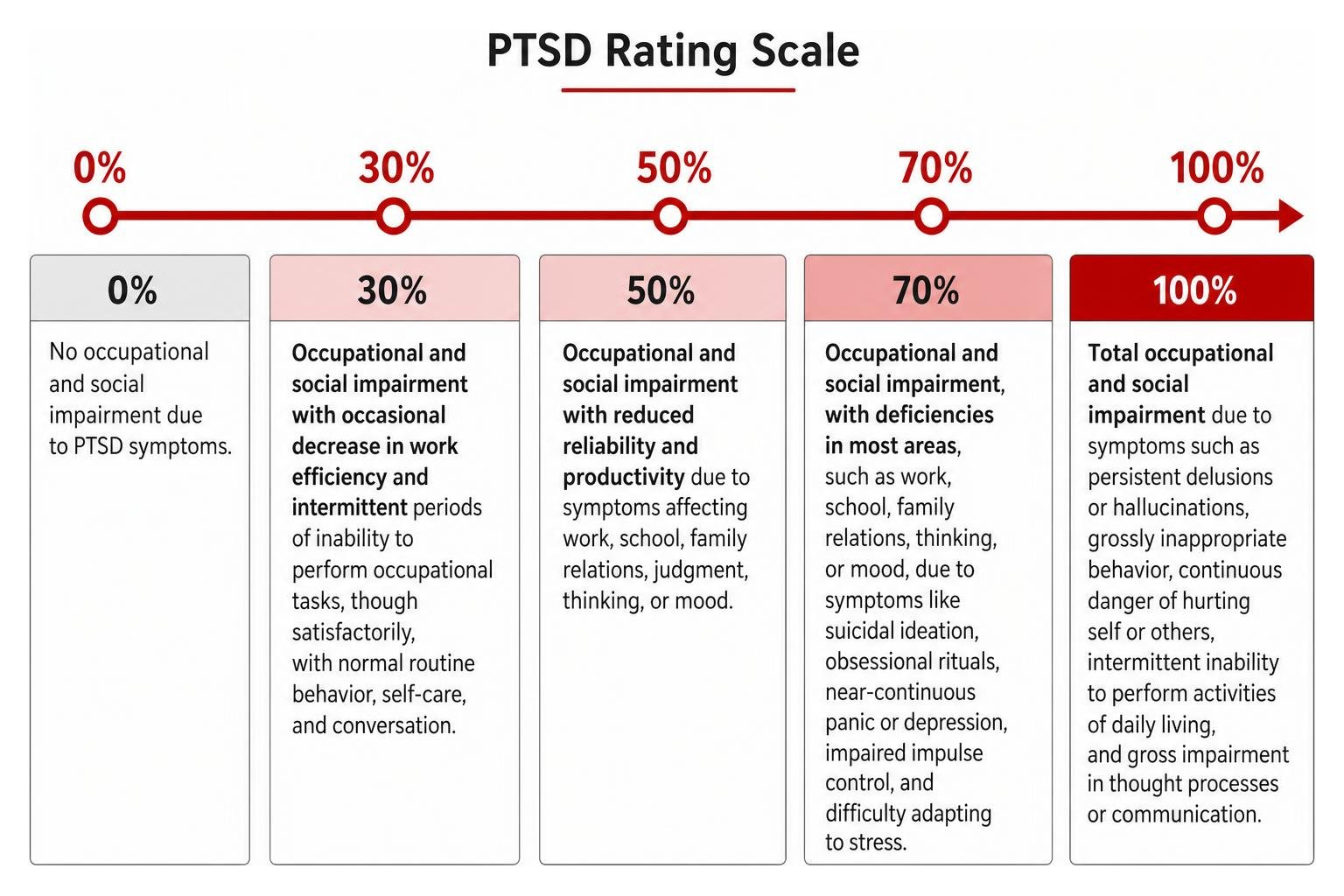
Understanding the VA Disability Rating Increase Expert Guide helps explain why many veterans hit a wall at the 70% level. The leap from 70% to 100% is substantial:
- The 70% Standard: Defined as “occupational and social impairment, with deficiencies in most areas, such as work, school, family relations, thinking, or mood.” Symptoms include suicidal ideation, obsessional rituals, illogical speech, near-continuous panic attacks, impaired impulse control, neglect of personal appearance, and inability to adapt to stressful circumstances.
- The 100% Standard: Defined strictly as “total occupational and social impairment.” The statutory benchmarks include persistent delusions or hallucinations, grossly inappropriate behavior, continuous danger of hurting self or others, intermittent inability to perform activities of daily living (ADLs) such as hygiene or feeding, and gross impairment in thought processes or communication.
Board of Veterans’ Appeals (BVA) decisions reveal that adjudicators deny 100% mental health ratings when symptoms are sporadic or intermittent rather than chronic and pervasive. For example, if a veteran experiences passive suicidal thoughts, social withdrawal, and occasional memory lapses, these symptoms align with the 70% criteria. Without clinical documentation showing total incapacitation, ongoing psychosis, complete inability to communicate, or daily self-care failure, the VA must deny the 100% schedular rating.
Top 15 Reasons Veterans Are Denied 100 Percent VA Disability Ratings

Securing a total disability rating requires navigating complex legal, evidentiary, and procedural hurdles. A review of Legal analysis of challenging VA claims and doctrinal barriers underscores that even valid claims are routinely rejected when the evidence fails to satisfy technical legal standards. Veterans seeking to understand the entire claims landscape should review The Complete Guide to VA Disability Claims to avoid the evidentiary breakdowns described below.
Top 15 Reasons Veterans Are Denied 100 Percent VA Disability Ratings: Evidentiary and Nexus Breakdowns
- Unverified Non-Combat PTSD Stressors: For combat veterans, lay statements often suffice to establish an in-service stressor. However, for non-combat PTSD claims—including Military Sexual Trauma (MST) or training accidents—the VA requires independent corroboration. If service records, police reports, buddy statements, or medical markers fail to substantiate the occurrence of the stressor event, the claim will be denied outright.
- Discounting Lay Testimony in Favor of Inadequate C&P Exams: While veterans are legally competent to report observable symptoms (such as pain, sleep disturbances, or depressive episodes), adjudicators frequently discount lay statements when an examining physician reports contrary clinical findings. Without a detailed nexus statement from an independent medical provider, the VA will give greater probative weight to a negative C&P exam.
- Failure to Overcome Pre-Existing Condition and Aggravation Rules: Under the presumption of soundness (38 U.S.C. § 1111), an injury or disease noted at entry is presumed pre-existing. When seeking an increased rating for an aggravated pre-existing condition, the veteran must prove a permanent increase in disability during service beyond its natural progression. Adjudicators frequently deny these claims by attributing symptom worsening to the natural course of the underlying disorder.
- Missing or Inconsistent Longitudinal Medical Records: A major reason claims for rating increases fail is a lack of continuous treatment history. Gaps in care lasting several years lead VA raters to conclude that the disability has improved or stabilized. If your record lacks consistent clinical notes, the VA will rely exclusively on the single snapshot provided by a 20-minute C&P exam.
- Lack of Independent Medical Opinions in Non-Presumptive Toxic Exposure Claims: While the PACT Act created presumptive service connection for many toxic exposure conditions, non-presumptive conditions (including rare cancers or autoimmune disorders) require affirmative proof of exposure and a scientifically sound medical nexus. VA examiners often deny service connection by citing a lack of epidemiological consensus, placing the burden entirely on the veteran to provide an expert independent medical opinion.
- Poorly Substantiated Secondary Service Connection Claims: Many veterans attempt to reach a 100% combined rating by claiming secondary conditions—such as radiculopathy secondary to degenerative disc disease, or sleep apnea secondary to PTSD. To get these approved, as outlined in our 12 Easiest VA Disability Claims Guide 2026, the veteran must provide a clear medical nexus establishing direct causation or aggravation. Without an expert medical rationale linking the secondary condition to the primary service-connected disability, the VA will deny service connection.
- Claims Under 38 U.S.C. § 1151 Failing Proximate Cause Standards: When a veteran suffers additional disability as a result of VA hospital care, medical treatment, or surgical complications, benefits may be sought under Section 1151. However, these claims are frequently denied because the veteran must prove that the VA’s care was negligent (lacking standard medical skill) or that an unforeseen event occurred, which requires rigorous independent expert testimony.
TDIU Pitfalls and Procedural Roadblocks
- Vague Proof of Inability to Maintain Substantially Gainful Employment for TDIU: Total Disability Based on Individual Unemployability (TDIU) allows veterans who cannot work due to service-connected disabilities to receive pay at the 100% rate. Understanding the exact payment terms in the VA Disability Pay 2026 Guide is essential. TDIU claims frequently fail because the veteran has not demonstrated an inability to secure substantially gainful employment. If a veteran earns income above the federal poverty threshold, the claim will be denied unless the employment is proven to be in a “protected work environment.” Because VA regulations do not clearly define what constitutes a protected work environment, adjudicators routinely deny TDIU to veterans working in family businesses or accommodated roles.
- Procedural Missteps: Staged Ratings and Effective Date Limitations: Under 38 C.F.R. § 3.156(c) and general effective date rules, retroactive 100% awards are only granted back to the date the medical evidence first proved total impairment. Adjudicators frequently assign “staged ratings”—granting a 100% evaluation for recent months while assigning lower ratings (such as 70% or 50%) for earlier periods on appeal, because the historical medical records did not document continuous, total disability during those earlier timeframes.
- Misapplication of the Benefit of the Doubt Doctrine and CUE Thresholds: Under 38 U.S.C. § 5107(b), when there is an approximate balance of positive and negative evidence regarding any material issue, the VA must resolve the benefit of the doubt in favor of the claimant. However, adjudicators rarely apply this doctrine in complex rating increases because they determine the negative C&P exam outweighs the veteran’s lay statements, shifting the evidentiary balance against the claim. Furthermore, attempts to fix past denials via Clear and Unmistakable Error (CUE) motions face an exceptionally high standard: the error must be undebatable and manifestly change the outcome based solely on the record as it existed at the time of the original decision.
Critical Strategies to Overcome Denials and Maximize Your Rating

Receiving a denial or an underrating from the VA is not the end of the road. With the implementation of the Appeals Modernization Act (AMA), veterans have structured pathways to challenge improper decisions. If your claim for a 100% rating was denied, you can systematically address the evidentiary gaps.
To build a compelling appeal, follow the structured methodology in our guide on 7 Critical Steps Increase VA Disability Rating. First, thoroughly review your Rating Decision Narrative. The VA is legally required to explain why the higher rating was denied and outline the specific evidence needed to qualify for the next evaluation tier.
If you are missing objective medical evidence, consult our resource on How to Turn Your VA Denial Into a Winning Appeal and choose the correct AMA appeal lane:
- Supplemental Claim Lane (VA Form 20-0995): Use this lane if you have “new and relevant” evidence. This is the best route when you need to submit an Independent Medical Opinion (IMO), private range-of-motion measurements, sleep study results, or continuous treatment logs.
- Higher-Level Review (VA Form 20-0996): Select this lane if you believe the adjudicator made an error based on the existing evidence. No new evidence can be submitted, but an experienced senior adjudicator will review the file, and you can request an informal conference to point out where the rating schedule was misapplied.
- Board of Veterans’ Appeals (VA Form 10182): Appeal directly to a Veterans Law Judge (VLJ). You can choose a direct review of the existing evidence, submit new evidence within a 90-day window, or request a formal hearing with the judge.
Frequently Asked Questions About 100 Percent VA Disability Denials
Why do most veterans get stuck at a 70 percent rating for PTSD instead of 100 percent?
The primary reason veterans remain at a 70% rating for PTSD is the vast difference in statutory criteria under 38 C.F.R. § 4.130. A 70% rating reflects severe, highly disruptive symptoms—such as panic attacks, depressed mood, chronic sleep impairment, and suicidal ideation—that cause deficiencies in most areas of life.
However, the 100% schedular evaluation requires total occupational and social impairment. Adjudicators look for continuous, profound symptoms, such as ongoing hallucinations, persistent danger to self or others, or the complete inability to manage activities of daily living (such as bathing, dressing, and eating). If a veteran retains the cognitive ability to manage personal affairs or communicate coherently during a C&P exam, the VA will assign a 70% rating rather than 100%.
Can I get a 100 percent rating solely from tinnitus, back pain, or migraines?
No, you cannot receive a 100% schedular rating from tinnitus or migraines alone due to statutory rating maximums. Under the VA Schedule for Rating Disabilities, tinnitus is capped at 10%, and migraines are capped at 50%.
For back pain (thoracolumbar spine), a 100% schedular rating is legally impossible unless there is medical documentation of unfavorable ankylosis of the entire spine. To reach a total combined 100% rating with these conditions, veterans must use the strategies found in the VA Disability Rating Increase Guide 2026 to establish service connection for secondary conditions (such as depression secondary to chronic pain, or radiculopathy secondary to back disease) to combine ratings using VA math.
What is the difference between a 100 percent schedular rating and TDIU?
A 100% schedular rating is based entirely on the severity of your service-connected disabilities as measured against the Diagnostic Codes in 38 C.F.R. Part 4. Veterans with a 100% schedular rating are legally permitted to work full-time and earn unlimited income without losing their disability benefits.
In contrast, Total Disability Based on Individual Unemployability (TDIU) is an alternate path that pays at the 100% rate to veterans who cannot maintain substantially gainful employment due to their service-connected disabilities. TDIU requires either one service-connected condition rated at 60% or higher, or a combined rating of 70% with at least one condition rated at 40% or higher. Unlike schedular total disability, TDIU recipients are subject to strict earned-income limitations and cannot maintain competitive employment exceeding the federal poverty threshold unless working in a protected or sheltered environment.
Conclusion
Securing a 100% VA disability rating requires complete alignment between your medical records and the statutory requirements of the VA rating schedule. Whether you are facing a denial due to schedular caps, range of motion limits, unverified stressors, or strict mental health criteria, understanding the exact legal basis of your rating decision is the first step toward correcting it.
If your claim was underrated or denied, take action by reviewing our guide to Winning the Battle for Your VA Disability Approval. You can also learn more about common claim hurdles by visiting our analysis of Common Reasons for Veterans Disability Claim Denials or exploring our central hub at USMilitary.com. With detailed medical documentation, well-crafted nexus letters, and the right appeal strategy, you can overcome these common roadblocks and secure the full disability compensation you earned through your service.
Free for Service Members & Veterans
Get the military benefits intel no one tells you about.
Weekly updates on VA benefits, pay changes, and money tips — free for service members and veterans.
No spam. Unsubscribe anytime. Your info is never shared.


