Should Veterans Wait Until 2027 to Buy a Home?

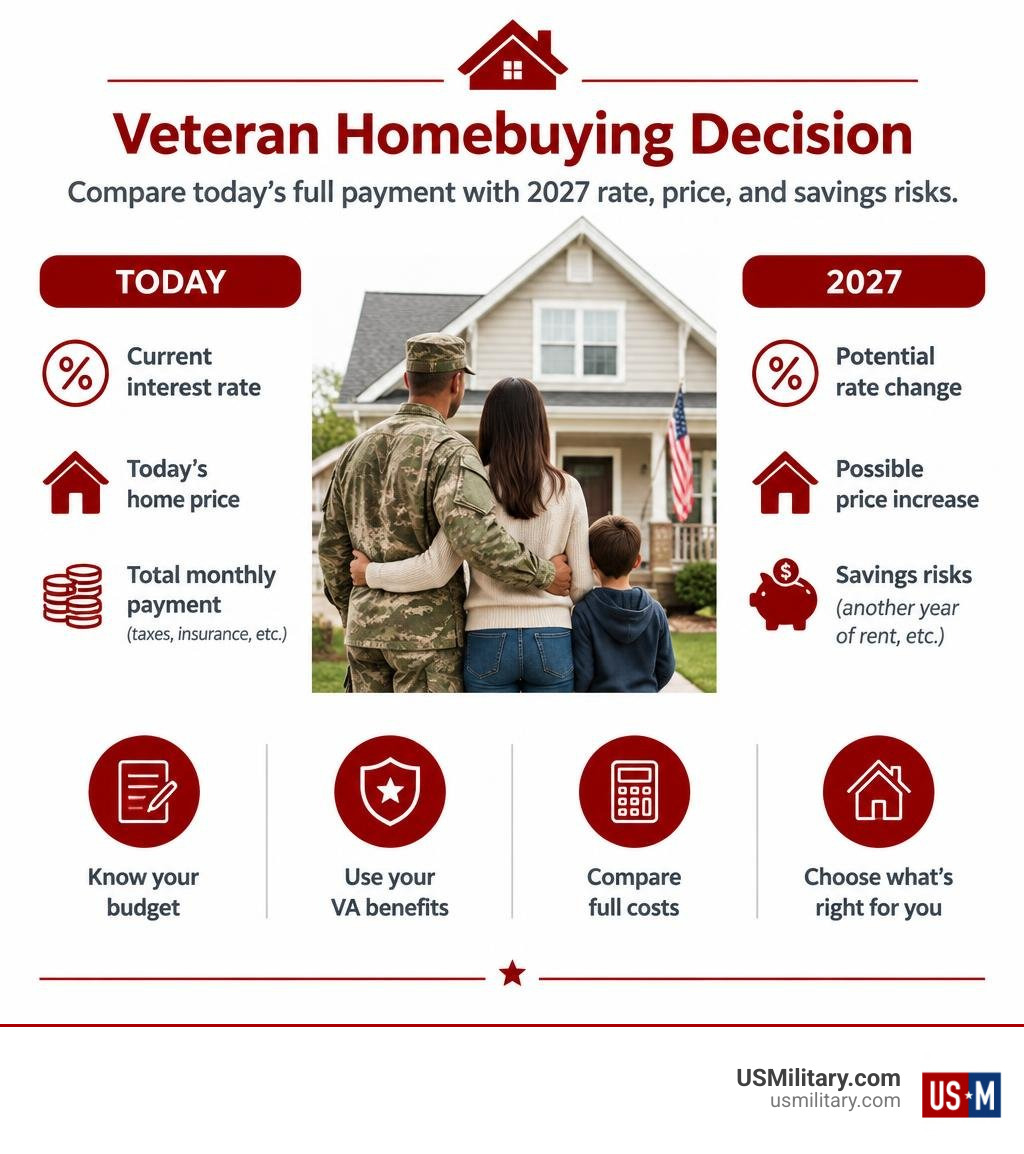
The Pros & Cons For Veterans Waiting To Buy a Home in 2027 come down to what you can afford now and what might change. Waiting could give you time to improve your credit, build savings, or find a lower rate. But rates could stay high, home prices could rise, and another year of rent could eat into your savings. If a home fits your budget today, don’t wait solely for a predicted rate cut. If the payment would stretch you thin, waiting may be the safer choice.
VA loans can offer no down payment and no private mortgage insurance, but those benefits do not make every monthly payment affordable. Compare the full cost of buying now with renting while you prepare for 2027, including taxes, insurance, and cash left for emergencies.
I’m Larry Fowler, a Navy veteran, BUD/S Class 89 graduate, and publisher of USMilitary.com. My years covering military benefits inform this guide to Pros & Cons For Veterans Waiting To Buy a Home in 2027.
The Current Housing Landscape: Interest Rates, Budget Impact, and Affordability
As of October 2026, navigating real estate feels like charting unfamiliar waters. Over recent years, borrowing costs spiked, with rates surpassing 8% at their peak before settling into the mid-6% range. This surge caused serious affordability strain for military buyers. The median household income for veterans climbed to approximately $85,955, but home sale prices over the past decade grew twice as fast as military wages. Consequently, only about 21.8% of active national listings are affordable for buyers using their zero-down benefit today, compared to 53% back in 2015.
Understanding these economic shifts requires tracking VA loan interest trends alongside broader market conditions. Even though rates moderated from record highs, buyers face stubborn list prices and tight inventory. In high-cost regions, less than 2% of homes match median veteran purchasing power, while metros like Detroit and San Antonio offer affordability rates above 50%.
Despite market pressures, the program remains a vital lifeline for military families. Guaranteed by the government, the VA home loan program overview demonstrates that qualified service members can bypass private mortgage insurance (PMI) and down payments. However, higher purchase prices mean larger loan balances, which translate directly into elevated monthly mortgage obligations.
Pros & Cons For Veterans Waiting to Buy a Home in 2027
Deciding whether to enter the housing market today or hold out for 2027 involves weighing personal readiness against broader financial cycles.
Financial and Market Pros for Veterans Waiting to Buy a Home in 2027
Waiting until 2027 offers several distinct financial advantages:
- Anticipated Rate Relief and Price Corrections: As inflation cools, mortgage rates are projected to stabilize. Sellers have started adjusting expectations, with roughly 15.5% of active listings seeing price reductions.
- Time to Strengthen Credit Scores: While the Department of Veterans Affairs sets no official minimum credit threshold, most lenders look for a 620 score. Spending the next year boosting your credit above 640 can secure significantly lower borrowing terms.
- Building Emergency Cash Reserves: Entering homeownership with two to three months of cash reserves prevents financial shock when unexpected repairs arise. You can run different scenarios by estimating monthly payments with VA loan calculators to see how extra savings reduce long-term interest.
- Negotiating Power: An expanding inventory gives buyers room to negotiate seller buydowns and closing concessions, which can reach up to 4% under program guidelines.
Key Risks and Cons for Veterans Waiting to Buy a Home in 2027
Delaying your purchase also carries notable financial risks:
| Decision Factor | Buying in Late 2026 | Waiting Until 2027 |
|---|---|---|
| Home Prices | Locks in current asset values before potential appreciation | Risk of higher purchase prices erasing rate drop savings |
| Competition | Moderated buyer demand; sellers open to concessions | Potential surge of competing buyers if interest rates fall |
| Equity Building | Immediate principal paydown and equity accumulation | Rent payments yield zero return on investment |
| Downscaling Risk | Secures a property based on present qualifications | Extended inflation may reduce real purchasing power |
Veterans like Army veteran Taylor Davis discovered that waiting can backfire. Despite securing a higher civilian salary, rising home prices in target markets forced Davis to look at smaller properties than originally planned. Furthermore, navigating VA loan eligibility rules and managing subsequent-use funding fees requires forward planning so your hard-earned benefits match your long-term wealth goals.
How Legislative Updates and the FY 2027 VA Budget Shift Buying Power
The proposed FY 2027 federal budget requests $488.2 billion for the Department of Veterans Affairs—a $34.9 billion (7.7%) increase over 2026. This funding expansion strengthens critical infrastructure, including $5.4 billion for medical facility construction and $3.8 billion dedicated to ending veteran homelessness.
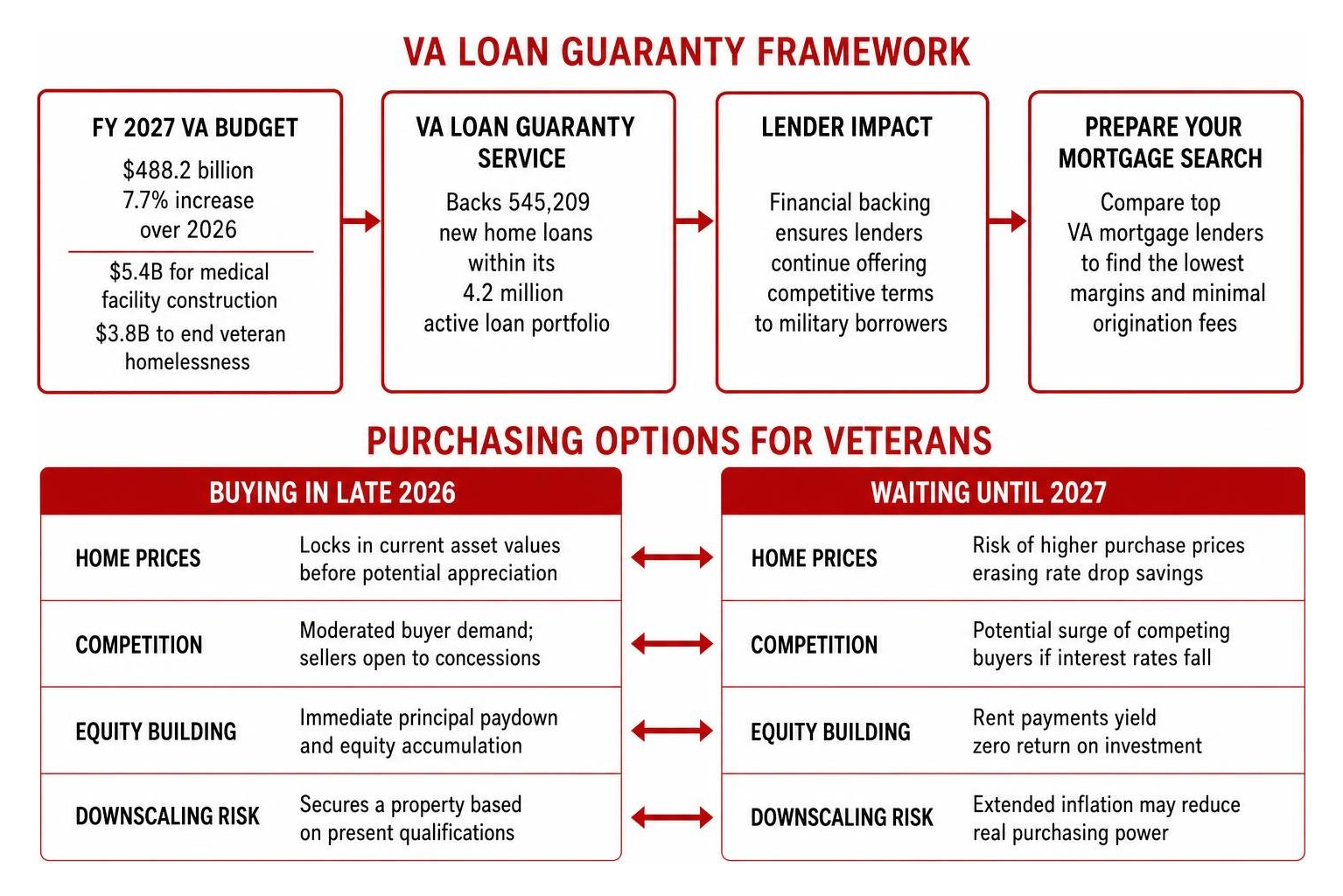
Within this budget, the VA Loan Guaranty Service is positioned to back 545,209 new home loans within its massive 4.2 million active loan portfolio. This financial backing ensures lenders continue offering competitive terms to military borrowers. When preparing your mortgage search, comparing top VA mortgage lenders helps you identify institutions offering the lowest margins and minimal origination fees.
Expanded Entitlements and Form Simplification
Significant administrative and legislative updates will take effect heading into 2027:
- Application Streamlining: The VA is transitioning Form 21-526EZ from a 15-page document into a streamlined 5-page application, cutting completion time from 25 minutes down to 15. However, service members should not delay filing disability claims just to wait for the shorter form, as doing so can surrender months of retroactive back pay.
- Expanded Eligibility: Recent legislation extends home loan access to thousands of National Guard and Reserve personnel who previously did not meet active-duty service thresholds.
- Entitlement Maximization: Understanding your benefits allows you to purchase higher-value homes without standard county loan limits, provided you have understanding full and bonus entitlement.
Strategic Alternatives: Renting, House Hacking, and Entitlement Preservation
If purchasing a single-family residence is out of reach right now, consider these strategic housing alternatives:
- House Hacking Multi-Unit Properties: You can use your zero-down benefit to purchase a multi-unit property (up to four units), live in one unit, and rent out the others. The projected rental income helps offset your mortgage obligations.
- Renting During Short PCS Tours: If your military orders station you in an area for fewer than three years, renting off-base often makes more sense than paying 2% to 5% in closing fees twice in a short span.
- Entitlement Preservation: Using conventional financing for short-term starter homes lets you preserve your primary guaranty for a higher-priced forever home later.
- Refinancing Down the Road: If you buy today at a higher rate, explore VA loan refinancing options to lower your payments via an Interest Rate Reduction Refinance Loan (IRRRL) once rates decline.
When you are financially ready, applying for a VA home loan is a direct, step-by-step process.
Frequently Asked Questions About Buying a Home as a Veteran
What credit score is needed to secure competitive VA rates for 2027?
The Department of Veterans Affairs does not mandate a minimum credit score, but private lenders set their own standards. Most lenders require a minimum FICO score of 620 to qualify for zero-down options, though scores of 640 or higher unlock the best pricing tiers. It pays to shop around with finding the best lenders for VA home loans to discover institutions offering flexible debt-to-income benchmarks.
How does the 2027 federal budget affect the VA loan guaranty?
The FY 2027 budget request ensures complete liquidity for the Loan Guaranty Service, supporting more than 545,000 new guaranteed mortgages. This federal backing eliminates the need for borrower-paid monthly private mortgage insurance (PMI). Additionally, veterans receiving service-connected disability compensation remain completely exempt from the standard funding fee.
Should active-duty service members rent or buy during a PCS move?
Active-duty families must evaluate their Permanent Change of Station (PCS) timeline. If you expect to stay at your duty station for at least three to four years, buying allows you to build equity and utilize your Basic Allowance for Housing (BAH) to pay down an asset. For tours under 36 months, renting protects you from sudden local market drops and short-turnaround selling costs.
Conclusion
Making the right homebuying choice in late 2026 or 2027 requires aligning your personal balance sheet with realistic housing costs. Do not gamble on predicted interest rate reductions if a property does not comfortably fit your monthly income right now. However, if your debt-to-income ratio is healthy, your credit score is solid, and you plan to stay in the home for several years, buying allows you to build wealth immediately while keeping future refinance options open.
Take charge of your financial future by exploring our comprehensive veteran homeownership resources and military branch guides at USMilitary.com today.
Free for Service Members & Veterans
Get the military benefits intel no one tells you about.
Weekly updates on VA benefits, pay changes, and money tips — free for service members and veterans.
No spam. Unsubscribe anytime. Your info is never shared.



Leave a Reply