US Military Home Buying Benefits at a Glance

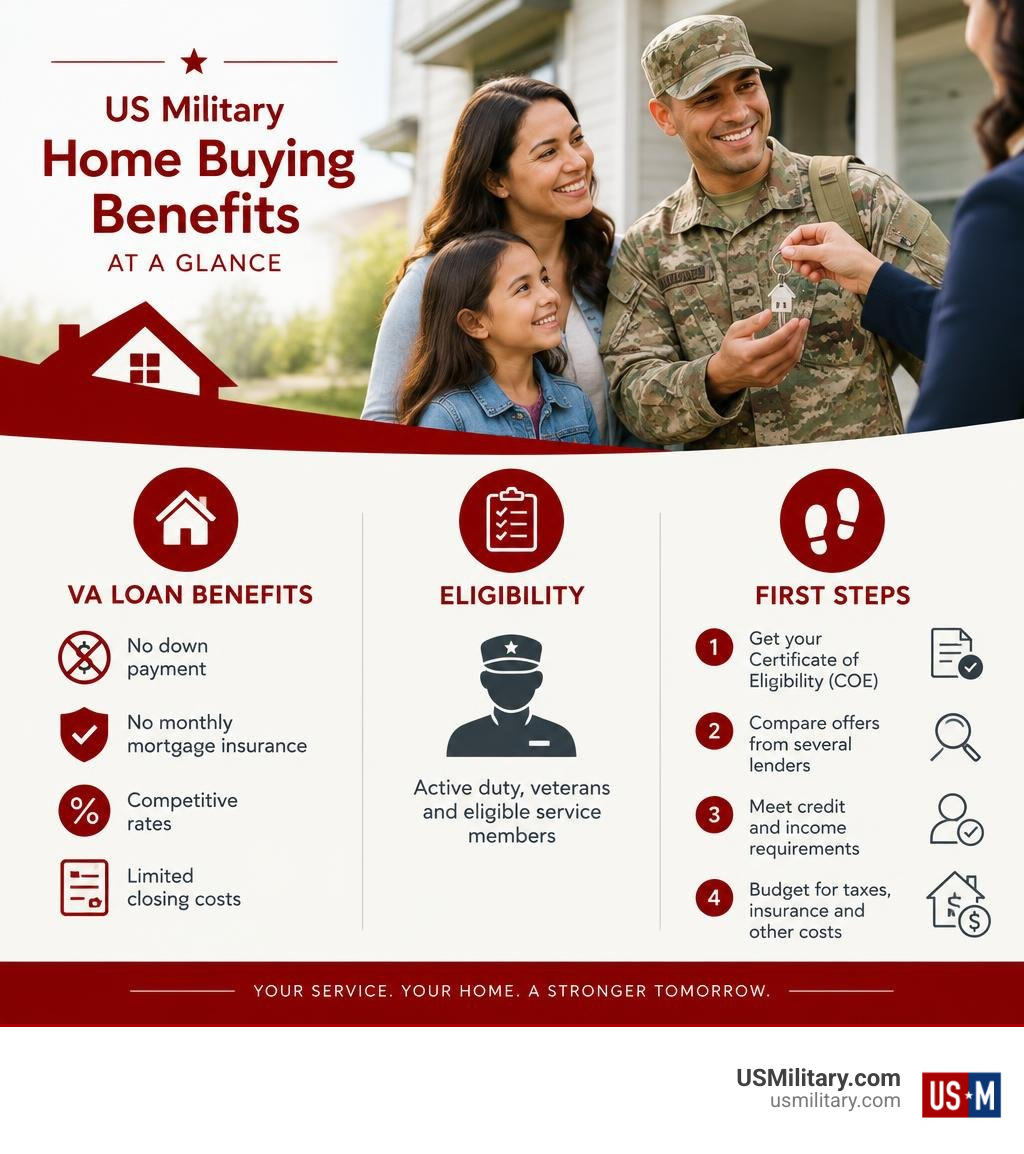
The biggest home-buying benefit for eligible service members and veterans is the VA loan: You may be able to buy a primary home with no down payment and no monthly mortgage insurance. VA loans can also offer competitive rates and limited closing costs. Start by getting a Certificate of Eligibility (COE), then compare offers from several lenders. You will still need to meet a lender’s credit and income requirements and budget for taxes, insurance, and other ownership costs.
A PCS move can change the math. Before buying, weigh your likely time at the duty station against the costs of selling or keeping the home later.
I’m L.C. Fowler, a Navy veteran and publisher of USMilitary.com, where I help military families make sense of service-related decisions. In this guide, I’ll break down US Military Home Buying Benefits so you can choose a path that fits your plans.
Handy US Military Home Buying Benefits terms:
Core US Military Home Buying Benefits and Loan Programs

The Department of Veterans Affairs has backed over 28.5 million mortgages since 1944. These loans remain the bedrock of military homeownership benefits because they eliminate standard commercial lending barriers.
The core pillars include:
- 0% Down Payment: Purchase without saving tens of thousands in cash upfront.
- No Private Mortgage Insurance (PMI): Unlike conventional loans with less than 20% down, VA loans carry zero monthly mortgage insurance premiums, saving borrowers $1,000 to $2,000 annually.
- Capped Closing Costs: The VA restricts the fees lenders can charge military borrowers.
To fund this program, the government charges a one-time VA funding fee, which ranges between 1.4% and 3.3% depending on your down payment and prior loan usage (or 0.5% for streamline refinances). Crucially, veterans receiving VA disability compensation for service-connected disabilities are completely exempt from paying this fee. Review the official guidelines on VA Home Loans – Veterans Benefits Administration to verify your fee status.
Maximizing US Military Home Buying Benefits with VA Loans
When you use a VA purchase loan, the federal government guarantees up to 25% of the mortgage balance to your private lender. This backstop allows lenders to offer lower rates and flexible underwriting. You can read your guide to VA home loans for an end-to-end breakdown of purchase structures.
Unlike conventional underwriting that leans solely on debt-to-income (DTI) caps, the VA requires lenders to evaluate residual income—the actual cash left over each month after paying all debt and living expenses. This safety buffer protects military families from overextending themselves financially. To evaluate current borrowing benchmarks, explore rate considerations and interest structures.
Expanding US Military Home Buying Benefits: Grants and Refinance Options
Beyond purchasing a primary residence, military benefits extend to equity management and specialized grants:
- Interest Rate Reduction Refinance Loan (IRRRL): Also known as a VA Streamline Refinance, this program lets you lower your interest rate with minimal paperwork, no appraisal, and no income verification. In fiscal year 2025, IRRRL volume surged by 135% to 119,459 loans as rates adjusted.
- Cash-Out Refinance: Access equity up to 100% of your home’s appraised value to consolidate high-interest debt or fund home improvements. Study proven refinance strategies for homeowners before extracting equity.
- Native American Direct Loan (NADL): Enables eligible Native American veterans to purchase, construct, or renovate homes on Federal Trust Land.
- Specially Adapted Housing (SAH) Grants: Provides direct federal grants to veterans with qualifying service-connected disabilities to construct or modify barrier-free homes.
- Soldier Next Door Program: Offers military buyers down payment assistance up to $24,000, direct housing grants up to $9,000, and closing fee discounts.
VA Loans vs. Conventional and FHA Financing
Mortgage programs differ significantly in down payment requirements, default insurance, and upfront fees.
| Loan Feature | VA Loan | FHA Loan | Conventional Loan |
|---|---|---|---|
| Minimum Down Payment | 0% | 3.5% | 3% – 5% |
| Monthly Mortgage Insurance | None | Mandatory (MIP for loan life) | Required if down payment < 20% (PMI) |
| Upfront Government Fee | 1.4% – 3.3% (Waived for disabled) | 1.75% Upfront MIP | None |
| Median Origination Fees | Lowest baseline | +202.94% higher ($2,070 difference) | +90.69% higher |
| 18-Year Safety Record | Lowest foreclosure rate | Higher default rate | Moderate default rate |
Home Mortgage Disclosure Act (HMDA) data shows that median FHA origination charges were 202.94% higher than VA charges in 2025—an immediate $2,070 disadvantage for FHA borrowers. Conventional loan charges were 90.69% higher. To run side-by-side estimates for your household budget, use these trusted loan calculators.
Navigating the Home Purchase Process: PCS, Budgeting, and Strategy

Permanent Change of Station (PCS) orders introduce unique real estate dynamics. Reassignment timelines usually range between two to four years, making transaction efficiency vital. Review these VA loan tips for serving military PCS families when coordinating your relocation window.
Target properties in military-friendly communities near installations to ensure strong resale liquidity or rental demand when your next orders drop. Furthermore, research your state’s tax laws; many states offer partial or complete property tax exemptions for disabled veterans and active-duty personnel.
Eligibility, Certificate of Eligibility (COE), and Entitlement Restoration
To qualify for VA home financing, you must satisfy minimum service thresholds:
- Active Duty: 90 consecutive days during wartime or 181 continuous days during peacetime.
- National Guard & Reserve: 6 creditable years of service, or 90 days of active-duty orders (including at least 30 consecutive days under Title 32 sections 316, 502, 503, 504, or 505).
- Surviving Spouses: Unremarried spouses of service members who died on active duty or from service-connected disabilities, as well as spouses receiving Dependency and Indemnity Compensation (DIC).
Review our guide to understanding VA home loan eligibility for wartime service date ranges.
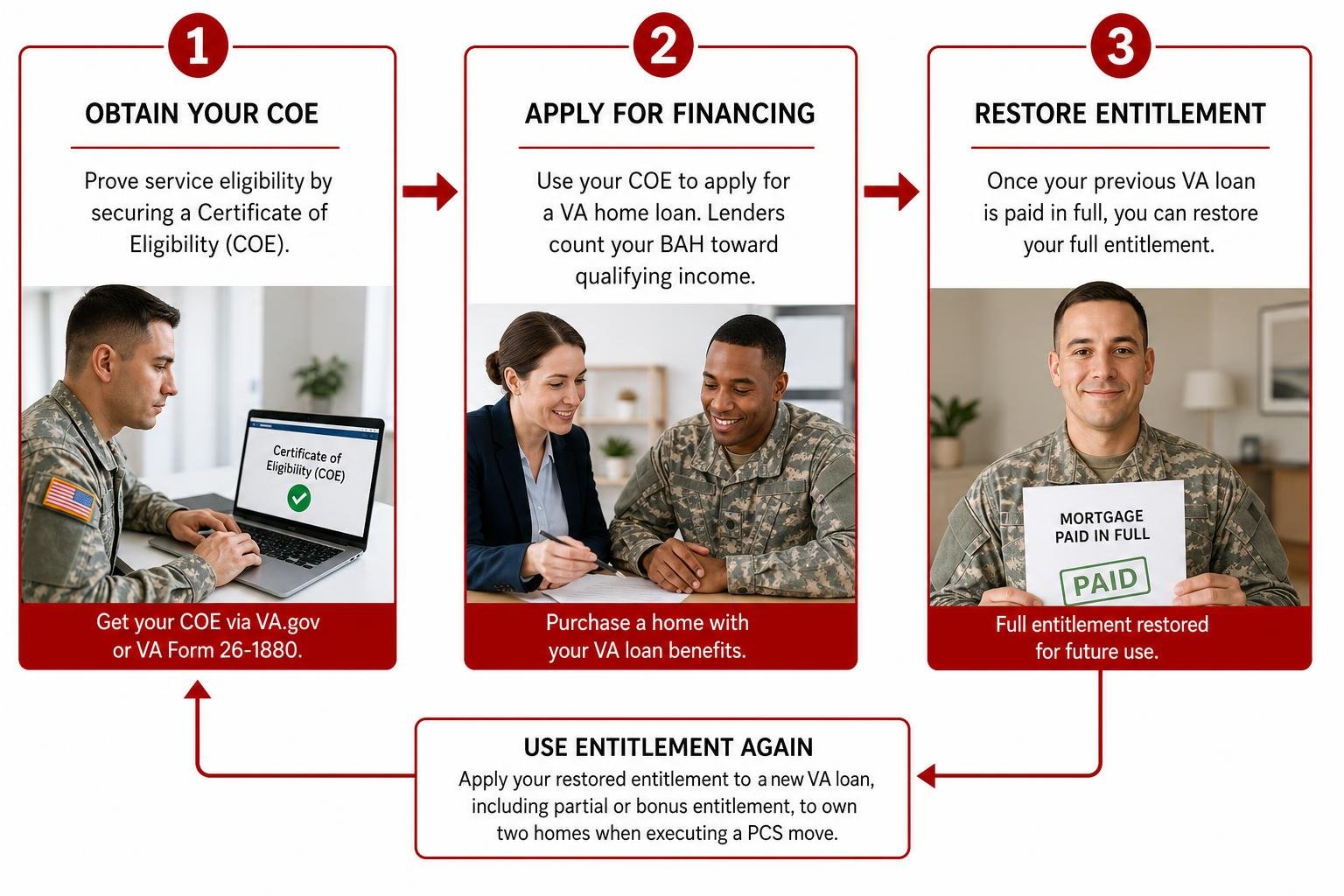
You prove service eligibility by securing a Certificate of Eligibility (COE) via VA.gov or VA Form 26-1880. If you have used your VA loan before, you can restore your full entitlement once the previous mortgage is paid in full. You can also utilize partial or bonus entitlement to own two homes simultaneously when executing a PCS move. Read our guide to entitlement restoration and bonus calculations to calculate your remaining balance.
Relocation Strategy: BAH Budgeting and PCS Move Planning
Your Basic Allowance for Housing (BAH) provides stable, tax-free income that lenders count directly toward your gross qualifying earnings. When calculating your housing budget, compare your local BAH rate against area rental rates and mortgage payments. The comprehensive Military Homebuyer Guide highlights how service members use BAH to build long-term real estate equity.
Two essential contractual safeguards protect you during purchase:
- The VA Escape Clause: Mandates that you receive a full refund of your earnest money deposit without penalty if the property fails to appraise for the agreed sales price.
- Reconsideration of Value (ROV): Allows your lender to challenge low appraisals using recent comparable sales.
Step-by-Step Purchase Roadmap and Conclusion
Executing a smooth home purchase requires a disciplined mission plan:
- Obtain Your COE: Pull your certificate online or have your lender generate it through the VA portal.
- Secure Pre-Approval: Determine your realistic budget using your base pay and BAH allowance. Follow our guide on applying for a home loan in five steps to prepare your financial records.
- Hire Military-Specialized Agents: Partner with real estate professionals experienced in VA loan contingencies, PCS schedules, and VA minimum property requirements.
- House Hunt and Negotiate: Ensure your purchase contract includes the mandatory VA Escape Clause.
- Appraisal and Underwriting: Clear conditions, finalize title commitments, and confirm closing disclosures.
- Close and Move In: Complete closing documents and transition into your new primary residence.
At USMilitary.com, we are committed to helping you make informed decisions across every stage of service. Explore our central resource on comprehensive military benefits for in-depth guidance on pay tables, education benefits, retirement planning, and disability compensation.
— L.C. Fowler
Free for Service Members & Veterans
Get the military benefits intel no one tells you about.
Weekly updates on VA benefits, pay changes, and money tips — free for service members and veterans.
No spam. Unsubscribe anytime. Your info is never shared.



Leave a Reply