Understanding Your Path to VA Aid and Attendance Benefits
VA Aid and Attendance is a tax-free monthly benefit that helps wartime veterans and surviving spouses pay for long-term care when they need help with daily activities like bathing, dressing, or eating. This benefit supplements the basic VA pension and can be used for assisted living, home care, or nursing home expenses.
Quick Answer: Do You Qualify for VA Aid and Attendance?
You may qualify if you meet ALL three requirements:
- Military Service – You served at least 90 days of active duty with at least one day during a wartime period
- Financial Need – Your net worth is below $163,699 (2025 limit) and income is below the Maximum Annual Pension Rate
- Medical Need – You need help with daily activities, are bedridden, live in a nursing home, or have severe vision impairment
Current Monthly Payment Rates (Dec 2025 – Nov 2026):
- Single Veteran: $2,424/month
- Veteran with Spouse: $2,873/month
- Surviving Spouse: $1,558/month
Many veterans have earned this benefit but don’t know it exists or feel overwhelmed by the complex application. Understanding the three core pillars makes the process much clearer.
I’m Larry Fowler, publisher of the USMilitary.com Network. Since 2007, I’ve helped over 500,000 veterans and families steer VA benefits like Aid and Attendance. My mission is to simplify complex VA processes, helping veterans access the care they’ve earned.
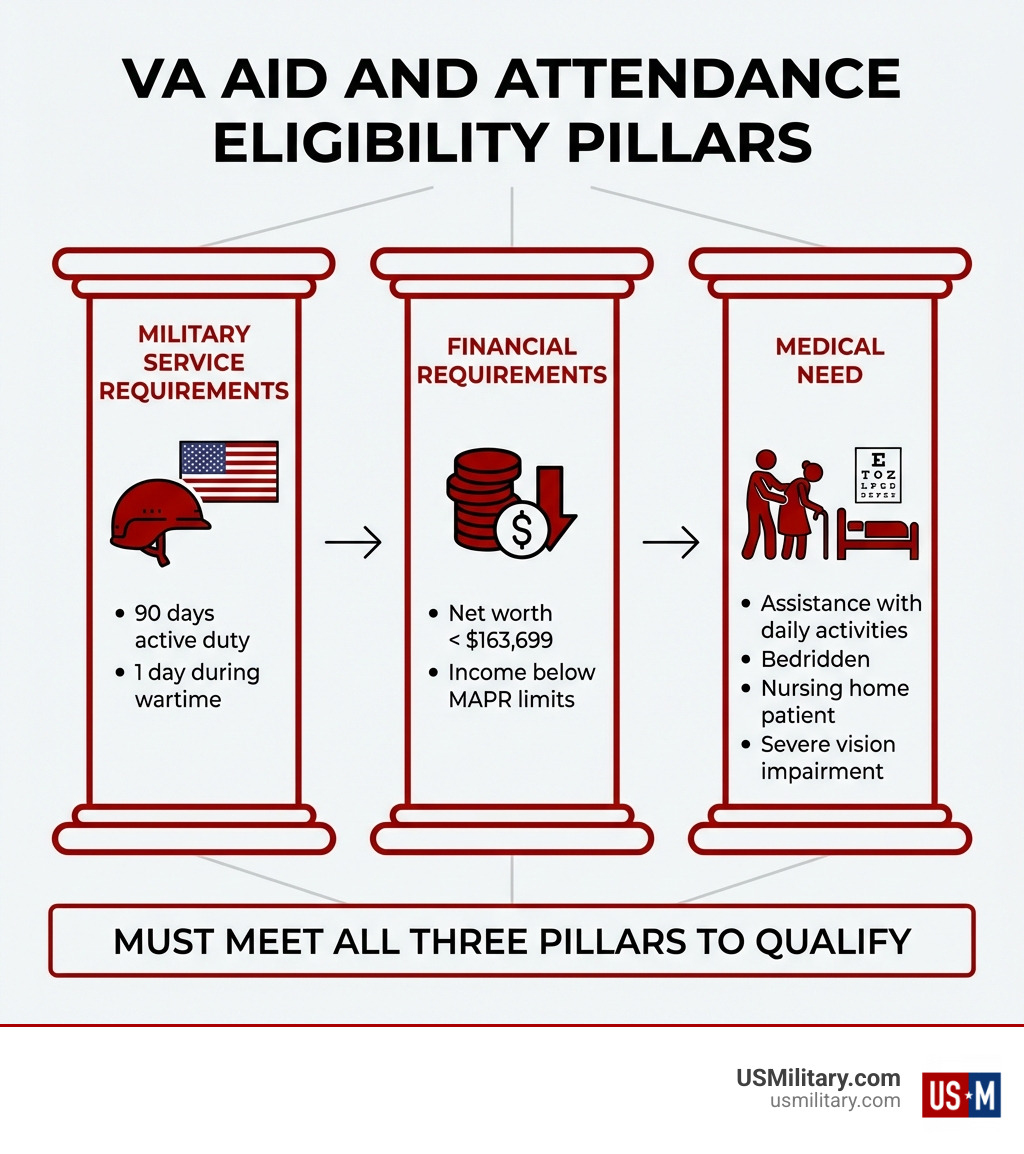
The Three Pillars of VA Pension Eligibility
Before diving into VA Aid and Attendance and Housebound benefits, it’s crucial to know they are improved benefits added to the basic VA pension. This means you must first qualify for the basic Veterans Pension. The basic pension relies on three main pillars of eligibility: military service, financial need, and an age or disability requirement.
Military Service Requirements
To qualify for a VA pension, you must meet specific military service criteria. A veteran generally needs at least 90 days of active duty, with at least one day during a wartime period. If you entered active duty after September 7, 1980, you must have served at least 24 months or the full period for which you were called to active duty (with at least one day during wartime). Exceptions exist, such as an early discharge for a service-connected disability.
Your discharge must also be under conditions other than dishonorable. A common misconception is that you had to serve in a combat zone. In reality, serving on active duty during these VA-defined wartime periods, even stateside, can qualify you.
Here are the wartime periods as defined by the VA for pension eligibility:
- World War II: December 7, 1941, through December 31, 1946
- Korean Conflict: June 27, 1950, through January 31, 1955
- Vietnam Era: August 5, 1964, through May 7, 1975. For those who served in the Republic of Vietnam, the period starts earlier: November 1, 1955, through August 4, 1964.
- Persian Gulf War: August 2, 1990, through a future date to be set by law or Presidential Proclamation. This means many veterans from recent conflicts may qualify.
For more detailed information on these periods, you can always refer to the official Wartime periods defined by the VA.
Financial Requirements for VA Aid and Attendance
The second pillar is your financial situation. The VA has specific limits on your net worth and annual income to ensure the benefit goes to those who need it.
The VA’s net worth limit for December 1, 2025, to November 30, 2026, is $163,699. This includes your assets and annual income. Your primary residence and personal vehicle are generally not counted toward this limit.
The VA looks at your “countable income,” which includes most income sources. However, you can deduct Unreimbursed Medical Expenses (UMEs)—out-of-pocket medical costs not covered by insurance. If your UMEs exceed 5% of your Maximum Annual Pension Rate (MAPR), the excess can be deducted, which can help you meet the income threshold.
The Maximum Annual Pension Rate (MAPR) is the maximum pension you can receive. Your payment is calculated by subtracting your countable family income from the applicable MAPR. If your income is below the MAPR, the VA pays the difference.
Be aware of the VA’s 3-year look-back period for asset transfers. If you transferred assets (e.g., gifted them to family) to reduce your net worth within three years of applying, it could result in a period of ineligibility.
Understanding these financial rules can be complex, so we recommend reviewing the official VA income and net worth limits or seeking professional advice.
Age and Disability Requirements
The third pillar for basic pension eligibility is your age or a significant disability. This ensures the benefit supports those who are no longer able to work or are facing substantial health challenges.
You must meet at least one of the following criteria:
- Age 65 or Older: If you are 65 years of age or older, you meet this requirement.
- Total and Permanent Disability: If you are permanently and totally disabled, regardless of your age, you may qualify. This disability does not have to be service-connected.
- Receiving SSDI or SSI: If you are receiving Social Security Disability Insurance (SSDI) or Supplemental Security Income (SSI), this generally indicates you meet the disability criteria for VA pension purposes.
- Patient in a Nursing Home: If you are a patient in a nursing home for long-term care, you also meet this requirement.
Once this foundation is in place, we can explore the improved benefits of VA Aid and Attendance and Housebound allowances.
Understanding VA Aid and Attendance and Housebound Benefits
Once you qualify for the basic pension, you can apply for two improved benefits for long-term care: VA Aid and Attendance and Housebound allowance. These are monthly payments added to your pension for a higher level of need. You cannot receive both benefits at the same time; the VA will grant the one that best fits your situation.

To help clarify the differences, let’s look at a quick comparison:
| Criteria | VA Aid and Attendance | Housebound Benefits |
|---|---|---|
| Mobility | Significantly impaired, may be bedridden, requires assistance | Confined to immediate premises |
| Level of Care | Requires assistance with Activities of Daily Living (ADLs) | Requires care, but generally more independent with ADLs |
| Qualifying Med. Cond. | Needs help with bathing, dressing, feeding; bedridden; nursing home patient; severe vision impairment | Single permanent 100% disability + confined to home; OR 100% disability + another 60%+ disability |
| Purpose | Helps pay for a caregiver, assisted living, nursing home care | Provides additional income for those largely confined to home |
| Exclusivity | Cannot be received with Housebound benefits | Cannot be received with VA Aid and Attendance benefits |
What are Aid and Attendance Benefits?
The VA Aid and Attendance benefit is for veterans and surviving spouses who need regular help from another person for daily activities. It helps cover long-term care costs in your home, an assisted living facility, or a nursing home.
Eligibility centers on your need for help with “Activities of Daily Living” (ADLs). If you need assistance with two or more of these basic self-care tasks, you may qualify:
- Bathing: Needing assistance to get in and out of the shower or tub, or to wash yourself.
- Dressing: Requiring help to put on or take off clothes.
- Feeding: Needing assistance to eat, such as cutting food or being fed.
- Attending to the wants of nature (personal hygiene): Requiring help with using the restroom or managing incontinence.
- Adjusting prosthetic devices: Needing help to put on or take off artificial limbs or other medical devices.
- Protecting oneself from daily hazards: Requiring supervision or assistance to ensure personal safety due to cognitive impairment or physical frailty.
What are Housebound Benefits?
Housebound benefits are for veterans and spouses who are substantially confined to their homes due to a permanent disability. The criteria focus on physical confinement rather than the need for hands-on daily assistance.
The purpose is to help with the increased costs and challenges of being unable to leave home due to a permanent disability.
To qualify for Housebound benefits, you must meet one of these conditions:
- You have a single permanent disability evaluated as 100% disabling, AND due to this disability, you are permanently and substantially confined to your immediate premises.
- You have a single permanent disability evaluated as 100% disabling, AND you have another disability or disabilities evaluated as 60% or more disabling.
The key is the permanent nature of the disability and the resulting confinement to your home.
✉ Get updates like this in your inbox
Weekly VA benefit changes, pay updates, and money tips for service members, veterans, and military families. Free, no spam.
Medical and Physical Conditions That Qualify
Both VA Aid and Attendance and Housebound benefits rely on medical evidence to show your need for care or confinement. A comprehensive doctor’s report, or functional assessment, is crucial. It should detail your medical conditions, how they impair your abilities, and how they affect your daily tasks or confinement status. The more detailed the report, the clearer the picture for the VA.
Specific Medical Criteria for VA Aid and Attendance
For VA Aid and Attendance, the medical criteria are specific, focusing on the level of care you need. You must meet at least one of the following conditions:
- You need another person to help you with daily activities: This includes tasks like bathing, dressing, feeding, using the restroom, or needing supervision to stay safe. This is the most common qualifying condition.
- You have to stay in bed (or spend a large portion of the day there) due to illness: Being largely bedridden due to a medical condition can qualify you.
- You are a patient in a nursing home: If you reside in a nursing home due to the loss of mental or physical abilities, you meet this criterion.
- Your eyesight is severely limited: Your corrected visual acuity must be 5/200 or less in both eyes, or your concentric contraction of the visual field must be 5 degrees or less.
Specific Conditions for Housebound Benefits
For Housebound benefits, the medical criteria revolve around permanent disability and confinement. The VA looks for evidence that your medical condition prevents you from leaving your home regularly.
To qualify for Housebound benefits, you must have:
- A single permanent disability evaluated as 100% disabling: This means the VA has rated one specific condition as completely incapacitating.
- AND, due to that disability, you are permanently and substantially confined to your immediate premises: This is the “housebound” part. Your medical condition makes it extremely difficult or unsafe for you to leave your home.
- OR, you have a single permanent disability evaluated as 100% disabling, AND another disability or disabilities evaluated as 60% or more disabling: In this case, the combination of serious disabilities contributes to your inability to leave your home.
Your medical documentation must clearly show the permanence of your disability and how it leads to your confinement.
How to Apply: A Step-by-Step Guide
Applying for VA Aid and Attendance or Housebound benefits can seem daunting, but with organization and the right help, you can steer the process successfully.

Gathering Your Documents and Forms
Preparation is the first step. Gathering all required forms and documents before applying can significantly speed up the process.
Here are the essential forms and documents you’ll need:
- VA Form 21-2680, “Examination for Housebound Status or Permanent Need for Regular Aid and Attendance”: This is the cornerstone of your medical evidence. Your physician must complete this form, detailing your medical conditions and how they affect your daily activities. It is crucial for your doctor to be thorough and descriptive on this form. You can download it here: VA Form 21-2680.
- VA Form 21-0779, “Request for Nursing Home Information in Connection with Claim for Aid and Attendance”: If you are in a nursing home, you will need this additional form.
- Military discharge papers (DD214 or equivalent): This proves your military service and character of discharge.
- Proof of income and assets: Documentation of all income sources and assets for yourself and your spouse.
- Proof of unreimbursed medical expenses (UMEs): Keep detailed records and receipts for all out-of-pocket medical costs.
- Marriage certificate (if applicable).
- Death certificate of the veteran (for surviving spouses).
Missing information or vague medical details can cause significant delays.
Submitting Your Application
Once your documents are gathered, you can submit your application using one of several options:
- Apply online: You can start the application process through VA.gov.
- Mail your application: Mail completed forms to the Pension Management Center (PMC): Department of Veteran Affairs Claims Intake Center, PO Box 4444, Janesville, WI 53547-4444.
- Work with an accredited representative or agent: This is an excellent option if the process feels overwhelming. Accredited representatives (like Veterans Service Officers) or agents are trained professionals who can help you prepare and submit your claim. They understand the nuances of the process and work directly with the VA. You can find more information here: Work with an accredited representative.
- In person at a VA medical center or clinic: You can visit your nearest VA facility for assistance.
- Visit a VA regional office: Your local office has an Outreach Coordinator who can help. Find your local office using the VA Facility Locator.
We highly recommend using an accredited representative, as their expertise can be invaluable.
Benefit Payment Rates and How They Work
Understanding the maximum monthly payments for VA Aid and Attendance and Housebound benefits helps you plan for long-term care costs. They are paid in addition to your basic VA pension, increasing your total monthly VA income.
These improved benefits differ from the basic pension. They are designed to offset the higher costs of daily care or home confinement, representing a higher level of financial support for a greater need.
The VA calculates your pension payment by taking the Maximum Annual Pension Rate (MAPR) for your category and subtracting your countable family income. If your countable income is less than the MAPR, you receive the difference, paid in 12 monthly installments.
Maximum Annual Pension Rates (MAPR)
The MAPR are set by Congress and typically adjusted annually. The rates for VA Aid and Attendance and Housebound benefits are higher than the basic pension rates.
Here are the Maximum Annual Pension Rates (MAPR) for December 1, 2025, through November 30, 2026. These figures represent the maximum you could receive before your countable income is factored in.
VA Aid and Attendance Pension (Dec. 1, 2025 – Nov. 30, 2026):
- Single Veteran: $29,091 per year ($2,424 per month)
- Veteran with a Spouse or Dependent Child: $34,486 per year ($2,873 per month)
- Surviving Spouse (no child): $18,696 per year ($1,558 per month)
Housebound Pension (Dec. 1, 2025 – Nov. 30, 2026):
- Single Veteran: $21,312 per year ($1,776 per month)
- Veteran with a Spouse or Dependent Child: $26,709 per year ($2,225 per month)
- Surviving Spouse (no child): $14,296 per year ($1,191 per month)
These rates show the significant support available. For example, a single veteran qualifying for Aid and Attendance could receive up to $2,424 monthly for care costs. These are maximums; your actual payment depends on your income and medical expenses.
Frequently Asked Questions about A&A
The world of VA benefits can be intricate. Here are answers to some common questions we hear about VA Aid and Attendance.
How long does it take for the VA to make a decision?
The time it takes the VA to decide on a claim can vary significantly. Claims are generally processed in the order they are received, but some may get priority due to extreme financial hardship or terminal illness. Processing times can range from a few months to over a year, especially if the VA needs more information.
Submitting a complete and accurate application is the best way to minimize delays.
Can these benefits pay for a family member to be a caregiver?
Yes, these benefits can help pay for care from a family member. The VA Aid and Attendance benefit is designed to cover the cost of care. If a family member provides care you would otherwise have to pay for, and they are not legally obligated to provide it, the cost can be counted as an unreimbursed medical expense (UME).
These UMEs are factored into your countable income calculation, which can increase your pension payment. The benefit is paid directly to you, and you use the funds to pay for your care. The benefit offers flexibility, allowing you to pay for assisted living, home care, or nursing home care.
What happens if my application is denied?
Receiving a denial can be disheartening, but it’s not the end of the road. If your VA Aid and Attendance application is denied, you have several options to appeal the decision.
You can typically pursue one of the following options:
- Supplemental Claim: If you have new and relevant evidence, you can file a supplemental claim for the VA to review.
- Higher-Level Review: You can request a review by a more experienced adjudicator, who will look for errors based on the evidence already on file.
- Board Appeal: You can appeal directly to the Board of Veterans’ Appeals, the highest level of administrative appeal within the VA.
The appeals process is complex, so we strongly recommend seeking help from an accredited representative or Veterans Service Officer (VSO). They can help you understand the denial and guide your appeal strategy. Your earned benefits are worth fighting for!
Explore Your Earned Military Benefits
Navigating VA Aid and Attendance and Housebound benefits can feel complex, but we hope this guide has provided a clear map. These benefits offer significant financial relief for wartime veterans and surviving spouses facing long-term care costs.
To recap, eligibility hinges on three pillars: your military service during a wartime period, your financial need, and your medical need. These are improved benefits, so you must first qualify for the basic VA pension.
At USMilitary.com, we are dedicated to helping our military community access their earned benefits. We encourage you to follow the steps in this guide: gather your documents, consider working with an accredited representative, and apply. Your service has earned you these benefits, and we are here to help you claim them.
For more information on a wide array of military benefits, from healthcare and education to home loans and more, we invite you to explore our extensive resources: More info about military benefits.
Free for Service Members & Veterans
Get the military benefits intel no one tells you about.
Weekly updates on VA benefits, pay changes, and money tips — free for service members and veterans.
No spam. Unsubscribe anytime. Your info is never shared.


