Why the VA Aid and Attendance Form Matters for Veterans and Families
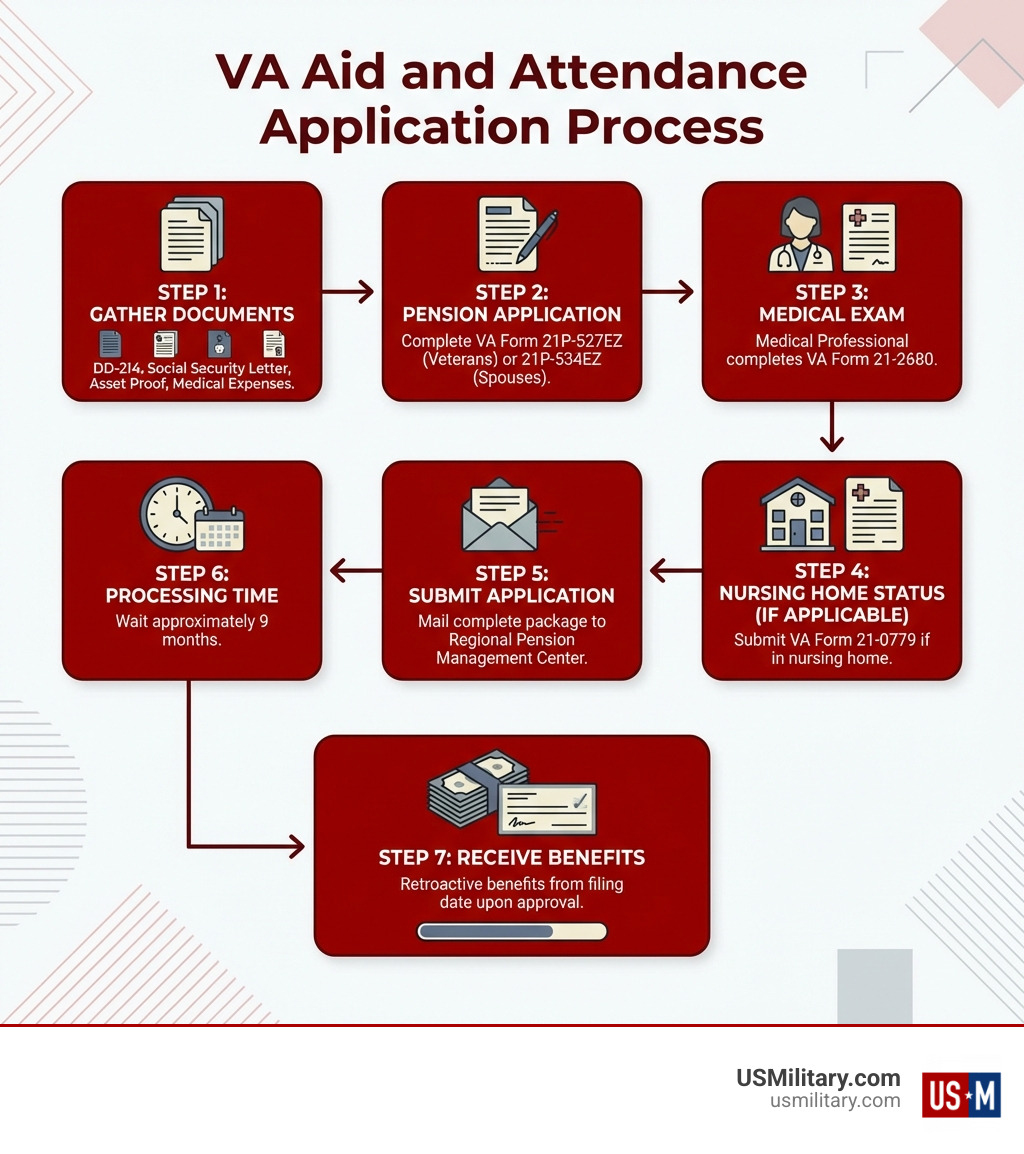
The VA Aid and Attendance Form (VA Form 21-2680) is the medical examination document required to apply for Aid and Attendance benefits—a tax-free monthly payment that can provide up to $2,795 to help cover home care, assisted living, or nursing home costs. This form must be completed by a qualified medical professional and submitted along with your pension application to verify that you or your loved one needs help with daily activities like bathing, dressing, eating, or moving around safely.
Quick Guide to the VA Aid and Attendance Form:
- Form Name: VA Form 21-2680 (Examination for Housebound Status or Permanent Need for Regular Aid and Attendance)
- Who Completes It: A Medical Doctor (MD), Doctor of Osteopathic Medicine (DO), physician assistant, or advanced practice registered nurse
- Purpose: Provides medical evidence that you need assistance with daily activities or are housebound
- Processing Time: Approximately 9 months from submission to approval
- Where to Submit: One of three regional VA Pension Management Centers based on your state of residence
- Key Related Forms: VA Form 21P-527EZ (veterans), VA Form 21P-534EZ (surviving spouses), VA Form 21-0779 (nursing home residents)
Understanding how to properly complete and submit VA Form 21-2680 can mean the difference between approval and denial of benefits that help families afford quality care. Many veterans and surviving spouses qualify for these benefits but struggle with the application process due to confusing instructions and strict documentation requirements.
I’m Larry Fowler, publisher of the USMilitary.com Network since 2007, where we’ve helped thousands of veterans and families steer the VA Aid and Attendance Form application process and secure the benefits they’ve earned. My team has provided resources and guidance on A&A benefits, helping families understand eligibility requirements and avoid common application mistakes.
VA Aid and Attendance Form terms simplified:
- Aid & Attendance
- How hard is it to get VA Aid and Attendance
- What is the income limit for VA Aid and Attendance
Understanding the VA Aid and Attendance Form 21-2680 and Eligibility
The primary purpose of VA Form 21-2680 is to gather official medical evidence. The VA uses this data to determine if a claimant meets the clinical criteria for either Special Monthly Compensation (SMC) or Special Monthly Pension (SMP). While the veteran or their family initiates the process, the “meat” of the form—the clinical assessment—must be handled by a medical professional.
At USMilitary.com, we often see families overwhelmed by the technical jargon. To put it simply: this form proves to the VA that you aren’t just “getting older,” but that you have specific functional limitations that require another person’s help. Whether you are looking for top-10-facts-about-veteran-aid-and-attendance or just trying to figure out the first step, it all starts with this medical examination.

VA Aid and Attendance vs. Housebound Benefits
One of the most common questions we receive is whether a veteran should apply for Aid and Attendance (A&A) or Housebound benefits. You cannot receive both at the same time, so it is vital to understand which one fits your situation better. Generally, A&A provides a higher monthly payment because it requires a higher level of care.
| Feature | Aid and Attendance (A&A) | Housebound Benefits |
|---|---|---|
| Primary Requirement | Needs help with Activities of Daily Living (ADLs) | Substantially confined to immediate premises |
| Disability Level | Permanent need for regular assistance | Permanent disability (100% rating or equivalent) |
| Living Situation | Home, assisted living, or nursing home | Usually confined to the home |
| Clinical Criteria | Bedridden, blind, or in a nursing home | Confinement is expected to be permanent |
For a deeper dive into these distinctions, check out our guide on va-aid-and-attendance.
Medical Conditions Qualifying for the VA Aid and Attendance Form
While the VA doesn’t have a “secret list” of approved diseases, certain conditions almost always necessitate the level of care that A&A covers. We frequently see approvals for:
- Dementia and Alzheimer’s: Because these conditions affect mental capacity and safety, claimants often need “protective environment” care.
- Parkinson’s Disease: Due to tremors and mobility issues, assistance with feeding and dressing is common.
- Legal Blindness: Defined as corrected visual acuity of 5/200 or less in both eyes.
- Bedridden Status: If the veteran must remain in bed for the majority of the day due to illness.
- Nursing Home Residency: Being a patient in a nursing home due to physical or mental incapacity.
If you are worried that is-aid-and-attendance-your-solution-for-in-home-care-costs-that-is-soaring, documenting these specific conditions on Form 21-2680 is your best path forward.
Step-by-Step Guide to Completing the Application
Completing the VA Aid and Attendance Form is an exercise in patience. The VA estimates the “respondent burden” is about 30 minutes, but that doesn’t include the time spent at the doctor’s office! The form is broken down into several sections that must be filled out accurately to avoid the dreaded 9-month delay.
- Section I & II: Veteran and Claimant Identification. This is where you put the basics: name, SSN, and VA file number.
- Section III: This is the medical examination portion. The doctor will record vitals and physical findings.
- Section IV: Functional Assessment. This is the most important part! The doctor must answer “Yes” or “No” to whether you can bathe, dress, or feed yourself.
- Section V & VI: Certification. The medical professional signs here, providing their NPI number and facility address.
When using online tools to fill these out, always ensure you Learn more about security & compliance to protect your sensitive medical data and SSN.
Who Must Complete the Form?
You (the veteran or spouse) complete Section I. However, you should never fill out the medical portions yourself. The VA requires a clinical assessment from a licensed professional. Eligible examiners include:
- Medical Doctors (MD)
- Doctors of Osteopathic Medicine (DO)
- Physician Assistants (PA)
- Nurse Practitioners (NP)
We’ve noted that many veterans get confused about the difference between a standard pension and these add-ons. You can read more about that at va-pensions-vs-aid-and-attendance.
Required Information for the VA Aid and Attendance Form
The VA isn’t just looking for a diagnosis; they want to know how that diagnosis affects your life. The form asks specific questions about:
- Bathing and Hygiene: Can you get in and out of the shower safely?
- Dressing: Can you button your own shirt or put on shoes?
- Toileting: Do you need help with incontinence or using the restroom?
- Feeding: Can you feed yourself, or do you need someone to prepare and serve meals?
- Environmental Hazards: Do you have the mental capacity to protect yourself from dangers like fire or strangers?
Documenting these “functional limitations” is essential for those seeking va-benefits-for-assisted-living.
Required Supporting Documents and Related VA Forms
Filing the VA Aid and Attendance Form 21-2680 by itself is like sending a letter without an envelope—it won’t get where it needs to go. You must include a “Fully Developed Claim” (FDC) packet.
Mandatory Supporting Documents:
- DD-214: Discharge papers showing wartime service. Pro Tip: Send a high-quality photocopy; never send your only original!
- Social Security Award Letter: To verify your current income.
- Proof of Assets: Bank statements and investment records.
- VA Form 21P-8416 Medical Expense Report: This is vital because it allows you to deduct the cost of care from your income, making you eligible for a higher benefit.
If you are a resident of a care facility, you will also need VA Form 21-0779 Nursing Home Information. This confirms the facility’s status and your monthly costs. Spouses should also check out va-benefits-for-assisted-living-for-spouses for specific requirements.
Additional Forms for Veterans and Spouses
Depending on your status, you’ll need one of the two main pension applications:
- Veterans: Use VA Form 21P-527EZ.
- Surviving Spouses: Use VA Form 21P-534EZ.
If a family member is helping you, submit VA Form 21-0845 (Authorization to Disclose) so the VA can speak with them. If you need to explain a unique situation (like why you don’t have a specific receipt), use VA Form 21-4138 (Statement in Support of Claim). For more details, see how-to-file-va-benefits-for-assisted-living.
Submission Methods and Processing Timelines
Once the VA Aid and Attendance Form is ready, where does it go? The VA uses three regional Pension Management Centers (PMCs). You must mail your application to the center that serves your state:
- Milwaukee PMC: Serves AL, AR, IL, IN, KY, LA, MI, MO, MS, OH, TN, WI.
- St. Paul PMC: Serves AK, AZ, CA, CO, HI, IA, ID, KS, MN, MT, ND, NE, NM, NV, OK, OR, SD, TX, UT, WA, WY, and parts of Central/South America.
- Philadelphia PMC: Serves CT, DC, DE, FL, GA, MA, MD, ME, NC, NH, NJ, NY, PA, PR, RI, SC, VA, VT, WV.
Many people ask how-hard-is-it-to-get-approved-for-the-va-caregiver-program, and the answer often comes down to submission accuracy. We recommend sending everything via USPS Certified Mail with Return Receipt so you have proof the VA received it.
Benefit Calculations and Retroactive Pay
The maximum benefit can reach $2,795 per month for a veteran with a dependent. While the 9-month wait is long, there is a silver lining: Retroactive Pay.
Benefits are backdated to the “effective date,” which is usually the first day of the month after the VA receives your application (or your “Intent to File”). If it takes the VA 10 months to approve your claim, you could receive a lump-sum check for 10 months of back pay. This is why understanding-aid-and-attendance-tax-free-income is so important for long-term financial planning.
Frequently Asked Questions about VA Form 21-2680
How can families expedite an A&A claim application?
If you can’t wait nine months, you can request “Priority Processing.” The VA typically grants this for:
- Terminal Illness: Provide a doctor’s letter stating the condition is terminal.
- Extreme Financial Hardship: Provide evidence of home foreclosure or eviction.
- Age: Claimants over age 85 often receive faster service.
- Status: Former POWs, Medal of Honor, or Purple Heart recipients may qualify for expedited handling.
Using the “Fully Developed Claim” (FDC) process is the best way for everyone else to speed things up.
What are common mistakes to avoid when filing?
We see these errors all the time at USMilitary.com:
- Missing Signatures: If the doctor forgets to sign or provide their NPI, the form is useless.
- Incomplete Sections: Leaving a “Yes/No” bubble blank in the functional assessment.
- Sending Originals: If you send your original DD-214, the VA will not return it. Send a copy!
- Incorrect Regional Center: Sending your mail to Philadelphia when you live in California will add weeks to your timeline.
Can a nurse practitioner or physician assistant complete the form?
Yes! While the form used to be strictly for “Medical Doctors,” the VA now accepts signatures from Physician Assistants (PA) and Advanced Practice Registered Nurses (APRN/NP). They must include their National Provider Identifier (NPI) and facility information in Section VI.
Conclusion
Navigating the VA Aid and Attendance Form 21-2680 is a journey, but it’s one you don’t have to take alone. At USMilitary.com, we strongly recommend working with an accredited Veterans Service Officer (VSO) or a qualified claims agent. These professionals can review your final application for free to ensure every “i” is dotted and every “t” is crossed.
Securing these benefits is about more than just money—it’s about ensuring our veterans live with the dignity and care they deserve. For more information, please visit our va-aid-and-attendance-complete-guide.
Free for Service Members & Veterans
Get the military benefits intel no one tells you about.
Weekly updates on VA benefits, pay changes, and money tips — free for service members and veterans.
No spam. Unsubscribe anytime. Your info is never shared.