What Veterans Need to Know About VA Disability Changes in 2026

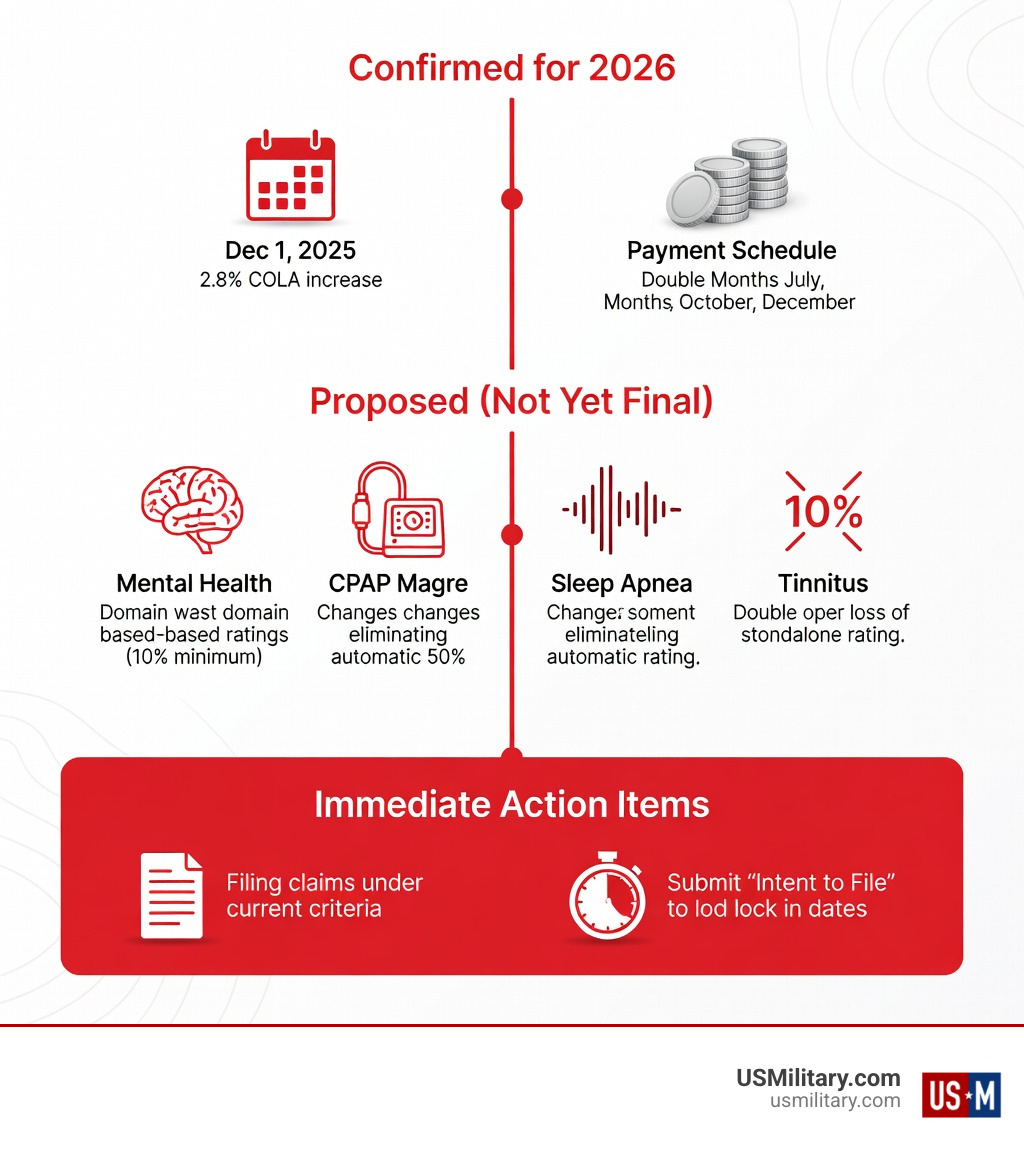
VA disability changes in 2026 include both confirmed adjustments and proposed rule updates that could significantly impact your monthly compensation. Here’s what you need to know right now:
Confirmed for 2026:
- 2.8% COLA increase effective December 1, 2025 (first payment December 31, 2025)
- 100% disabled veteran alone: $3,938.58/month (up from $3,831.30)
- Payment schedule includes double-payment months in July, October, and December
- Special grants increase: SAH Grant to $126,526, Automobile Allowance to $27,074.99
Proposed (Not Yet Final):
- Mental health ratings: New domain-based system with 10% minimum rating
- Sleep apnea changes: Elimination of automatic 50% for CPAP use
- Tinnitus updates: Loss of standalone 10% rating in most cases
- Timeline: No official date confirmed, projected late 2026
The 2026 changes fall into two categories that require different responses. The confirmed COLA increase happens automatically with no action needed on your part. The proposed rating changes for mental health, sleep apnea, and tinnitus remain under review and could be delayed, revised, or even canceled.
If you currently use a CPAP machine or have tinnitus, the proposed changes could reduce future ratings from 50% down to 10% or even 0% for sleep apnea, and eliminate most standalone tinnitus claims. However, existing ratings are generally protected through grandfathering rules unless you request an increase or the VA finds evidence of improvement.
The most urgent action for veterans is filing claims for sleep apnea or tinnitus under current favorable criteria before any new rules take effect. An Intent to File locks in your effective date while you gather medical evidence, protecting potential backpay even if processing extends into 2026.
I’m Larry Fowler, publisher of USMilitary.com since 2007, where we’ve helped hundreds of thousands of veterans navigate VA disability changes in 2026 and beyond through our benefit tracking and eligibility resources. This guide will walk you through both the confirmed payment increases and the proposed rating changes, so you can make informed decisions about your benefits.
Terms related to va disability changes in 2026:
Confirmed 2026 VA Disability COLA Increase and Payment Rates

One of the most important pieces of news for the upcoming year is the confirmed Cost-of-Living Adjustment (COLA). For veterans, this isn’t just a “bonus”—it is a legally mandated adjustment designed to ensure that the purchasing power of your benefits isn’t eroded by inflation.
The official COLA information from the Social Security Administration dictates how much the VA will increase its payments. For 2026, we are looking at a 2.8% increase (though some earlier projections hovered around 2.7%). This increase is based on the Consumer Price Index for Urban Wage Earners and Clerical Workers (CPI-W), which tracks the costs of things like food, housing, and healthcare.
What does this mean in actual dollars? If you are a veteran rated at 100% disability with no dependents, your monthly payment will jump from $3,831.30 in 2025 to $3,938.58 in 2026. That is an extra $107.28 per month, or over $1,287 more per year. Best of all, this compensation remains 100% tax-free at both the federal and state levels.
For a deeper dive into the math, you can check our guide on understanding VA disability rates and COLA in 2026.
Impact of Dependents on VA Disability Changes in 2026
If you have a disability rating of 30% or higher, the VA provides additional compensation for your dependents. This includes your spouse, children under 18, children between 18 and 23 who are still in school, and even dependent parents.
The 2.8% COLA increase applies to these “added amounts” as well. For example:
- Spouse Allowance: A veteran at 100% with a spouse will see their rate increase significantly compared to the “veteran alone” rate.
- Child Additions: Each additional child under 18 adds a specific dollar amount based on your rating percentage. At the 100% level, each additional child adds approximately $109.11 per month.
- Schoolchildren (18-23): If your child is attending an approved secondary school or college, they qualify for a higher rate than younger children to help offset education costs. At 100%, this is roughly $352.45 per month.
To find your exact household rate, you should consult the official VA compensation rate tables. It is also important to note that if your spouse requires Aid and Attendance (A&A) due to their own disability, you can receive an additional monthly amount, which scales with your rating level.
Special Monthly Compensation (SMC) Adjustments
Beyond standard disability pay, many veterans qualify for Special Monthly Compensation (SMC). This is for those with catastrophic injuries, loss of use of limbs, or those who are housebound.
In 2026, SMC rates will also see the 2.8% boost.
- SMC-K: Often awarded for the loss or loss of use of a creative organ, this is a flat addition to your other compensation.
- SMC-L through SMC-S: These levels cover more severe disabilities and Aid and Attendance. For instance, the highest levels (SMC-R.2/T) can reach over $11,271 per month in 2026.
- Legacy SMC-Q: While this is a “protected” legacy level that no longer receives COLA increases, most other SMC categories will see the full adjustment.
For those curious about the medical requirements for these higher tiers, we have a resource on Veterans Aid and Attendance requirements 2026 that breaks down the specifics.
The 2026 VA Disability Payment Schedule and “VA Math”
Budgeting is critical, and knowing exactly when your money hits your bank account is part of that. The VA pays disability compensation on the first business day of the month for the previous month. However, if the 1st falls on a weekend or a holiday, the VA pays on the last business day of the preceding month.
This creates what we call “double-payment months.” You aren’t actually getting twice the money; you are just getting your next month’s pay a few days early.
- July 2026: Since August 1st is a Saturday, you will receive your August payment on July 31st.
- October 2026: November 1st is a Sunday, so you get paid on October 30th.
- December 2026: January 1, 2027, is a holiday, so your first 2027 check arrives on December 31, 2026.
We recommend setting up direct deposit and opting into text notifications through the official VA payment history and schedule portal to stay updated. For a full list of dates, see our article on 2026 VA disability rates: everything you need to know.
Calculating Combined Ratings for VA Disability Changes in 2026
If you have multiple service-connected conditions, the VA doesn’t just add them together (e.g., 30% + 20% does not equal 50%). Instead, they use a “Combined Rating Table,” often jokingly referred to by veterans as “VA Math.”
The VA treats you as a whole person. If you have a 30% disability, you are 70% “efficient.” If you then have a 20% disability, the VA takes 20% of that remaining 70% (which is 14%). They add that 14 to your original 30, giving you 44%, which they then round to the nearest 10%—in this case, 40%.
Understanding this is vital if you are trying to figure out how to increase VA disability rating for 2026. Adding a new 10% rating might not actually move your total percentage if you are at the lower end of a rounding bracket.
Total Disability Individual Unemployability (TDIU) in 2026
If your service-connected disabilities prevent you from maintaining “substantially gainful employment,” you may qualify for TDIU. This is a massive benefit because it pays you at the 100% rate even if your combined rating is only 60% or 70%.
To qualify for “schedular” TDIU, we generally see requirements such as:
- One disability rated at 60% OR
- A combined rating of 70% with at least one disability at 40%.
In 2026, receiving TDIU means you will get that $3,938.58 base rate (plus dependent pay), which is a life-changer for those who can no longer work. You can learn more about TDIU eligibility or read our guide on how to get a 100% VA disability.
Proposed VA Disability Changes in 2026: Mental Health, Sleep Apnea, and Tinnitus
Now we get to the part that has many veterans nervous: the proposed modernization of the Veterans Affairs Schedule for Rating Disabilities (VASRD). The VA has been working on these updates for years, and while they are not yet final, they represent a major shift in how the VA evaluates three very common conditions.
The proposed changes to mental health ratings are actually seen by many advocates as a “win.” Currently, mental health ratings (like PTSD, anxiety, or depression) can be subjective. The new proposal moves toward a “domain-based evaluation.”
Instead of a broad look at “social and industrial impairment,” the VA would look at five specific domains:
- Cognition and executive functioning
- Interpersonal interactions and relationships
- Shared activities and tasks
- Life activities (work, school, home)
- Self-care
One of the biggest positives? The proposal eliminates the 0% rating for mental health. If you are service-connected for a mental health condition, the minimum rating would be 10%. This is a significant change for the thousands of veterans currently sitting at 0%. For more on this, read our guide on navigating potential 2026 VA disability changes.
Sleep Apnea Rating Shifts for VA Disability Changes in 2026
While the mental health changes look positive, the proposed sleep apnea rating overhaul is a major concern. Under current rules, if you are prescribed a CPAP machine, you almost automatically receive a 50% rating.
The proposed 2026 rules would change this to focus on treatment effectiveness. If a CPAP machine successfully treats your sleep apnea and you are asymptomatic, your rating could drop to 10% or even 0%. You would only maintain a higher rating if the treatment doesn’t work or if you have severe underlying complications like heart failure.
This is why many veterans are looking for ways to raise my VA disability rating now, before these rules are finalized. If you have sleep apnea symptoms, now is the time to get your sleep study done and file your claim.
Tinnitus and Auditory System Updates
Tinnitus (ringing in the ears) is the most commonly claimed VA disability. Currently, it is a standalone 10% rating. The proposed rules for tinnitus ratings would eliminate this standalone rating (Diagnostic Code 6260).
Instead, tinnitus would be considered a symptom of hearing loss. If you have tinnitus but your hearing loss is “non-compensable” (meaning it doesn’t meet the threshold for a 10% rating), you might walk away with a 0% rating for both. This is a massive loss for veterans who use tinnitus as a “gateway” claim for secondary conditions like anxiety or sleep disturbances.
If you are wondering how do I increase my VA disability rating in light of these auditory changes, the answer is simple: file your tinnitus claim immediately while the 10% standalone rule is still in effect.
Protecting Your Benefits: Grandfathering and Rating Protections
We often get asked, “If the VA changes the rules in 2026, will they take away my 50% sleep apnea rating?”
The short answer is: Generally, no. The VA typically includes a “grandfather clause” in these updates. If you already have a rating for sleep apnea or tinnitus, you keep that rating under the old rules as long as your condition doesn’t improve. However, if you file for an increase after the new rules take effect, you might be re-evaluated under the new, stricter criteria.
There are also several long-standing protections you should know about:
- 5-Year Rule: If your rating has been in place for 5 years or more, the VA cannot reduce it unless the condition shows “sustained improvement.”
- 10-Year Rule: After 10 years, the VA cannot terminate your service connection unless there was fraud.
- 20-Year Rule: After 20 years, your rating is essentially permanent and cannot be reduced below that level.
- Permanent and Total (P&T): If the VA determines your conditions are not likely to improve, you are protected from future re-examinations.
You can see how these rules look on a current VA disability rating chart 2025 to understand your current standing. Additionally, be aware of the new interim final rule regarding 38 CFR 4.10, which may change how the VA views “medicated states” during C&P exams.
2026 Updates to VA Housing, Automobile, and Clothing Allowances
Disability compensation isn’t just about the monthly check; it’s also about the grants that help you live an independent life. In 2026, these grants are seeing significant increases.
- Specially Adapted Housing (SAH) Grant: For veterans with severe service-connected disabilities (like the loss of use of both legs), this grant increases to $126,526 in 2026. This money is used to build or remodel a home to be wheelchair accessible.
- Special Housing Adaptation (SHA) Grant: For those with specific visual or respiratory disabilities, this grant increases to $25,350.
- Automobile Allowance: If you lost a limb or have severe vision loss due to service, you may qualify for a one-time grant to purchase a specially equipped vehicle. In 2026, this limit is $27,074.99.
- Clothing Allowance: If your prosthetic or orthopedic device wears out your clothes, or if your skin medication stains them, you can receive an annual clothing allowance. For 2026, this is $1,053.19.
We track all VA aid and attendance changes for 2026 and aid and attendance 2026 changes to ensure you don’t leave any money on the table.
Frequently Asked Questions about VA Disability Changes in 2026
What should I do right now to protect my 2026 benefits?
The most important thing you can do is file an Intent to File immediately. This “locks in” today’s date as your effective date. If you eventually win your claim, the VA will pay you backpay to the date you filed the intent.
Gather your medical evidence now. If you are claiming sleep apnea, get a sleep study. If you are claiming a mental health increase, document your symptoms in a daily log. When you are ready, use VA Form 21-526EZ to submit your claim.
When will the proposed rating changes for sleep apnea and tinnitus become official?
There is no confirmed date. These changes were first proposed in the Federal Register in early 2022. While some GAO reports suggest a full VASRD modernization by fiscal year 2026, the VA has a history of delays. Once a “final rule” is published, there is usually a 60-day window before it becomes law.
If you are still on active duty, take advantage of the Benefits Delivery at Discharge (BDD) program. This allows you to file your claim while still in uniform, often resulting in a decision the day after you separate.
Who can help me navigate these VA disability changes in 2026?
We always recommend working with a trained professional. This could be a Veterans Service Officer (VSO) from organizations like the DAV, VFW, or American Legion, or a VA-accredited claims agent or attorney.
You can find help using the VA health facility locator. If you are facing extreme financial hardship or a terminal illness, don’t forget to submit VA Form 20-10207 for priority processing, which can cut your wait time significantly.
Conclusion
At USMilitary.com, we know that the VA system can feel like an uphill battle. But with the va disability changes in 2026, there are real opportunities to secure the compensation you’ve earned. Whether it’s the automatic 2.8% COLA increase or the chance to file for a mental health rating under a more favorable domain-based system, being proactive is the key to success.
Don’t wait for the new rules to make things harder. Lock in your effective date, gather your nexus letters, and stay informed. For more updates and resources, be sure to check out more info about disabled veteran benefits on our site. We’ve got your back!


