
When you step into a VA disability evaluation, you are participating in a legal and medical review designed to measure how your service-connected health conditions affect your daily life and earn your rightful compensation. At USMilitary.com, we frequently explain that the entire rating schedule—governed by federal law under PART 4—SCHEDULE FOR RATING DISABILITIES—is designed around functional impairment.
The evaluation process measures average impairment in earning capacity and overall bodily function. To learn more about navigating these assessments, explore our detailed breakdown of Veteran Benefits Evaluations.
Purpose of a VA Disability Evaluation vs. Routine Care
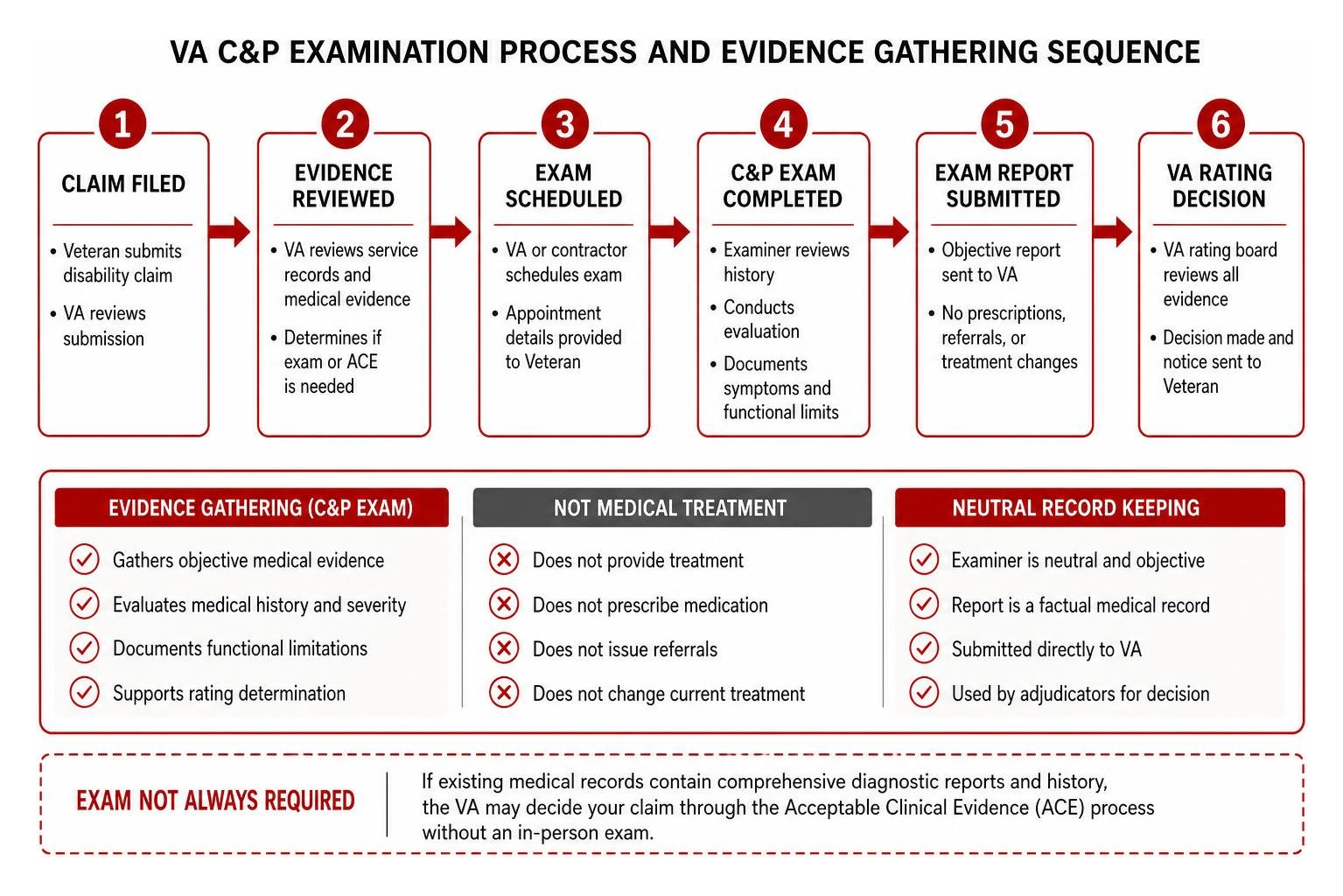
It is critical to recognize that a VA disability evaluation serves a completely different objective than a routine appointment with your primary care provider:
- Evidence Gathering vs. Direct Treatment: A routine doctor visit focuses on diagnosing illnesses, prescribing medications, and improving your health. A disability evaluation exists solely to collect objective evidence, evaluate your medical history, and document your functional limits for rating purposes.
- No Prescriptions or Referrals: Disability examiners will not write prescriptions, refer you to specialists, or adjust your medical treatments.
- Neutral Record Keeping: The examiner’s objective report is submitted directly to the Department of Veterans Affairs (VA) rating board, where adjudicators review the evidence alongside your service records.
Eligibility Criteria and Service Connection Basics
To qualify for tax-free monthly disability compensation, you must meet basic eligibility standards and establish a clear service connection. Basic requirements include:
- Active Military Service: You served on active duty, active duty for training, or inactive duty training.
- Current Medical Diagnosis: You have a documented physical or mental health condition (such as PTSD, back injuries, tinnitus, or respiratory issues).
- In-Service Event or Injury: An event, injury, or exposure occurred during your service that caused or aggravated the condition.
Establishing service connection generally falls into three main pathways:
- Direct In-Service Claims: An injury or illness caused directly by active duty service.
- Pre-Service Aggravation: A condition you had prior to military service that was demonstrably worsened by your active duty service beyond its natural progression.
- Post-Service or Secondary Connection: A condition that developed after service as a result of a primary service-connected disability.
Connecting these dots often requires a strong Nexus Letter for VA Claim written by a qualified medical professional to formally link your current diagnosis to your time in uniform.
The C&P Exam Process and Presumptive Conditions

If the VA determines that additional evidence is required to assess your service connection or condition severity, they will request a Compensation and Pension (C&P) exam. Detailed instructions on scheduling and provider expectations can be found directly through the official VA Claim Exam (C&P Exam) | Veterans Affairs portal.
Not every claim requires an in-person exam. Under the Acceptable Clinical Evidence (ACE) process, if your existing medical records contain comprehensive diagnostic reports and history, the VA can evaluate your claim without making you travel to a clinic.
How C&P Exams Are Scheduled and Conducted
When an exam is needed, the VA will schedule it through VA medical centers or authorized third-party contractor networks.
- Contractor Networks: Third-party vendors contact you via mail, phone, or email to set up your appointment.
- Travel Distance Guidelines: Contractor targets dictate scheduling exams as close to your home as possible—typically within a 50-mile radius for general exams, or up to 100 miles for specialized providers (such as hearing, vision, or dental experts).
- Travel Reimbursement: Eligible veterans traveling to in-person evaluations can receive travel pay reimbursement, typically processed within 14 days of the appointment.
- Telehealth Options: Mental health assessments or consultations that do not require physical measurements (such as range-of-motion tests) may be conducted virtually over secure video platforms.
- Disability Benefits Questionnaires (DBQs): Examiners complete standardized DBQs during your exam to capture your exact symptoms, functional loss, and occupational impact.
PACT Act Presumptive Conditions and Ratings
The PACT Act significantly expanded benefit access for generations of veterans exposed to burn pits, radiation, agent orange, and other toxic substances.
Under presumptive guidelines, the VA legally presumes that specific health conditions (such as specific respiratory cancers, asthma, or chronic bronchitis) were caused by your military service. This eliminates the requirement to prove an in-service cause.
However, attending a VA disability evaluation for a presumptive condition is still necessary. While the service connection is automatically established by law, the C&P exam determines the precise severity of your symptoms to assign an accurate percentage rating.
Preparing for Your Exam and Avoiding Critical Mistakes

Properly preparing for a VA disability evaluation can make the difference between an accurate rating and a delayed or denied claim. If you are starting your application from scratch, review our resource on How to File a VA Disability Claim.
Preparation Checklist and Best Practices
To get the most accurate result from your evaluation, follow these practical steps:
- Submit Medical Records Early: Do not rely on handing stacks of paper to your doctor during the exam. Upload all private medical records, test results, and statements through the VA claims portal well before your appointment.
- Track Daily Functional Impact: Keep notes describing how your condition affects daily activities, self-care, mobility, and your ability to work.
- Be Direct and Accurate: Describe your symptoms based on your worst days, not your best days. Veterans often downplay their pain out of habit; be open, honest, and direct about your actual physical and mental limitations.
- Wear Comfortable Clothing: Wear loose-fitting clothes that allow full range-of-motion testing if you are undergoing physical evaluations.
What Happens If You Miss an Exam
Failing to show up for a scheduled C&P exam is one of the quickest ways to stall or jeopardize your claim.
If you miss your appointment without notice, the VA will not automatically reschedule it. Instead, they may make a rating decision based solely on your existing evidence, which frequently results in a claim denial.
- 48-Hour Reschedule Window: If a conflict arises, notify the scheduling vendor or the VA at least 48 hours in advance. Contractor-scheduled appointments can generally only be rescheduled once, and the new date must fall within 5 days of the original appointment.
- Good Cause Reasons: If you miss an exam due to severe, unavoidable circumstances—such as unexpected hospitalization, severe illness, homelessness, or a family death—contact the VA immediately at 800-827-1000. Providing documented “good cause” allows the VA to reopen scheduling without penalizing your claim.
How Disability Ratings and Calculations Work
Once your evaluation is complete, the VA reviews the examiner’s report alongside your medical history to assign a rating percentage ranging from 0% to 100%. For comprehensive details on rating breakdowns, visit our dedicated portal on VA Disability Ratings.
A vital regulatory update occurred when the Department of Veterans Affairs issued a final rule rescission in the Federal Register. On February 27, 2026, the VA formally rescinded an interim rule regarding medication impact on ratings, restoring the prior language of 38 CFR § 4.10. This ensures disability evaluations remain anchored to actual functional impairment under daily living conditions.
The Combined Ratings Table and Rounding Rules
If you have multiple service-connected disabilities, the VA does not simply add your percentages together (for example, 50% + 30% does not equal 80%). Instead, they apply the “whole person theory,” which recognizes that a person cannot be more than 100% disabled.
The VA calculates your total rating sequentially:
- List your individual ratings in descending order (highest to lowest).
- Take your highest rating first. If your highest condition is 50%, you are considered 50% disabled and 50% efficient (“whole”).
- Apply your second rating (e.g., 30%) to the remaining efficient portion (30% of 50% = 15%).
- Combine these values (50% + 15% = 65% unrounded total).
- If you have disabilities affecting paired extremities (both arms or both legs), the bilateral factor adds 10% to the combined value of those specific paired conditions before combining them with other body systems.
- Round your final unrounded total to the nearest 10% (values ending in 1–4 round down; values ending in 5–9 round up). Thus, an unrounded 65% score rounds up to a 70% combined VA rating.
| First Rating | Second Rating | Combined Unrounded | Final Rounded Rating |
|---|---|---|---|
| 10% | 10% | 19% | 20% |
| 50% | 30% | 65% | 70% |
| 65% (unrounded) | 10% | 69% | 70% |
If severe service-connected conditions prevent you from maintaining substantially gainful employment, you may qualify for Total Disability based on Individual Unemployability (TDIU). TDIU pays out at the 100% disability rate even if your combined schedular rating is below 100% (typically requiring one single condition rated at 60%+ or a combined rating of 70%+ with at least one condition at 40%+).
Requesting Your VA Disability Evaluation Results
Examiners will not give you your evaluation results or disability rating at the conclusion of your C&P exam. To get a copy of the official exam report, you must request it from the VA.
To obtain your report, submit a formal Freedom of Information Act (FOIA) or Privacy Act request using VA Form 20-10206. You can file this request online through your VA account, submit it by mail, or hand-deliver it to your local VA Regional Office. For step-by-step claims support, consult The Complete Guide to VA Disability Claims.
Frequently Asked Questions About VA Disability Evaluations
How long does a C&P exam take?
The duration of a C&P exam depends entirely on the number and complexity of the conditions being evaluated. Simple, straightforward evaluations (such as hearing loss or a single joint issue) may take as little as 15 minutes. Complex cases involving multiple body systems, traumatic brain injury (TBI), or severe mental health conditions can last an hour or longer.
Can I bring a family member or caregiver to my exam?
Yes, you can bring a family member, caregiver, or chaperone to your evaluation. Caregivers can often provide valuable observational details about your daily struggles, memory issues, or mobility limits. However, the examiner retains the right to conduct portions of the evaluation privately, particularly during sensitive mental health assessments.
How does third-party contractor scheduling work?
The VA partners with medical contractor networks to expand exam availability across the country. Third-party vendors contact veterans directly to coordinate appointments within established travel limits. You can learn more about how contractor networks coordinate evaluations by visiting Veterans Evaluation Services: Home.
Conclusion
Conclusion
Navigating a VA disability evaluation can feel overwhelming, but understanding the steps allows you to take full control of your claim. By gathering strong medical evidence, being completely honest about your symptoms, and keeping your appointments, you give yourself the best opportunity to secure the tax-free disability compensation you have earned.
You never have to navigate the benefits system alone. Work alongside accredited Veterans Service Organizations (VSOs) or trained veteran representatives for trusted guidance throughout your claims journey.
For continuous updates on military benefit trends, career transitions, loan options, and military branch guides, rely on our comprehensive resources right here at USMilitary.com.
Free for Service Members & Veterans
Get the military benefits intel no one tells you about.
Weekly updates on VA benefits, pay changes, and money tips — free for service members and veterans.
No spam. Unsubscribe anytime. Your info is never shared.


