What You Need to Know About VA Home Loan Eligibility Requirements

VA home loan eligibility requirements are based on three core factors: your military service history, your character of discharge, and a valid Certificate of Eligibility (COE).
Here’s a quick summary of who qualifies:
| Category | Minimum Requirement |
|---|---|
| Wartime veteran | 90 days active duty, other than dishonorable discharge |
| Peacetime veteran | 181 continuous days active duty, other than dishonorable discharge |
| Post-Sept. 7, 1980 enlisted | 24 continuous months, or full active duty period called |
| Active-duty service member | 90 continuous days currently serving |
| National Guard / Reserve | 6 credible years, OR 90 days active service including 30 consecutive days under Title 32 |
| Surviving spouse | Unremarried spouse of veteran who died in service or from service-connected disability |
You also need to meet your lender’s credit and income standards — not just the VA’s. Most lenders require a minimum 620 FICO score and follow VA residual income guidelines.
The VA loan program has been helping veterans become homeowners since the original G.I. Bill was signed in 1944. It removes major financial barriers — no down payment, no private mortgage insurance, and competitive interest rates — that would otherwise block many military families from owning a home.
My name is Larry Fowler, publisher of the USMilitary.com Network since 2007, and I’ve spent nearly two decades tracking VA benefits trends — including VA home loan eligibility requirements — to help active-duty members and veterans make the most of what they’ve earned. In this guide, I’ll walk you through everything you need to know to determine your eligibility and take your next step toward homeownership.
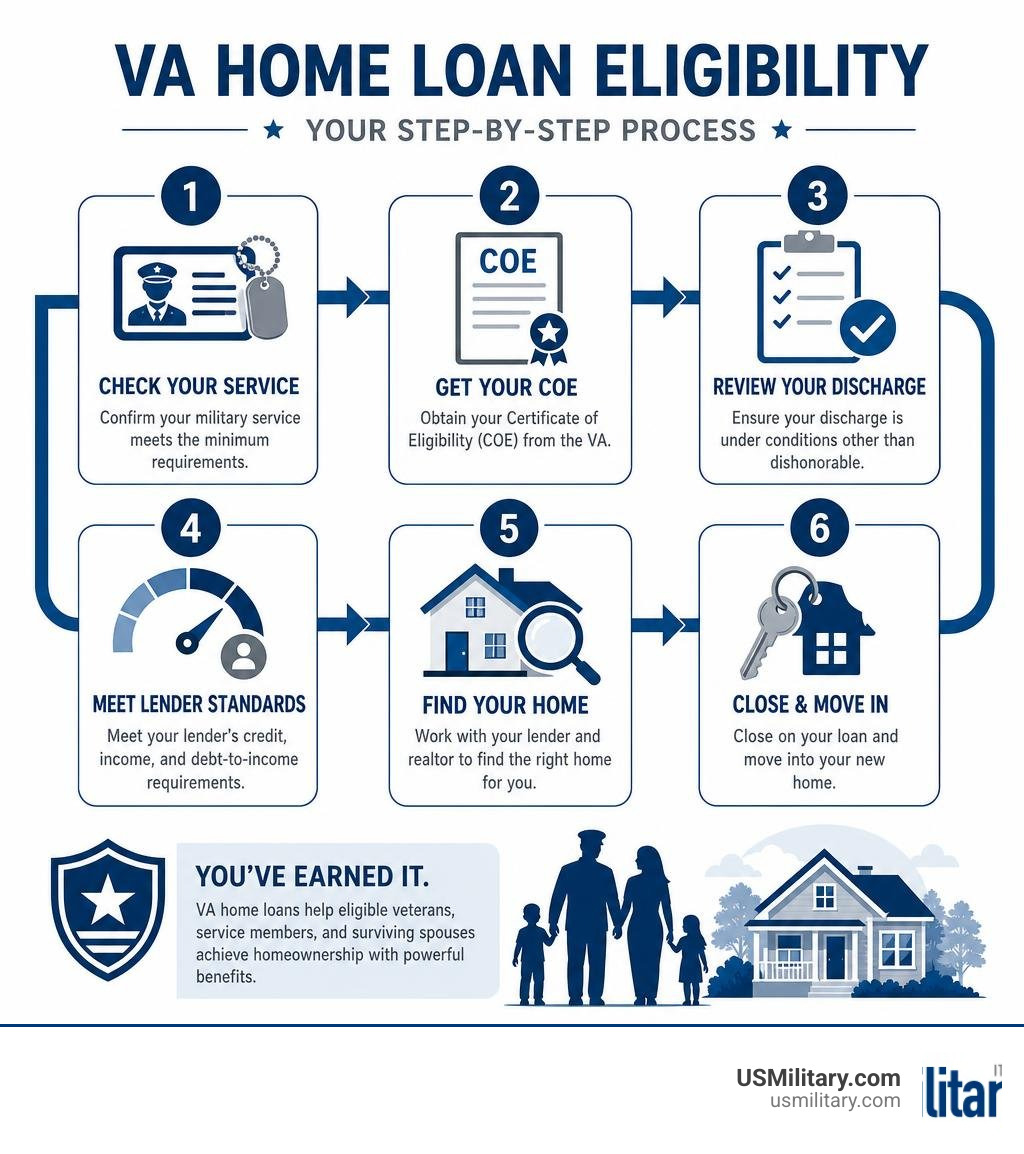
Understanding VA Home Loan Eligibility Requirements
When we talk about a VA home loan, it is helpful to clarify what it actually is. The Department of Veterans Affairs (VA) does not typically hand you a check or act as a direct mortgage lender. Instead, private financial institutions—such as banks, credit unions, and mortgage companies—provide the funding. The VA’s role is to step in and guarantee a portion of the loan (usually up to 25% of the loan amount).
This government backing reduces the risk for private lenders, allowing them to offer terms that are incredibly favorable, such as zero down payment options and competitively low interest rates. However, before a lender can offer you these benefits, they must confirm that you meet the official VA home loan eligibility requirements.
The absolute key to unlocking this benefit is the Certificate of Eligibility (COE). The COE is an official document issued by the VA that proves to your lender you have met the minimum service requirements to qualify for the program.
Fortunately, getting your hands on this document is easier than ever. Thanks to the VA’s Web LGY system, participating lenders can pull your COE electronically in a matter of seconds, provided the VA has sufficient records of your service history. In fact, nearly all COE requests are now processed electronically, and about two-thirds are issued immediately.
If you are wondering about your eligibility status or want to dive deeper into the preparation steps, you can learn more about How to Qualify for a VA Home Loan through our resources, or visit the VA Home Loans – Veterans Benefits Administration portal for official military documentation.
Service Requirements by Era and Duty Status
Your minimum active-duty service requirements depend entirely on the era in which you served. The military has transitioned between wartime and peacetime periods over the decades, and the VA adjusts its eligibility timelines accordingly.
As of June 2026, the VA continues to categorize service requirements based on these historical eras. Additionally, your character of discharge must be “under conditions other than dishonorable” to maintain your eligibility.
The table below outlines the service requirements across major historical eras:
| Service Era | Dates of Era | Minimum Active-Duty Service Required |
|---|---|---|
| World War II | Sept. 16, 1940 – July 25, 1947 | 90 total days |
| Post-World War II Peacetime | July 26, 1947 – June 26, 1950 | 181 continuous days |
| Korean War | June 27, 1950 – Jan. 31, 1955 | 90 total days |
| Post-Korean War Peacetime | Feb. 1, 1955 – Aug. 4, 1964 | 181 continuous days |
| Vietnam War (Served in Republic) | Nov. 1, 1955 – May 7, 1975 | 90 total days |
| Vietnam War (Served outside Republic) | Aug. 5, 1964 – May 7, 1975 | 90 total days |
| Post-Vietnam War Peacetime | May 8, 1975 – Sept. 7, 1980 | 181 continuous days |
| 24-Month Rule Era (Enlisted) | Post-Sept. 7, 1980 | 24 continuous months (or full period called to active duty, min. 90 days) |
| Gulf War Era to Present | Aug. 2, 1990 – Present | 24 continuous months (or 90 days of active service for National Guard/Reserves) |
Active-Duty and Veteran VA Home Loan Eligibility Requirements
If you are currently on active duty, your path to eligibility is straightforward. You must complete at least 90 continuous days of active service. Once you cross that 90-day mark, you are eligible to request a COE.
For veterans, the rules depend on when you served. If you enlisted after September 7, 1980, or entered active duty as an officer after October 16, 1981, you are generally subject to the “24-month rule.” This means you must have served either 24 continuous months or the full period for which you were called or ordered to active duty (with a bare minimum of 90 days for wartime or 181 days for peacetime).
To prove your service, veterans must provide a copy of their DD Form 214 (specifically Copy 4, which details the character of service and the narrative reason for separation). Active-duty personnel will instead need a signed Statement of Service from their commander or military personnel office, detailing their full name, Social Security number, date of birth, date of entry onto active duty, and confirmation of any lost time.
For those currently serving, exploring the Top 5 Military Home Loans for Active Duty Service Members can help you compare options before you apply.
National Guard and Reserve VA Home Loan Eligibility Requirements
The eligibility rules for National Guard and Reserve members have historically been different from active-duty service members, but recent legislative updates have expanded access significantly.
Traditionally, Selected Reserve or National Guard members had to complete at least six credible years of service in an active Reserve or Guard unit and receive an honorable discharge to qualify. Under this path, you must provide documentation such as your NGB Form 22 (Report of Separation and Record of Service) or NGB Form 23 (Retirement Points Accounting).
However, updated rules have made it much easier for Guard members to qualify through active service. National Guard members are now eligible if they have at least 90 days of active service, which must include at least 30 consecutive days of service under Title 32, Sections 316, 502, 503, 504, or 505. This change ensures that Guard members mobilized for domestic missions, state emergencies, or training events can access their hard-earned benefits much sooner.
To check your specific status, you can review the official guidelines on Eligibility For VA Home Loan Programs.
Exceptions, Discharge Upgrades, and Surviving Spouse Rules
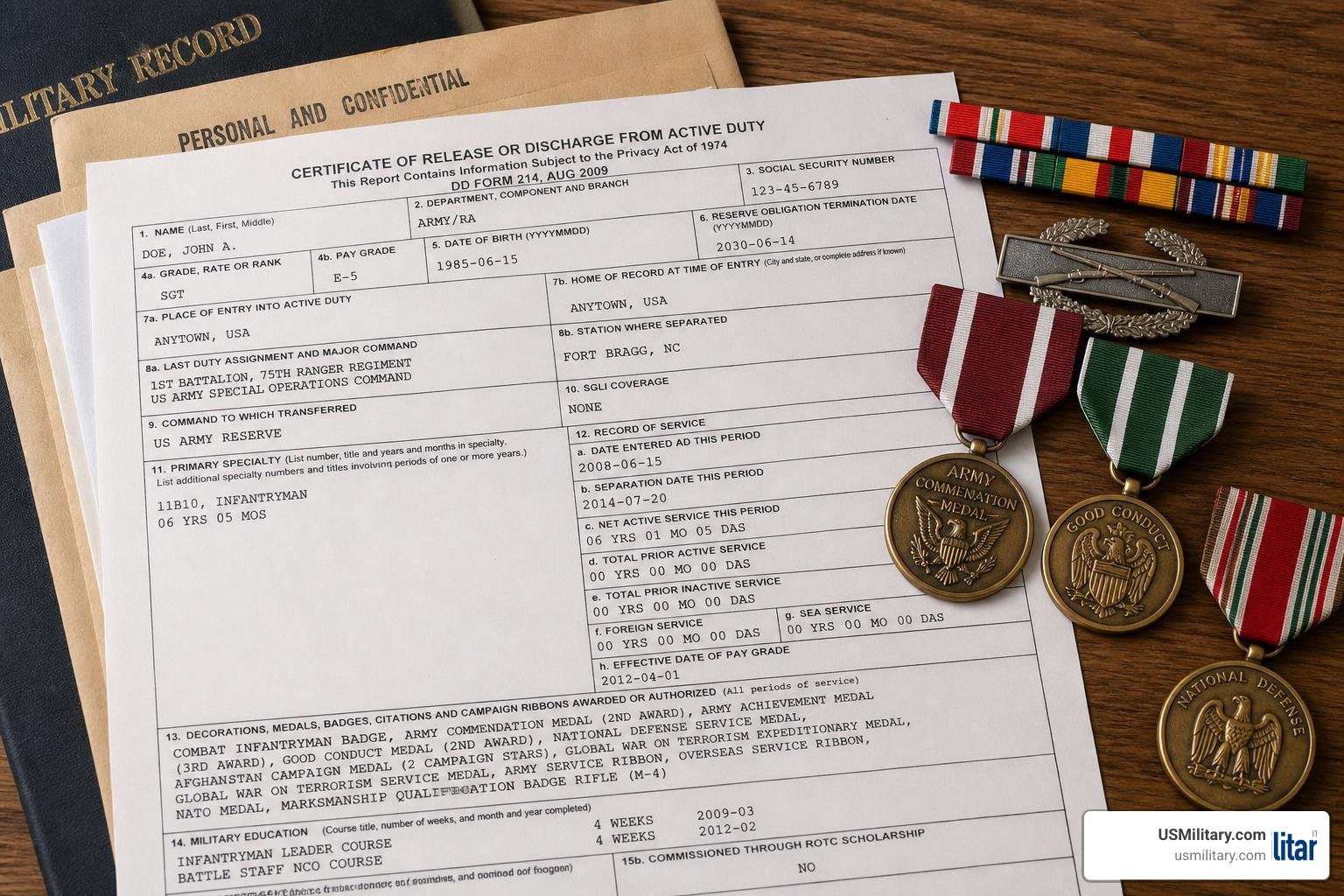
What happens if you did not meet the minimum active-duty service requirements? Do not count yourself out just yet. The VA provides several qualifying exceptions that allow you to obtain a COE even if your time in uniform was cut short.
You may still be eligible for a VA home loan if you were discharged early for any of the following reasons:
- A service-connected disability.
- A medical condition that was pre-existing but aggravated by your service.
- An early out or reduction in force (RIF) program.
- A hardship discharge.
- A physical or mental condition that interfered with your ability to perform duty (but was not classified as a disability).
Qualifying with an Other Than Honorable Discharge
Your character of service is a major factor in determining your eligibility. The VA requires that your discharge be under conditions “other than dishonorable.” This means that an Honorable or General (Under Honorable Conditions) discharge will clear the way for your COE.
However, if you received an Other Than Honorable (OTH) discharge or a Bad Conduct discharge, you are not automatically barred from the program. You have two main pathways to pursue your benefit:
- Apply for a Discharge Upgrade: You can petition your military branch’s Discharge Review Board (DRB) or Board for Correction of Military Records (BCMR) to have your discharge upgraded. If successful, this changes your official service record, granting you full access to VA home loans.
- Request a VA Character of Discharge Review: You can ask the VA to conduct an administrative review of your service. The VA will look at your entire record to determine if your service can be considered “honorable for VA purposes,” regardless of what is written on your DD Form 214.
Please note that a Dishonorable discharge is an absolute exclusion and cannot be bypassed through a VA administrative review; it must be upgraded by your service branch to regain eligibility.
Certificate of Eligibility Rules for Surviving Spouses
The VA home loan is not just for veterans; it is also a vital benefit for surviving spouses who have lost their partners in service to our nation.
You may be eligible for a COE as a surviving spouse if you meet one of the following criteria:
- You are the unremarried spouse of a veteran who died in service or from a service-connected disability.
- You are the spouse of an active-duty service member who is officially listed as Missing in Action (MIA) or a Prisoner of War (POW) for at least 90 days (limited to a one-time use).
- You are a surviving spouse receiving Dependency and Indemnity Compensation (DIC) benefits.
The remarriage rules are highly specific. Generally, if you remarry, you lose your eligibility. However, a surviving spouse who remarries on or after age 57, and on or after December 16, 2003, may still qualify.
To apply, you will need to submit VA Form 26-1817 along with your marriage license, the veteran’s death certificate, and their DD Form 214 (if available). You can review the complete criteria on the official Eligibility – VA Home Loans page.
How to Obtain, Restore, and Reuse Your Entitlement

One of the most common myths about the VA home loan is that it is a “one-and-done” benefit. That could not be further from the truth! Your VA loan entitlement is a lifetime benefit that you can use, restore, and reuse multiple times.
Your “entitlement” is the specific dollar amount the VA guarantees to your lender. If you have “full entitlement” (meaning you have never used a VA loan before, or you have fully paid off and restored your prior VA loan), there is no limit to the size of the mortgage the VA will back. You can borrow as much as your lender is willing to approve based on your income and credit, all with zero down payment.
If you currently have an active VA loan, you still have “partial entitlement” remaining. You can actually use this leftover entitlement to buy another home (perhaps because you are relocating or need a larger house) without selling your first property, though you may have to make a down payment if the new purchase exceeds your remaining entitlement limits.
To restore your entitlement so you can use it again for a new home purchase, you must complete VA Form 26-1880. Entitlement restoration typically requires:
- Selling the home and paying off the active VA loan in full.
- A one-time exception where you pay off the VA loan in full but are permitted to keep the property (perhaps as a rental) while restoring your entitlement for a new purchase.
- Having another qualified veteran assume your loan and substitute their own entitlement for yours.
If you are curious about how assumptions work, check out our guide on Can a VA Loan Be Assumed by a Non-Veteran?.
Beyond the COE: Lender Requirements and Property Rules
Getting your COE is a massive milestone, but it is only the first step. The VA sets the baseline eligibility rules, but private lenders are the ones risking their capital. Because of this, lenders impose their own requirements—often called “overlays”—on top of the standard VA home loan eligibility requirements.
Here is what lenders will evaluate:
- Credit Score: The VA does not mandate a minimum credit score, but most lenders require a FICO score of at least 620 to qualify for their best rates.
- Debt-to-Income (DTI) Ratio: Lenders look at how much of your monthly income goes toward paying debts. While the VA’s recommended DTI limit is 41%, lenders can be highly flexible if you have strong “compensating factors,” such as excellent credit or significant cash reserves.
- Residual Income: This is a unique VA requirement designed to ensure you have enough money left over each month after paying your mortgage and other debts to cover basic living expenses (like food, gas, and utilities). The required residual income amount varies by your family size and geographic region.
Additionally, the VA has strict rules regarding the property itself. The home you purchase must be your primary residence. You generally must occupy the home within 60 days of closing.
Exceptions to this occupancy rule exist for active-duty members who are deployed; in these cases, a spouse or dependent child can satisfy the occupancy requirement on your behalf. Furthermore, VA loans cannot be used to purchase vacation homes, investment properties, or real estate located outside of the United States and its territories.
To weigh the differences between these rules and standard financing, check out the Pros and Cons of VA Loan vs Conventional Loan comparison. For a complete look at the physical standards a property must meet, consult the official VA Home Loan Guaranty Buyer’s Guide.
Frequently Asked Questions About VA Loans
Can I use a VA loan for a non-primary residence or vacation home?
No. The VA home loan program is strictly designed to help military members secure primary housing. To qualify, you must certify that you intend to personally occupy the home as your primary residence.
Lenders enforce a “60-day rule,” meaning you must move into the property within 60 days of closing. The only major exception is for deployed service members, whose spouses or dependent children can fulfill the occupancy requirement.
What are the credit and income requirements set by private lenders?
While the VA does not set a hard credit score floor, most private lenders prefer a minimum FICO score of 620. Lenders will also evaluate your debt-to-income (DTI) ratio, preferring it to be at or below 41%, though they will allow higher ratios if you pass the VA’s residual income test.
To find a financial institution that fits your credit profile, you can compare the Best VA Loan Lenders currently operating in the market.
How do I restore my VA loan entitlement to buy another home?
To restore your entitlement, you must pay off your existing VA loan in full and dispose of the property (usually by selling it). Once the loan is paid, you can submit VA Form 26-1880 to the VA to have your full entitlement restored.
You are also allowed a single, one-time restoration where you pay off the loan but keep the property, allowing you to use your restored entitlement to buy a new primary residence.
Conclusion
At USMilitary.com, we believe that homeownership is one of the most powerful ways to build long-term wealth and secure stability for your family. The VA home loan program is one of the finest benefits you earned through your service, removing major financial hurdles so you can buy a home of your own.
Whether you are active duty, a veteran, or a member of the National Guard or Reserves, understanding the VA home loan eligibility requirements is the first step toward unlocking this lifetime benefit.
If you are planning your next steps in your military career or transition, we invite you to Explore Air Force Enlisted Ranks and our other comprehensive guides to keep your military knowledge sharp. When you are ready, gather your service documents, contact a VA-approved lender, and put your hard-earned benefits to work!
Free for Service Members & Veterans
Get the military benefits intel no one tells you about.
Weekly updates on VA benefits, pay changes, and money tips — free for service members and veterans.
No spam. Unsubscribe anytime. Your info is never shared.


