Why So Many Veterans Miss Out on the VA Home Loan Benefit

Find out if you’re qualified for a VA home loan before assuming it’s out of reach — because the answer is often yes, and the process is simpler than most people expect.
Here’s a quick look at the core requirements:
| Category | Basic Requirement |
|---|---|
| Active-Duty Service Member | 90 continuous days of active service |
| Wartime Veteran | 90 days active duty, other than dishonorable discharge |
| Peacetime Veteran | 181 days continuous active duty |
| National Guard / Reserve | 6 creditable years, or 90 days active service under Title 32 |
| Surviving Spouse | Spouse died in service or from a service-connected disability |
Three things you need to qualify:
- Meet minimum military service requirements
- Obtain a Certificate of Eligibility (COE)
- Satisfy your lender’s credit and income standards
Nearly 70% of Veterans and active-duty members say housing affordability is a major challenge — yet the VA home loan program removes two of the biggest barriers: the down payment and private mortgage insurance. As of May 2026, that makes this benefit more valuable than ever.
I’m Larry Fowler, publisher of USMilitary.com, and since 2007 I’ve helped Veterans and service members navigate complex benefits like the VA home loan program — including how to find out if you’re qualified for a VA home loan quickly and without confusion. Let’s walk through everything you need to know.
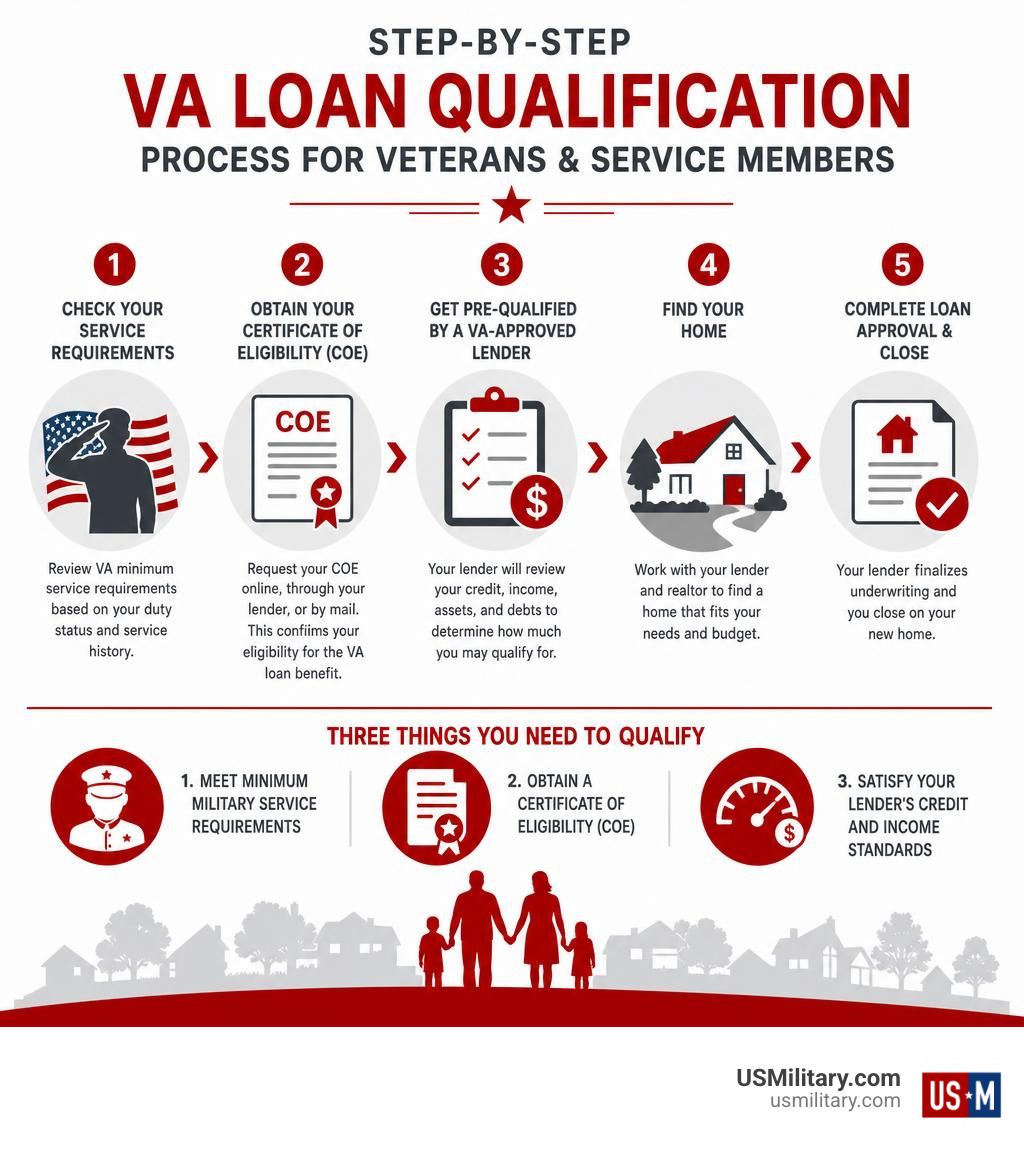
Find Out If You’re Qualified For a VA Home Loan: Service Requirements
To officially find out if you’re qualified for a VA home loan, you must first examine your military service history. The Department of Veterans Affairs (VA) sets specific service limits based on when and how long you served, as well as your duty status.
Whether you are active-duty military, a retired Veteran, or a member of the National Guard or Selected Reserve, your path to homeownership starts with meeting these baseline parameters. The table below outlines the service eras and minimum active-duty service requirements needed to secure your benefits.
| Service Era / Period | Service Dates | Minimum Active-Duty Service Requirement |
|---|---|---|
| World War II | Sept. 16, 1940 – July 25, 1947 | 90 total days |
| Korean War | June 27, 1950 – Jan. 31, 1955 | 90 total days |
| Vietnam War (In-Country) | Nov. 1, 1955 – May 7, 1975 | 90 total days |
| Vietnam War (Era) | Aug. 5, 1964 – May 7, 1975 | 90 total days |
| Peacetime Era | July 26, 1947 – June 26, 1950 Feb. 1, 1955 – Aug. 4, 1964 May 8, 1975 – Sept. 7, 1980 | 181 continuous days |
| Post-Vietnam (Enlisted) | Sept. 8, 1980 – Aug. 1, 1990 | 24 continuous months, or at least 181 days with an early discharge exception |
| Post-Vietnam (Officers) | Oct. 16, 1981 – Aug. 1, 1990 | 24 continuous months, or at least 181 days with an early discharge exception |
| Gulf War (including current era) | Aug. 2, 1990 – Present | 24 continuous months, or 90 days active service (for active-duty members) |
To learn more about the complete history of these benefits, you can read our comprehensive guide on VA Loans. For official policy details, you can also review the Eligibility – VA Home Loans page.
Minimum Active-Duty Service for Veterans and Active Duty
For those currently on active duty, the qualification threshold is straightforward: you generally become eligible after serving for at least 90 continuous days.
For Veterans, the rules depend heavily on when you served. During designated wartime periods, such as the Gulf War era (which extends to the present day), the service requirement is typically 90 days of active service. For peacetime service, the requirement increases to 181 continuous days.
If you served as an enlisted member after September 7, 1980, or as an officer after October 16, 1981, you must typically have completed 24 continuous months of active service, or the full period for which you were called to active duty (but not less than 181 days). If you were discharged early under a qualifying exception — such as a service-connected disability — you may still qualify even if you did not meet the standard length of service.
National Guard and Reserve Member Eligibility
Members of the National Guard and Selected Reserve have multiple pathways to establish eligibility. Historically, the standard requirement has been six creditable years of service in the Selected Reserve or National Guard, accompanied by an honorable discharge, placement on the retired list, or continued service.
However, eligibility pathways have expanded. You can also qualify if you have at least 90 days of active-duty service, including at least 30 consecutive days under Title 32 orders. When applying, National Guard members typically need to provide their NGB Form 22 (Report of Separation and Military Service) or an official points statement to verify their service time.
Understanding the Certificate of Eligibility (COE)
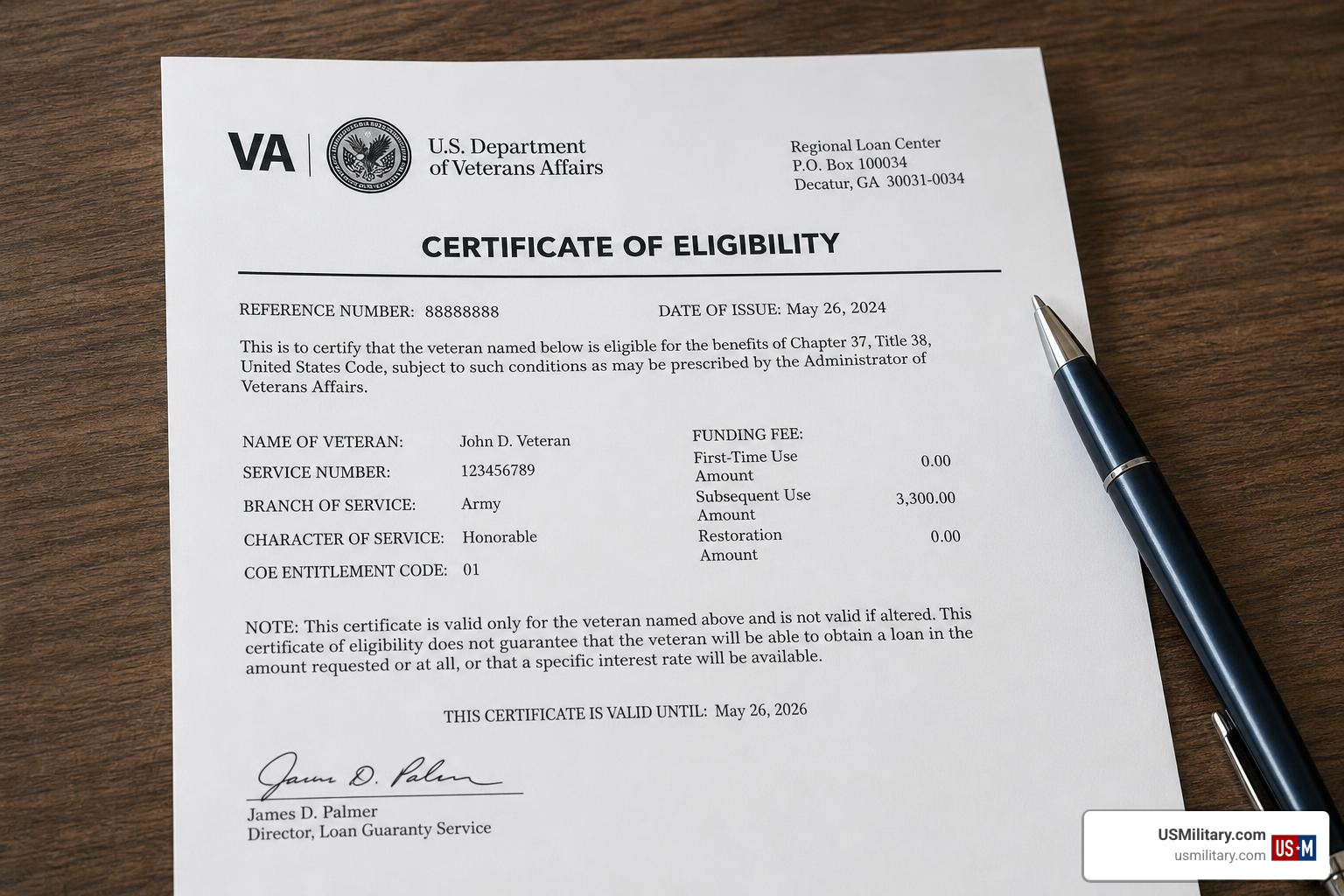
Once you determine that you meet the service requirements, the next step is to obtain your Certificate of Eligibility (COE). The COE is the official document issued by the VA that proves to your mortgage lender that you have earned this benefit. Without it, your lender cannot finalize a VA-backed mortgage.
To understand how this document fits into the broader mortgage process, you can read How Do VA Loans Work: A Simple Guide to Home Buying.
What is a COE and Why Do You Need It?
The COE is the bridge between your military service and your financial transaction. While the VA guarantees a portion of your mortgage, they do not actually lend the money. Private mortgage lenders handle the financing.
The COE acts as the official verification your lender needs to confirm that you qualify for the VA’s guarantee. It also outlines your “entitlement” amount and indicates whether you are exempt from the VA funding fee (which is common for Veterans receiving VA disability compensation).
To explore official guidelines regarding this document, visit the Certificate of Eligibility – VA Home Loans resource.
How to Find Out If You’re Qualified For a VA Home Loan COE
Obtaining your COE is faster and easier than it has ever been. In fact, nearly all COE requests are processed electronically, and about two-thirds of those requests are issued immediately.
There are three primary ways to apply for your COE:
- Through Your Lender: This is the easiest route. Most VA-approved lenders have access to the VA’s Web LGY system. By providing your Social Security number and date of birth, your lender can often pull and print your COE in seconds.
- Online via eBenefits: You can apply directly through the VA’s eBenefits portal. If the VA has sufficient records of your service on file, you can download your certificate instantly.
- By Mail: If you prefer the traditional route, you can fill out VA Form 26-1880 (Request for a Certificate of Eligibility) and mail it to the Atlanta Eligibility Center along with physical copies of your proof of service. That mail applications take significantly longer to process than electronic ones.
Required Documents to Verify Eligibility and Obtain a COE
To ensure a smooth application process, you should gather your military documentation ahead of time. The exact paperwork you need depends on your service status:
- Veterans: You will need your DD Form 214 (specifically Copy 4, which shows your character of service and the narrative reason for separation). Make sure the document clearly states that your discharge was “other than dishonorable.”
- Active-Duty Service Members: You need a current Statement of Service signed by your commander, adjutant, or personnel officer. This letter must display your full name, Social Security number, date of birth, the date you entered active duty, and confirmation that you have no lost time.
- National Guard and Reserve Members: You must provide an official points statement (such as an NGB Form 22 or retirement points summary) showing at least six years of creditable service, or active-duty orders showing 90 days of active service (with at least 30 consecutive days under Title 32).
Beyond the COE: Lender Requirements and Special Circumstances

Securing your COE is a major milestone, but it is only one part of the puzzle. The VA establishes the baseline eligibility rules, but private lenders set their own underwriting requirements. To successfully buy a home, you must satisfy both the VA’s standards and your chosen lender’s financial criteria.
To learn more about what the VA expects, check the Eligibility For VA Home Loan Programs page. If you are ready to shop around for a mortgage provider, you can read our analysis of the Best Lenders for VA Home Loans.
Credit, Income, and Financial Qualifications
While the VA does not enforce a strict minimum credit score, most lenders do. These lender-specific rules are known as “overlays.” Most lenders look for a credit score of at least 580 to 620, though some may accept lower scores if you have strong compensating factors.
In addition to credit, lenders will evaluate:
- Debt-to-Income (DTI) Ratio: While the VA does not set a hard limit on your DTI ratio, lenders closely examine ratios over 41%. If your DTI is higher, you may need to demonstrate significant residual income.
- Residual Income: This is a unique VA requirement. Residual income is the amount of money you have left over each month after paying all major bills, taxes, and your new mortgage payment. This buffer ensures you can comfortably cover daily necessities like groceries, gasoline, and utilities.
- Occupancy Requirements: VA loans are strictly for primary residences. You must intend to move into the home within a reasonable timeframe (usually 60 days after closing). You cannot use a standard VA purchase loan to buy an investment property or a vacation home, though you can use it for multi-unit properties (up to four units) as long as you live in one of them. For alternative properties, you can read about options like a VA Loan for Mobile Home or see if you Can You Buy Land with a VA Loan.
Special Discharge Circumstances and Surviving Spouses
If you did not complete your full service term, you may still qualify for a VA loan under specific circumstances. The VA grants early discharge exceptions for service members who were separated due to:
- A service-connected disability
- A medical condition that interfered with duty
- Hardship or an early out program
- A reduction in force (RIF)
Surviving spouses of military members also have a clear path to eligibility. You may qualify for a COE if:
- Your spouse died in the line of duty
- Your spouse died as a result of a service-connected disability
- Your spouse is currently missing in action (MIA) or a prisoner of war (POW)
Surviving spouses who receive Dependency and Indemnity Compensation (DIC) benefits can typically apply by submitting VA Form 26-1817 to their lender or directly to the VA.
How to Find Out If You’re Qualified For a VA Home Loan with a Lender
The absolute best way to find out if you’re qualified for a VA home loan from a financial standpoint is to seek pre-approval. During pre-approval, a lender will review your income, credit report, and employment history to determine exactly how much they are willing to lend you.
This step also allows you to compare current mortgage rates and see how the benefit holds up against other options. To see how these loans stack up against standard options, read our guide on VA Loan vs FHA vs Conventional.
Frequently Asked Questions About VA Loan Eligibility
Navigating the mortgage process can bring up plenty of questions. Below, we address some of the most common concerns Veterans and service members have when verifying their eligibility.
How long does it take to get a decision on a COE application?
If you apply through your lender’s online portal or via eBenefits, you will often receive your COE instantly. If your application requires manual review by a VA specialist (which is common if your service records are older or incomplete), the VA’s goal is to contact home loan COE applicants within an average of 5 business days.
While your request is under review, do not submit a duplicate request, as this can delay the process. If you want to track an active application, you can Check The Status Of Your VA Home Loan COE online.
Can I reuse my VA loan eligibility?
Yes! The VA home loan is a lifetime benefit, meaning you can use it multiple times. Once you pay off your existing VA mortgage and sell the property, your full entitlement can be restored for your next home purchase.
You can also have multiple active VA loans at the same time under certain circumstances using your “remaining entitlement.” Additionally, if you want to lower your current interest rate or cash out equity on an existing home, you can read about how to Can You Refinance a VA Loan.
What happens if my discharge was other than honorable?
If your discharge is characterized as “Other Than Honorable” (OTH), “Bad Conduct,” or “Dishonorable,” you are not automatically barred from the benefit, but you face a steeper climb. The VA reviews OTH discharges on a case-by-case basis to determine if the service was “under conditions other than dishonorable.”
You can also apply for a discharge upgrade through your branch’s Board for Correction of Military Records if you believe your characterization was unjust.
Conclusion
At USMilitary.com, we believe that every service member and Veteran who has earned the right to homeownership should be able to claim it. Navigating the May 2026 housing market is no easy task, but the VA home loan remains one of the most powerful financial tools available to help you secure a piece of the American Dream.
Right now, 3,349 Veterans started their quote online today. If you are ready to take the next step on your homebuying journey, we encourage you to gather your service documents, connect with a trusted lender, and explore our central hub for VA Home Loans to get started today.
Free for Service Members & Veterans
Get the military benefits intel no one tells you about.
Weekly updates on VA benefits, pay changes, and money tips — free for service members and veterans.
No spam. Unsubscribe anytime. Your info is never shared.


