What Is VA TDIU and Why It Matters for Veterans Who Can’t Work

VA TDIU Explained: Eligibility, Rates, & How To File in 2026 — here’s the short version if you need a quick answer:
| Question | Quick Answer |
|---|---|
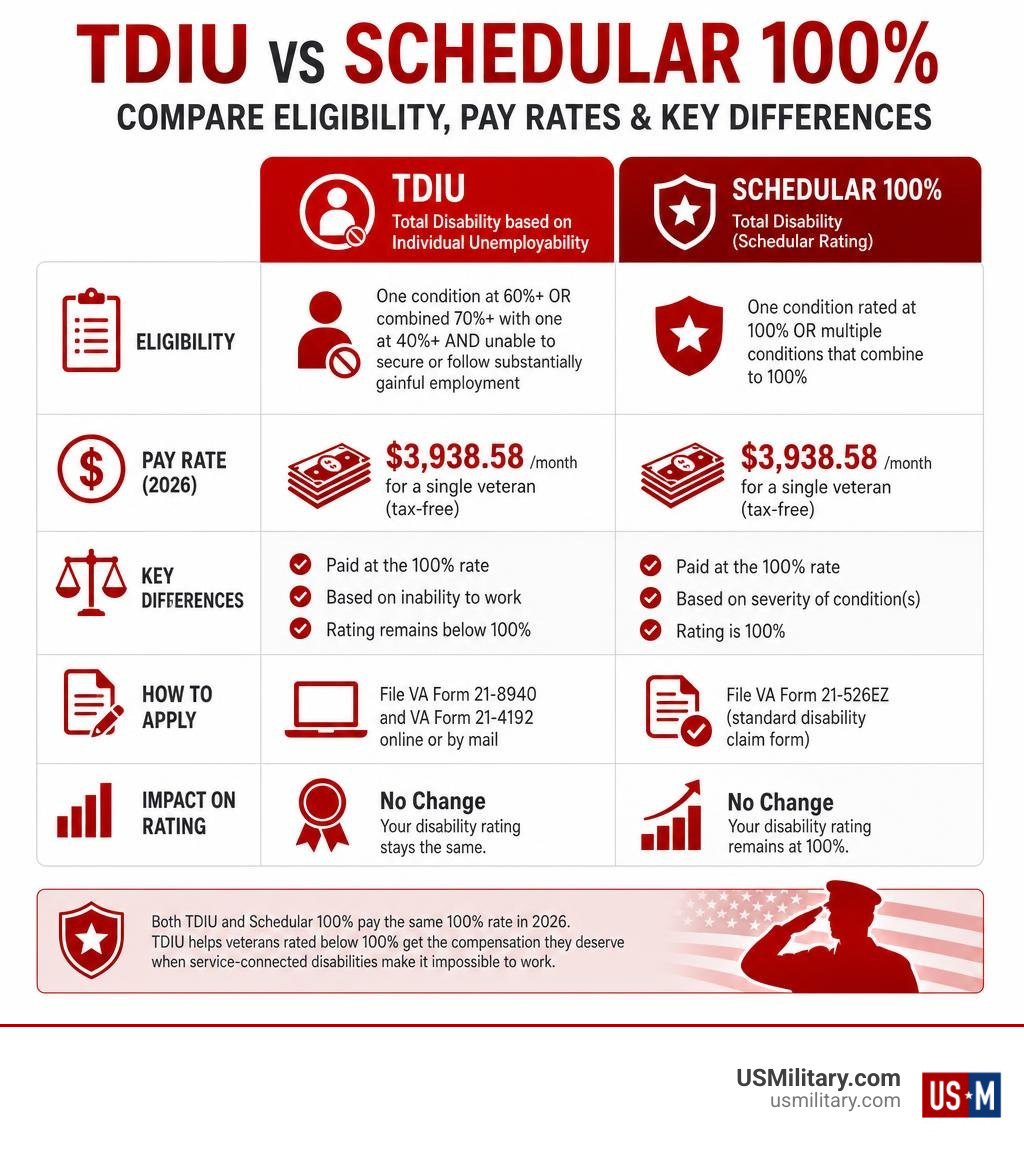
| What is TDIU? | A VA benefit that pays you at the 100% rate even if your rating is below 100% |
| Who qualifies? | Veterans with one condition at 60%+ OR combined 70%+ with one at 40%+ who can’t hold steady work |
| How much does it pay in 2026? | $3,938.58/month for a single veteran (tax-free) |
| How do you apply? | File VA Form 21-8940 and VA Form 21-4192 online or by mail |
| Does your rating change? | No — your disability rating stays the same, only your pay increases |
There’s a gap in the VA rating system that leaves a lot of veterans behind. You might be rated at 70% or 80% — clearly disabled — but still fall short of the 100% schedular rating that unlocks maximum compensation. That gap can mean over $1,800 less per month compared to what a 100%-rated veteran receives.
That’s exactly what Total Disability based on Individual Unemployability (TDIU) is designed to fix.
If your service-connected disabilities make it impossible to hold a steady job that pays above the poverty level, VA can compensate you at the 100% rate — regardless of what your combined rating actually is. Your rating doesn’t change. Your pay does.
Consider this real-world example from VA’s own guidance: a veteran with a 60% service-connected heart condition developed chest pain during physical work. Her doctor recommended she retire. VA approved her for TDIU, and she began receiving compensation at the full 100% rate.
Less than 8% of eligible veterans file for TDIU — meaning thousands of veterans who qualify are leaving significant tax-free income on the table every single month.
I’m Larry Fowler, publisher of the USMilitary.com Network and a longtime advocate for veteran benefits education. Since 2007, I’ve tracked VA benefit trends — including everything covered in VA TDIU Explained: Eligibility, Rates, & How To File in 2026 — helping veterans understand what they’ve earned and how to claim it. In this guide, I’ll walk you through every step clearly, so you can make confident decisions about your benefits.
Simple guide to VA TDIU Explained: Eligibility, Rates, & How To File in 2026:
VA TDIU Explained: Eligibility, Rates, & How To File in 2026
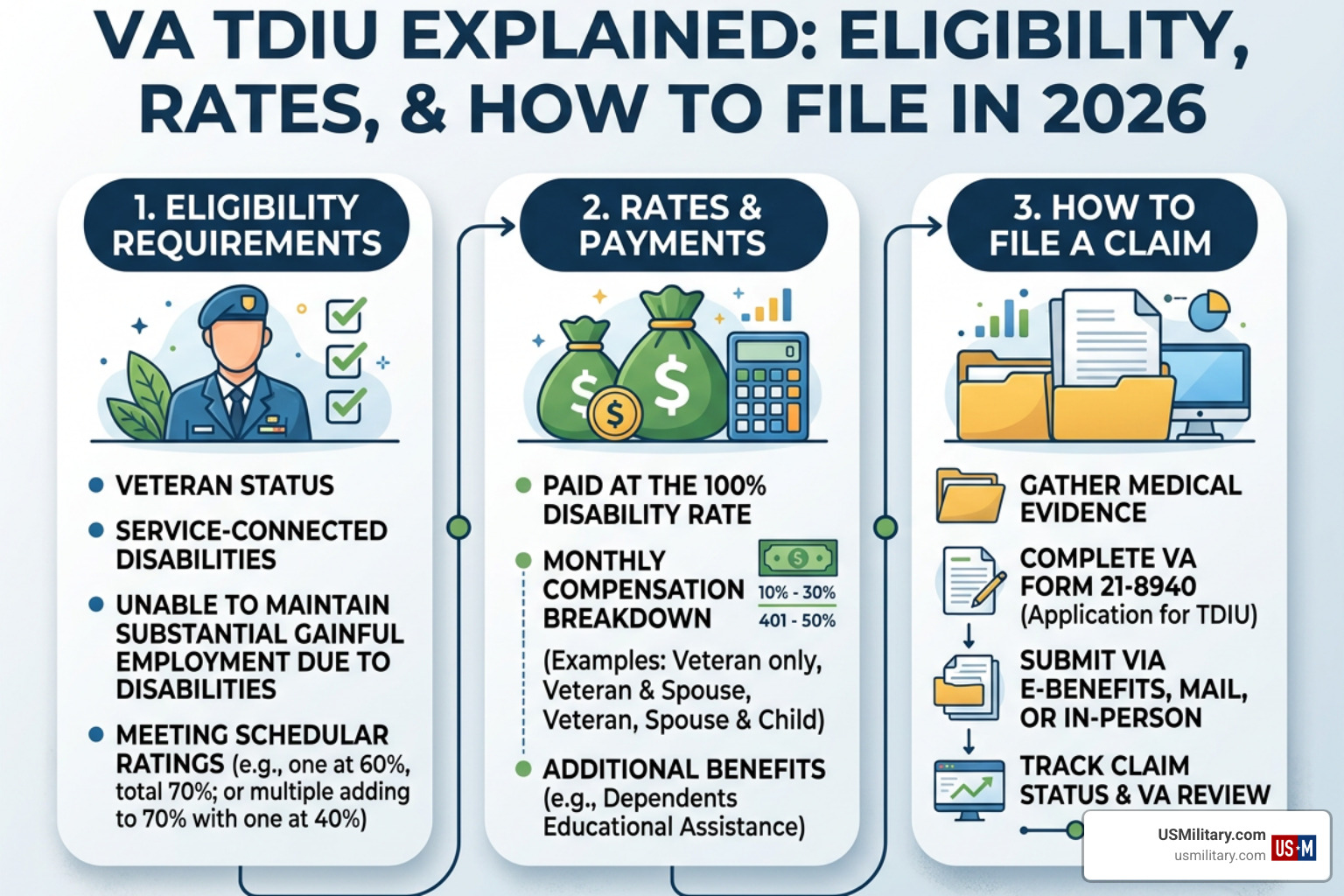
When we talk about “Individual Unemployability,” we are diving into one of the most powerful safety nets the Department of Veterans Affairs offers. Officially governed by federal law under 38 CFR 4.16, TDIU is a benefit option created specifically for unemployable veterans.
Many veterans assume that the only way to get paid at the 100% rate is to climb the complex, mathematical ladder of “VA math” until their combined ratings equal 100%. But as many of us know, VA math does not add up like normal arithmetic. If you have a 70% rating and a 30% rating, you do not have a 100% rating. Instead, you have an 79% rating, which the VA rounds down to 80%.
TDIU bypasses this mathematical headache. It recognizes that a veteran with a 70% rating for Post-Traumatic Stress Disorder (PTSD) or a 60% rating for a severe spinal condition might be just as unable to work as someone with a 100% schedular rating. By focusing on the impact of your service-connected conditions on your ability to work, the VA can award you the exact same monthly compensation as a 100% disabled veteran.
To explore the official framework, you can read the VA Individual Unemployability (TDIU) – Official VA Guide. The core philosophy here is simple: your rating stays the same on paper, but your bank account is compensated at the maximum level because your service-connected conditions have forced you out of the competitive workforce.
Schedular Requirements: VA TDIU Explained: Eligibility, Rates, & How To File in 2026
To qualify for TDIU through the standard, “schedular” pathway under 38 CFR 4.16(a), you must meet two main criteria. First, you must have service-connected disabilities that prevent you from maintaining what the VA calls “substantially gainful employment.” Second, you must meet one of the following percentage thresholds:
- The Single Disability Rule: You have at least one service-connected disability rated at 60% or higher.
- The Combined Disability Rule: You have two or more service-connected disabilities, with a combined rating of 70% or higher, and at least one of those individual conditions is rated at 40% or higher.
It is important to know that the VA is relatively generous regarding what counts as a “single” disability for the 60% threshold. For example, if you have multiple injuries from a single combat incident, or if you have a back condition that causes nerve damage (radiculopathy) in both of your legs, the VA can group these related conditions together to help you meet that 60% requirement.
If you meet these percentage requirements, your path to TDIU is much more straightforward. The VA will focus almost entirely on whether your medical records and work history prove that your service-connected disabilities are the direct reason you cannot hold down a steady job. For more details on what life looks like at this tier of compensation, check out our guide on More info about 100% disability.
Extraschedular TDIU: VA TDIU Explained: Eligibility, Rates, & How To File in 2026
What happens if you are completely unable to work, but your ratings do not meet the 60% or 70% thresholds? Perhaps you have a 50% rating for severe depression, or a 40% rating for a back injury, and yet you are entirely unemployable.
This is where 38 CFR 4.16(b), known as Extraschedular TDIU, comes into play.
The VA recognizes that its standard rating schedule cannot capture every unique, real-world situation. If your case is exceptional—meaning your disabilities present an unusual clinical picture or cause a level of occupational impairment that the standard ratings do not fully reflect—your claim can be referred to the VA’s Director of Compensation Service for an extraschedular review.
While only about 3.2% of veterans are aware that this extraschedular pathway exists, it is a highly viable option. In fact, extraschedular TDIU approvals for veterans with ratings in the 40% to 50% range have increased by roughly 18% recently. To win an extraschedular claim, you must build an incredibly strong paper trail. You need to show that your conditions cause severe, frequent, and disruptive symptoms that completely rule out regular employment, even if your official rating is low.
For a deep dive into navigating this specific legal route, you can read our comprehensive guide on Understanding Extraschedular TDIU Ratings.
2026 VA TDIU Pay Rates and Financial Impact
For 2026, VA disability compensation rates have been updated to reflect a 2.8% Cost-of-Living Adjustment (COLA). This adjustment is designed to help veterans keep pace with inflation, and it has pushed the monthly payout for a 100% disability rating—and therefore TDIU—to a historic high.
As of 2026, a single veteran receiving TDIU benefits will receive a base payment of $3,938.58 per month. This money is 100% tax-free at both the federal and state levels.
To put the financial impact of TDIU into perspective, let’s look at the massive gap between lower ratings and the 100% TDIU level. A veteran rated at 80% receives $2,102.15 per month in 2026. If that same veteran is approved for TDIU, their monthly payment jumps to $3,938.58. That is an extra $1,836.43 per month—adding up to more than $22,000 in additional tax-free income every single year.
If you have dependents, your monthly TDIU payout increases even further. Here is a breakdown of the 2026 VA disability compensation rates for veterans at the 100% or TDIU level:
| Dependent Status | 2026 Monthly Payout |
|---|---|
| Veteran Alone | $3,938.58 |
| Veteran with Spouse (No Children) | $4,158.17 |
| Veteran with Spouse and 1 Child | $4,318.99 |
| Veteran with 1 Child (No Spouse) | $4,078.22 |
| Each Additional Child Under 18 | +$109.11 |
| Each Child (18-23) in School | +$352.45 |
To compare these rates with standard ratings across the entire spectrum, you can view the More info about 2026 VA disability pay chart.
Substantially Gainful Employment and Income Limits
The most common question veterans ask about TDIU is: “Can I work at all while receiving this benefit?”
The answer is yes, but with very strict rules. TDIU is designed for veterans who cannot maintain substantially gainful employment. The VA defines substantially gainful employment as any job that produces an annual income above the Federal Poverty Level. For 2026, the federal poverty threshold for a single person is approximately $15,650 to $15,960 per year.
If you earn more than this threshold in a standard, competitive work environment, the VA will consider you “gainfully employed” and will likely propose to reduce or terminate your TDIU benefits. However, there are two major exceptions to this rule:
- Marginal Employment: If you work odd jobs, do occasional gig work, or work part-time, and your total annual earnings stay below the federal poverty threshold, your TDIU status is safe. This is considered marginal employment.
- Protected or Sheltered Employment: This is a crucial exception. If you work in a “protected work environment”—such as a family business, a sheltered workshop, or a company that provides you with extreme accommodations that a typical employer would not offer—you can earn above the poverty line and still keep your TDIU. Examples of accommodations include being allowed unlimited unexcused absences, having no set productivity quotas, or being allowed to rest for hours during a shift.
To understand the legal nuances of these work restrictions, read our detailed breakdown of VA TDIU Income Limits and Rules.
How to File a TDIU Claim in 2026

Filing a TDIU claim is essentially filing a claim for an increased rating. The VA treats your application for unemployability as an implicit request to evaluate your service-connected conditions for a higher percentage. Because of this, you must treat your application like a legal trial, building a solid “paper mountain” of evidence.
The application process requires two primary forms:
- VA Form 21-8940 (Veteran’s Application for Increased Compensation Based on Unemployability): This is the backbone of your claim. On this form, you will document your entire 5-year work history prior to leaving the workforce, your education level, and how your service-connected conditions specifically prevent you from performing physical or mental work tasks.
- VA Form 21-4192 (Request for Employment Information): The VA will send this form to your past employers from the last 12 months of your employment to verify why you left. Pro tip: Many past employers ignore this form. If your former boss refuses to fill it out, do not panic. Document your attempts to contact them and submit that proof to the VA so your claim is not delayed.
Beyond the forms, your medical evidence is what actually wins the claim. You must submit recent medical records (ideally within the last 12 months) showing the functional limitations of your conditions. For example, if you have a back condition, your doctor should state exactly how long you can sit or stand before needing to lie down. If you have PTSD, your records should document how panic attacks, concentration issues, or social anxiety prevent you from interacting with bosses, coworkers, or customers.
Many veterans also benefit from hiring a vocational expert. A vocational assessment is a formal report written by an employment expert who reviews your medical limits and concludes that there are no realistic jobs in the local economy that you can perform.
For step-by-step instructions on navigating this process, read More info about how to file a VA disability claim.
Common Reasons for TDIU Denials and How to Avoid Them
TDIU claims have a historically high initial denial rate, with nearly 50% of first-time applications being turned down. Understanding why the VA denies these claims is the best way to prevent it from happening to you:
- The “Sedentary Work” Trap: The VA will often deny a claim by stating that while you cannot do heavy physical labor, you are still capable of doing “sedentary” (desk) work. To beat this, your medical evidence must show that your limitations affect desk work too. For example, sitting for long periods might flare up your back pain, or pain medications might make it impossible to concentrate or stay awake at a desk.
- Blaming Non-Service-Connected Conditions: If you are over 60, the VA rater might try to claim you stopped working due to natural aging or a non-service-connected condition (like age-related arthritis). You must secure a clear medical opinion stating that your service-connected conditions alone are enough to prevent you from working.
- Inconsistent Work History Dates: If the dates on your VA Form 21-8940 do not match your Social Security earnings records or the statements from your doctor, the VA may flag your claim for inconsistency. Double-check every date before submitting.
- Missing a C&P Exam: If the VA schedules you for a Compensation and Pension (C&P) exam to evaluate your unemployability, you must attend. Missing an exam is an automatic grounds for denial.
If your claim has been denied, do not lose hope. You have excellent legal pathways to fight back, including requesting a Higher-Level Review (HLR) or filing a Supplemental Claim with new evidence. Learn how to navigate this by reading More info about turning a VA denial into a winning appeal.
Frequently Asked Questions About VA TDIU
Navigating the rules of individual unemployability can feel like walking through a legal maze. Below, we answer some of the most common questions veterans have about how TDIU interacts with other aspects of their lives.
Yes! You can absolutely receive both Social Security Disability Insurance (SSDI) and VA TDIU at the exact same time.
Because the VA and the Social Security Administration (SSA) are completely separate government entities, there is no financial offset. Receiving one does not reduce the payout of the other. However, keep in mind that their definitions of disability are different. The SSA requires you to prove you cannot perform any job in the national economy due to any medical condition (service-connected or not). The VA only cares if your service-connected conditions prevent you from working.
If you are already approved for SSDI, make sure to submit your Social Security award letter as evidence for your TDIU claim—it is highly persuasive to VA raters.
TDIU is not automatically permanent, but it can become permanent.
If the VA determines that your service-connected conditions are “static” (meaning they are highly unlikely to improve over time), they will grant you Permanent and Total (P&T) status. When you have TDIU P&T, your rating is protected, and the VA will not schedule you for routine future medical exams.
If your TDIU is not rated as permanent, the VA may periodically ask you to fill out VA Form 21-4140 to verify your employment status and ensure you have not returned to a high-paying job. If you fail to return this form, or if the VA finds evidence that your medical conditions have significantly improved under ordinary life circumstances, they can propose to reduce or terminate your benefits.
A very common myth is that you lose your TDIU when you reach retirement age. This is completely false.
The VA is legally prohibited from using your age as a factor when determining your eligibility for TDIU. Whether you are 25 or 85, the only question that matters is whether your service-connected disabilities are the reason you cannot work. If you are already receiving TDIU and decide to officially “retire” and collect age-based Social Security retirement benefits, your TDIU payments will continue completely unaffected.
Conclusion
At USMilitary.com, our mission is to ensure that every veteran who sacrificed their physical or mental health in service to our nation receives every single dollar of compensation they have rightfully earned. VA TDIU Explained: Eligibility, Rates, & How To File in 2026 is not just an informational guide—it is a roadmap to financial security for veterans who have been pushed out of the workforce by their service-connected injuries.
If your disabilities make it impossible to hold down a steady job, do not let “VA math” keep you from the 100% compensation level. Gather your medical records, work with your doctors, and file your TDIU claim with confidence.
To learn more about the wide range of housing, educational, and financial benefits available to you and your family, we invite you to Explore Military Benefits on our homepage at USMilitary.com. For an inspiring look at overcoming life’s toughest challenges with faith and resilience, you can also check out the powerful veteran-authored book, Dare to Live Greatly.
Thank you for your service, and remember: we are here to support you every step of the way.
Free for Service Members & Veterans
Get the military benefits intel no one tells you about.
Weekly updates on VA benefits, pay changes, and money tips — free for service members and veterans.
No spam. Unsubscribe anytime. Your info is never shared.


