How Veterans Can Spot an Overpriced Auto Insurance Quote

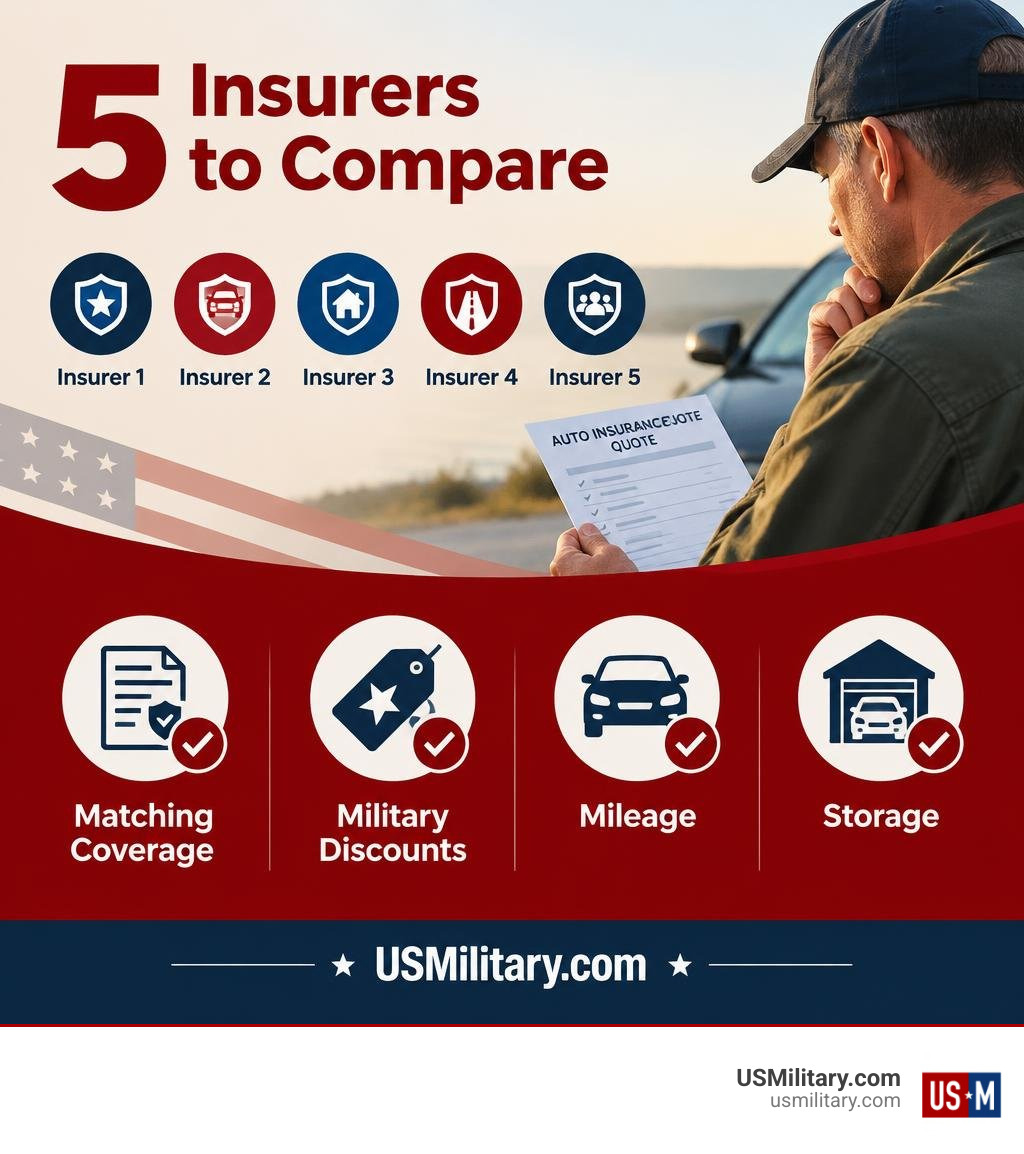
Our look at 5 Auto Insurance Companies That May Over Charge Veterans starts with USAA, GEICO, Farmers, Progressive, and Allstate. That does not mean these companies overcharge every veteran. USAA faces allegations about pricing for enlisted members, while discounts and base rates at other insurers can vary by driver and state. Compare the final price for the same coverage, not just the advertised military discount.
Before you renew, ask each insurer to verify your service discount, annual mileage, and garaging address. If your car will sit unused during a deployment, ask about storage coverage rather than canceling your policy.
I’m Larry Fowler, a Navy veteran, BUD/S Class 89 graduate, and publisher of USMilitary.com. In 5 Auto Insurance Companies That May Over Charge Veterans, I’ll help you identify rate traps and ask the right questions when comparing quotes.
Quick 5 Auto Insurance Companies That May Over Charge Veterans definitions:
5 Auto Insurance Companies That May Over Charge Veterans and How Pricing Traps Work
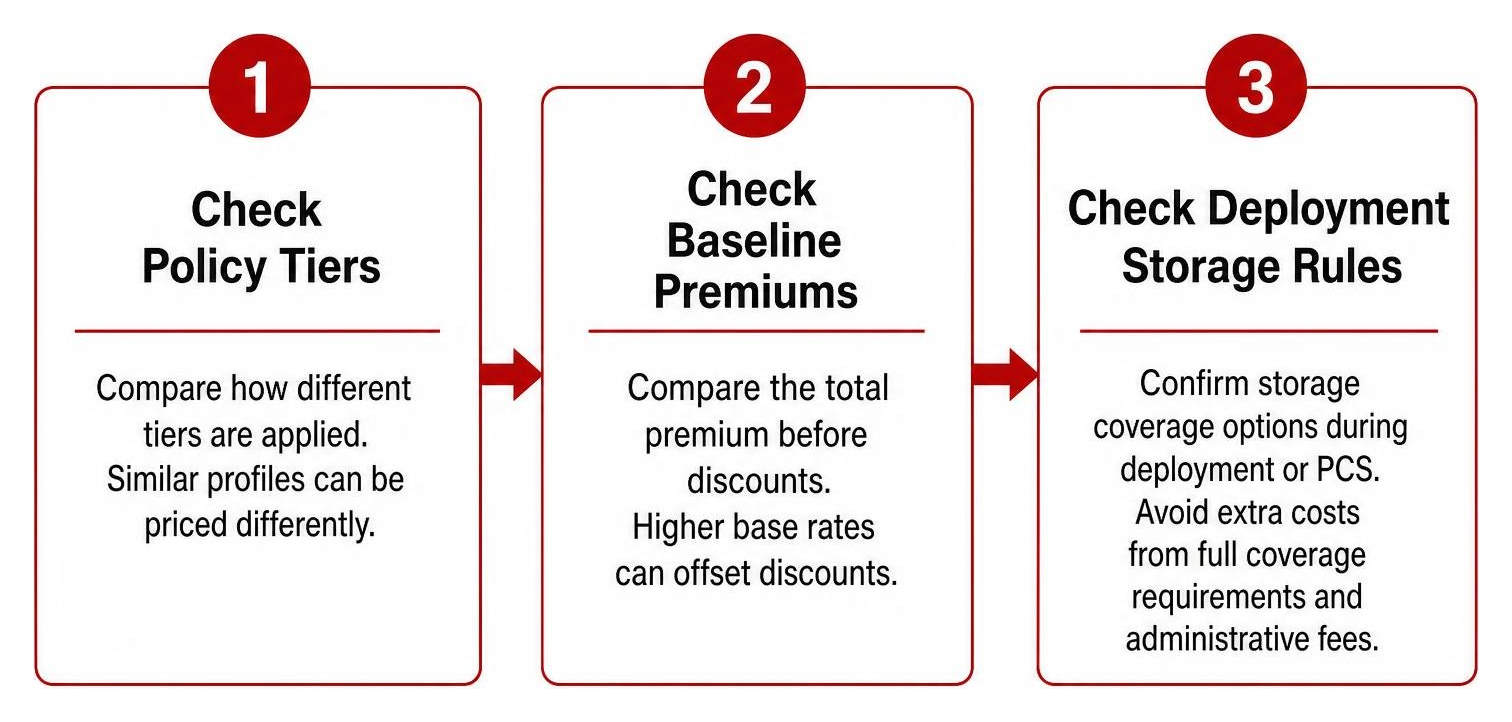
Many drivers assume that an insurer offering a dedicated military discount will naturally provide the lowest total rate. However, a major pricing trap occurs when an insurer applies a 10% to 15% discount to an inflated baseline premium. For example, a 15% discount on a $2,400 annual policy results in a $2,040 premium, which is still higher than a company offering a $1,600 base rate with no military discount at all.
Marketing campaigns often highlight military support while baseline premiums climb behind the scenes. In fact, regulatory and legal filings have put a spotlight on these pricing dynamics. A notable example is when a California judge grants class-action status to USAA lawsuit, focusing on how corporate structures and tiering impact what drivers actually pay out of pocket.
| Insurance Carrier | Advertised Military Discount | Average Annual Military Premium | Potential Cost Driver |
|---|---|---|---|
| USAA | Storage up to 60%, On-Base up to 15% | ~$1,628 | Subsidiary tiering disparities |
| GEICO | Up to 15% (Up to 25% deployed) | ~$2,159 | Higher baseline rates in specific metro areas |
| Farmers | Up to 10% | Varies by state | Geographic limits on military discount availability |
| Progressive | Up to 25% (Restricted availability) | Varies by state | Military discount limited primarily to Louisiana |
| Allstate | Affinity / Standard discounts | Higher than average | No standalone nationwide military rate reduction |
Identifying 5 Auto Insurance Companies That May Over Charge Veterans Through Affiliate Tiering
One of the most complex pricing practices involves corporate subsidiary tiering. Under this model, an insurance group operates multiple underwriting companies under one brand umbrella. Commissioned officers might be placed in the parent reciprocal company with preferred rates, while enlisted service members (pay grades E-1 through E-6) are placed into higher-priced subsidiaries.
Legal filings in cases such as the Coleman et al. v. USAA class action complaint allege that enlisted personnel were charged collision base rates up to 74.7% higher than officer base rates for identical coverage profiles. When risk relativities for mileage, age, and location are multiplied by a higher base rate, enlisted veterans can end up paying 25% to 27% more per year without realizing they are in a different pricing tier.
Red Flags in 5 Auto Insurance Companies That May Over Charge Veterans on Deployment Coverage
Another common area where costs spiral is during overseas assignments or Permanent Change of Station (PCS) relocations. Certain carriers fail to offer true comprehensive-only vehicle storage options, forcing service members to maintain full liability coverage on an automobile locked in a garage for nine months.
Additionally, administrative fees, unexpected policy adjustment charges during state-to-state relocations, and failing to adjust garaging ZIP codes promptly can lead to quiet premium creep.
The 5 Essential Do’s for Military Drivers Seeking Lower Rates

✉ Get updates like this in your inbox
Weekly VA benefit changes, pay updates, and money tips for service members, veterans, and military families. Free, no spam.
Securing the best premium requires an active approach to shopping and policy management. As we explain when covering the ultimate guide to military benefits, financial protection starts with knowing how your service impacts your civilian expenses. You can also explore the best cheap veteran and military car insurance options to establish current market benchmarks.
Here are the five essential things you should do:
- Benchmark against industry averages: Compare your rate against average annual benchmarks like USAA ($1,628) and GEICO ($2,159) to see where your quote falls.
- Bundle your policies: Combine auto coverage with your homeowners, renters, or life insurance to capture multi-policy savings between 5% and 25%.
- Claim on-base garaging credits: If you live or garage your car on a secure military base, ask for on-base comprehensive discounts of up to 15%.
- Optimize deductibles: Raising collision and comprehensive deductibles from $500 to $1,000 can reduce your physical damage premiums by 15% to 30%, provided you maintain an emergency fund.
- Shop at every renewal cycle: Request side-by-side quotes for identical liability limits ($100k/$300k/$100k or higher) every 6 to 12 months.
Verify All Military Affiliations and Proof of Service
Carriers rarely apply military rate reductions automatically. You must actively provide official proof of military affiliation to trigger internal discount codes.
Acceptable documentation typically includes:
- Form DD-214 (Certificate of Release or Discharge from Active Duty)
- Leave and Earnings Statements (LES)
- NGB-22 forms for National Guard personnel
- State driver’s licenses with official veteran designations
- Membership proof with veteran service organizations (e.g., AUSA, MBA) to unlock stacked affinity discounts
Leverage Deployment Storage and Low-Mileage Credits
If you are facing deployment or drive infrequently as a civilian veteran, do not pay for daily commuter coverage. Specialized military policies allow you to place vehicles into comprehensive-only “storage status,” which cuts premium expenses by up to 60% while preserving protection against theft, fire, hail, and vandalism.
If you drive under 7,500 miles annually, ensure your insurer updates your classification to a low-mileage tier or consider opt-in telematics tracking programs that reward safe, low-mileage driving.
The 5 Costly Don’ts That Lead to Overpaying on Auto Insurance
Avoiding pricing mistakes is just as vital as finding discounts. Making smart coverage choices is part of our strategy in the veterans guide to not leaving money on the table.
Keep these five critical “don’ts” in mind:
- Don’t drop continuous coverage: Never completely cancel a policy before a new one is active; even a one-day lapse can push you into a high-risk underwriting tier.
- Don’t carry redundant add-ons: If you already have roadside assistance through an auto club or secondary household vehicles, avoid paying extra for roadside and rental reimbursement riders.
- Don’t ignore credit scores: In most states, insurers calculate credit-based insurance scores. Keeping your credit healthy directly lowers your baseline premium.
- Don’t buy minimum liability: State minimum limits are often too low to protect your savings and home equity after an accident. Aim for limits that match your overall net worth.
- Don’t assume past pricing remains competitive: Insurers regularly adjust territory risk models, meaning the cheapest carrier three years ago may now be overcharging you.
Don’t Assume Branded Military Insurers Are Always Cheapest
Brand loyalty can be costly. Even if a provider claims deep military roots, variations in regional claims, vehicle types, and corporate underwriting structures mean standard civilian insurers might offer lower total premiums. Always compare bottom-line annual dollars rather than relying solely on brand marketing.
Don’t Cancel Coverage During Deployment or PCS Moves
Canceling auto coverage while deployed or in transit between duty stations creates an insurance lapse on your state driving record. When you reapply, standard carriers will categorize you as a high-risk driver, leading to rate increases of 20% to 50% that can take 36 months to clear. Instead, request storage status and check your state’s vehicle registration rules regarding stored vehicles.
Frequently Asked Questions About Military Auto Insurance Overcharges
What proof do veterans need to get an auto insurance discount?
Veterans can prove eligibility by submitting a copy of their DD-214 discharge paperwork, an active military ID, an LES statement, an NGB-22 form, or a state driver’s license displaying an official veteran designation.
How much can veterans actually save on car insurance?
Standard military affiliation discounts range from 5% to 15% off base premiums. However, specialized deployment storage can reduce comprehensive and collision costs by up to 60%, and states like Louisiana mandate a 25% liability discount for active personnel and reservists.
Is USAA or GEICO always the cheapest option for veterans?
No. While USAA averages roughly $1,628 annually and GEICO averages $2,159, individual rates depend heavily on your driving history, vehicle type, credit-based insurance score, and ZIP code. Comparing quotes across multiple carriers is the only reliable way to guarantee the lowest price.
Conclusion
Finding affordable auto insurance as a veteran requires looking beyond marketing slogans and advertised percentage discounts. By benchmarking baseline rates, watching for corporate affiliate tiering, maintaining continuous coverage, and utilizing vehicle storage credits when deployed, you can protect your hard-earned benefits and keep your family’s budget intact.
Take control of your household finances by exploring our comprehensive guide to U.S. veteran benefits to ensure you are maximizing every resource available to you.
Free for Service Members & Veterans
Get the military benefits intel no one tells you about.
Weekly updates on VA benefits, pay changes, and money tips — free for service members and veterans.
No spam. Unsubscribe anytime. Your info is never shared.


Leave a Reply