How the VA Disability Process Works

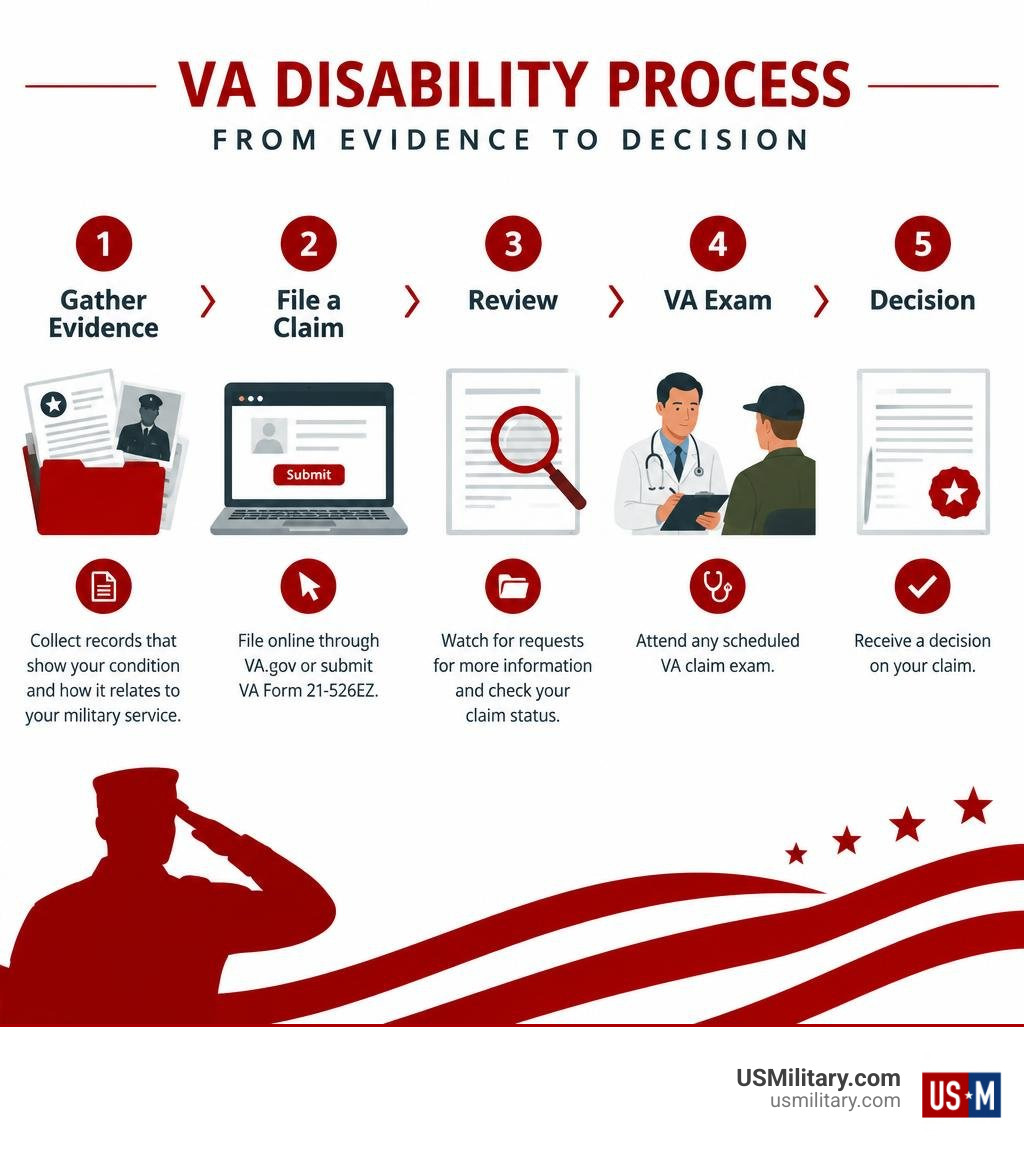
To start the VA disability process, gather records that show your condition and how it relates to your military service. File online through VA.gov or submit VA Form 21-526EZ. Then watch for requests for more information, attend any scheduled VA claim exam, and check your claim status until you receive a decision. If you are not ready to file, an Intent to File may help protect an earlier benefit date while you gather evidence.
I’m Larry Fowler, a Navy veteran and BUD/S Class 89 graduate. Since 2007, I’ve published helpful information for military veterans through the USMilitary.com network, including practical guidance on navigating every stage of the VA disability process effectively.
Explore more about VA disability process:
Preparing for the VA Disability Process and Gathering Evidence
Understanding Required Evidence and Service Connection
Securing disability compensation requires proving that your current medical condition connects directly to your military service. We always advise starting with a solid foundation of documentation. Having detailed paperwork upfront avoids unnecessary delays and keeps raters focused on your core symptoms.
To establish direct service connection, the Department of Veterans Affairs requires three basic elements:
- A current physical or mental diagnosis from a medical provider.
- An in-service event, injury, illness, or aggravation.
- A medical link—known as a nexus—connecting your current diagnosis to your military service.
You should compile your military personnel files, including your DD Form 214 and Service Treatment Records (STRs). Add any treatment documents from private healthcare providers and VA medical centers. When official military medical entries are sparse, lay and buddy statements from fellow service members, spouses, or friends can confirm when symptoms began. Clear personal statements add valuable context regarding how your daily life and working capability are altered.
If you are unsure whether your diagnosis meets the standard, review what conditions qualify for veteran disability benefits before submitting paperwork.
Filing an Intent to File vs. Starting an Online Claim
If you need time to collect medical documentation, you can preserve your effective date by notifying the VA of your plan to apply. Submitting VA Form 21-0966 (Intent to File) establishes an official placeholder date. You then have up to 365 days (one full year) from that date to submit your completed claim packet and supporting evidence.
When the VA approves your claim, your monthly compensation pays back to that initial effective date. We cover this topic thoroughly in our guide to calculating your VA retroactive benefits.
If you apply directly through the VA.gov portal, you do not need to mail a separate Form 21-0966. Starting an online application automatically creates your Intent to File in the system and locks in your effective date for 365 days.
How to File Your Claim: 5 Submission Methods
Exploring Methods to Submit Your VA Disability Process Application
Veterans can submit disability claims through several official channels. Pick the method that best matches your comfort level and timeline:
| Method | Submission Channel | Key Requirement / Destination |
|---|---|---|
| Online | VA.gov Portal | Digital upload; immediate confirmation within 1 hour |
| Janesville Intake Center | VA Form 21-526EZ to PO Box 4444, Janesville, WI 53547-4444 | |
| In Person | VA Regional Office | Physical drop-off with a regional claims counselor |
| Fax | Centralized Intake Fax | Domestic: (844) 531-7818 | International: (248) 524-4260 |
| Accredited Rep | VSO / Claims Agent / Attorney | Signed Power of Attorney to submit on your behalf |
To learn more about standard application procedures, read the official guidance on how to file a VA disability claim and our step-by-step disability application guide.
Standard Claims vs. the Fully Developed Claims Program
When filing VA Form 21-526EZ, you can choose between a standard claim and the Fully Developed Claims program.
In a Fully Developed Claim (FDC), you submit all private medical evidence, service records, and statements upfront while certifying that you have no additional evidence to offer. This allows VA raters to bypass lengthy external evidence requests and make faster decisions.
If the VA discovers that additional private records are required, your file moves to the standard claim process without any penalty or loss of effective date. For Army and Air Force veterans affected by the 1973 National Personnel Records Center fire in St. Louis, the VA uses specialized reconstruction protocols to replace lost military files. For a deeper breakdown of claim types, see the complete guide to VA disability claims. Make sure you maintain copies of every paper submitted for your personal files.
The 8 Internal Stages of the VA Claim Adjudication
Navigating the Post-Filing Steps in the VA Disability Process

Once submitted, every claim moves through eight structured adjudication phases:
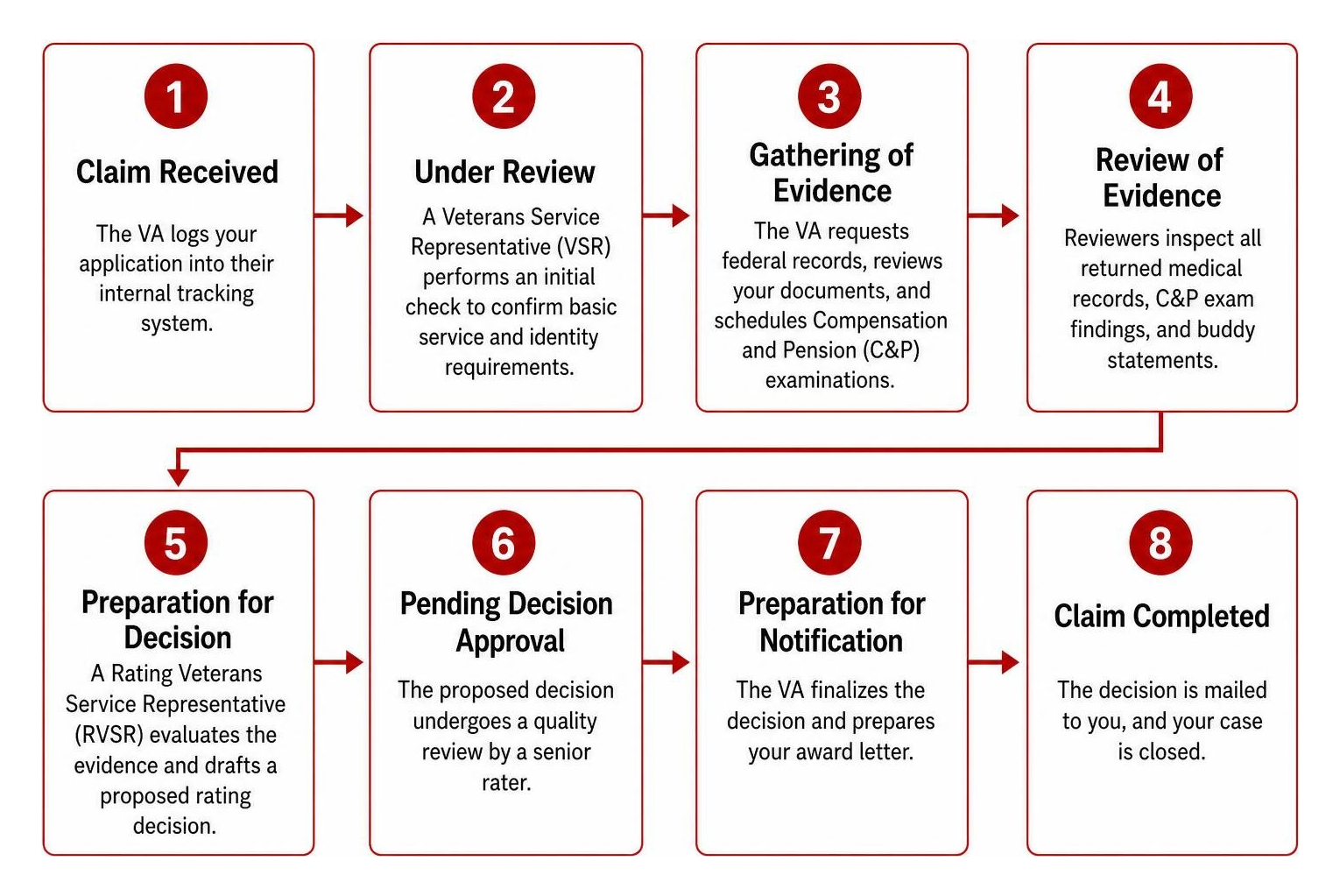
- Claim Received: The VA logs your application into their internal tracking system.
- Under Review: A Veterans Service Representative (VSR) performs an initial check to confirm basic service and identity requirements.
- Gathering of Evidence: The VA requests federal records, reviews your documents, and schedules Compensation and Pension (C&P) examinations.
- Review of Evidence: Reviewers inspect all returned medical records, C&P exam findings, and buddy statements.
- Preparation for Decision: A Rating Veterans Service Representative (RVSR) evaluates the evidence and drafts a proposed rating decision.
- Pending Decision Approval: A senior adjudicator reviews the recommended rating for policy compliance.
- Preparation for Notification: Staff compile the official rating packet, complete administrative checks, and draft your award letter.
- Complete: The VA finalizes the claim and issues your official rating decision packet.
Official details on these internal steps are available directly through the VA compensation process portal and VA post-filing guidelines.
Average Claim Timelines and Tracking Your Status
Disability claims took an average of 81.1 days in late 2025, and current performance metrics show disability-related claims completing in an average of 68.2 days.
The longest phase is Step 3 (Gathering of Evidence), which typically runs 30 to 90+ days. Submitting new evidence while your claim is in Step 4, 5, or 6 moves the application back to Step 3 so the new records can be reviewed.
You can monitor your application’s progress directly through the VA.gov claim status tool and review our breakdown on navigating the VA claim process properly. Staying proactive helps you respond immediately if the agency requests more details.
Understanding Decision Letters, Ratings, and Appeals
Evaluating Disability Ratings and Monthly Compensation
Your completed rating decision outlines your service connection status, assigned percentage (from 0% to 100%), and monthly compensation rate. The VA combines individual ratings using a non-additive scale (“VA math”) based on remaining whole-person efficiency.
Physical decision packets typically arrive by mail within 10 business days of completion, but you can download an electronic copy immediately from VA.gov once the claim status switches to Complete. To check how your combined percentages convert into monthly compensation, see our 2026 VA disability rating chart and our overview of 2026 VA disability payment rates.
Decision Review Pathways When Disagreeing with an Outcome

If the VA denies service connection or assigns a rating lower than your symptoms warrant, you can pursue three decision review pathways:
- Supplemental Claim: Submit new and relevant evidence using VA Form 20-0995. Read our guide on reopening claims with Form 20-0995.
- Higher-Level Review: Request that a senior adjudicator re-examine the existing record without adding new evidence.
- Board of Veterans’ Appeals: Appeal your case directly to a Veterans Law Judge in Washington, D.C.
If you plan to challenge a claim outcome, review our guide on turning a VA claim denial into an appeal. Choosing the right review pathway protects your effective filing date while addressing specific rating errors.
Frequently Asked Questions About the VA Disability Process
How long does the VA disability claim process take on average?
As of late 2026, disability-related claims average 68.2 days to complete. Complex claims with multiple conditions, secondary claims, or delayed private medical records can take longer.
What happens if I submit new evidence during the rating phase?
Submitting new medical evidence while your claim is in Step 4, Step 5, or Step 6 returns the claim to Step 3 (Gathering of Evidence). To keep your claim moving smoothly, try to submit all relevant evidence upfront with your initial filing.
Can I apply for VA health care while my disability claim is processing?
Yes. Health care enrollment is evaluated separately through VA Form 10-10EZ. Turnaround times for health care applications usually take less than one week. Learn how to get started through the official guide on how to apply for VA health care. Enrolling early ensures you receive comprehensive medical care while waiting on disability decisions.
Conclusion
Navigating your VA benefits comes down to thorough preparation, organized service records, and clear medical evidence. Whether you file online or work alongside an accredited Veterans Service Organization representative, collecting your records early gives your claim the strongest possible foundation.
We invite you to explore military and veteran resources on USMilitary.com for ongoing updates on disability ratings, military benefits, and transition assistance to help you secure the benefits you earned.
Free for Service Members & Veterans
Get the military benefits intel no one tells you about.
Weekly updates on VA benefits, pay changes, and money tips — free for service members and veterans.
No spam. Unsubscribe anytime. Your info is never shared.



Leave a Reply