Which Military Branch Has the Greatest Number of College-Degreed Members?
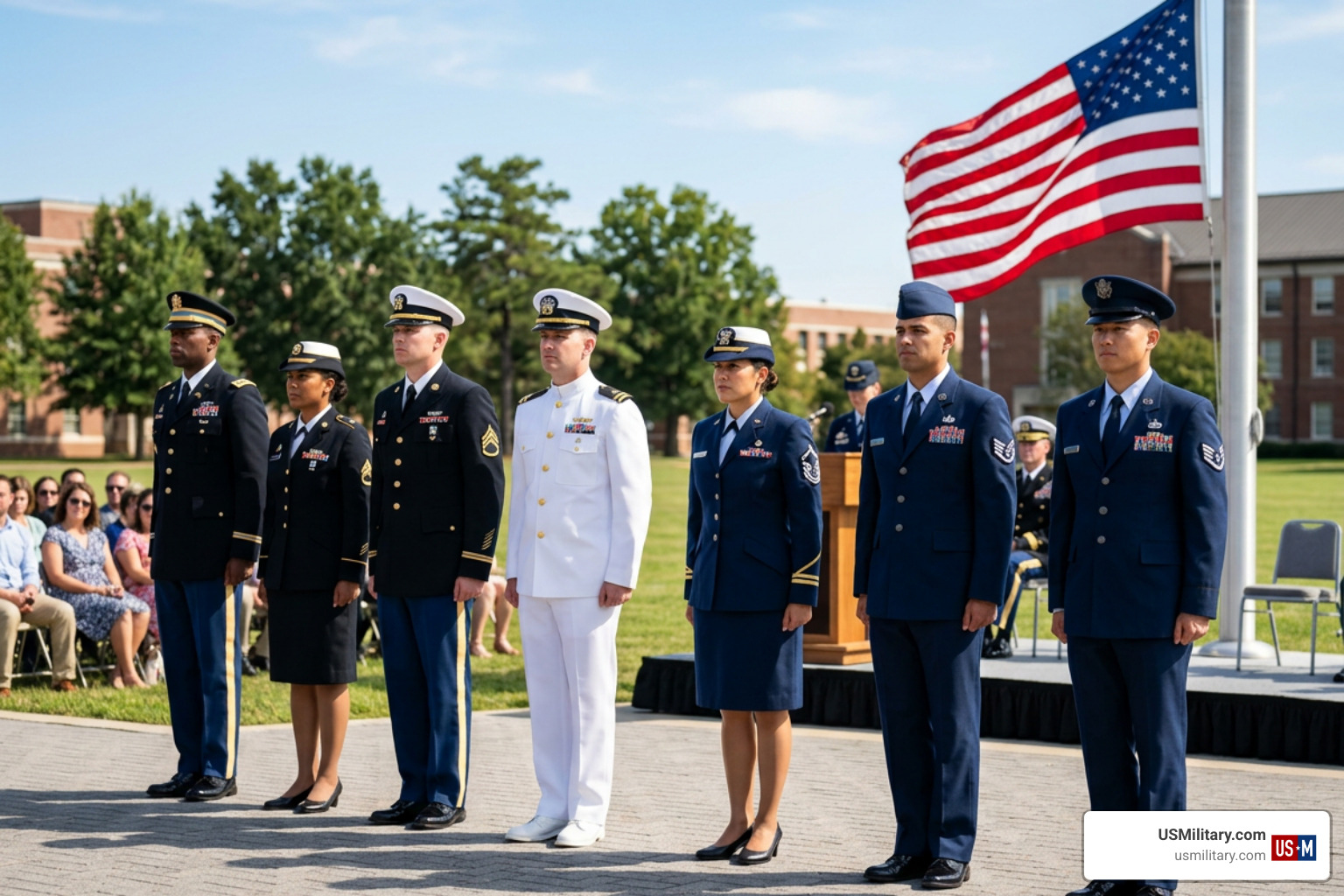
Which military branch has the greatest number of college-degreed members depends on how you measure it — raw headcount or percentage of the force.
Here is the quick answer:
| Branch | Bachelor’s Degrees | Advanced Degrees | Total Degreed | % of Force |
|---|---|---|---|---|
| Army | 78,655 | 41,526 | 120,181 | ~24.9% |
| Air Force (DAF) | 51,617 | 39,738 | 91,355 | ~27.8% |
| Navy | 42,169 | 23,258 | 65,427 | ~19.1% |
| Marine Corps | 18,223 | 4,809 | 23,032 | ~12.8% |
By raw numbers: The U.S. Army has the most college-degreed members — over 120,000 — simply because it is the largest branch.
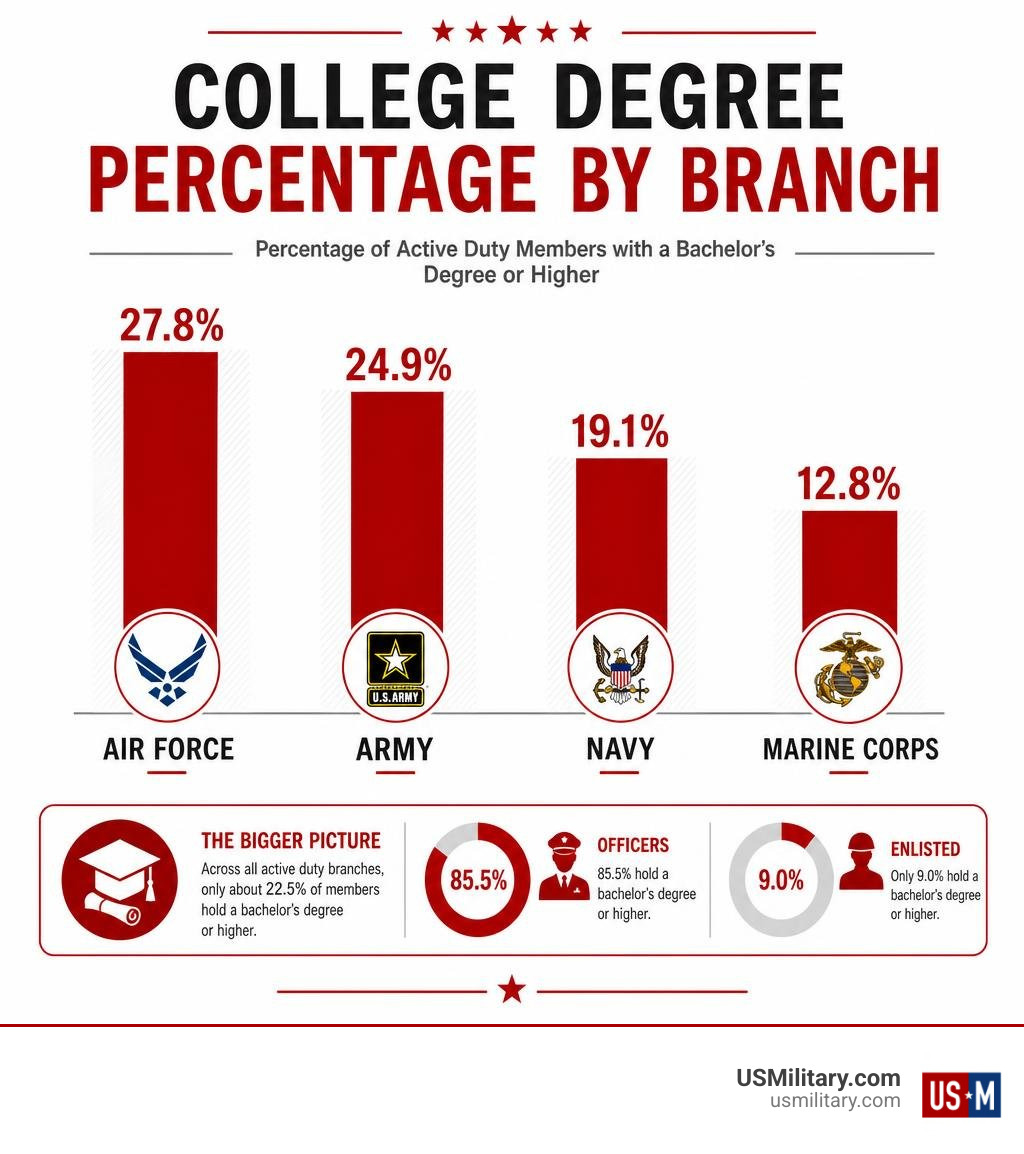
By percentage of force: The Air Force leads, with the highest proportion of advanced degree holders (12.1% of its force) and the most educated overall profile relative to its size.
So the answer depends on your question. If you want volume, the Army wins. If you want educational density, the Air Force comes out on top.
The bigger picture: across all active duty branches, only about 22.5% of members hold a bachelor’s degree or higher. That number jumps to 85.5% among officers — and drops to just 9.0% among enlisted personnel. The gap is enormous, and it shapes everything about how branch-level education stats look.
I’m Larry Fowler, publisher of USMilitary.com since 2007, and I’ve spent nearly two decades helping servicemembers and veterans navigate exactly these kinds of questions — including which military branch has the greatest number of college-degreed members and what that means for your career path. In the sections below, we’ll break down the numbers branch by branch so you can make a confident, informed decision.
Know your Which Military Branch Has The Greatest Number of College Degreed Members terms:
Which Military Branch Has The Greatest Number of College Degreed Members?
When analyzing which military branch has the greatest number of college degreed members, we have to separate raw totals from force percentages. Headcount numbers favor the largest branch, while proportional metrics reveal organizational structure and technical demands.
The United States Armed Forces consists of distinct service components, each structured around specific tactical and operational requirements. If you review our Complete Guide to Branches of the Military, you will quickly see that the U.S. Army maintains a far larger overall headcount than any other service branch. Because the Army has roughly 481,000 active duty service members, its sheer size gives it a massive advantage in sheer volume.
However, total headcount alone doesn’t tell the full story. The U.S. Air Force operates with a significantly lower enlisted-to-officer ratio and heavy structural emphasis on technical specializations. As a result, when looking at educational attainment as a percentage of total active strength, the Air Force outpaces all other branches.
Understanding this dynamic requires looking at official Department of Defense (DoD) demographic census data tracking educational attainment across the U.S. Army, U.S. Air Force, U.S. Navy, and U.S. Marine Corps.
Key Raw Numbers: Which Military Branch Has The Greatest Number of College Degreed Members by Total Count?
If we evaluate which military branch has the greatest number of college degreed members purely by total headcount, the U.S. Army takes first place by a wide margin.
According to official Department of Defense data featured in the 2022 USAF & USSF Almanac: DOD Personnel | Air & Space Forces Magazine , the active duty Army includes:
- 78,655 members holding a Bachelor’s degree (16.3% of the Army force)
- 41,526 members holding an Advanced degree (master’s, doctorate, or professional degrees, representing 8.6%)
- 27,631 members holding an Associate degree (5.7%)
Combining bachelor’s and graduate-level degrees, the Army boasts 120,181 active duty members with at least a four-year degree.
Here is how the four primary active duty services stack up in absolute college-degreed headcount:
- U.S. Army: 120,181 total bachelor’s and advanced degree holders (out of 481,254 total personnel).
- U.S. Air Force (including Space Force): 91,355 total bachelor’s and advanced degree holders (out of 329,614 total personnel).
- U.S. Navy: 65,427 total bachelor’s and advanced degree holders (out of 341,996 total personnel).
- U.S. Marine Corps: 23,032 total bachelor’s and advanced degree holders (out of 180,958 total personnel).
The Army wins the total headcount contest simply because it commands the largest military force. However, when we adjust for total personnel strength, the ranking changes dramatically.
Percentage Breakdown: Which Military Branch Has The Greatest Number of College Degreed Members Relative to Force Size?
When evaluating which military branch has the greatest number of college degreed members as a proportion of total active personnel, the Department of the Air Force claims top honors.
Data published in the 2021 USAF & USSF Almanac: DOD Personnel | Air & Space Forces Magazine highlights the educational density of the Air Force:
- 15.7% of active Air Force personnel hold a Bachelor’s degree (51,617 members).
- 12.1% hold an Advanced degree (39,738 members) — the highest percentage across the entire Department of Defense.
- 18.5% hold an Associate degree (61,063 members).
When combining bachelor’s and advanced degrees, 27.8% of active duty Air Force personnel hold a four-year college degree or higher.
A major driver behind the Air Force’s massive numbers in associate-level educational attainment is the Community College of the Air Force (CCAF). The CCAF is a regionally accredited institution that automatically awards Enlisted Airmen college credit for their technical school training and military occupational specialty (MOS/AFSC) instruction. As a result, 18.5% of Air Force personnel possess an associate degree, compared to just 5.7% in the Army, 6.8% in the Navy, and 2.2% in the Marine Corps.
If you include Associate degrees alongside Bachelor’s and Advanced degrees:
- Air Force: 46.3% of total active personnel hold a college degree (Associate degree or higher).
- Army: 30.6% of total active personnel hold a college degree.
- Navy: 25.9% of total active personnel hold a college degree.
- Marine Corps: 15.0% of total active personnel hold a college degree.
For applicants looking for a culture heavily centered on higher education, technical certification, and structured college degree progress during active service, the Air Force presents the highest overall educational concentration.
Comparing Officer vs. Enlisted Education Across Military Branches
To understand why military degree numbers look the way they do, we must examine the divide between commissioned officers and enlisted service members.
Across the total Department of Defense force, degree attainment is heavily concentrated in the officer corps:
- Active Duty Officers: 85.5% hold a bachelor’s degree or higher.
- Active Duty Enlisted: 9.0% hold a bachelor’s degree or higher.
Because a bachelor’s degree is a universal mandatory entry requirement for commissioning as a standard military officer, virtually 100% of non-warrant commissioned officers enter service with a four-year college degree. The small percentage of officers who do not register a bachelor’s degree in demographics reports typically consists of specialized warrant officer tracks or prior-enlisted commissioned officers completing final degree requirements.
If you are weighing your entry options, read our guide on Should I Be a Military Officer or Enlisted? to see how your education directly dictates your starting rank, compensation structure, and leadership authority.
For enlisted members, a high school diploma or GED is the primary requirement for enlistment. However, post-college enlistment has expanded rapidly in recent years. As detailed by Joining the Military With a College Degree: Rank + Benefits | Outlier , entering the enlisted ranks with college credits or a completed degree allows recruits to enlist at elevated pay grades (such as E-3 or E-4) while taking advantage of federal student loan repayment programs.
The Enlisted-to-Officer Ratio Impact on Branch Statistics
A branch’s overall educational profile depends heavily on its enlisted-to-officer ratio. Because officers almost universally hold college degrees, any branch with a higher percentage of officers will naturally report higher overall degree metrics.
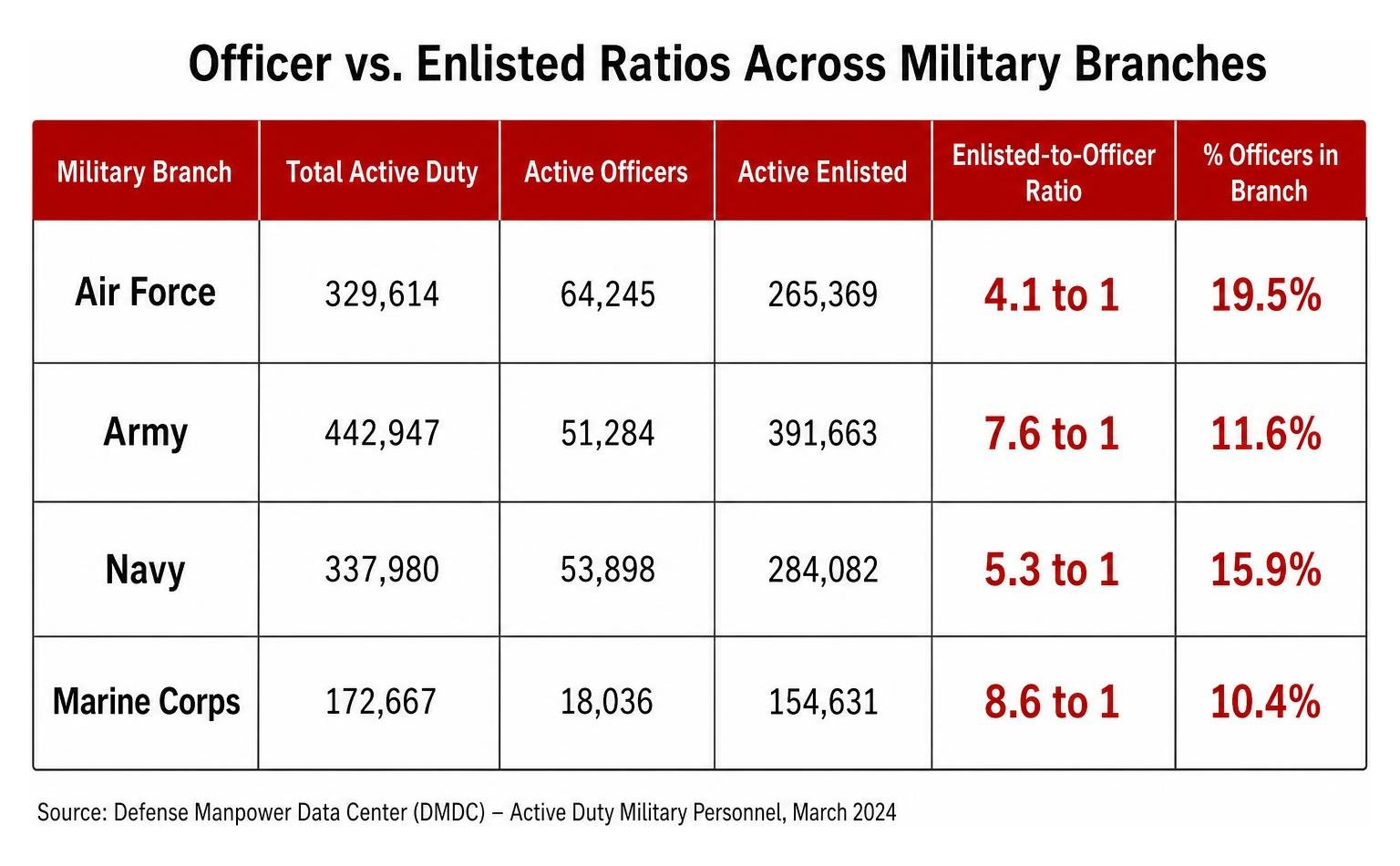
Notice how officer distribution shifts across service branches:
| Military Branch | Total Active Duty | Active Officers | Active Enlisted | Enlisted-to-Officer Ratio | % Officers in Branch |
|---|---|---|---|---|---|
| Air Force | 329,614 | 64,245 | 265,369 | 4.1 to 1 | 19.5% |
| Navy | 341,996 | 55,224 | 286,772 | 5.2 to 1 | 16.1% |
| Army | 481,254 | 74,013 | 407,241 | 5.5 to 1 | 15.4% |
| Marine Corps | 180,958 | 21,450 | 159,508 | 7.4 to 1 | 11.9% |
The Air Force maintains the lowest enlisted-to-officer ratio in the Armed Forces at 4.1 enlisted members per officer. Nearly 1 out of every 5 active duty Air Force personnel is an officer. Because officers carry bachelor’s and graduate degrees, this structural ratio lifts the Air Force’s overall college degree statistics.
Conversely, the Marine Corps operates with a 7.4 to 1 ratio, where officers make up only 11.9% of total strength. This tactical force structure relies heavily on non-commissioned officer (NCO) leadership on the ground, which naturally lowers the branch’s total percentage of college-degreed personnel.
To learn more about how technical requirements influence force structure and intelligence testing across military services, check out our analysis on Which Military Branch Has the Highest IQ?.
Enlisted Degree Attainment and Post-College Enlistment
While officers account for the majority of four-year degrees, 9.0% of active duty enlisted members hold a bachelor’s degree or higher — up from 4.9% in 2010. Furthermore, tens of thousands of enlisted personnel earn college degrees during active duty service by using Tuition Assistance (TA) and military college credit conversions.
Why would a college graduate enlist rather than apply for Officer Candidate School (OCS) or Officer Training School (OTS)?
- Guaranteed Career Field: Enlistment contracts allow applicants to select their specific Military Occupational Specialty (MOS/AFSC) upfront, whereas officer commissioning paths assign branch branches based on class ranking and service needs.
- Student Loan Repayment Program (LRP): Services like the Army and Navy offer up to $65,000 in direct student loan repayment for qualified enlistment contracts.
- Accelerated Entry Rank: Enlisting with a completed Bachelor’s degree enables candidates to enter active duty as an E-4 (Specialist in the Army) or E-3 in other branches, instantly earning higher basic pay than standard E-1 recruits.
- Immediate Security Clearance and Training: Enlisting provides fast-track access to top-secret security clearances and specialized intelligence or cyber training.
If you already hold a degree or college credits and are weighing enlistment against commissioning, review our complete walk-through on Joining the Military After College.
Advanced Degrees, Reserve Components, and Specialized Career Fields
When answering which military branch has the greatest number of college degreed members, we must also look at post-graduate education (master’s, professional, and doctorate degrees), the Selected Reserve, and specialized technical fields.
Graduate-level education in the military is heavily tied to promotion requirements for senior officer pay grades (O-4 Field Grade Officers through O-10 General/Flag Officers), specialized medical professions, judge advocate general (JAG) legal corps, and scientific research units.

According to the research report on Undergraduate Military Learners: , service members actively engage in higher education throughout their careers, using military tuition benefits to advance through professional ranks.
Advanced Degree Concentrations and High-IQ Pay Grades
The Air Force leads all branches in advanced degree concentration, with 12.1% of its active duty members holding a Master’s, Doctorate, or Professional degree.
Here is how advanced degree holders are distributed across military services:
- U.S. Army: 41,526 members (8.6% of active force)
- U.S. Air Force: 39,738 members (12.1% of active force)
- U.S. Navy: 23,258 members (6.8% of active force)
- U.S. Marine Corps: 4,809 members (2.7% of active force)
Advanced degrees are strongly concentrated within technical, aviation, cyber, medical, and strategic intelligence leadership roles. Officers in pay grades O-4 (Major / Lieutenant Commander) and above are frequently required or strongly incentivized to complete Intermediate Level Education (ILE) and Master’s degrees through institutions like the Naval War College, Air University, or civilian university partnerships.
For a closer look at technical job fields requiring advanced cognitive testing and academic credentials, explore our guide to Military Jobs Requiring a High IQ.
Selected Reserve vs. Active Duty Education Trends
An interesting demographic reality emerges when comparing Active Duty forces to the Selected Reserve (including the Army National Guard, Air National Guard, and Armed Forces Reserves).
The Selected Reserve features a higher percentage of college degree holders than Active Duty forces.
According to official figures in the 2020 Demographics Report :
- Selected Reserve Overall: 25.4% hold a bachelor’s degree or higher (compared to 22.5% on Active Duty).
- Selected Reserve Officers: 88.5% hold a bachelor’s degree or higher.
- Selected Reserve Enlisted: 12.6% hold a bachelor’s degree or higher (compared to 9.0% on Active Duty).
Why is education higher in the Guard and Reserves?
- Dual Civilian-Military Careers: Reservists and National Guard members maintain full-time civilian careers or attend civilian universities full-time while serving part-time.
- State Tuition Waiver Benefits: Many states offer 100% free tuition at state universities for active National Guard members, driving up enlistment among college students and graduates.
- Ten-Year Upward Trend: Between 2010 and 2020, active duty enlisted degree holders grew from 4.9% to 9.0%, while active officer degree holders rose from 82.7% to 85.5%. Higher educational requirements across all civilian and military job markets continue to drive this upward trend.
Frequently Asked Questions About Military College Degrees
What percentage of active duty military members hold a college degree?
Across all military branches of the U.S. Armed Forces, 22.5% of active duty service members hold a bachelor’s degree or higher.
However, there is a substantial difference between rank tiers:
- Officers: 85.5% possess a bachelor’s degree or higher.
- Enlisted Personnel: 9.0% possess a bachelor’s degree or higher.
When including Associate degrees, approximately 31.4% of all active duty service members hold an accredited college degree.
Can you enter the military as an officer without a college degree?
Generally, no. A four-year Bachelor’s degree from an accredited university is a mandatory baseline requirement to earn a commission as an officer in the Army, Navy, Air Force, Marine Corps, Space Force, or Coast Guard.
There are two primary exceptions:
- Warrant Officers: Warrant officers are technical subject-matter experts. While a bachelor’s degree is highly competitive, many Army warrant officer tracks (such as rotary-wing aviators) require a high school diploma and technical experience rather than a four-year degree.
- Enlisted Commissioning Programs: Active duty enlisted members accepted into commissioning programs (such as the Navy STA-21 or Army Green to Gold) may attend college full-time to complete their bachelor’s degree before taking their oath as commissioned officers.
Which military branch has the highest percentage of advanced degree holders?
The U.S. Air Force has the highest percentage of advanced degree holders. 12.1% of active duty Air Force personnel hold a Master’s degree, Doctorate, or professional graduate degree.
By comparison, 8.6% of active Army members, 6.8% of Navy members, and 2.7% of Marine Corps members hold advanced degrees.
Conclusion
When determining which military branch has the greatest number of college degreed members, the answer comes down to headcount versus force density:
- The U.S. Army has the largest absolute volume of college degree holders, boasting over 120,000 active duty members with a bachelor’s degree or higher.
- The U.S. Air Force has the highest educational density, leading all services with 27.8% of its active force holding a four-year degree or higher, 12.1% holding advanced graduate degrees, and 18.5% holding associate degrees.
Whether you plan to enlist with an existing degree to clear student loans or seek an officer commissioning pathway through ROTC or OCS, serving in the Armed Forces provides powerful financial and career advantages.
At USMilitary.com, we are dedicated to helping service members, veterans, and prospective recruits navigate career pathways, military benefits, VA home loans, and branch comparisons. Explore Military Branch Options with USMilitary.com today to take the next step in your military and educational journey.
Free for Service Members & Veterans
Get the military benefits intel no one tells you about.
Weekly updates on VA benefits, pay changes, and money tips — free for service members and veterans.
No spam. Unsubscribe anytime. Your info is never shared.


