Understanding America’s Elite Naval Warriors
Navy SEALs are the United States Navy’s primary special operations force, representing the pinnacle of military training and operational capability. Here’s what you need to know:
- SEAL Acronym: Sea, Air, and Land – reflecting their ability to operate in all environments
- Active Force: Approximately 2,500 SEALs currently serving
- Primary Missions: Direct action, counter-terrorism, special reconnaissance, unconventional warfare, and hostage rescue
- Training Success Rate: Only about 20-25% of candidates complete the rigorous Basic Underwater Demolition/SEAL (BUD/S) training
- Age Requirements: Candidates must be between 17-28 years old (waivers available up to age 33)
- Formation: Established in January 1962 under President John F. Kennedy’s directive
- Unit Structure: Basic operational unit is a 16-man platoon
Navy SEALs trace their heritage back to World War II, when naval combat demolition units and underwater demolition teams—known as “frogmen”—destroyed obstacles on enemy-held beaches before amphibious landings. These warriors earned the nickname “Naked Warriors” for conducting dangerous daylight reconnaissance missions in just swim trunks and goggles.
The SEAL ethos captures their warrior spirit: “In times of war or uncertainty there is a special breed of warrior ready to answer our Nation’s call. Common citizens with uncommon desire to succeed.” This commitment to excellence and unwavering dedication defines every operator who earns the coveted SEAL Trident.
I’m Larry Fowler, publisher of USMilitary.com Network, and since 2007 I’ve been dedicated to providing accurate information about military careers and benefits, including detailed resources on elite forces like the Navy SEALs. This guide draws on official sources and verified information to help you understand what it takes to join these legendary warriors.

Easy navy seals glossary:
From Frogmen to Modern Warriors: The History of the Navy SEALs
When we dig into the origins of the Navy SEALs, we find a story of innovation born from necessity during World War II. Their lineage traces back to elite units that redefined naval special warfare.
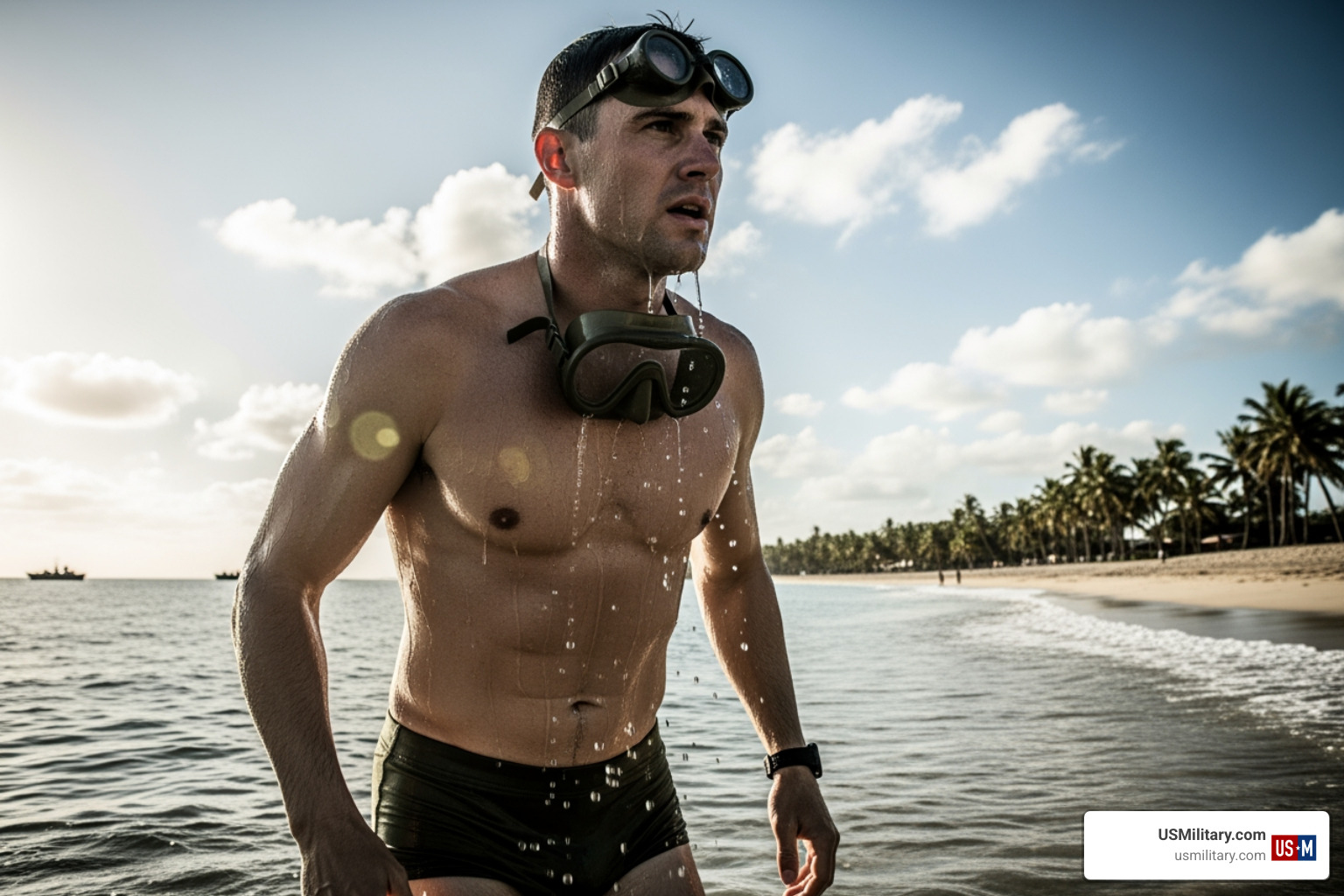
During WWII, the U.S. Navy faced the daunting task of landing troops on enemy-held beaches. To clear the path, they formed Naval Combat Demolition Units (NCDUs) and Amphibious Scouts and Raiders. These brave individuals, often called “frogmen,” were tasked with destroying obstacles and gathering intelligence in advance of amphibious assaults. Their sacrifices were immense; for instance, NCDUs suffered a staggering 52% casualty rate at Omaha Beach during Operation Overlord. These units were the forerunners of what would become the Underwater Demolition Teams (UDTs).
The UDTs continued their critical work during the Korean War, notably disrupting enemy transportation lines inland. These “Naked Warriors,” as they were sometimes called, performed daring daylight reconnaissance missions, often equipped with little more than swim trunks and goggles, showcasing incredible courage and resourcefulness.
The formal birth of the Navy SEALs came in 1962, following President John F. Kennedy’s call for increased special forces capabilities in 1961. President Kennedy recognized the need for a versatile force capable of operating across varied environments. This led to the creation of the first two Navy SEALs teams in January 1962: SEAL Team One, stationed at Naval Amphibious Base Coronado, California, and SEAL Team Two, at Naval Amphibious Base Little Creek, Virginia Beach, Virginia.
The Vietnam War quickly became a proving ground for the newly formed Navy SEALs. They engaged in a wide array of missions, from training South Vietnamese naval commandos to conducting counterguerrilla operations along riverbanks and on beaches. Their effectiveness was undeniable, though the cost was high; 48 SEALs were killed in Vietnam, with estimates of their kill count reaching as high as 2,000. By 1970, as President Richard Nixon initiated his Vietnamization plan, the Navy SEALs had firmly established their reputation as an indispensable special operations force.
In 1983, recognizing the evolving needs of naval special warfare, all remaining UDTs were redesignated as either Navy SEALs teams or units that would eventually become known as SEAL Delivery Vehicle (SDV) teams, further integrating and streamlining these elite capabilities. To dive deeper into their fascinating journey, you can learn more about SEAL history at the Navy SEAL Museum.
The Unforgiving Path: How to Become a Navy SEAL
The journey to becoming a Navy SEAL is one of the most arduous and demanding in the world. It requires extreme physical and mental fortitude, a relentless spirit, and an unwavering commitment to excellence. As the famous saying goes among the teams, “The only easy day was yesterday.” This isn’t just a motto; it’s a daily reality for those who aspire to earn the coveted SEAL Trident. The training is designed to push individuals to their absolute limits, ensuring that only the most resilient and capable succeed. The attrition rate is notoriously high, a testament to the unforgiving nature of the path.

Eligibility and Age Requirements for the Navy SEALs
Before even dreaming of Hell Week, candidates must meet stringent eligibility criteria. For those in the U.S. Navy, you can apply for Navy SEAL training between the ages of 17 and 28. We understand that life paths vary, so special waivers are available for candidates up to age 33. Beyond age, U.S. citizenship is a fundamental requirement, ensuring loyalty and dedication to our nation.
Vision requirements are also critical; candidates must possess excellent eyesight, though specific correctable vision standards apply. Additionally, strong academic performance, demonstrated by competitive scores on the Armed Services Vocational Aptitude Battery (ASVAB), is necessary.
A crucial early hurdle is the Physical Screening Test (PST), designed to assess a candidate’s baseline physical fitness. The PST includes several events, and while minimums exist, aspiring SEALs are expected to far exceed these to stand a chance:
- 500-yard swim: Maximum time of 12 minutes, 30 seconds (competitive times are often under 9 minutes)
- Push-ups: Minimum of 50 repetitions in 2 minutes (competitive candidates aim for 80-100)
- Sit-ups: Minimum of 50 repetitions in 2 minutes (competitive candidates aim for 80-100)
- Pull-ups: Minimum of 10 repetitions (no time limit, dead hang) (competitive candidates aim for 15-20+)
- 1.5-mile run: Maximum time of 10 minutes, 30 seconds (competitive times are often under 9 minutes)
Meeting these minimums is just the first step. We encourage anyone interested in this challenging path to strive for far superior scores. You can see official career requirements for the most up-to-date information.
The Crucible: BUD/S, SQT, and Hell Week
For those who pass the initial screenings, the real test begins with Basic Underwater Demolition/SEAL (BUD/S) training. This rigorous six-month program, conducted in Coronado, California, is divided into three distinct phases, each pushing candidates to their physical and mental breaking points.
The first phase focuses on physical conditioning, water competency, and teamwork. It’s during this phase that candidates face the infamous Hell Week. This grueling period lasts more than five days, during which candidates endure continuous training with minimal sleep—often no more than four hours total. It’s a non-stop barrage of physical exertion, cold, wet conditions, and psychological pressure. Hell Week is specifically designed to identify individuals who possess the mental toughness, teamwork, and unwavering determination required to be a Navy SEAL. We know that normally only about one-quarter of any candidate class completes BUD/S training, with Hell Week being a primary filter.
The second phase of BUD/S shifts focus to combat diving. Candidates learn open-circuit and closed-circuit scuba techniques, underwater navigation, and combat swimmer tactics. This phase is intense, with a strong emphasis on comfort and proficiency in the water, often under extreme stress.
The third and final phase of BUD/S is dedicated to land warfare. Here, candidates learn demolitions, reconnaissance, patrolling, small-unit tactics, and weapons proficiency. The training culminates in complex tactical exercises, preparing them for real-world combat scenarios.
Upon successful completion of BUD/S, candidates move on to SEAL Qualification Training (SQT). This advanced tactical training is another demanding phase, lasting several months, where they refine their skills in areas such as close-quarters combat, advanced demolitions, airborne operations, and cold weather survival. It’s during SQT that candidates develop the specialized skills needed for a diverse range of missions.
Finally, after successfully navigating BUD/S and SQT, these exceptional individuals earn the right to wear the Navy SEAL Trident, symbolizing their mastery of Sea, Air, and Land operations.
It’s important to acknowledge the evolving landscape of military service. Naval special warfare training was formally opened to women for the first time in 2016. In 2021, we saw the historic graduation of the first female sailor from the naval special warfare pipeline, who became a special warfare combatant-craft crewman (SWCC). While this was a significant milestone, as of now, no women have completed the rigorous Basic Underwater Demolition/SEAL (BUD/S) training to become a Navy SEAL. We continue to support all service members who aspire to these elite roles and meet the demanding standards.
Mission, Structure, and Operations of the Elite Navy SEALs
The Navy SEALs are renowned for their global deployment capabilities, operating as quiet professionals who adapt to every environment. Their primary role and mission are to conduct special operations warfare missions across the Sea, Air, and Land domains. This includes direct raids or assaults on enemy targets, special reconnaissance to gather critical intelligence, and a host of other specialized tasks that often go unseen by the public eye.
How are Navy SEAL teams structured?
The organizational structure of the Navy SEALs is designed for flexibility, rapid deployment, and operational effectiveness. At the top of the naval special warfare command structure is the Naval Special Warfare Command (NSW). Under NSW, there are several Naval Special Warfare Groups (NSWGs).
The primary operational units are the Navy SEALs Teams. These teams are geographically divided: SEAL Team One and its subordinate units operate under Naval Special Warfare Group One (NSW Group One) on the West Coast (Coronado, California), while SEAL Team Two and its subordinate units operate under Naval Special Warfare Group Two (NSW Group Two) on the East Coast (Little Creek, Virginia Beach, Virginia).
The basic operational unit within a SEAL Team is the platoon, numbering approximately 16 men. This 16-man platoon is further divided into two squads, and each squad can be broken down into two four-man fire teams. This modular structure allows for incredible adaptability, enabling teams to deploy as a full unit for larger missions or as smaller, highly specialized elements for more discreet operations. Within these platoons, individuals hold specialized roles, such as communicators, snipers, breachers, and medics, ensuring a comprehensive skill set for any scenario.
Additionally, we have SEAL Delivery Vehicle (SDV) Teams. These specialized units operate submersible craft designed for covert insertion and extraction of SEALs and their equipment in maritime areas, extending the reach and stealth capabilities of naval special warfare.
Notable Engagements and Modern Capabilities
The Navy SEALs have a long and distinguished history of critical engagements and operations, many of which have shaped global events.
One of the earliest post-Vietnam operations with significant SEAL involvement was Operation Urgent Fury in Grenada in 1983. This mission, however, tragically highlighted the extreme risks involved, as four SEALs drowned during a challenging combat airborne water insertion. Later, in 1989, SEALs played a role in Operation Just Cause in Panama.
During the Iran-Iraq War (1987-88), Navy SEALs were instrumental in protecting merchant shipping in the Persian Gulf. They continued their vital work in the region during the Persian Gulf War (1990-91), contributing to the liberation of Kuwait.
In the modern era, particularly during the global War on Terrorism, Navy SEALs have been at the forefront of counterguerrilla and counterterrorist operations in Afghanistan and Iraq. Their adaptability and specialized skills have made them invaluable in these complex conflict zones. We recall the tragic loss of 17 Navy SEALs on August 6, 2011, when their CH-47 Chinook helicopter was shot down in Afghanistan, a stark reminder of the dangers they face.
Two of their most widely known operations demonstrate their precision and effectiveness:
- Maersk Alabama hijacking rescue (2009): In a dramatic display of skill, Navy SEALs from the Naval Special Warfare Development Group (DEVGRU), often referred to as SEAL Team 6, successfully rescued Captain Richard Phillips from Somali pirates. Three DEVGRU snipers simultaneously neutralized the three pirates holding Captain Phillips hostage with single shots to the head.
- Operation Neptune Spear (2011): This clandestine raid saw a team of Navy SEALs from DEVGRU execute the mission that resulted in the death of Osama bin Laden in Abbottabad, Pakistan. This operation showcased unparalleled planning, execution, and technological integration.
Today, the current operational capabilities of the Navy SEALs are vast and constantly evolving. They continue to specialize in:
- Direct Action (DA): Small-unit, short-duration strike operations to destroy, seize, capture, recover, or inflict damage on facilities or personnel.
- Counter-terrorism (CT): Preventing, deterring, and responding to terrorist acts.
- Foreign Internal Defense (FID): Training and advising foreign militaries or other forces.
- Unconventional Warfare (UW): Supporting resistance movements or insurgencies.
- Special Reconnaissance (SR): Gathering intelligence behind enemy lines.
- Psychological Operations (PSYOP): Influencing the emotions, motives, objective reasoning, and ultimately the behavior of foreign governments, organizations, groups, and individuals.
- Civil Affairs Operations (CAO): Building relationships and supporting local populations in conflict zones.
- Information Operations (IO): Managing information in support of military objectives.
- Counterproliferation (CP) of Weapons of Mass Destruction (WMD): Preventing the spread and use of WMDs.
The Navy SEALs remain at the tip of the spear, constantly training and adapting to new threats and challenges, ensuring our nation’s security wherever and whenever needed.
The SEALs in the Special Operations Community
Within the broader landscape of U.S. special operations, the Navy SEALs stand out not just for their unique maritime capabilities, but for the profound ethos that guides their actions. It’s a community built on uncompromising integrity and an unbreakable brotherhood.
The SEAL Ethos: A Warrior’s Code
The Navy SEAL Ethos is more than just a set of rules; it’s a way of life, a moral compass that guides every operator. It instills values that are critical for survival and success in the most demanding environments. We believe this ethos is what truly sets them apart:
- Loyalty to Country and Team: An unwavering commitment to our nation and to the brothers-in-arms by their side. They are taught to always place the welfare of others before their own, accepting inherent hazards voluntarily.
- Leading by Example: A SEAL is expected to lead, even in the absence of orders, and to inspire others through their actions and courage.
- Never Quit: The ethos demands perseverance and thriving on adversity. “I will not fail” is a deep-seated belief, meaning they will get back up every time they are knocked down, drawing on all remaining strength to protect teammates and accomplish the mission.
- Demanding Discipline and Innovation: Success hinges on meticulous attention to detail, continuous training, and the ability to adapt and innovate under pressure. They maintain technical skill and tactical proficiency, recognizing that their training is never truly complete.
- Training for War and Fighting to Win: Every moment of training is geared towards combat readiness. When called upon, they execute their duties swiftly and violently, but always guided by the principles they defend.
This warrior’s code forms the bedrock of their operations, influencing every decision and action. It also implicitly shapes the ethical considerations and rules associated with Navy SEAL operations, emphasizing discipline, integrity, and the protection of others. For a deeper understanding of these guiding principles, you can read the full SEAL Ethos.
Navy SEALs vs. Other Special Operations Forces
The United States Special Operations Command (SOCOM) oversees a diverse array of elite units, each with distinct specialties. While all special operations forces (SOF) are highly trained and capable, the Navy SEALs possess a unique maritime focus that differentiates them from their counterparts.
We can compare Navy SEALs with other prominent SOF units like the Army’s Delta Force and Green Berets (Special Forces):
| Feature | Navy SEALs | Army Delta Force | Army Green Berets (Special Forces) |
|---|---|---|---|
| Primary Mission | Maritime special operations, direct action, special reconnaissance, counter-terrorism, unconventional warfare | Counter-terrorism, direct action, hostage rescue, special reconnaissance, national critical missions | Unconventional warfare, foreign internal defense, special reconnaissance, counter-terrorism, direct action |
| Training Focus | BUD/S, combat diving, land warfare, maritime operations, small unit tactics, airborne operations | Advanced specialized skills, direct action, close-quarters combat, intelligence gathering, specialized weapons | Language, cultural immersion, specialized warfare, foreign internal defense, unconventional warfare tactics |
| Branch | U.S. Navy | U.S. Army | U.S. Army |
| Operating Environment | Sea, Air, Land (strong maritime emphasis) | Primarily land-based, global deployment, high-threat environments | Global deployment, emphasis on working with indigenous forces |
While there can be overlap in mission sets, the fundamental difference often lies in their initial training and core competencies. Navy SEALs are inherently designed to exploit the maritime domain for infiltration and exfiltration, giving them unparalleled access to coastal and riverine environments. Army Delta Force, on the other hand, is generally regarded as a premier counter-terrorism unit with a focus on direct action and hostage rescue in a wide array of environments. Green Berets excel in unconventional warfare and foreign internal defense, often spending extended periods training and advising foreign militaries.
All these units are comprised of some of the most highly trained soldiers, sailors, and airmen in the world. They are the best of the best, but each brings a distinct set of skills and operational philosophy to the table. For those seeking a more in-depth comparison, you can compare Army Delta Force vs. Navy SEALs in more detail.
Frequently Asked Questions about Navy SEALs
We often receive questions about the Navy SEALs, their training, and their role. Here are some of the most common inquiries we address:
What does “SEAL” stand for?
SEAL is an acronym for Sea, Air, and Land, which reflects the diverse environments where these elite operators are trained to conduct missions. They are the U.S. Navy’s primary special operations force, capable of operating undetected in the most challenging maritime, airborne, and ground conditions. This acronym isn’t just a name; it’s a constant reminder of their comprehensive operational capabilities.
What is the success rate for BUD/S training?
The training to become a Navy SEAL is exceptionally demanding, both physically and mentally. The Basic Underwater Demolition/SEAL (BUD/S) training program is specifically designed to identify individuals with extraordinary resilience. Historically, only about 20-25% of candidates who start BUD/S successfully complete it and move on to SEAL Qualification Training (SQT). This high attrition rate is one of the highest in the U.S. military, underscoring the extreme difficulty and selectivity of the program. It ensures that only the most dedicated and capable individuals earn the right to be called a SEAL.
Are there female Navy SEALs?
As of 2016, all military occupations, including Navy SEALs, are officially open to women who meet the required standards. This policy change reflects our nation’s commitment to equal opportunity within the armed forces. While women have successfully completed other Naval Special Warfare training pipelines, such as becoming Special Warfare Combatant-craft Crewmen (SWCC), no female candidate has yet successfully completed the rigorous BUD/S training to become a Navy SEAL. The standards for entry and completion remain identical for all candidates, regardless of gender, ensuring that the integrity and demanding nature of the SEAL qualification are maintained.
Conclusion
The Navy SEALs represent the pinnacle of dedication, courage, and sacrifice within the U.S. military. They are truly the tip of the spear, embodying a legacy of heroism that continues to inspire. From their humble beginnings as WWII frogmen to their modern-day role in complex global operations, Navy SEALs remain a symbol of American strength and resolve, protecting our nation’s interests and defending freedom around the world. Their public perception and cultural impact are profound, often seen as the ultimate warriors, a testament to their unwavering commitment and the extraordinary sacrifices they make.
We at USMilitary.com are honored to provide resources that shed light on these exceptional individuals and the critical role they play. For comprehensive resources on military careers and benefits, we encourage you to explore the information provided by USMilitary.com, where you can find guidance on everything from VA disability information like Aid & Attendance to military loans, career paths, and financial planning. To learn more about the differences between elite units like Delta Force vs. Navy SEALs, we invite you to continue your exploration on our platform.
Learn more about the differences between elite units like Delta Force vs. Navy SEALs
Free for Service Members & Veterans
Get the military benefits intel no one tells you about.
Weekly updates on VA benefits, pay changes, and money tips — free for service members and veterans.
No spam. Unsubscribe anytime. Your info is never shared.


