What You Need to Know About Who Gets Pulled First in a US Military Draft
Who gets pulled first in a US military draft? Here’s the quick answer:
| Priority | Age Group | How Selected |
|---|---|---|
| 1st | Men turning 20 in the draft year | Birthday lottery (lowest sequence number first) |
| 2nd | Men turning 21 | Birthday lottery |
| 3rd | Men turning 22 | Birthday lottery |
| 4th | Men turning 23 | Birthday lottery |
| 5th | Men turning 24 | Birthday lottery |
| 6th | Men turning 25 | Birthday lottery |
| 7th | Men turning 19 | Birthday lottery |
| 8th | Men turning 18 | Birthday lottery |
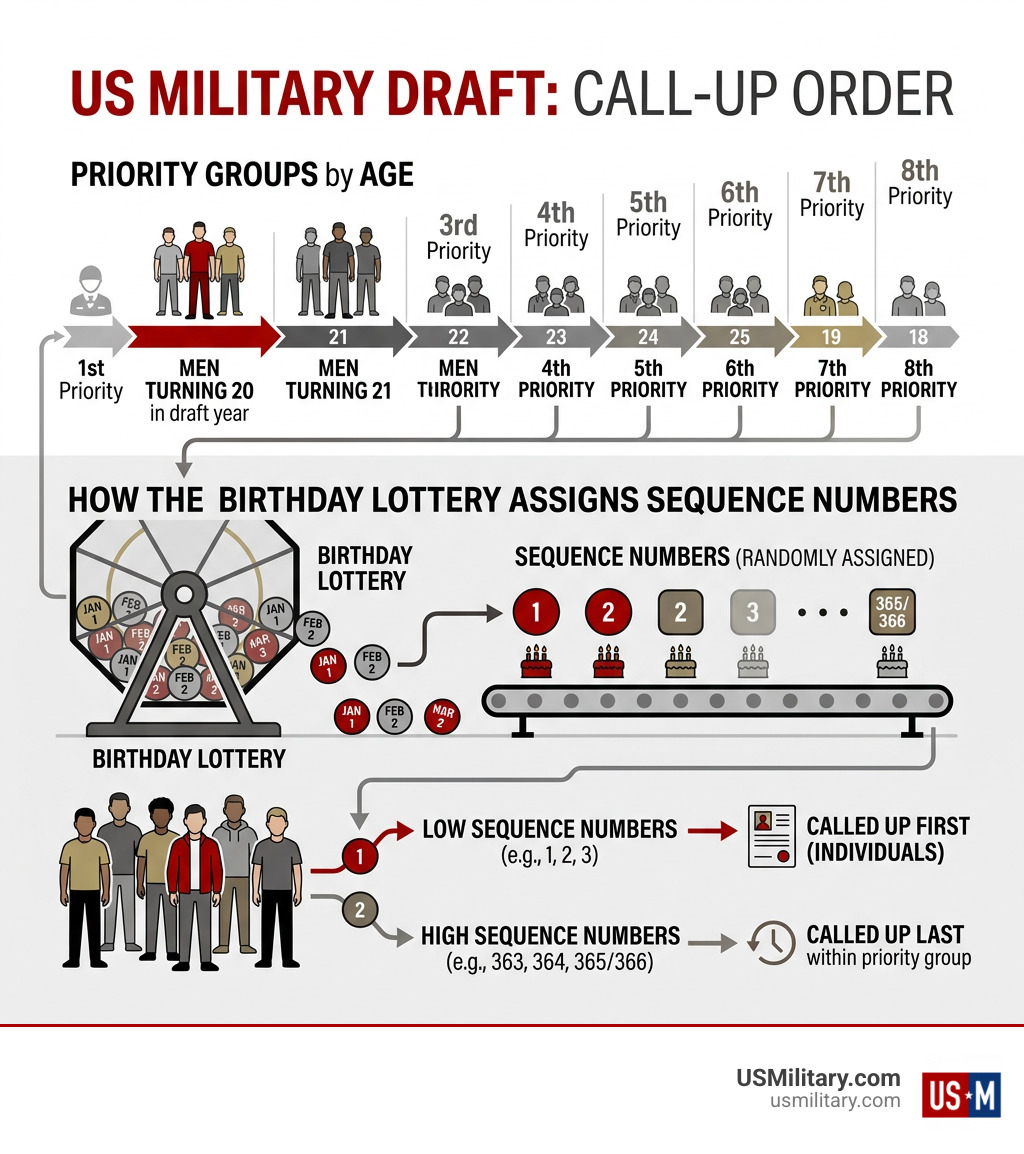
So if a draft were activated today, 20-year-old registered males would be called up first — selected by a random birthday lottery that assigns sequence numbers 1 through 365 (or 366 in a leap year). The lowest numbers get induction notices first.
The U.S. hasn’t used a military draft since 1973. But the Selective Service System still quietly maintains a database of roughly 15–20 million registered males aged 18–25 — ready to mobilize if Congress and the President ever authorize it. Within 193 days of a national emergency declaration, the first draftees could already be reporting for duty.
That’s a system most people don’t think about until geopolitical tensions spike. And when they do, the questions pour in fast.
I’m Larry Fowler, publisher of the USMilitary.com Network since 2007 and a resource for active military members and veterans on everything from VA benefits to enlistment decisions. Understanding who gets pulled first in a US military draft is exactly the kind of need-to-know information I’ve built this platform to answer clearly and accurately. Let’s break it all down.
Quick Who gets pulled first in a us military draft? terms:
How the Selective Service System Prepares for a Crisis
While we currently enjoy an all-volunteer force, the United States maintains the Selective Service System (SSS) as a “backup plan.” Think of it as an insurance policy for national security. The agency’s mission is to provide manpower to the Department of Defense in the event of a national emergency that exceeds the capacity of our active-duty and reserve components.
Even though there hasn’t been a draft in over 50 years, the machinery is constantly humming in the background. The sss.gov website is the primary hub for this activity. Currently, the system is designed to be incredibly lean, with a small staff of full-time civilians and thousands of volunteers ready to serve on local draft boards if the call ever comes.
The SSS maintains a massive registration database. Every male U.S. citizen and most male immigrants living in the U.S. are required by law to register within 30 days of their 18th birthday. This database currently holds between 15 and 20 million names. The goal of this constant upkeep is “mobilization readiness.” If a crisis occurs, the SSS is mandated to deliver the first inductees to the military within 193 days.
The legal framework for all of this is found in the Title 32, Subtitle B, Chapter XVI, Code of Federal Regulations. These regulations outline exactly how the agency would transition from a peacetime registration mode to an active draft. It covers everything from how the lottery is conducted to how local boards are formed to hear appeals.

Who gets pulled first in a us military draft?
If the “unthinkable” happened and the draft was reinstated, the selection process wouldn’t be a free-for-all. It is a highly structured, age-based system designed to be as fair as possible. The primary answer to who gets pulled first in a us military draft? is the “First Priority Selection Group.”
This group consists of all registered men who will reach the age of 20 during the calendar year in which the draftees are scheduled to be inducted. For example, if a draft were authorized in 2025, every man born in 2005 would be in that first-priority bucket.
The order within that group is determined by a birthday lottery. This isn’t like the lottery where you hope to win millions; it’s a random drawing that determines the sequence of induction. You can find the official breakdown of this process on the Lottery : Selective Service System page.
Once the lottery is held, men are assigned a “Random Sequence Number” (RSN) based on their birth date. If your birthday is drawn first, your RSN is 1. If it’s drawn last, your RSN is 365 (or 366). The Selective Service then begins issuing induction notices starting with RSN 1 and moving up the list until the military’s manpower requirements are met.
The Lottery System and Age 20 Priority
The physical act of the lottery is designed for maximum transparency. We’re talking about two large air-mix machines (similar to those used in state lotteries). One machine contains 365 (or 366) capsules, each holding a date of the year. The second machine contains capsules numbered 1 through 365.
Officials draw one capsule from the date machine and one from the number machine simultaneously. If “January 1st” is drawn with the number “150,” then every man in the priority group born on January 1st is assigned sequence number 150.
This process continues until every day of the year has a corresponding sequence number. This ensures that every individual in the age group has an equal, random chance of being called. During the Vietnam era, the highest number called varied by year—reaching 195 in 1970 but dropping to 95 by 1972 as the war wound down.
Why 20-Year-Olds are Who Gets Pulled First in a US Military Draft
You might wonder why we start with 20-year-olds instead of 18-year-olds. Historically, the U.S. found that 20-year-olds offered the best balance of physical fitness and relative maturity. Younger men (18 and 19) are often still in high school or just starting their transition to adulthood, while men in their early 20s are generally considered at their physical peak for the rigors of combat.
If the military needs more men than the entire 20-year-old crop can provide, the SSS moves to the next priority groups. The order goes:
- Age 20
- Age 21
- Age 22
- Age 23
- Age 24
- Age 25
- Age 19
- Age 18
As you can see, 18 and 19-year-olds are actually the last to be called. Once a man turns 26, he is officially “over the age of liability” and can no longer be drafted under the current general draft rules. For more specifics on these age brackets, check the Frequently Asked Questions on the SSS site.
Authorization, Induction, and the Evaluation Process
A draft cannot be started by the President alone. It requires an Act of Congress. Both the House of Representatives and the Senate must pass legislation authorizing the draft, which the President must then sign into law. This ensures that the decision to conscript citizens has broad political support and public debate.
✉ Get updates like this in your inbox
Weekly VA benefit changes, pay updates, and money tips for service members, veterans, and military families. Free, no spam.
Once authorized, the Return to the Draft : Selective Service System protocols kick in. The SSS sends out induction notices via the U.S. Postal Service. But receiving a notice doesn’t mean you’re heading to boot camp the next day.
Every draftee must go through a rigorous evaluation process. This happens at a Military Entrance Processing Station (MEPS). You’ll undergo:
- Physical Exams: Doctors check everything from your vision and hearing to your joints and heart health.
- Mental Testing: You’ll take the ASVAB (Armed Services Vocational Aptitude Battery) to determine your mental fitness and potential job specialties.
- Behavioral Screening: Background checks and interviews to ensure you meet the moral standards of the military.
Only after you pass these evaluations are you actually “inducted” into the service. If you are found “unfit” for any reason, you are sent home with a disqualification classification.
Exemptions, Deferments, and Classifications
Not everyone who is called up will serve in combat. The law allows for several types of exemptions and deferments. If you receive an induction notice, you have a window of time to file a claim with your local draft board.
One of the most well-known categories is the Conscientious Objector (CO). These are individuals who, by reason of religious, ethical, or moral belief, are sincerely opposed to participation in war in any form. If a local board approves a CO claim, the individual may be assigned to non-combatant military service (like a medic) or civilian “alternative service” that contributes to the national interest. You can read more about the history of these claims through the Conscientious Objection archives.
Other common classifications include:
- 4-F: Registrant not qualified for any military service (usually due to medical or mental health reasons).
- 1-A: Available for unrestricted military service (this is what you are by default).
- 3-A: Hardship deferment (if your induction would cause extreme hardship to your dependents).
- 2-D: Ministerial students (deferment for those preparing for the ministry).
- 1-S: Student postponements (allowing high schoolers to graduate or college students to finish a semester).
The local board, made up of civilian volunteers from your community, is responsible for reviewing these claims. Their goal is to ensure the draft is applied fairly and that legitimate personal or medical issues are respected.
Modern Draft Status: Women and Healthcare Personnel
One of the hottest topics in recent years is whether women should be required to register. Currently, the law states that only “male persons” must register. This is based on the sex assigned at birth. Even though the Department of Defense lifted all gender-based restrictions on military roles in 2015—meaning women can serve in combat—Congress has not yet updated the Selective Service Act to include women.
There have been several legislative attempts to change this, and a 2020 national commission recommended including women in the interest of fairness and national readiness. However, as of today, women are not required to register and would not be part of a general draft.
There is, however, a “special” draft you should know about: the Health Care Personnel Delivery System (HCPDS). In a massive crisis where medical professionals are in short supply, the government can authorize a draft specifically for doctors, nurses, and other healthcare specialists.
Unlike the general draft, the HCPDS can include both men and women, and the age limit is much higher—extending up to age 54. This system relies on professional licensing lists rather than the general SSS database. You can find the specific Health Care Personnel Delivery System regulations through official government channels to see how these specialized calls are structured.
Frequently Asked Questions about the Military Draft
What are the penalties for failing to register?
We can’t stress this enough: registration is a legal requirement. Failing to register with the Selective Service is a felony. While the government hasn’t prosecuted anyone for non-registration since the mid-1980s, the “administrative” penalties are severe and permanent.
According to the Benefits and Penalties page, if you don’t register by age 26, you may be permanently barred from:
- Federal Student Aid: No Pell Grants or government-backed student loans.
- Federal Jobs: You cannot work for the executive branch of the federal government or the U.S. Postal Service.
- Job Training: Ineligibility for programs under the Workforce Innovation and Opportunity Act.
- Citizenship: For immigrants, failure to register can be a dealbreaker for U.S. citizenship.
Technically, the law allows for a fine of up to $250,000 and a 5-year prison sentence, though the loss of lifetime benefits is the more common “punishment.”
How has the draft changed since the Vietnam War?
The draft we have today is not the same one your grandfather dealt with. During the Vietnam War, the lottery system was often criticized for being non-random and for allowing too many loopholes for the wealthy (like the famous “college deferment” that allowed people to avoid service indefinitely).
In 1971, the system was overhauled. Most deferments were abolished to make the draft more egalitarian. In 1973, the U.S. transitioned to the All-Volunteer Force, and the draft was suspended. It was briefly stopped entirely in 1975 before being reactivated as a “registration-only” system in 1980 by President Carter following the Soviet invasion of Afghanistan.
Modern lotteries use the The Vietnam Lotteries as a lesson in what not to do, ensuring the current Titan machines provide a truly random sequence.
Are non-citizens required to register for the draft?
Yes. This is a common point of confusion. The registration requirement applies to almost all male U.S. residents between 18 and 25. This includes:
- U.S. Citizens (both native-born and naturalized).
- Permanent Residents (Green Card holders).
- Refugees, parolees, and asylum seekers.
- Undocumented immigrants.
- Dual nationals (even if they live outside the U.S.).
The only major exceptions are those on current, valid non-immigrant visas (like international students or tourists). For more details, see the Selective Service System: Aliens and Dual Nationals guide.
Conclusion
Understanding who gets pulled first in a us military draft? is about more than just knowing your “number.” It’s about understanding the civic responsibility that comes with living in a democracy. While the draft remains a “break glass in case of emergency” tool, the Selective Service System ensures that we are never caught off guard.
At USMilitary.com, we are committed to providing you with the most accurate, up-to-date information on all things military. Whether you’re looking for More info about military services (including branch overviews, benefits guidance, and enlistment basics), trying to navigate VA disability claims, or just staying informed on national defense, we’re here to help.
Registration compliance is not just about avoiding penalties – it’s about ensuring our nation remains ready for whatever challenges the future may hold. Stay informed, stay prepared, and thank you for your interest in our nation’s defense.
Want to learn more about your options?
- The Ultimate Guide to Military Age Requirements
- An Essential Guide to Military Age Limits
- Could there be a 2025 Draft?
What is the US Military Draft?
Free for Service Members & Veterans
Get the military benefits intel no one tells you about.
Weekly updates on VA benefits, pay changes, and money tips — free for service members and veterans.
No spam. Unsubscribe anytime. Your info is never shared.


