Would a Smaller Defense Budget Cut Veteran Benefits?

Not automatically. Cutting the Pentagon’s budget would not, by itself, reduce VA disability payments. Congress funds the Defense Department and the VA separately. The more immediate risk is a proposal to lower future disability compensation for tinnitus and sleep apnea to help pay for other veterans’ legislation. Veterans groups say the changes could affect up to 1.5 million people. They have not become law.
I’m Larry Fowler, a Navy veteran, BUD/S Class 89 graduate, and publisher of USMilitary.com. My years covering VA benefits inform this look at “Will Veteran Benefits Be Cut When Democrats Minimize US Military Defense Budgets” and the budget choices behind the proposed cuts.

Will Veteran Benefits Be Cut When Democrats Minimize US Military Defense Budgets word guide:
Will Veteran Benefits Be Cut When Democrats Minimize US Military Defense Budgets? The Defense Spending Debate
Every time Capitol Hill enters budget season, rumors swirl through the veteran community about potential cuts to monthly checks, healthcare access, and service-connected compensation. When defense spending debates intensify, many wonder whether shrinking the Pentagon’s top line trickles down to reduce earned benefits for those who served.

To understand how these fiscal battles work, we have to look at how Congress divides its money. The Department of Defense (DoD) operational budget and the Department of Veterans Affairs (VA) budget are fundamentally distinct appropriations. Even as Republicans advance plans to raise military spending by at least $100 billion to $150 billion, those increases do not automatically protect or fund VA programs. Navigating comprehensive VA disability compensation requires understanding that VA disability is classified as mandatory entitlement spending, whereas base defense operations fall under discretionary spending.
Assessing Whether Veteran Benefits Will Be Cut When Democrats Minimize U.S. Military Defense Budgets
A major question facing military families is whether veteran benefits will be cut when Democrats minimize U.S. military defense budgets or prioritize domestic social programs over defense hikes. The legislative record shows that Democratic lawmakers have generally fought against direct reductions to VA disability compensation, instead proposing alternative funding streams.
When fiscal offsets became a major hurdle for new veteran legislation, leading Democrats advocated tapping into unspent Pentagon resources. According to a Blumenthal statement on TCAVA, lawmakers proposed using nearly $100 billion in unobligated and unspent DoD funds that sit idle each fiscal year. In a key procedural showdown, three House Republicans joined 207 House Democrats to support replacing proposed disability cuts with these unobligated Pentagon dollars. Reviewing your full military entitlements and compensation options shows that funding battles rarely align neatly along simple party talking points.
Social Safety Net Risks: Medicaid, SNAP, and Broader Federal Budget Cuts
While core VA disability compensation remains legally protected from routine DoD adjustments, broader budget battles present indirect risks to military families. Many low-income veterans rely on federal safety-net programs outside the VA healthcare system.
- Medicaid Reliance: Medicaid covers roughly 10% of veterans under the age of 65 and serves as the sole healthcare coverage for 40% of those individuals.
- Food Assistance: Approximately 1.2 million veterans live in households that participate in the Supplemental Nutrition Assistance Program (SNAP).
- Fiscal Pressures: Sweeping budget proposals that aim to offset trillion-dollar tax packages or defense increases often target safety-net programs for spending reductions, placing vulnerable veterans at financial risk.
| Budget Proposal Area | Target Funding Shift | Direct Impact on Veterans |
|---|---|---|
| Defense Base Budget | +$100B to +$150B Proposed Hike | Funds military readiness; does not directly fund VA disability accounts. |
| VA Disability Offsets | ~$57B to $60B Proposed Reduction | Would alter rating schedules for conditions like tinnitus and sleep apnea. |
| Unobligated DoD Funds | ~$100B Unspent Pentagon Money | Proposed by Democrats as an alternative offset to protect veteran checks. |
| Medicaid & SNAP Safety Nets | Major Proposed Reductions | Threatens coverage for over 1.2M veterans relying on food and medical assistance. |
The Take Care of America’s Veterans Act and Proposed Disability Benefit Offsets
The most contentious threat to veteran compensation has emerged from within veteran-specific legislation rather than defense reductions. The Take Care of America’s Veterans Act (H.R. 9237), an omnibus package bundling over 60 individual measures, sparked national outrage among major Veterans Service Organizations (VSOs).

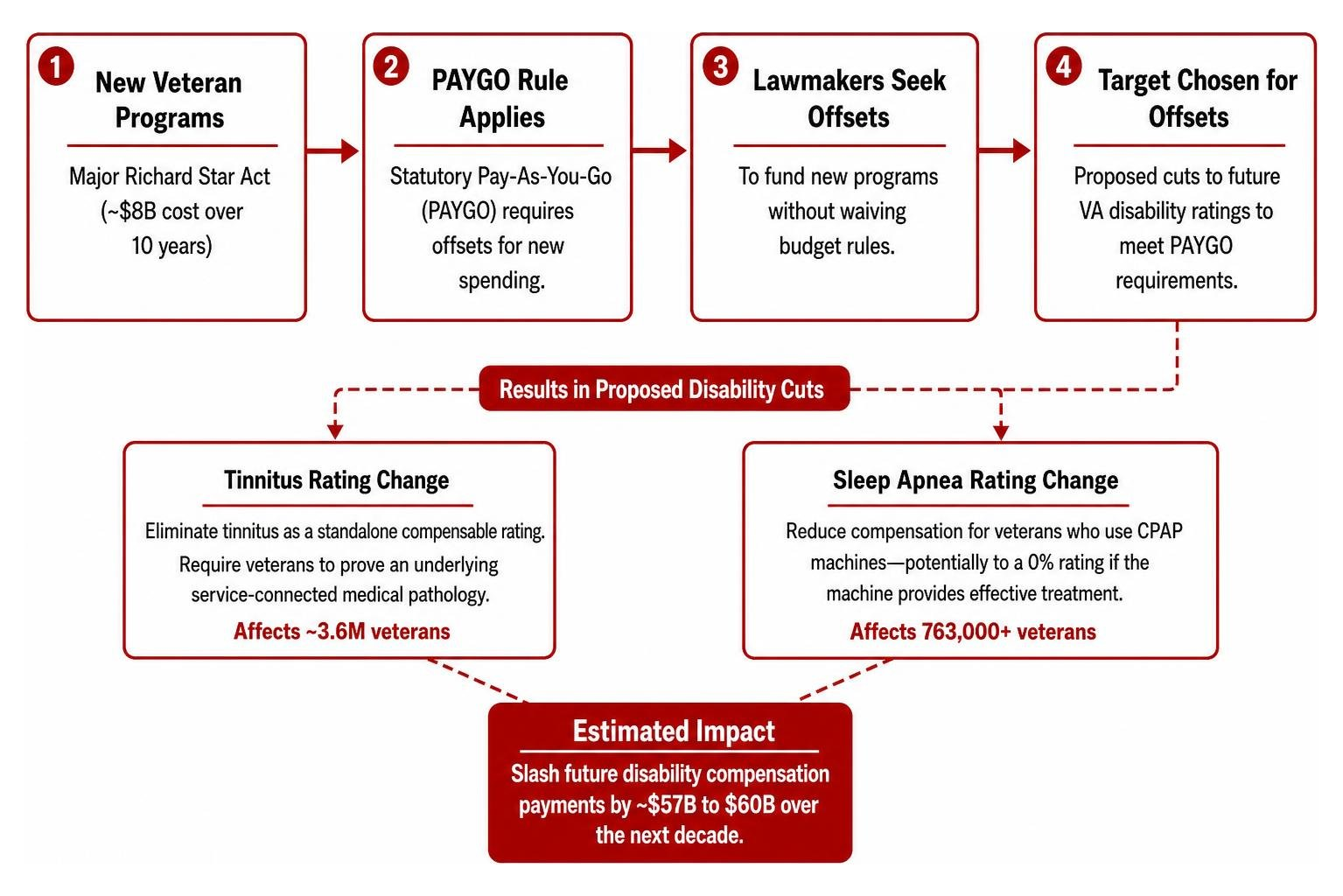
To pay for new programs under statutory Pay-As-You-Go (PAYGO) rules, the legislation proposed restructuring how future service-connected conditions are evaluated. A formal statement by DAV condemns congressional proposal to cut disability benefits, pointing out that the plan would slash future disability compensation payments by up to $57 billion to $60 billion over the next decade. If you are currently evaluating service-connected disability claims, understanding how PAYGO rules force lawmakers to find budget offsets is vital.
The Targeting of Tinnitus and Sleep Apnea Ratings
The proposed rating schedule changes focus primarily on two of the most prevalent conditions diagnosed among military personnel:
- Tinnitus: An estimated 3.6 million veterans currently receive compensation for service-connected tinnitus, making it the single most common VA disability. The proposed overhaul would eliminate tinnitus as a standalone compensable rating, requiring veterans to prove an underlying service-connected medical pathology instead.
- Sleep Apnea: More than 763,000 veterans receive service-connected benefits for sleep apnea. Under the draft changes, compensation for veterans who manage their condition with continuous positive airway pressure (CPAP) machines would drop significantly—potentially to a 0% rating if the machine provides effective treatment.
A united coalition of VSOs reject largest veterans benefits cut, warning that nearly one million veterans would face reduced monthly compensation under these revised rating criteria. Medical experts and advocacy groups argue that symptoms persist even when treated, and penalizing veterans for using prescribed medical devices breaks the sacred promise made to our armed forces.
The Battle Over the Major Richard Star Act and Concurrent Receipt
At the heart of the PAYGO budget dilemma is the Major Richard Star Act. This widely supported bill would allow combat-injured, medically retired veterans with fewer than 20 years of service (Chapter 61 retirees) to receive both their military retirement pay and VA disability compensation concurrently without an offset.
Despite boasting 336 bipartisan cosponsors in the House and 79 in the Senate, the legislation has faced repeated procedural delays due to its estimated $8 billion cost over ten years. Rather than waiving budget rules—as Congress frequently does for defense packages or tax legislation—lawmakers attempted to fund the Star Act by reducing future tinnitus and sleep apnea payouts. This created an unfortunate dynamic where one group of disabled veterans was pitted against another, while overlooked military and veteran support programs remain underutilized across the nation.
VA Leadership, Legislative Roadblocks, and What’s Ahead in 2026
The political pushback against these offsets triggered significant turbulence in Congress. Following widespread resistance from organizations like the DAV, VFW, and IAVA, House leadership pulled the measure from consideration. As reported by news outlets when House Republicans cancel vote on veterans benefits package, internal divisions and bipartisan procedural votes brought the legislation to an immediate standstill.
VA Secretary Doug Collins has publicly insisted that veterans’ earned benefits will not be dismantled and that the department is working to eliminate administrative waste, streamline claims processing, and review external contracting through efficiency initiatives. However, balancing departmental promises with strict congressional budget caps remains an ongoing challenge for VA leadership.
Will Veteran Benefits Be Cut When Democrats Minimize US Military Defense Budgets in Future Fiscal Battles?
As we navigate fiscal year 2026, the question of whether defense reductions will harm veteran support depends heavily on congressional budget rules. Minimizing the DoD top-line defense budget does not mathematically trigger automatic cuts to VA healthcare or disability checks. The true legislative risk stems from PAYGO requirements and budget reconciliation battles, where lawmakers search for offsets to fund expansive new programs.
Ensuring you and your family are fully aware of all available resources—from healthcare services to accessing healthcare and home loan entitlements—is your best personal defense against shifting legislative tides.
Frequently Asked Questions About Veteran Benefits and Budget Cuts
What specific disability benefits were targeted under recent congressional proposals?
Recent legislative and regulatory proposals targeted service-connected ratings for tinnitus and sleep apnea. The measures proposed eliminating standalone 10% ratings for tinnitus and reducing sleep apnea ratings to 0% for veterans whose symptoms are effectively managed by CPAP machines, potentially impacting compensation for up to 1.5 million veterans.
What is the Major Richard Star Act and why has it stalled in Congress?
The Major Richard Star Act is a bipartisan bill designed to provide full concurrent receipt of retirement pay and VA disability compensation for combat-injured veterans medically retired before completing 20 years of service. Despite having overwhelming cosponsorship across both parties, it has stalled over statutory PAYGO requirements that demand mandatory spending offsets.
How does defense budget spending differ from VA disability compensation funding?
Department of Defense spending is largely discretionary funding appropriated annually for military personnel, weapons systems, and base operations. In contrast, VA disability compensation is mandatory entitlement spending set by federal law, meaning payments are legally guaranteed to eligible veterans regardless of annual changes to the Pentagon’s defense budget.
Conclusion
The debate surrounding military budgets, party priorities, and veteran compensation makes one reality clear: cuts to VA disability benefits are not an automatic byproduct of smaller Pentagon defense budgets. Instead, the real threats arise when lawmakers attempt to offset new legislative costs by altering the VA rating schedule for common service-connected conditions.
At USMilitary.com, we stand committed to keeping our servicemembers, veterans, and military families informed on every legislative development that touches their livelihood. To explore all of your earned benefits and protect your financial future, explore our comprehensive guides on financial planning and servicemember benefits today.
Free for Service Members & Veterans
Get the military benefits intel no one tells you about.
Weekly updates on VA benefits, pay changes, and money tips — free for service members and veterans.
No spam. Unsubscribe anytime. Your info is never shared.



Leave a Reply