Why Understanding Navy SEALs Requirements Matters
Navy SEALs requirements represent some of the most rigorous standards in military service, demanding exceptional physical fitness, mental toughness, and unwavering commitment. If you’re considering this elite path, you need to understand exactly what stands between you and the Trident.
Quick Answer: Core Navy SEAL Requirements
- Age: 17-28 years old (waivers available up to 30; officers up to 42)
- Citizenship: Must be a U.S. citizen
- Education: High school diploma or equivalent
- Physical Screening Test (PST) Minimums:
- 500-yard swim: 12:30 or less
- Push-ups: 42 in 2 minutes
- Sit-ups: 50 in 2 minutes
- Pull-ups: 6 (no time limit)
- 1.5-mile run: 11:00 or less
- ASVAB Scores: GS+MC+EI=170 OR VE+MK+MC+CS=220
- Vision: Correctable to 20/25 (uncorrected: 20/70 worst eye, 20/40 best eye)
- Security Clearance: Must qualify for Secret clearance
- Medical: Pass dive physical and general health standards
Here’s the reality: only about 9.5% of candidates who start the pipeline actually graduate. The training isn’t designed to get you in shape—it’s designed to test whether you already have what it takes.
Many candidates begin questioning their commitment during the brutal first phase of Basic Underwater Demolition/SEAL (BUD/S) training. The infamous “Hell Week” involves just four hours of sleep over five and a half days, more than 200 miles of running, and over 20 hours of physical training daily.
But physical fitness is just the entry ticket. Success requires mental resilience that can’t be measured by any test. You need the ability to convert negative feedback into motivation, work seamlessly with a team under extreme stress, and maintain focus when your body screams to quit.
This guide breaks down every requirement—from the initial eligibility standards through the multi-phase training pipeline. We’ll show you not just the minimums, but the competitive standards that actually give you a fighting chance at earning the Trident.
Foundational Eligibility: The First Problems
Before you can even think about the grueling training, you must meet the fundamental eligibility criteria. These are the non-negotiable Navy SEALs requirements that determine if you’re even allowed to apply. Think of them as the gatekeepers to the selection process.
We’re talking about everything from your citizenship and age to your educational background, medical history, and even your ability to hold a security clearance. These standards ensure that every candidate possesses the baseline qualifications for a role as demanding and sensitive as a Navy SEAL.
Core Citizenship, Age, and Educational Requirements
First and foremost, to become a Navy SEAL, you must be a U.S. Citizen. There are no waivers or exceptions for this fundamental requirement.
When it comes to age, enlisted applicants must generally be between 17 and 28 years old. If you’re 17, you’ll need parental permission to enlist. However, we understand that life paths are varied, and the Navy does too. Waivers for candidates aged 29 and 30 are available for highly qualified individuals. These waivers are typically granted to those who demonstrate exceptional physical, mental, and personal readiness.
For those pursuing the officer pathway, the age requirements are a bit more flexible. Active Duty officers must be at least 19 years old and not have passed their 42nd birthday at the time of commissioning. For Reserve officers, the age range is 25 to 42 at the time of commissioning. Notably, men with prior enlisted service as SEALs seeking to become SEAL Officers can request waivers up to age 33.
Educational requirements are straightforward: all candidates, whether enlisted or officer, must possess at least a high school diploma or a GED. If you’re aiming to become a SEAL Officer, you’ll need to go a step further and have a baccalaureate degree from a regionally accredited institution. You can even apply in your final academic year, but your contract won’t be finalized until your degree is confirmed.
Vision, Health, and Security Clearance Standards
Your physical health and sensory capabilities are paramount for a SEAL. Vision standards are strict: your uncorrected vision must be at least 20/70 in your worst eye and 20/40 in your best eye. Crucially, both eyes must be correctable to 20/25. If you have perfect vision, that’s fantastic, but if not, ensure your corrective lenses bring you within these parameters. A critical disqualifier is color blindness; this condition will prevent you from becoming a Navy SEAL.
Beyond vision, you must be in overall excellent physical health. This includes passing a comprehensive general physical examination and a specialized dive physical. These assessments ensure your body can withstand the extreme pressures and environments SEALs operate in, from deep underwater to high altitudes.
Given the nature of their missions, all Navy SEALs must be able to obtain a Secret security clearance. This involves a thorough background check into your personal history, finances, and any past legal issues. A clean record is essential, meaning no felonies involving drugs, weapons, violence, or sex. While waivers for certain convictions might be considered depending on their severity and number, they are rare and not guaranteed. Your moral character is continuously assessed throughout the selection and training process.
Requirements for Women in Naval Special Warfare
Since December 2015, the U.S. military has opened all combat roles, including special operations, to women. This means women are now allowed to join the Navy SEAL training pipeline, provided they meet the identical, rigorous standards as their male counterparts. There are no separate or modified physical or mental standards for women seeking to earn the Trident.
As of 2021, no woman had successfully completed SEAL training to become a qualified Navy SEAL. However, the path has been blazed in other Naval Special Warfare roles. For example, we saw the first woman successfully complete the demanding Special Warfare Combatant-craft Crewmen (SWCC) training in 2021, marking a significant milestone in Naval Special Warfare. You can read more about this historic achievement in this CNN article about the first woman to complete SWCC training.
This demonstrates that while the journey to becoming a SEAL is incredibly challenging for everyone, the opportunity is now formally open to all qualified individuals, regardless of gender.
Proving Your Mettle: The Navy SEALs Requirements for Physical and Mental Aptitude
Meeting the foundational eligibility is just the first hurdle. The next, and arguably most challenging, phase involves proving your physical and mental capabilities. This is where the true Navy SEALs requirements for strength, endurance, and resilience come into play, primarily through the Physical Screening Test (PST), ASVAB, and C-SORT.

These tests are not just checkpoints; they are predictors of your potential to withstand the intense demands of BUD/S and beyond. While minimums exist, we strongly encourage candidates to push far past them. As one expert puts it, if you aim for minimums, you’re destined to just try to survive each event, which often leads to quitting or injury. You have to be more aggressive, more capable, and more determined than that.
The SEAL Physical Screening Test (PST): Minimums vs. Competitive Scores
The Physical Screening Test (PST) is your initial physical entrance exam, administered by a Naval Special Warfare coordinator or mentor. Its purpose is simple: to assess your raw physical fitness and determine if you have the baseline conditioning to even begin the SEAL pipeline. The PST consists of five components:
- 500-yard swim: Using breaststroke or sidestroke.
- Push-ups: Maximum repetitions in two minutes.
- Sit-ups: Maximum repetitions in two minutes.
- Pull-ups: Maximum repetitions (no time limit).
- 1.5-mile run: Timed.
While there are minimum standards to qualify for a contract, achieving “optimum” or “competitive” scores dramatically increases your chances of selection and, more importantly, your likelihood of surviving BUD/S. Candidates with composite PST scores below 800 (a cumulative score based on performance) are three times more likely to fail BUD/S.
Let’s look at the breakdown:
| Event | Minimum | Average | Optimum |
|---|---|---|---|
| 500-yard Swim | 12:30 | 10:00 | 9:30 |
| Push-ups | 42 in 2 min | 79 in 2 min | 100 in 2 min |
| Sit-ups | 50 in 2 min | 79 in 2 min | 100 in 2 min |
| Pull-ups | 6 | 11 | 25 |
| 1.5-mile Run | 11:00 | 10:20 | 9:30 |
Source: Navy SEALs Requirements, sealswcc.com
Notice the significant difference between the minimum and optimum scores. We recommend you train to exceed the optimums if you want to stand out and truly prepare your body for what’s to come. You can check your current fitness level and compare your scores using the Official Navy SEAL PST Calculator.
Decoding the ASVAB and C-SORT Requirements
Beyond physical prowess, intellectual capacity and mental resilience are critical Navy SEALs requirements. These are assessed through the Armed Services Vocational Aptitude Battery (ASVAB) and the Computerized-Special Operations Resilience Test (C-SORT).
The ASVAB is designed to measure your mental sharpness and ability to learn. While the Navy requires an Armed Forces Qualification Test (AFQT) score of at least 35 for general enlistment, men who traditionally succeed at BUD/S often have AFQT scores of 78 or better. More specifically for SEAL candidates, you’ll need to meet specific line score combinations:
- Option 1: General Science (GS) + Mechanical Comprehension (MC) + Electronics Information (EI) = 170 or better
- Option 2: Verbal Expression (VE) + Mathematics Knowledge (MK) + Mechanical Comprehension (MC) + Coding Speed (CS) = 220 or better
Additionally, you must score VE + AR = 110 with a minimum MC = 50. Waivers for these minimum ASVAB scores are generally not granted. There’s a strict limit on Mechanical Comprehension (MC) score waivers; if you’re more than five points below the minimum, a waiver won’t be considered. If your initial ASVAB score isn’t high enough, you can often retake it after a waiting period, working with a recruiter or using Navy College preparation courses.
The Computerized-Special Operations Resilience Test (C-SORT) is a unique assessment designed to evaluate your mental toughness and resilience. It digs into three key areas: performance strategies, psychological resilience, and personality traits. The C-SORT provides a band score (1-4) that, combined with your PST scores (especially run and swim times), helps determine your eligibility for a SEAL contract. This test is crucial because it assesses your ability to perform under stress and your intrinsic motivation—qualities that are impossible to fake during BUD/S. A critical detail about the C-SORT: it can only be taken one time. So, you need to be prepared. If your C-SORT score isn’t ideal, demonstrating extreme motivation through significantly improved PST scores (especially run and swim times) on subsequent qualifying PSTs can sometimes help your case.
Assessing Maturity and Mental Resilience
While tests like the C-SORT provide a baseline, true maturity and mental resilience are continuously assessed throughout the entire SEAL pipeline, starting from your first interactions with recruiters and extending through BUD/S and SQT. These are perhaps the most intangible yet vital Navy SEALs requirements.
Instructors and evaluators look for more than just physical strength; they seek individuals who are “morally, mentally and physically qualified.” This means possessing an unwavering commitment to the goal, the ability to maintain composure under immense pressure, and a profound capacity for stress management. The legendary “never quit” mindset isn’t just a slogan; it’s a fundamental expectation.
You’ll be evaluated on your teamwork skills, your willingness to put the team’s needs before your own, and your potential for leadership. The training is designed to strip away individual ego and foster collective strength. Success in BUD/S often hinges on your ability to channel negative feedback into positive energy, to persevere when your body and mind are screaming for rest, and to make mature choices even when exhausted. As we’ve seen, many candidates question their decision to continue during the brutally challenging First Phase of BUD/S; only those with true mental fortitude push through.
The Path to the Trident: Application and Training Pipeline
Once you meet the initial Navy SEALs requirements and pass the preliminary tests, you’re ready to start on the application and training journey. This path is arduous, with high attrition rates designed to filter out all but the most determined and capable individuals.
How to Apply: Enlisted vs. Officer Pathways
The application process differs slightly depending on whether you’re joining as an enlisted sailor or an officer.
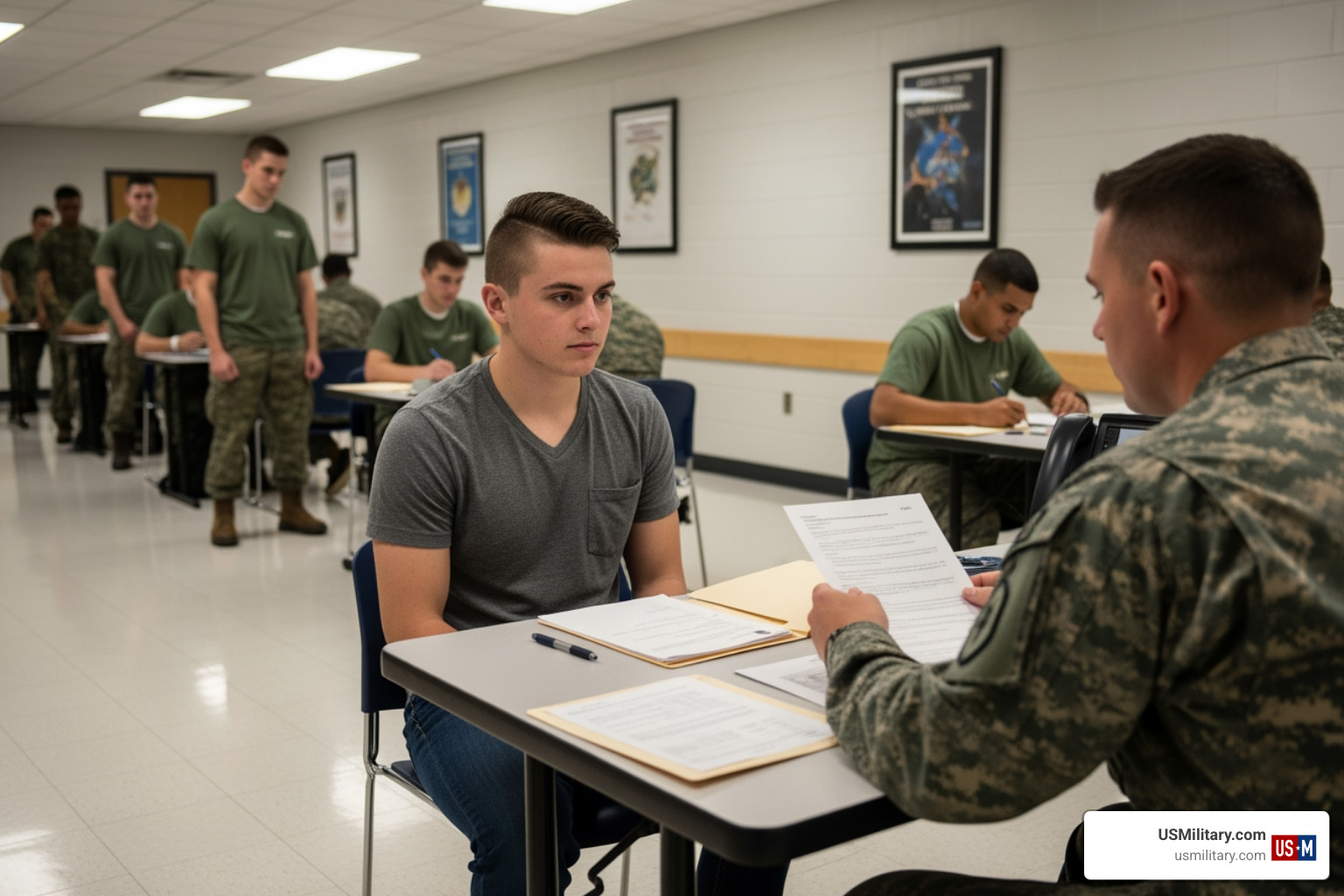
For enlisted personnel, the most common and recommended route is to secure a SEAL Challenge Contract before you even enlist. We can’t stress this enough: tell your Navy recruiter that you want to take the SEAL challenge BEFORE you enlist. This contract guarantees you an opportunity to become a SEAL candidate and often comes with additional benefits upon enlistment. If you enlist without this contract, you can still volunteer for the Physical Screening Test (PST) during your first week of boot camp, but you won’t qualify for the same benefits. To get started, you should contact a Navy recruiter to discuss your options.
For officer candidates, the path requires a baccalaureate degree. You’ll submit a comprehensive officer package through a Navy Officer recruiter, which includes your PST results, resume, transcripts, letters of recommendation, and medical forms. A key step for many officer applicants is attending the SEAL Officer Assessment and Selection (SOAS) program, which further evaluates your leadership potential and suitability for special warfare. Age waivers for officers can extend up to 42 for general commissioning, and up to 33 for highly qualified prior enlisted SEALs.
Surviving the Gauntlet: From BUD/S to SQT
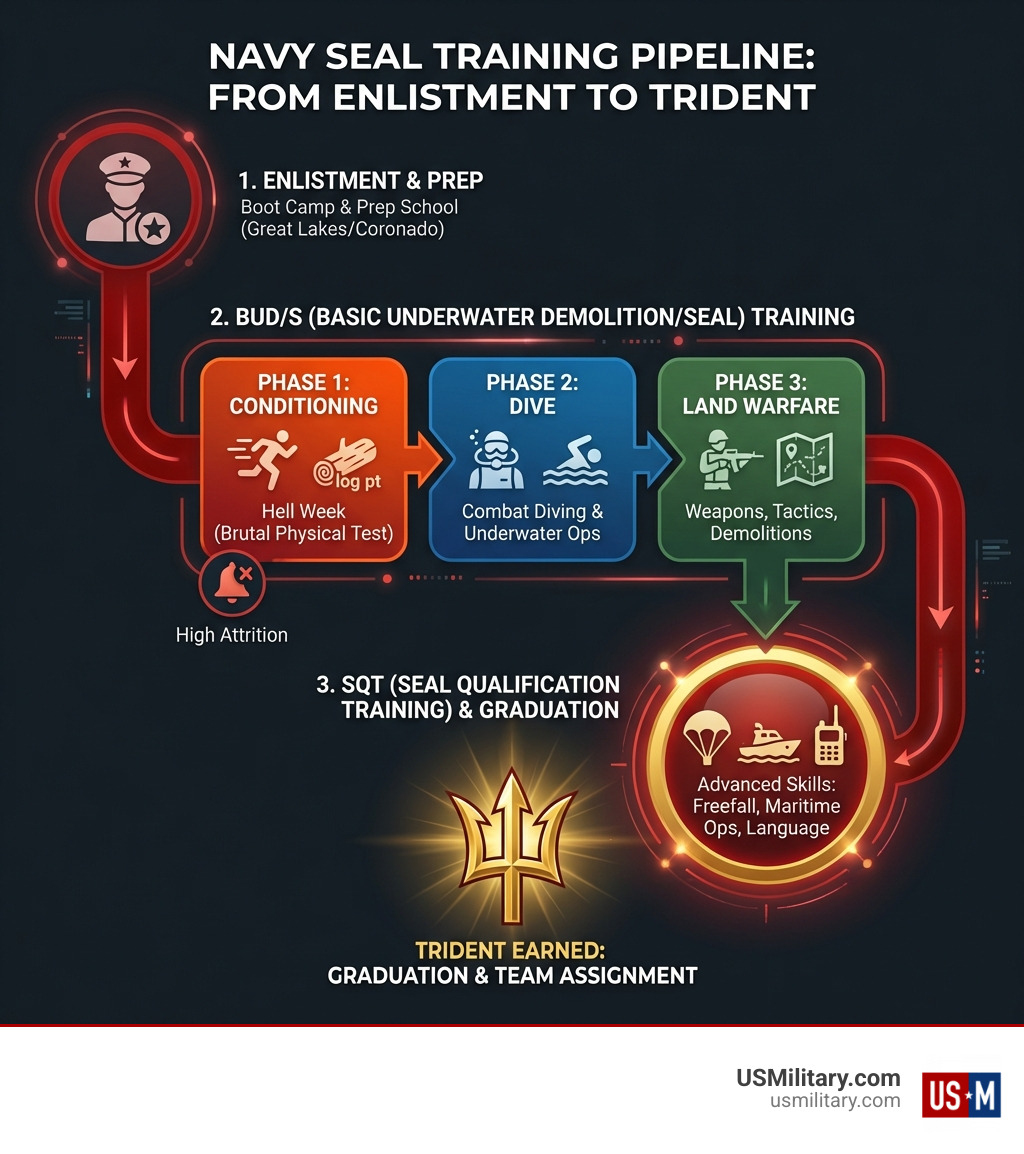
The training pipeline itself is a multi-phase crucible designed to forge ordinary individuals into extraordinary warriors. It’s a continuous assessment of your physical and mental limits.
- Naval Special Warfare Preparatory School (NSW Prep): After boot camp, you’ll attend this 5-week advanced workout program at Great Lakes, designed to get you back into peak physical condition and prepare you for the rigors of BUD/S.
- BUD/S Orientation: A 2-week introduction to the training environment in Coronado, California.
- BUD/S Phase 1: Physical Conditioning (7 weeks): This is where most candidates question their life choices. It’s an intense period focused on basic conditioning, small boat seamanship, and mastering fundamental physical skills. The fourth week is the infamous Hell Week, a grueling 5.5-day stretch with less than 4 hours of sleep total, over 200 miles of running, and more than 20 hours of physical training per day. It’s a non-stop test of physical and mental endurance, teamwork, and commitment.
- BUD/S Phase 2: Combat Diving (7 weeks): This phase focuses on mastering combat diving skills. Candidates must become comfortable and proficient in the water, learning open- and closed-circuit SCUBA, underwater navigation, and various waterborne operations.
- BUD/S Phase 3: Land Warfare (7 weeks): The final BUD/S phase shifts focus to land-based operations. You’ll learn basic weapons, demolitions, land navigation, patrolling, rappelling, marksmanship, and small-unit tactics.
- Parachute Jump School (3 weeks): Upon completion of BUD/S, graduates attend jump school to become qualified in both static-line and freefall parachute operations.
- SEAL Qualification Training (SQT) (26 weeks): This extensive course is where students transition from basic trainees to fully capable special operators. SQT covers advanced weapons training, small unit tactics, land navigation, demolitions, cold weather training, medical skills, maritime operations, and survival, evasion, resistance, and escape (SERE) training. Graduates of SQT are awarded the coveted Trident insignia, officially making them U.S. Navy SEALs.
The Stark Reality of the Navy SEALs Requirements: Attrition and Failure
The journey to becoming a Navy SEAL is notoriously difficult, and the statistics underscore this harsh reality. The overall success rate from initial enlistment to graduation from the entire SEAL pipeline is approximately 9.5%. This means that for every 100 people who start, only about 9 or 10 will earn their Trident.
Attrition is significant at every stage:
- Approximately 45% of candidates graduate recruit training.
- About 41% complete SEAL pre-indoctrination.
- Roughly 35% complete SEAL indoctrination.
- Only around 11% of candidates complete BUD/S Phase 1.
- Approximately 10% complete BUD/S Phase 2.
- Just 10% of candidates successfully complete BUD/S Phase 3.
Candidates can “Drop on Request” (DOR) at any point if they decide the training is not for them. Others may be dropped due to medical reasons or failure to meet performance standards. The consequences of failing to meet the physical or mental requirements during training are clear: you will be reassigned to a different role within the Navy, often based on the needs of the service and your qualifications. There’s no shame in it; the standards are simply that high.
Frequently Asked Questions about Navy SEAL Requirements
We understand you likely have many questions about the specifics of joining this elite force. Here, we address some of the most common inquiries regarding Navy SEALs requirements.
What are the absolute minimum physical scores I need for the PST?
While we always encourage you to aim for competitive scores, the absolute minimums for the Physical Screening Test (PST) are:
- 500-yard swim: 12 minutes, 30 seconds or less.
- Push-ups: 42 repetitions in two minutes.
- Sit-ups: 50 repetitions in two minutes.
- Pull-ups: 6 repetitions (no time limit).
- 1.5-mile run: 11 minutes or less.
These are the bare minimums to simply qualify for a contract. To truly stand a chance at selection and success in BUD/S, you need to be performing closer to, or even exceeding, the optimum scores we outlined earlier.
Can I become a SEAL with less than perfect vision or a past medical issue?
Yes, it is possible to become a SEAL with less than perfect vision, provided it meets specific criteria. Your uncorrected vision must be at least 20/70 in your worst eye and 20/40 in your best eye, and it must be correctable to 20/25 with glasses or contacts. However, color blindness is an absolute disqualifier.
For past medical issues, the situation is more complex. You must pass a comprehensive general physical and a specialized dive physical. Medical waivers are rare and are reviewed on a case-by-case basis by Navy medical professionals. Any condition that could compromise your safety or the safety of your team during demanding operations will likely be disqualifying. A dive medical officer’s signature is required for accession into Naval Special Warfare. It’s always best to be upfront and honest about your medical history during the application process.
What happens if I fail out of BUD/S?
If you fail out of BUD/S, or if you decide to “Drop on Request” (DOR), you will be reassigned to a different role within the Navy. Your new assignment will typically be based on your initial enlistment contract, your performance during boot camp and any other training you completed, and the needs of the Navy.
While failing out of BUD/S can be a deeply disappointing experience, it is not the end of your military career. Many individuals who do not complete SEAL training go on to have successful and fulfilling careers in other demanding rates and communities within the Navy. The Navy invests significantly in all its recruits, and your skills and dedication will be used elsewhere.
Conclusion: Do You Have What It Takes?
The journey to becoming a Navy SEAL is not for the faint of heart. It demands an extraordinary blend of physical prowess, mental fortitude, and an unwavering commitment that few possess. We’ve explored the extensive Navy SEALs requirements, from the foundational eligibility criteria and stringent physical benchmarks to the psychological assessments and the multi-phase training pipeline.
What becomes clear is that simply meeting the minimums offers a slim chance of success. To truly earn the Trident, you must strive to exceed every standard, accept the challenge, and cultivate a “never quit” mindset that will carry you through the darkest moments of training. The process is designed to push you to your absolute limits, revealing your true character under extreme duress.
If you’re reading this, you’re likely considering one of the most elite paths in military service. We hope this guide has provided you with a clear, realistic understanding of what that entails. At USMilitary.com, we are dedicated to providing comprehensive resources and guidance for those interested in elite military careers. Do you have what it takes? Only you can answer that, but we’re here to help you prepare.
Free for Service Members & Veterans
Get the military benefits intel no one tells you about.
Weekly updates on VA benefits, pay changes, and money tips — free for service members and veterans.
No spam. Unsubscribe anytime. Your info is never shared.

More Than 90% Of Clients Have Increased Ratings! Why Settle For Less Than You Deserve? Expert Priority Help With Your VA Claim Today! Free Evaluation Call!
The mission of Veteran Services United is to support veterans in filing and winning disability claims by offering expert guidance, advocacy, and personalized assistance. Through dedicated service, Veteran Services United empowers veterans to secure the benefits they have earned, ensuring they receive the care and support they deserve.