Finding an Army Recruiter Near Me

Finding an Army recruiter near me is the first real step toward a military career — and right now, with more than 480,000 soldiers on active duty and the Army working hard to meet its recruiting goals, local recruiters are ready to talk.
How to find an Army recruiter near you — quick answer:
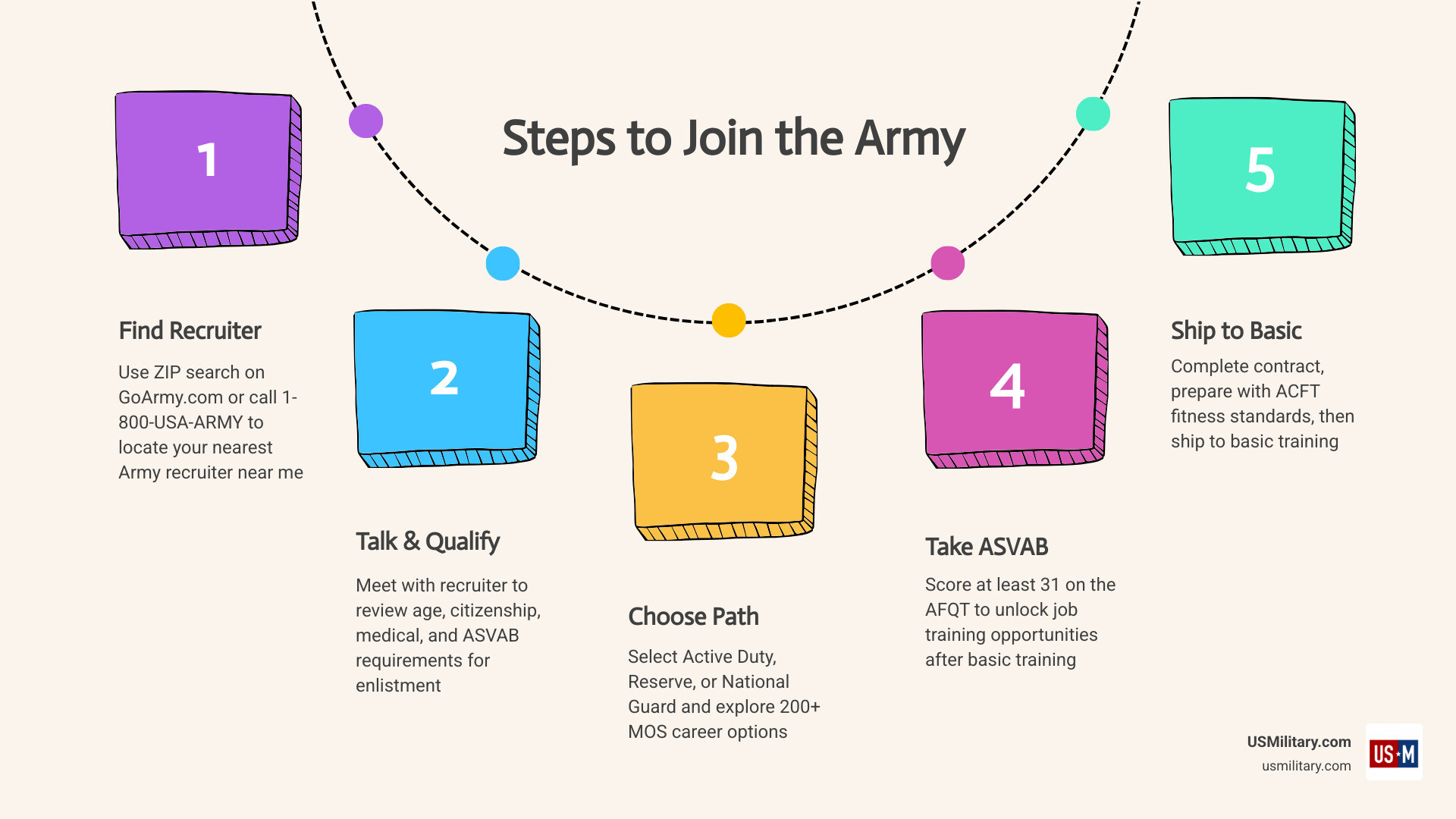
- Visit GoArmy.com and use the recruiter finder tool with your ZIP code
- Call 1-800-USA-ARMY (ext. 181 for active duty, ext. 182 for Army Reserve)
- Visit your nearest Army recruiting station in person — most are in local strip malls or office buildings
- Use USMilitary.com’s Army Recruiter Near Me tool to locate stations by location
The U.S. Army has roughly 10,000 recruiters spread across the country, organized into recruiting battalions that cover specific geographic regions. Whether you live in a big city or a rural area, there is almost certainly a recruiting station within a reasonable drive.
As of May 2026, the Army is actively expanding its recruiter force — it needs to add 800 more recruiters to keep pace with demand. That means local recruiters are motivated, accessible, and eager to help you explore your options with no obligation.
This guide covers everything you need to know — from finding your nearest station to understanding what happens at your first meeting, what jobs are available, and what it takes to qualify.
I’m Larry Fowler, publisher of the USMilitary.com Network since 2007, and I’ve spent nearly two decades helping people connect with an Army recruiter near me and other military branches — delivering up to 750 qualified prospects per day to Army recruiting programs. Everything in this guide is built on that experience, so you can make a confident, informed decision.
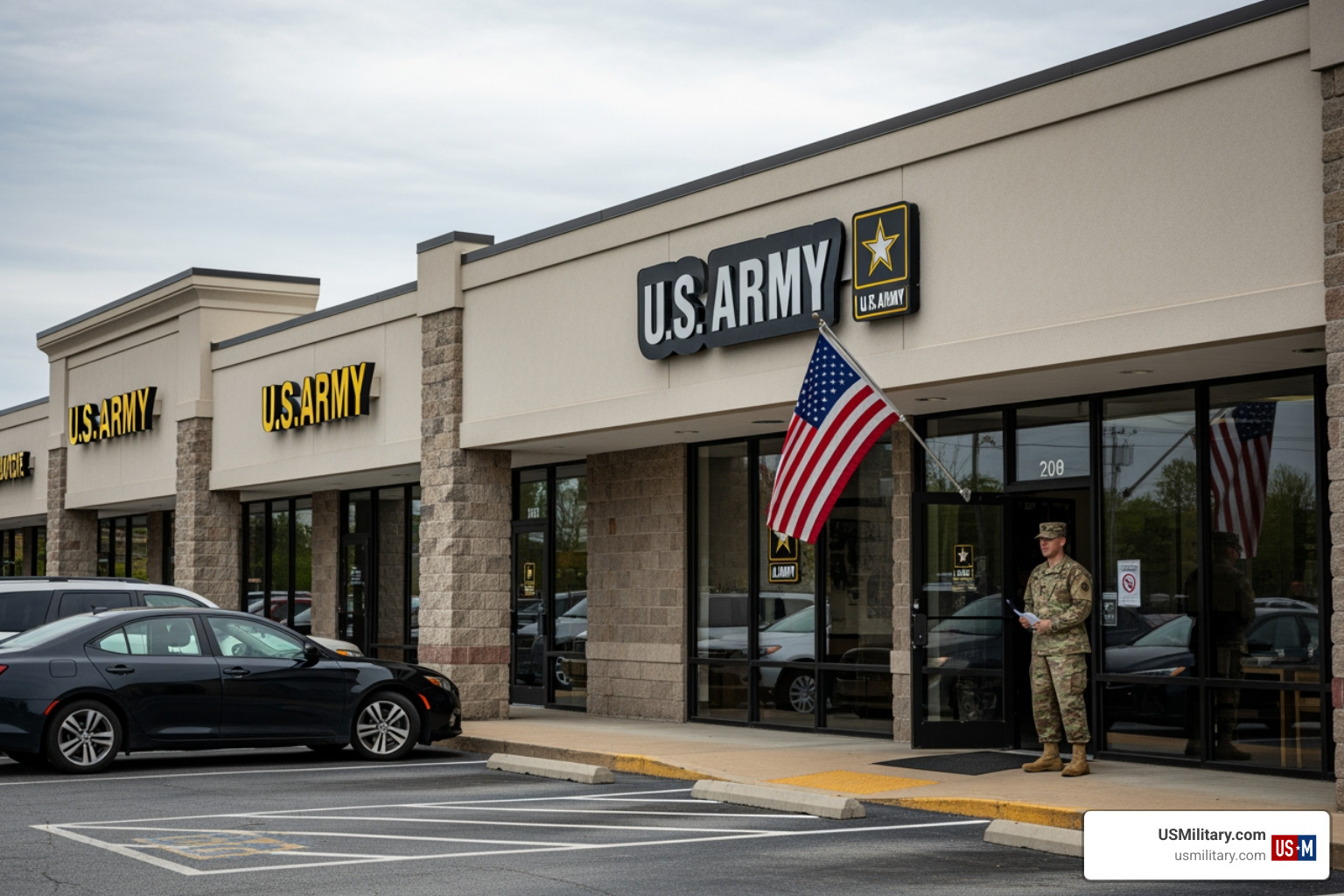
When you start searching for an Army recruiter near me, it helps to understand how the U.S. Army Recruiting Command (USAREC) is structured. The Army doesn’t just scatter individual recruiters randomly across the map. Instead, the country is divided into structured recruiting brigades and battalions. These battalions oversee dozens of local recruiting stations (often called centers) in your communities.
Local recruiting stations are staffed by active-duty noncommissioned officers (NCOs) who live and work in your area. These recruiters do much more than sit in an office waiting for the phone to ring; they participate in local community outreach, visit high schools, attend job fairs, and sponsor local events.
Each station is led by a station commander who ensures that the recruitment process is conducted with absolute integrity. Because recruiters are deeply embedded in their local communities, they understand the local job market and can help you compare what the Army offers against civilian opportunities in your exact town or city.
Locating Your Nearest Army Recruiter Near Me Station
Finding the physical office of a local recruiter is incredibly straightforward. The easiest way to start is by using online search tools that map out offices based on your current location.
- The ZIP Code Search: By visiting the official Be All You Can Be | U.S. Army website, you can plug in your ZIP code to get the exact address, phone number, and email of the closest recruiting station.
- Our Dedicated Locators: At USMilitary.com, we have built simplified search tools to help you bypass the clutter. You can use our Army Recruiter Near Me directory or search our broader Military Recruiter Near Me database to compare the locations of different military branch offices in your neighborhood.
Most recruiting offices are open during standard business hours, but recruiters are highly flexible. They frequently schedule evening or weekend appointments to accommodate school or work schedules.
Major Recruiting Battalions Across the Country
To give you an idea of how the Army organizes its geographic footprint, let’s look at some of the major recruiting battalions operating across the United States. These command hubs manage the local stations you visit:
- Minneapolis Recruiting Battalion: Established during the transition to the all-volunteer force in the 1970s, this massive battalion manages recruiting operations across Minnesota, Iowa, North Dakota, South Dakota, and portions of Wisconsin and Michigan.
- Cleveland Recruiting Battalion: Headquartered in downtown Cleveland, this battalion oversees recruiting offices throughout northern Ohio, western Pennsylvania, and parts of West Virginia.
- Northern California Recruiting Battalion: Responsible for a massive 112,000-square-mile territory, this battalion commands six recruiting companies stretching from the San Francisco Bay Area and Sacramento up through Southern Oregon and Western Nevada.
- Harrisburg Recruiting Battalion: This battalion covers 52 of Pennsylvania’s 67 counties, directing 31 recruiting centers and coordinating with two different Military Entrance Processing Stations (MEPS).
- Montgomery Recruiting Battalion: Managing over 59,000 square miles across Alabama and the Florida Panhandle, this battalion commands 32 local recruiting stations.
No matter which battalion commands your region, the local recruiters working under them are trained to guide you through the exact same standardized enlistment process.
Requirements and the Enlistment Process

Joining the Army is a milestone that requires meeting specific mental, physical, and moral standards. The process is designed to ensure you are fully prepared for the rigors of military service.
One of the first decisions you will make when talking to an Army recruiter near me is whether you want to enter as an enlisted soldier or an officer.
- Enlisted Soldiers (82% of the Army): These are the doers and technical specialists of the force. You can enlist with a high school diploma or GED.
- Commissioned Officers (18% of the Army): These are the managers and leaders. To become an officer, you generally need a four-year college degree and must complete an officer commissioning program like ROTC, Officer Candidate School (OCS), or the U.S. Military Academy at West Point.
Regardless of your path, everyone starts with basic preparation, followed by Basic Combat Training (boot camp) and Advanced Individual Training (AIT) to learn your specific job.
Basic Eligibility and Common Concerns
To enlist in the U.S. Army, you must meet several baseline requirements. However, many prospective applicants assume minor issues will disqualify them when, in reality, waivers are often available. Here is how the basic eligibility criteria break down:
- Age: You must be between 17 and 35 years old to enlist (17-year-olds require parental consent).
- Citizenship: You must be a U.S. citizen or a permanent resident alien (possessing a valid Green Card).
- Education: A high school diploma is highly preferred, though a GED is acceptable.
- Tattoos: The Army has relaxed its tattoo policy in recent years. Tattoos are generally permitted as long as they are not offensive, extremist, or racist. Tattoos on the hands, behind the ears, and a small one on the back of the neck are now largely acceptable, but face tattoos remain restricted.
- Medical History: You will undergo a comprehensive physical exam. While chronic conditions can be disqualifying, many historical medical issues (such as childhood asthma or past fractures) can be cleared with a medical waiver.
- Legal Issues: Minor traffic violations won’t hold you back, but a history of felony convictions or unresolved legal issues will require careful evaluation and a moral waiver.
If you have questions about your specific background, we recommend reading our comprehensive guide on how to Join the Army to see how different eligibility criteria are evaluated.
Preparing for the ASVAB with an Army Recruiter Near Me
The Armed Services Vocational Aptitude Battery (ASVAB) is the standardized test used to determine your eligibility to enlist and, more importantly, which jobs you qualify for.
Your overall score is compiled into the Armed Forces Qualification Test (AFQT) score. To enlist in the Army, you typically need a minimum AFQT score of 31. However, your line scores (individual sections of the test like science, math, and electronics) are what recruiters use to match you to specific Military Occupational Specialties (MOS).
An experienced recruiter can be an invaluable asset when preparing for this test. For example, online resources and profiles like SFC Ronnie Curtis ▪ U.S. Army Recruiter highlight how dedicated recruiters work directly with applicants to provide study guides, practice tests, and tutoring to help them raise their scores. Working closely with an experienced Army Recruiter ensures you don’t just pass, but score high enough to land the exact career path you want.
Choosing Your Path: Active Duty, Reserve, or National Guard
The Army offers three distinct ways to serve, allowing you to choose a path that fits your personal and professional lifestyle. When you sit down with a recruiter, they will ask whether you want to serve full-time or part-time.
| Service Component | Time Commitment | Primary Mission | Geographic Flexibility |
|---|---|---|---|
| Active Duty | Full-time (24/7) | Federal defense and global operations | Stationed worldwide based on Army needs |
| Army Reserve | Part-time (1 weekend/month, 2 weeks/year) | Federal support and combat support roles | Live anywhere; train at a local reserve center |
| Army National Guard | Part-time (1 weekend/month, 2 weeks/year) | State emergency response & federal missions | Serve in your home state under the Governor |
Choosing the right service option is a personal decision. Fortunately, Finding an Active Army Recruiter Near You Is Easier Than Basic Training, and they can help you weigh the pros and cons of each component.
Exploring Career Paths and the Soldier Prep Quiz
With more than 200 different jobs available in the Army, finding the right one can feel overwhelming. The Army has careers in aviation, engineering, information technology, intelligence, healthcare, and combat arms.
To narrow down your choices, you can use the interactive Soldier Prep Quiz or the Career Match tool on the official GoArmy website. These tools ask about your interests, hobbies, and strengths to suggest matching military roles. Once you have a list of potential jobs, you can use our guide, Your Army Path: Locate Recruiters Today, to find a local expert who can explain what those jobs look like on a day-to-day basis.
Contacting Reserve and National Guard Recruiters
If you decide that part-time service is the best fit for your civilian career or college plans, you will want to contact recruiters who specialize in those branches.
- For federal part-time service, you can reach out through the Contact Us – Army Reserve portal.
- For state-specific service that includes state college tuition benefits, you should use the Find a Recruiter – Army National Guard tool.
- You can also search our directory of Military Recruiters Near Me to find National Guard and Reserve offices sharing space in your local community.
Physical Fitness Standards and the ACFT
To succeed in the Army, you must meet its physical fitness standards. Every recruit must pass a physical assessment at MEPS, but your true fitness journey begins when preparing for the Army Combat Fitness Test (ACFT).
The ACFT is the modern physical fitness test of record for the Army. It consists of six events designed to mimic real-world combat physical demands:
- 3-Repetition Maximum Deadlift: Tests lower body strength.
- Standing Power Throw: Tests explosive power.
- Hand-Release Push-Up-Arm Extension: Tests upper body endurance.
- Sprint-Drag-Carry: Tests anaerobic capacity and agility.
- Plank: Tests core strength (this officially replaced the leg tuck event).
- 2-Mile Run: Tests aerobic endurance.
The test is scored on a point system adjusted by age and gender groups. Your recruiter will help you prepare for basic training by hosting physical training (PT) sessions with other future soldiers. Participating in these sessions is highly recommended, as arriving at basic training in good physical shape will make your transition infinitely easier.
Frequently Asked Questions About Army Recruiters
What should I expect during my first meeting with a recruiter?
Your initial meeting with an Army recruiter is entirely informational. There is absolutely no obligation to sign anything on your first visit. The recruiter will ask about your background, education, medical history, and personal goals.
We recommend bringing a list of questions to ask. You should ask about job availability, contract lengths, shipping dates, and educational incentives. If you are ready to take this step, find an office using our Military Recruiter Office Near Me locator.
What benefits and bonuses does the Army offer?
The Army offers a massive benefits package that rivals or exceeds most civilian careers:
- Education: The Post-9/11 GI Bill covers up to 100% of tuition and fees at public universities, plus a monthly housing allowance. You can also use Tuition Assistance while on active duty.
- Cash Bonuses: Depending on your chosen job and how quickly you agree to ship to basic training, the Army offers enlistment bonuses up to $50,000. Quick-ship bonuses of $5,000 are also frequently available.
- Healthcare: Active-duty soldiers and their families receive comprehensive medical and dental care through TRICARE at no cost.
- Post-Service Advantages: Veterans gain access to VA home loans (with 0% down payment options), VA disability benefits, and hiring preferences for federal jobs.
Do Army recruiters hate their job?
Like any high-responsibility sales or public-facing role, recruiting has its challenges. Recruiters face long hours, strict administrative requirements, and the pressure of meeting monthly recruitment goals.
In late 2023 and leading into recent years, the Army faced a significant recruiting shortfall, falling 10,000 recruits short of its active-duty goal. To combat this, the Army executed emergency measures, rapidly ordering hundreds of NCOs to recruiting school to bolster the force. This sudden shift caused temporary stress for many military families.
However, many recruiters find the job deeply rewarding because they get to watch young men and women transform their lives. To read an honest, unfiltered look at the daily realities of the assignment, check out our article: Do Army Recruiters Hate Their Job?.
Conclusion
Deciding to serve in the United States Army is a life-changing choice. Whether you want to gain valuable technical skills, secure money for college, or serve your country full-time, a local recruiter is your gateway to making those goals a reality.
At USMilitary.com, we are dedicated to providing you with the accurate, unbiased information you need to make the best decision for your future. When you are ready to take the next step, use our comprehensive tool to Find Army, Navy, Air Force, Marine Corps Recruiter Near Me and begin your journey. Once you’ve made contact, don’t forget to study hard and start training so you can confidently Prepare for Basic Training.
Free for Service Members & Veterans
Get the military benefits intel no one tells you about.
Weekly updates on VA benefits, pay changes, and money tips — free for service members and veterans.
No spam. Unsubscribe anytime. Your info is never shared.