Where 25 Politicians Stand on Strengthening America’s Military in 2026

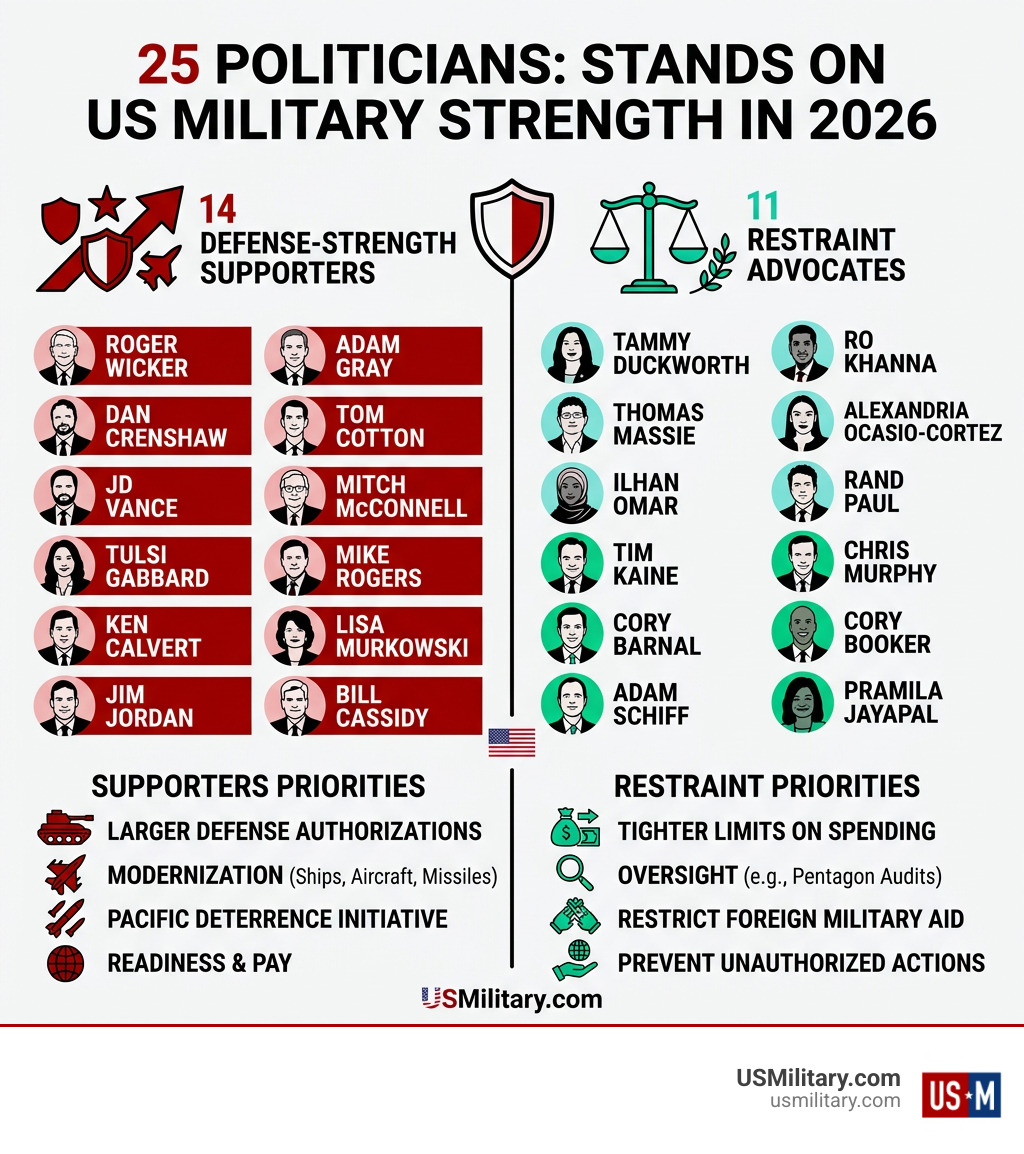
The clearest divide is between lawmakers backing larger defense authorizations, modernization, and deterrence, and those seeking tighter limits on Pentagon spending, foreign military aid, or presidential war powers.
- Generally backing a stronger military: Roger Wicker, John Cornyn, Dan Crenshaw, JD Vance, Tulsi Gabbard, Ken Calvert, Jim Jordan, Adam Gray, Robert Aderholt, Tom Cotton, Mitch McConnell, Mike Rogers, Lisa Murkowski, and Bill Cassidy.
- Generally backing restraint or stronger conditions: Tammy Duckworth, Ro Khanna, Thomas Massie, Alexandria Ocasio-Cortez, Ilhan Omar, Rand Paul, Tim Kaine, Chris Murphy, Cory Booker, Adam Schiff, Pramila Jayapal, and Bernie Sanders.
The FY2026 debate is not a simple vote for or against troops. Supporters point to readiness, pay, ships, aircraft, missiles, cyber capabilities, and the Pacific Deterrence Initiative. Critics point to Pentagon audit failures, the cost of overseas conflicts, aid to Israel and Ukraine, and efforts to prevent unauthorized military action against Iran. The House’s $1.15 trillion NDAA-SAVE package also added election-law issues, making a defense vote a fight over far more than military policy.
I am LARRY FOWLER, publisher of the USMilitary.com Network, and I have spent since 2007 helping active-duty personnel, veterans, and military families follow the policies that can shape service, benefits, and career decisions. In this guide examining how 25 politicians are for and against strengthening and supporting America’s military in 2026, I use major defense votes and public policy positions to separate support for military readiness from calls for oversight and restraint.
Explore related military insights and analysis:
- Is The US Military Becoming More Confident & Stronger With President Trump
- Why Military Veterans Love President Donald J. Trump
- How Massive is the US Military
Legislative Battlegrounds: The FY2026 NDAA, S 2296, S 1071, and the SAVE Act Package
The battle over the FY2026 defense authorization exposed one of the deepest ideological rifts on Capitol Hill. In the House, lawmakers narrowly passed a $1.15 trillion national defense package by a 216–212 margin. The legislation brought together core military readiness priorities with contentious non-defense policy riders, reflecting the ongoing legislative struggle over comprehensive national defense legislation.
To understand where individual lawmakers stand, we must examine the core vehicles carrying these defense initiatives through Congress:
- Senate Bill 2296: The primary Senate version of the National Defense Authorization Act for Fiscal Year 2026, sponsored by Senator Roger Wicker, focused heavily on strategic deterrence and procurement. The upper chamber passed the measure with a broad bipartisan coalition, recording 85 Yea votes (including 30 Democrats and 1 Independent) against 15 Nay votes (13 Democrats and 2 Independents). Lawmakers can review official roll call votes on S 2296 to see individual senator positions.
- Senate Bill 1071: S. 1071 served as another major legislative benchmark authorizing critical weapons systems, aircraft, naval vessels, and missile defense interceptors. Detailed provisions in S 1071 also addressed artificial intelligence, cyber warfare infrastructure, healthcare, and foreign military financing.
- The House NDAA-SAVE Package: The House combined traditional defense authorizations with provisions from the SAVE America Act, tying national defense authorizations to federal voter identification standards. This complex combination yielded a narrow passage where roughly 209 Republicans and six Democrats voted yes, while seven Republicans and 205 Democrats voted against the combined bill. An in-depth breakdown of House Democratic votes highlights the razor-thin margins that define modern defense negotiations.
Pacific Deterrence, DEI Repeals, and Foreign Aid Conflicts
Policy mandates inside the FY2026 defense bills extended far beyond simple procurement tallies. A cornerstone of the authorized spending was the extension and expansion of the Pacific Deterrence Initiative (PDI). Geared toward maintaining maritime security and deterring aggression in the Indo-Pacific, the PDI received broad support from defense hawks who emphasize naval modernization, forward-basing assets, and joint-force integration across Taiwan and partner nations.
At the same time, cultural provisions within the authorization text created fierce floor fights. The legislation eliminated the Department of Defense’s Chief Diversity Officer position and rolled back several diversity, equity, and inclusion initiatives. Lawmakers debated whether these offices enhanced recruitment or distracted from operational readiness, a theme central to navigating military recruitment culture debates. Furthermore, the bill mandated a comprehensive Department of Defense strategy on the national security implications of emerging biotechnologies and funded foreign military assistance programs for Indo-Pacific partners and Israel.
House NDAA-SAVE Package Dynamics and Cross-Party Coalitions
Attaching the SAVE America Act—which requires documentary proof of citizenship for federal election registration—to the military authorization bill forced members to weigh military funding against partisan election reforms.
The six House Democrats who crossed party lines to vote in favor cited non-negotiable troop welfare provisions, notably an essential servicemember pay raise, expanded child-care stipends for military families, and critical investments in regional defense industrial bases. Conversely, the vast majority of House Democrats opposed the package, arguing that combining military funding with voting regulations was an inappropriate legislative maneuver. Parallel battles occurred over defense appropriations, where lawmakers tracked spending allocations through measures like DoD appropriations tracking (H.R. 4016), setting baseline operational spending at $831 billion.
25 Politicians Are For And Against Strengthening & Supporting America’s Military in 2026? Key Votes and Alliances
| Politician | Chamber / Role | Party | Core Stance on 2026 Military Policy | Key Legislative Action / Focus |
|---|---|---|---|---|
| Roger Wicker | Senate (MS) | Republican | Defense Expansion | Sponsored S. 2296; champion of naval shipbuilding and Pacific Deterrence |
| John Cornyn | Senate (TX) | Republican | Defense Expansion | Sponsored S. 1071; prioritizes semiconductor supply chains and missile defense |
| Dan Crenshaw | House (TX-02) | Republican | Defense Expansion | Voted YES on DoD Appropriations; focuses on special operations and SOCOM readiness |
| JD Vance | Administration / Senate | Republican | Targeted Modernization | Advocates for industrial base revitalizing while urging strategic European burden-sharing |
| Tulsi Gabbard | DNI / Veteran | Independent/Appointee | Intelligence Modernization | Emphasizes military intelligence reform and domestic security priorities over foreign intervention |
| Ken Calvert | House (CA-41) | Republican | Defense Expansion | Defense Appropriations Subcommittee Chair; leads procurement allocations |
| Jim Jordan | House (OH-04) | Republican | Defense Expansion | Backed the NDAA-SAVE Act package; champion of eliminating Pentagon DEI offices |
| Adam Gray | House (CA-13) | Democrat | Defense Expansion | Voted YES on FY2026 DoD Appropriations; focuses on servicemember compensation |
| Robert Aderholt | House (AL-04) | Republican | Defense Expansion | Voted YES on foreign military supplemental packages; backs aerospace manufacturing |
| Tom Cotton | Senate (AR) | Republican | Defense Expansion | Pushes for expanded defense outlays, hypersonic weapons, and deterrence against China |
| Mitch McConnell | Senate (KY) | Republican | Global Defense Alliances | Staunch backer of full military funding, NATO integration, and foreign security assistance |
| Mike Rogers | House (AL-03) | Republican | Defense Expansion | House Armed Services Committee Chair; led the $1.15T defense authorization effort |
| Lisa Murkowski | Senate (AK) | Republican | Targeted Defense | Backs Arctic defense infrastructure and strategic missile defense sites in Alaska |
| Bill Cassidy | Senate (LA) | Republican | Defense Modernization | Supports modernization of Gulf Coast military installations and energy grid resilience |
| Tammy Duckworth | Senate (IL) | Democrat | Spending Restraint / War Powers | Voted NAY on S. 2296; led amendments requiring War Powers approval for Iran operations |
| Ro Khanna | House (CA-17) | Democrat | Spending Restraint / Reform | Co-sponsored amendments to reduce foreign military aid and limit unchecked procurement |
| Thomas Massie | House (KY-04) | Republican | Fiscal Restraint / Non-Intervention | Voted NO on DoD Appropriations; introduced amendments cutting $3.3B in foreign military aid |
| Alexandria Ocasio-Cortez | House (NY-14) | Democrat | Budget Reduction | Voted NO on FY2026 DoD Appropriations; advocates shifting funds to social domestic programs |
| Ilhan Omar | House (MN-05) | Democrat | Budget Reduction / Oversight | Opposes defense spending hikes; demands strict human rights conditions on military aid |
| Rand Paul | Senate (KY) | Republican | Fiscal Restraint / War Powers | Voted NAY on S. 2296; vocal opponent of foreign intervention and unconstitutional war spending |
| Tim Kaine | Senate (VA) | Democrat | War Powers Guardrails | Pushes for congressional authorization on overseas operations; demands Pentagon audit compliance |
| Chris Murphy | Senate (CT) | Democrat | Diplomatic Prioritization | Advocates reallocating defense funding toward State Department diplomatic initiatives |
| Cory Booker | Senate (NJ) | Democrat | Restraint / Oversight | Opposes unilateral military actions in the Middle East; demands strict Pentagon fiscal audits |
| Adam Schiff | Senate (CA) | Democrat | Oversight / Targeted Restraint | Focuses on intelligence oversight and restricting executive war authorizations |
| Pramila Jayapal | House (WA-07) | Democrat | Budget Reduction | Congressional Progressive Caucus leader pushing for 10% across-the-board Pentagon cuts |
| Bernie Sanders | Senate (VT) | Independent | Significant Budget Reduction | Voted NAY on S. 2296; staunch critic of defense contractor profits and failed audits |
Lawmakers Championing Defense
Those leading the push for increased defense investments argue that growing threats across Europe, the Middle East, and the Indo-Pacific leave no room for budget freezes. Key figures include:
- Senator Roger Wicker & Senator John Cornyn: As primary sponsors of S. 2296 and S. 1071 respectively, both senators have consistently advanced legislation that accelerates naval shipbuilding, expands munitions stockpiles, and hardens Pacific defenses.
- Representative Dan Crenshaw: A former Navy SEAL, Representative Dan Crenshaw has prioritized special operations readiness, advanced tactical equipment, and medical support for combat veterans.
- Senator JD Vance & DNI Tulsi Gabbard: Both Senator JD Vance and Director of National Intelligence Tulsi Gabbard advocate for reorienting defense investments toward core homeland defense, high-end cyber systems, and domestic industrial reshoring rather than prolonged foreign nation-building.
- Representative Ken Calvert & Representative Mike Rogers: Leading the appropriations and armed services committees, Calvert and Rogers secured authorizations for fifth-generation fighters and next-generation attack submarines.
- Representative Jim Jordan & Representative Robert Aderholt: Jordan championed the stripping of political initiatives from military codes, while Aderholt ensured continued funding for missile defense programs and aerospace manufacturing.
- Centrist Democratic Support: Lawmakers like Representative Adam Gray broke with their party’s leadership to support defense appropriations, ensuring service personnel received critical pay adjustments.
- Senators Tom Cotton, Mitch McConnell, Lisa Murkowski, and Bill Cassidy: These senior lawmakers consistently champion forward deterrence, noting that the foundation of American security relies on the principle that the US military must be strong. Many of these policy positions reflect defense posture assessments that highlight critical shortfalls in global force readiness.
Lawmakers Voting for Restraint (Cuts in the Military)
Lawmakers who voted against the FY2026 defense authorization and appropriations measures did so from diverse ideological viewpoints, including progressive budget reduction, constitutional war powers enforcement, and conservative fiscal restraint:
- Senator Tammy Duckworth: The combat veteran and Illinois senator pushed aggressively for legislative amendments to enforce Article I War Powers, insisting that no funds authorize offensive strikes against Iran without express congressional approval.
- Representative Thomas Massie & Representative Ro Khanna: Demonstrating rare bipartisan alignment, Massie and Khanna co-sponsored amendments to reduce foreign military aid allocations—such as cutting $3.3 billion in direct foreign assistance—arguing that taxpayer resources must prioritize domestic needs and veteran healthcare.
- Representatives Alexandria Ocasio-Cortez, Ilhan Omar, and Pramila Jayapal: These progressive lawmakers consistently vote against defense authorizations that exceed $800 billion, demanding that portions of the Pentagon budget be redirected toward education, domestic healthcare, and climate resilience.
- Senators Rand Paul and Bernie Sanders: Representing opposing sides of the political spectrum, Paul and Sanders routinely unite in voting “Nay” on defense authorizations. Paul targets escalating national debt and unvetted foreign aid, while Sanders challenges the immense profits earned by top defense contractors amidst ongoing Pentagon audit failures.
- Senators Tim Kaine, Chris Murphy, Cory Booker, and Adam Schiff: This coalition has focused on restoring congressional war powers, curbing unilateral executive military actions, and incorporating emerging defense perspectives that prioritize diplomacy and economic engagement over overseas force projection.
Strategic Impact: Global Deterrence, Public Opinion, and Military Readiness in 2026
The congressional debate over the 2026 defense budget takes place in a volatile global security environment. The Munich Security Conference highlighted these exact challenges, releasing its report titled Under Destruction, which outlined critical vulnerabilities across Western defense alliances, supply chains, and artificial intelligence infrastructure. Furthermore, Freedom House reported that global freedom declined for the twentieth consecutive year in 2025, underscoring the pressure on the U.S. military to provide forward-deployed deterrence.
These international developments heavily shape domestic public opinion. Polling data indicates that Americans remain divided on defense spending levels: while a majority supports increased pay for active-duty troops and upgraded benefits for veterans, voters express growing skepticism regarding prolonged foreign engagements and unmonitored overseas military financing. Lawmakers frequently calibrate their legislative maneuvers based on evolving foreign policy and national security evaluations.
Modern readiness also demands heavy capitalization in technological domains beyond traditional platforms. A major share of the FY2026 authorization funds modern cybersecurity priorities, cloud network protection, and space-based early-warning systems, ensuring our armed forces maintain decision dominance against peer competitors.
Foreign Aid Dilemmas: Ukraine, Israel, Taiwan, and Iran Policy
Foreign military aid votes have become contentious flashpoints within defense debates. Supplemental packages like H.R. 815 forced legislators to take distinct positions on multi-theater military aid. While aid to Taiwan through the Pacific Deterrence Initiative received broad bipartisan backing, security assistance to Israel and funding for ongoing operations in the Middle East sparked deep disagreements.
Floor debates reached high tension regarding U.S. naval operations along the Strait of Hormuz and potential escalation with Iran. Restraint-oriented lawmakers argued that routine naval maneuvers and deterrence operations—similar to when the military conducts forward naval maneuvers in international waters—risk pulling the nation into unauthorized conflict without an explicit declaration of war from Congress.
Balancing Fiscal Accountability Against Force Modernization
Fiscal conservatives and progressive oversight advocates frequently point to the Department of Defense’s financial management track record. According to the Government Accountability Office (GAO), the Pentagon failed its seventh consecutive independent financial audit, leaving approximately $4.1 trillion in assets insufficiently tracked.
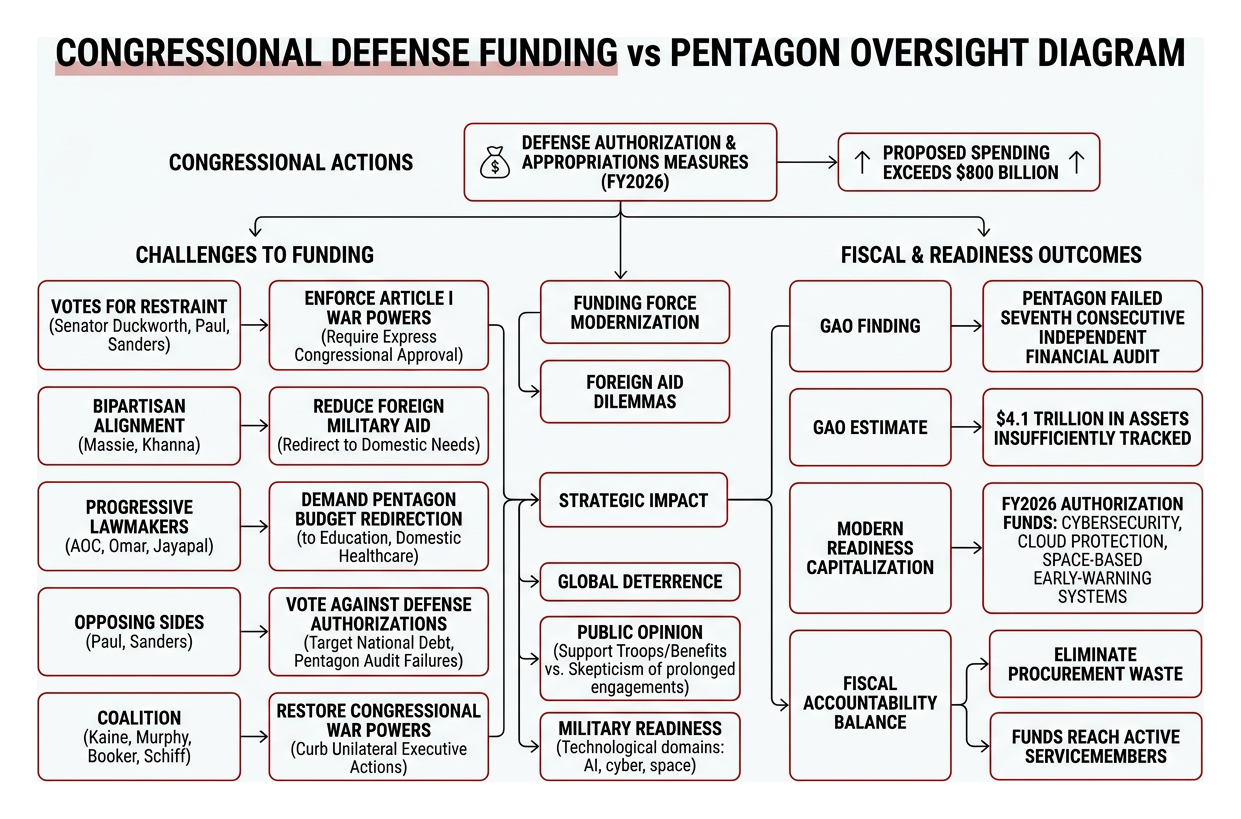
Furthermore, research from Brown University’s Costs of War project estimates the total long-term cost of post-9/11 military engagements at over $8 trillion when accounting for direct operations, veteran healthcare, and debt service. Lawmakers balancing these financial realities argue that force modernization cannot come at the expense of fiscal discipline. Ensuring funds reach active service members while eliminating procurement waste remains a defining challenge, reflecting lessons from historic leadership protecting the military.
Frequently Asked Questions About 2026 Defense Votes and Politicians
Which Democrats voted in favor of the FY2026 NDAA-SAVE Act package?
In the House roll-call vote, six moderate and centrist Democrats joined 209 Republicans to pass the combined $1.15 trillion defense and election policy package (216–212). These members, including Representative Adam Gray, justified their votes by pointing to vital quality-of-life provisions for servicemembers—such as substantial pay raises, housing allowances, and base infrastructure investments—arguing that troop support must take precedence over procedural disputes surrounding the attached SAVE America Act.
Why did lawmakers oppose funding authorizations for Iran operations in 2026?
Lawmakers opposing unrestricted operational funding for Middle East theaters argued that the executive branch was conducting military operations without Article I constitutional authorization from Congress. Led by Senator Tammy Duckworth, these members introduced amendments to enforce the War Powers Resolution, seeking to restrict funding for offensive strikes against Iranian targets while preserving resources strictly for personnel defense and intelligence collection.
How do failed Pentagon audits influence congressional opposition to defense budgets?
The Department of Defense’s failure to pass seven consecutive annual independent financial audits has fueled bipartisan skepticism over top-line spending increases. Lawmakers like Senator Bernie Sanders and Representative Thomas Massie argue that Congress should not approve budgets exceeding $830 billion while the Pentagon cannot adequately account for over $4 trillion in physical assets and equipment, demanding stricter procurement caps and mandatory audit compliance before passing major budget expansions.
Conclusion
The congressional battle over the 2026 defense authorization and appropriations bills highlights a fundamental divide in American governance. One coalition views aggressive top-line spending, naval expansion, and advanced deterrence initiatives as indispensable shields against rising global threats. Another coalition demands strict fiscal accountability, War Powers enforcement, and a re-examination of foreign aid commitments.
As these legislative debates continue on Capitol Hill, the outcomes directly affect military families, active-duty personnel, and veterans awaiting critical decisions on compensation, healthcare, and transition support. At USMilitary.com, we remain dedicated to providing clear, unbiased insights into defense legislation, VA home loan benefits, disability ratings, and career advancement. Explore our complete library of USMilitary.com resources and career guidance to stay informed on the policies shaping our armed forces.
Free for Service Members & Veterans
Get the military benefits intel no one tells you about.
Weekly updates on VA benefits, pay changes, and money tips — free for service members and veterans.
No spam. Unsubscribe anytime. Your info is never shared.


