How VA Disability Ratings Affect Your Benefits

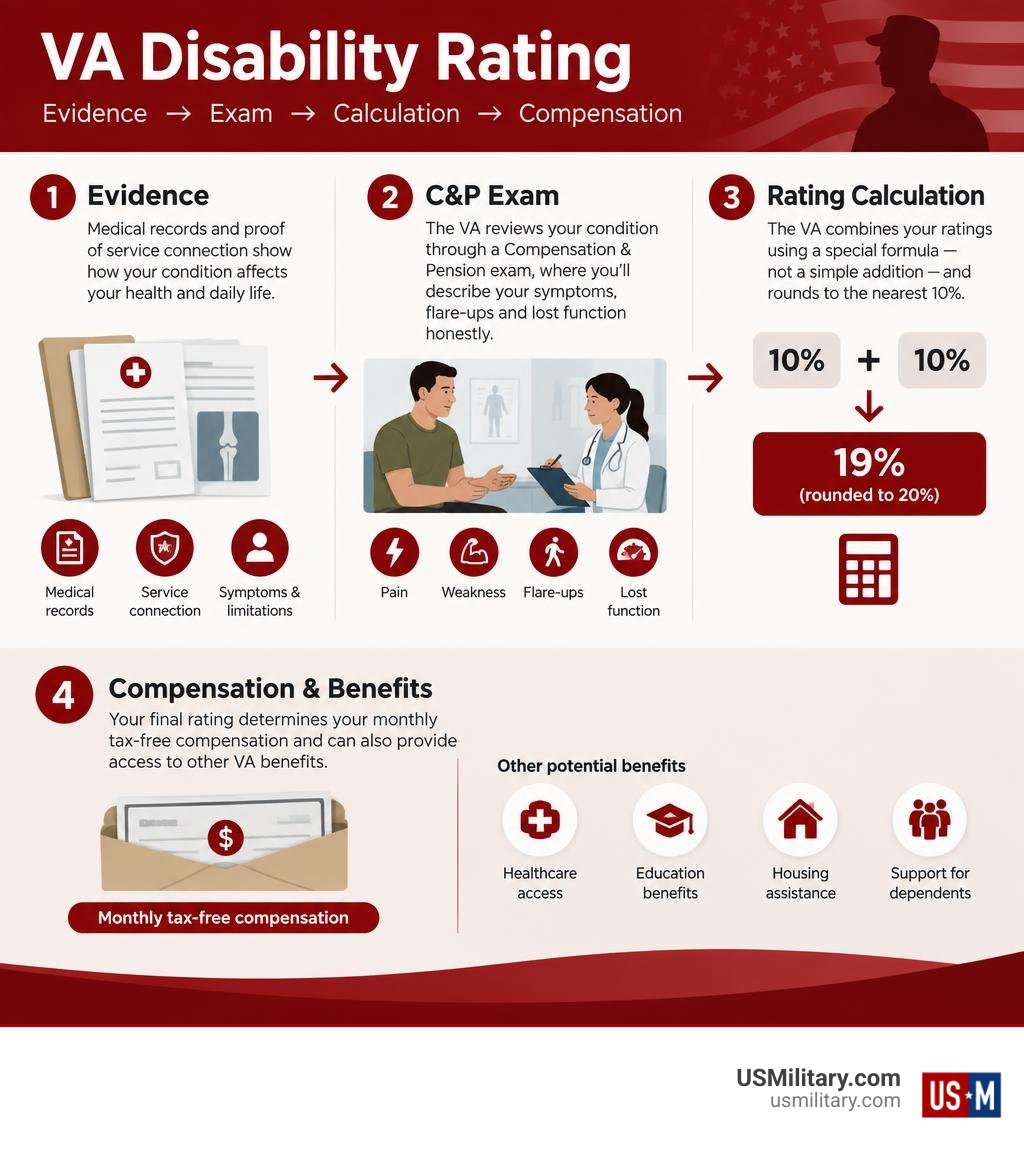
VA disability ratings are percentages that show how much a service-connected condition affects your health and ability to function. The VA uses medical records, claim exam findings, and the rating schedule to assign each condition a rating from 0% to 100%, usually in 10% steps. That percentage helps determine your monthly tax-free compensation and access to some other VA benefits.
More Than 90% Of Clients Have Increased VA Disability Ratings! Why Settle For Less Than You Deserve? Expert Priority Help With Your VA Claim! Free Evaluation Call! Click Here For Your VA Disability Information.
To get a clear picture of your likely rating:
- Confirm that each condition is connected to or aggravated by military service.
- Submit medical evidence that explains your symptoms and daily limits.
- Attend the Compensation and Pension (C&P) exam and describe flare-ups, pain, weakness, and lost function honestly.
- Check how multiple ratings combine, since VA math does not simply add percentages together.
For example, two 10% ratings combine to 19%, which the VA rounds to 20%. The details matter: pain, reduced function, disabilities affecting both arms or legs, dependents, and inability to maintain substantially gainful work can all change the outcome or payment.
I am Larry Fowler, publisher of the USMilitary.com Network, which has helped active-duty members and veterans follow VA benefits and VA disability ratings trends since 2007. This guide breaks down the rules in plain English so you can better understand your decision, compensation, and next steps.
Understanding VA Disability Ratings and How They Are Assigned
When you file a claim with the Department of Veterans Affairs, the ultimate goal is establishing direct service connection and determining how significantly your condition diminishes your earning capacity and overall quality of life. The VA follows comprehensive VA disability rating guidelines established under Title 38 of the Code of Federal Regulations (38 CFR).
To assign an accurate rating, rating specialists examine three core elements:
- Official service treatment records showing an in-service injury, illness, or event
- Current medical evidence confirming a formal diagnosis
- A medical nexus tying your current diagnosed disability directly to your military service
In addition to your private treatment records and military files, the VA frequently schedules a Compensation and Pension (C&P) exam. During this examination, a medical provider assesses your physical and psychological limitations, measures joint mobility, and documents your overall functional loss. Understanding what conditions qualify for disability benefits ensures you file claims supported by solid clinical records.
What Determines Your Service-Connected Rating Percentage
Each condition listed in the VA’s rating schedule is assigned a four-digit diagnostic code. This code specifies the exact criteria required to achieve a particular percentage level. Ratings are assigned in 10% increments ranging from 0% up to 100%.
A 0% rating is considered non-compensable: it confirms your condition is formally recognized as service-connected, giving you priority access to VA medical care for that issue, even though it does not trigger a monthly cash payout. To reach higher percentage tiers, your medical evidence must demonstrate specific diagnostic milestones:
- Frequency, duration, and severity of flare-ups or symptoms
- Measurable loss of joint range of motion (measured with a goniometer)
- Psychological occupational and social impairment levels
- Objective laboratory results, imaging studies, and formal physician statements (nexus letters)
Form 21-526EZ and Pre-Service Aggravation Claims
When filing an initial claim or seeking an increase, veterans use VA Form 21-526EZ (Application for Disability Compensation and Related Benefits). This form covers both new direct conditions and pre-existing medical issues made worse during active service.
If you entered military service with an existing physical or mental condition that worsened beyond natural progression during your time in uniform, you may be entitled to compensation based on the level of aggravation.
For example, if entrance medical records show you had a mild pre-service hearing issue considered equivalent to a 10% disability, and military noise exposure aggravated that condition to a 20% severity level, the VA deducts the pre-service baseline (10%) from your current level (20%). You receive a 10% compensable service-connected rating for the aggravation caused by your military service.
How the VA Calculates Combined Ratings and VA Math
One of the most confusing hurdles for veterans is understanding why adding up individual ratings does not equal your final rating. In VA math, standard addition does not apply. If you receive a 50% rating for PTSD, 50% for sleep apnea, 20% for diabetes, and 20% for a lumbar spine strain, simple addition suggests a 140% rating. However, the VA assigns a combined rating of 80%.

The VA calculates ratings using the whole person theory. Under this legal principle, a veteran is evaluated as a 100% whole, healthy individual at the start of the calculation. Each disability diminishes only a fraction of whatever healthy, remaining efficiency is left, meaning your combined rating can never exceed 100%.
Calculating Multiple VA Disability Ratings with VA Math
To combine multiple conditions, the VA sorts your individual ratings in descending order from highest to lowest severity before applying the non-additive formula.
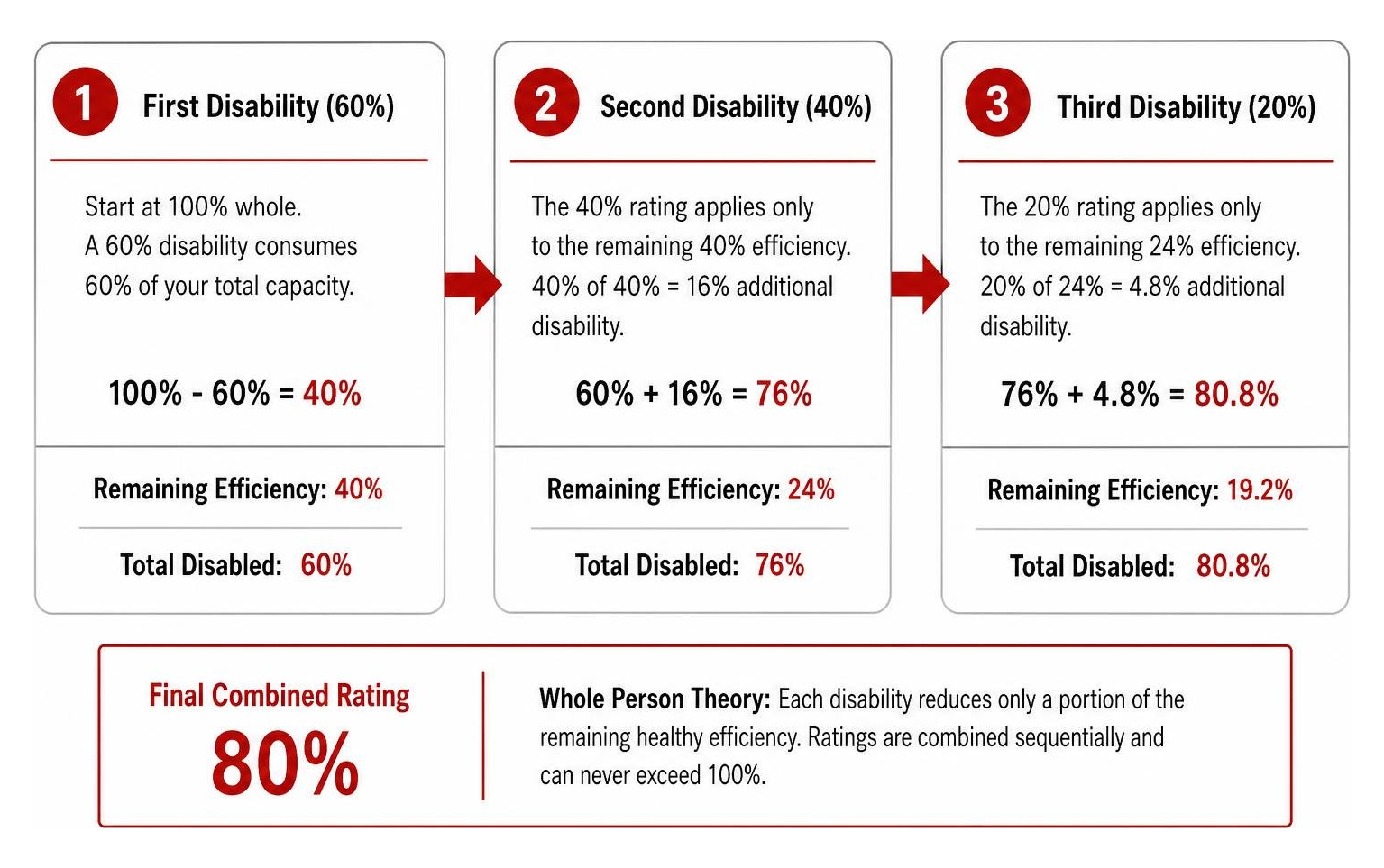
Let’s walk through an example with three separate conditions rated at 60%, 40%, and 20%:
- First Disability (60%): You start at 100% whole. A 60% disability consumes 60% of your total capacity, leaving you 40% efficient (100 – 60 = 40).
- Second Disability (40%): The 40% rating applies only to the remaining 40% efficiency. 40% of 40% equals 16% additional disability. Combining 60% + 16% leaves you 76% disabled and 24% efficient.
- Third Disability (20%): The 20% rating applies to the remaining 24% efficiency. 20% of 24% equals 4.8% additional disability. Adding 4.8% to 76% yields an exact combined value of 80.8%.
- Final Rounding: The VA rounds the combined value to the nearest 10%. Values ending in 1% through 4% round down, while 5% through 9% round up. Thus, 80.8% rounds down to a final combined disability rating of 80%.
Similarly, if you have a 50% rating and a 30% rating:
- 50% leaves 50% efficiency.
- 30% of 50% is 15%.
- 50% + 15% = 65%, which rounds up to a 70% combined rating.
You can review our complete breakdown using the Va Disability Rating Chart 2026 Guide to see how different combinations intersect across official rating schedules.
Applying the Bilateral Factor to Extremity Injuries
When a veteran suffers service-connected disabilities affecting paired extremities—such as both knees, both shoulders, both feet, or an arm and an opposite leg—the VA adds an extra calculation called the bilateral factor.
Under 38 CFR § 4.26, disabilities affecting opposite sides of the body are combined together first using standard VA math. Once those extremity ratings are combined, an additional 10% of that subtotal value is added to the result. This boosted figure is then combined with any non-extremity disabilities (such as PTSD, tinnitus, or sleep apnea). The bilateral factor recognizes the disproportionate physical toll that paired-extremity limitations place on mobility and daily function.
Pain, Motion, and Functional Loss in Disability Assessments
For decades, VA examiners focused almost entirely on mechanical range of motion during musculoskeletal C&P exams. If a veteran could bend their knee or raise their arm to normal limits during an exam, examiners often assigned minimal or 0% ratings, ignoring the severe pain, weakness, and instability the veteran experienced during movement.
How DeLuca v. Brown Evaluates Pain in VA Disability Ratings
The landmark court ruling DeLuca v. Brown changed musculoskeletal evaluations forever. Under the DeLuca precedent, the VA cannot measure disability solely by passive joint movement in a quiet clinic room. Examiners must evaluate and document:
- Pain during active motion
- Weakness and diminished muscle strength
- Fatigability (tiring rapidly during repetitive movements)
- Incoordination and loss of stability
- Functional impairment during periodic flare-ups
If moving a joint causes pain, that pain must be treated as a functional limitation. Under the legal guidelines established in DeLuca, if pain prevents you from moving a joint past 30 degrees during daily activities—even if an examiner physically forces it to 60 degrees—your rating must reflect the functional limitation at that 30-degree threshold.
To support your claim under DeLuca, secure written buddy letters and lay statements from family members, coworkers, and fellow service members detailing how your flare-ups and pain episodes impair daily tasks like driving, carrying groceries, or walking up stairs.
Range of Motion vs. Functional Range of Motion
There is a major legal and clinical distinction between anatomical range of motion and functional range of motion:
- Anatomical Range of Motion: The maximum mechanical degree to which a joint moves when physically guided or pushed by an examiner.
- Functional Range of Motion: The range you can comfortably achieve repeatedly under real-world conditions without severe pain, muscle fatigue, or structural instability.
During a C&P exam, examiners must use a goniometer to record exact degrees of motion. Make sure to tell your examiner the exact moment pain begins, and do not push past your pain threshold. The point where pain starts represents the boundary of your functional range of motion.
2026 VA Compensation Rates, Dependents, and TDIU
VA disability compensation delivers tax-free monthly financial support designed to offset lost earning capacity resulting from military injuries. Each year, benefits are adjusted based on Social Security Cost-of-Living Adjustments (COLA) to maintain pace with inflation.
Check the official VA compensation rate index or consult our in-depth guide to va disability rates for 2026 for comprehensive updates on payment tiers.
The table below illustrates sample monthly compensation baselines across different rating tiers:
| Disability Rating | Single Veteran (No Dependents) | Veteran with Spouse Only | Veteran with Spouse & 1 Child |
|---|---|---|---|
| 10% | $171.23 | $171.23 | $171.23 |
| 20% | $338.49 | $338.49 | $338.49 |
| 30% | $524.31 | $586.31 | $632.31 |
| 40% | $755.28 | $838.28 | $900.28 |
| 50% | $1,074.81 | $1,178.81 | $1,256.81 |
| 60% | $1,361.88 | $1,486.88 | $1,580.88 |
| 70% | $1,716.28 | $1,861.28 | $1,970.28 |
| 80% | $2,044.89 | $2,210.89 | $2,335.89 |
| 90% | $2,297.98 | $2,484.98 | $2,625.98 |
| 100% | $3,831.30 | $4,043.30 | $4,198.30 |
Monthly Payout Tiers and Dependent Allowances
Veterans receiving a 10% or 20% disability rating receive a flat monthly payment regardless of family size. However, once you cross the 30% disability rating threshold, you can add eligible dependents to your monthly award, including:
- A lawful spouse
- Dependent children under age 18
- Children between ages 18 and 23 attending an approved secondary school or college
- Dependent parents who rely on you for financial support
Adding qualifying dependents noticeably increases your monthly compensation. Furthermore, if your spouse requires everyday care, you may claim an added monthly allowance for a spouse receiving Aid and Attendance.
Total Disability Based on Individual Unemployability (TDIU)
Reaching a schedular 100% combined rating using VA math can be extremely difficult. Fortunately, the VA provides a critical safety net known as Total Disability Based on Individual Unemployability (TDIU) under 38 CFR § 4.16.
TDIU allows veterans whose service-connected conditions prevent them from securing or maintaining substantially gainful employment to receive full monthly compensation at the 100% rate, even if their combined rating is lower.
To qualify for schedular TDIU, you must meet one of the following criteria:
- Have one service-connected condition rated at 60% or higher
- Have a combined rating of 70% or higher, with at least one individual condition rated at 40% or higher
Marginal employment (earning below the federal poverty line) or working in a protected family business environment does not disqualify you. Securing TDIU provides life-changing financial relief; learn more about unlocking 100% disability compensation to evaluate your eligibility.
What to Do If You Disagree With Your Decision
If the VA denies your service connection, assigns an effective date that seems incorrect, or grants a rating lower than your symptoms warrant, you have legal rights to challenge the decision. Under the Veterans Appeals Improvement and Modernization Act (AMA), you have one year from the date on your decision letter to file an appeal while preserving your initial effective date.

Supplemental Claims, Higher-Level Reviews, and Board Appeals
Veterans can pursue three distinct decision review lanes:
- Supplemental Claim (VA Form 20-0995): Select this option if you have gathered new and relevant evidence not previously evaluated by the VA, such as updated private medical records, independent medical opinions, or new buddy statements.
- Higher-Level Review (VA Form 20-0996): Choose this lane if you believe the rating specialist made an error based on the evidence already in your file. A senior adjudicator reviews your claim from scratch. You cannot introduce new evidence, but you can request an informal phone conference to explain where the VA made a mistake.
- Board of Veterans’ Appeals (VA Form 10182): Appeal directly to a Veterans Law Judge at the Board of Veterans’ Appeals (BVA) in Washington, D.C. You can choose a direct record review, submit additional evidence within a 90-day window, or request a formal hearing with a judge.
If you are dealing with an unfavorable outcome, our step-by-step guide details how to turn a VA denial into a winning appeal to help you secure the benefits you earned.
Frequently Asked Questions About VA Disability Ratings
How does the whole person theory keep my rating from exceeding 100%?
The whole person theory views a veteran as a single unit of 100% functional efficiency. Each disability percentage is applied sequentially to whatever percentage of health remains rather than being added together. Because you can never lose more than 100% of your total working capacity, your combined rating can never exceed 100%.
What is the financial difference between an 80% and 100% rating?
The financial leap between 80% and 100% is substantial. A single veteran rated at 80% receives $2,044.89 per month, whereas a veteran rated at 100% receives $3,831.30 per month. This difference represents nearly double the compensation for a 20% increase in your combined rating, alongside additional benefits like full dental care, property tax exemptions in many states, and CHAMPVA health coverage for dependents.
Can pain alone increase my disability rating without bone damage?
Yes. Under the DeLuca v. Brown ruling and 38 CFR § 4.59, pain that causes functional impairment must be rated appropriately by examiners. Even if an X-ray or MRI shows no severe structural bone degeneration, documented pain that limits your functional range of motion or prevents normal daily movement justifies a compensable disability rating.
Conclusion
Understanding how the VA evaluates medical evidence, calculates non-additive ratings, and accounts for functional pain ensures you receive an accurate disability rating for your military service. Take the time to gather comprehensive medical documentation, clearly articulate your daily limitations during C&P exams, and exercise your appeal rights whenever a decision falls short.
At USMilitary.com, we are dedicated to helping service members, veterans, and military families navigate the complexities of government benefits. Explore our complete USMilitary.com disability ratings guide to access additional tools, expert claims walkthroughs, and regular compensation updates.
Free for Service Members & Veterans
Get the military benefits intel no one tells you about.
Weekly updates on VA benefits, pay changes, and money tips — free for service members and veterans.
No spam. Unsubscribe anytime. Your info is never shared.


