When BUD/S Breaks You Down to Build You Back Up
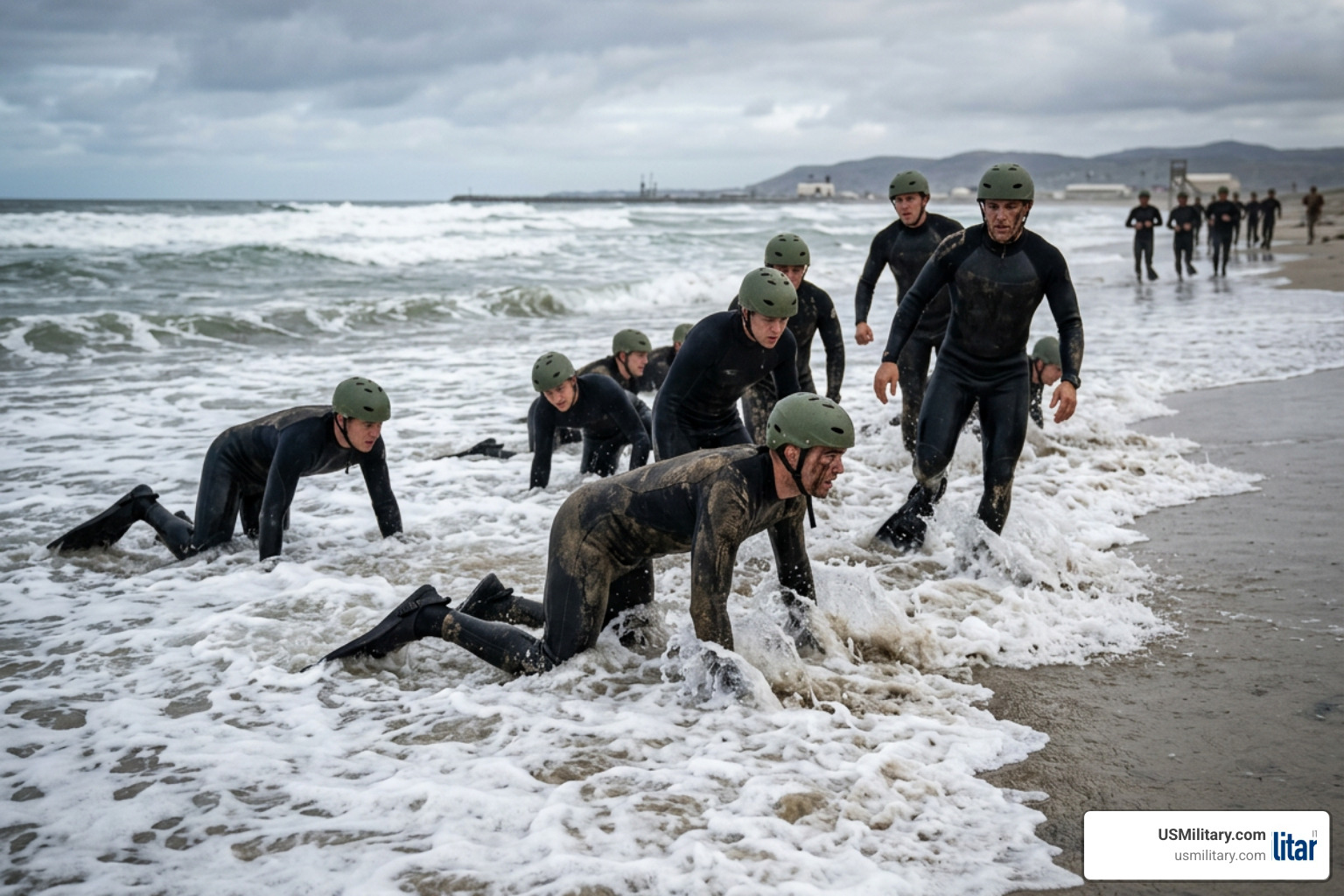
What Navy SEAL BUD/S Training Taught Me About Myself is one of the most searched questions among people considering military service — and for good reason. The answers are raw, surprising, and deeply personal.
Here’s a quick summary of the core lessons BUD/S reveals about the people who attempt it:
- You have more in you than you think. Most candidates quit long before their bodies actually give out.
- Mental strength beats physical strength. The fastest runners and strongest swimmers don’t always make it.
- Micro-goals keep you alive. Surviving meal to meal, evolution to evolution, is the real strategy.
- The team matters more than you. Individual performance means nothing if your boat crew fails.
- Identity changes under pressure. Who you are going in is not who you are coming out.
- Desire is everything. The single biggest separator between those who finish and those who ring the bell is wanting it badly enough.
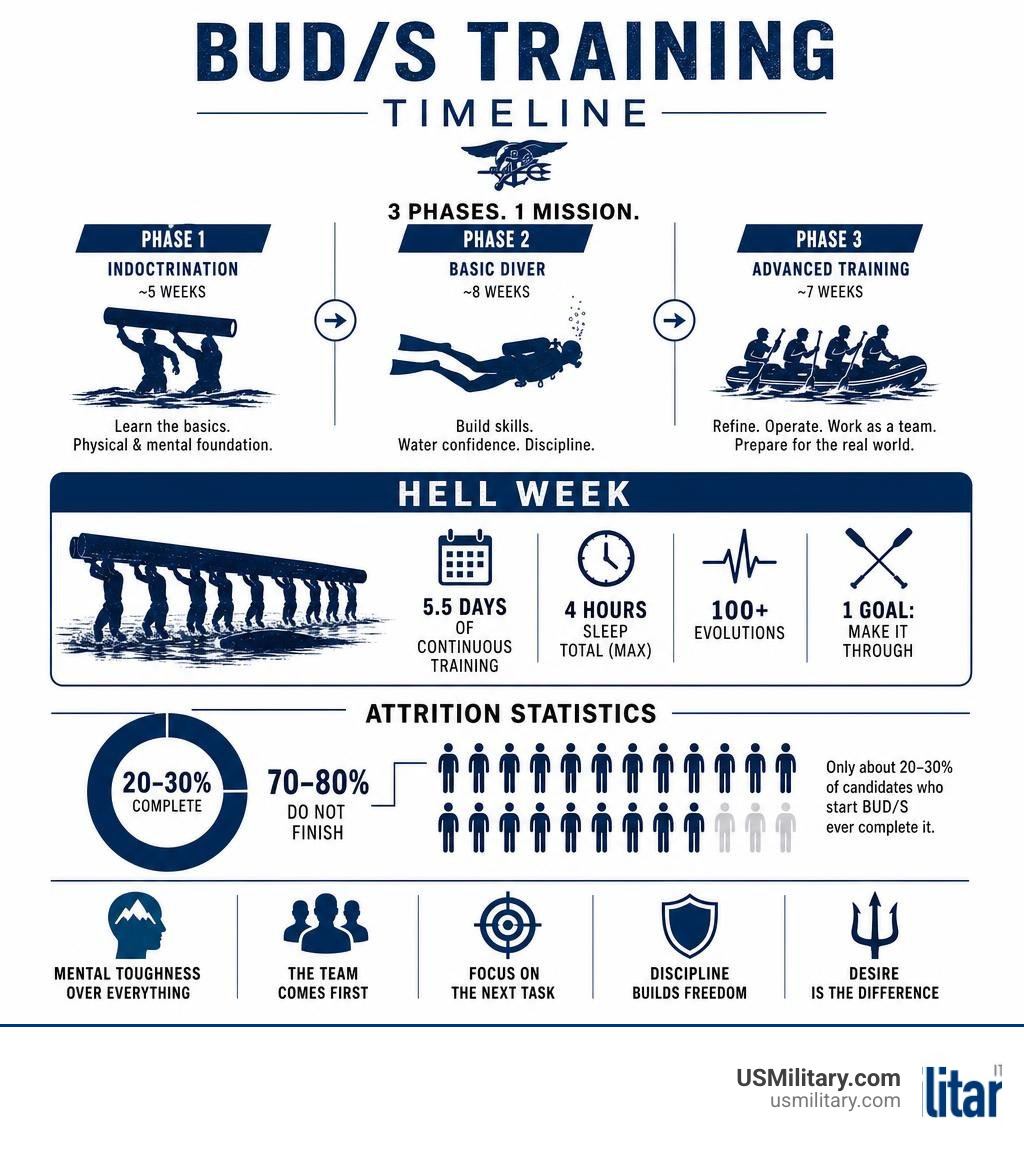
Only about 20-30% of candidates who start BUD/S ever complete it. That 70-80% attrition rate isn’t just a statistic — it’s the story of thousands of highly fit, highly motivated people discovering something unexpected about themselves under extreme pressure.
I’m Larry Fowler, publisher of USMilitary.com, and I’ve spent nearly two decades connecting service members, veterans, and military families with reliable information on everything from enlistment to VA benefits. The question of what Navy SEAL BUD/S training taught me about myself comes up constantly in our community, and in this article I’ll break down the real lessons — backed by accounts and verified training data — so you can decide what they mean for your own path.
What Navy SEAL BUD/S Training Taught Me About Myself terms simplified:
- Navy SEALs BUD/S Training Requirements
- What is Navy SEAL Training 3 Phases And WHy is it so tough
- A Day In The Life Of A Navy SEAL Operator
What Navy SEAL BUD/S Training Taught Me About Myself: The Reality vs. Expectations
When we look at elite military programs, we often imagine a linear progression of physical fitness. We think that if we can run a faster mile, swim a stronger stroke, or lift more weight, we will succeed. But the reality of Basic Underwater Demolition/SEAL (BUD/S) training is a psychological shock that shatters these expectations on day one.
| Expectation of BUD/S | Brutal Reality of BUD/S |
|---|---|
| It is primarily a test of physical strength and conditioning. | It is a psychological crucible; the physically dominant often quit first. |
| You can prepare for the cold and wet by taking cold showers. | Nothing prepares you for hours of shivering in 55-degree ocean water. |
| Individual athletic superstars will lead the pack. | Lone wolves are weeded out; only cohesive boat crews survive. |
| The training is a straightforward progression of military skills. | It is a constant, deliberate test of mental resolve and adaptability. |
To get to Coronado, a candidate must first pass the physical screening test (PST)—a baseline of a 500-yard swim, push-ups, sit-ups, pull-ups, and a 1.5-mile run in boots and pants. But passing the test on paper is a world away from standing on the grinder while instructors scream in your face.
The Four ‘Day Ones’ of BUD/S
Ask any graduate about their “first day,” and they will tell you there isn’t just one. There are actually four distinct “day ones” that mark a candidate’s journey, each serving as a unique milestone described in First Day of BUD/S:
- The Check-In: This is the surreal moment you arrive at the quarterdeck. You are surrounded by the legacy of the teams, seeing the brass bell and the rows of helmets. It is often marked by immediate psychological games, like a Senior Chief throwing a candidate’s cover over a fence because it wasn’t perfectly clean.
- Indoctrination (Indoc) Phase Start: This is where the physical reality begins. You learn how to move as a class, how to handle the inflatable boat small (IBS), and what is expected of your gear. It is a massive shock to the system, and it is not uncommon for candidates to quit or go AWOL during this phase.
- The Official Training Start: When the actual BUD/S class officially begins, the intensity ramps up. This is where you first link arms and walk into the cold Pacific surf, realizing that the stories you read online are now your immediate, freezing reality.
- First Phase Day One: This is the formal start of the first official phase of training. The instructors transition from teaching to actively weeding out those who do not possess the absolute desire to be there.
Expectation vs. Brutal Reality
Many candidates arrive in Coronado thinking their high-school athletic achievements or intense pre-training routines have prepared them. They expect a tough workout program. What they find instead is a psychological meat grinder.
The media portrays SEALs as invincible action heroes, but BUD/S is designed to find your absolute breaking point. It does not matter if you can run a four-mile beach run in record time if you panic the moment you are submerged in dark, freezing water. We quickly learn that What BUD/S is Really Like is less about physical glory and more about enduring constant, wet, sandy discomfort while maintaining the mental clarity to follow orders.
Surviving the Crucible: Hell Week and the Mindset of Micro-Goals
If First Phase is the gateway, Hell Week is the gatekeeper. Occurring in the sixth week of First Phase, it is the ultimate test of human endurance. It is designed to prove to you that your body can do ten times what your mind thinks is possible.
To understand this journey, candidates must look at the Navy SEAL Training Journey & Challenges as a complete transformation.
What Navy SEAL BUD/S Training Taught Me About Myself During Hell Week
During Hell Week, candidates face 5.5 days of continuous training. They run more than 200 miles, engage in physical training for more than 20 hours a day, and receive a maximum of four hours of sleep total across the entire week.
The physical toll is immense:
- Extreme Sleep Deprivation: Hallucinations are common. Candidates fall asleep while paddling, walking, and even standing up.
- Hypothermia: The constant cold water immersion is a rite of passage. The Pacific Ocean is unyielding, and the shivering is violent and constant.
- Chafing and Raw Skin: The combination of sand, saltwater, and wet utility uniforms wears the skin raw, making every movement painful.
As shown in documentaries like To Hell and Back, this is where the mind must take complete control over the body. It teaches you that physical strength is a finite resource, but mental resolve is virtually limitless.
The Meal-to-Meal Mindset
How do you survive when you are shivering, exhausted, and have 100 miles left to run? You do not think about the end of the week. If you think about Friday on a Monday morning, you will quit.
Instead, you develop a “day-to-day, meal-to-meal” mindset. Your entire universe shrinks to the next micro-goal:
- Just make it to breakfast.
- Just survive this next surf entry.
- Just keep paddling until the whistle blows.
This micro-goal strategy is one of the 4 Qualities You Need to Become a Navy SEAL. It teaches you to break down seemingly impossible, overwhelming obstacles into small, manageable tasks. If you can focus entirely on the present moment, you can survive almost anything.
The Power of the Collective: Teamwork, Peer Pressure, and the Bell
No one survives BUD/S alone. The training is deliberately structured to make individual success impossible. If you try to be a lone superstar, the instructors will target you, and your classmates will eventually squeeze you out.
Shared agony is the glue that binds a class together, revealing The Secret to Navy SEAL Training—that the strength of the unit always supersedes the strength of the individual.
Log PT, Boat Carries, and Balancing Individual Performance
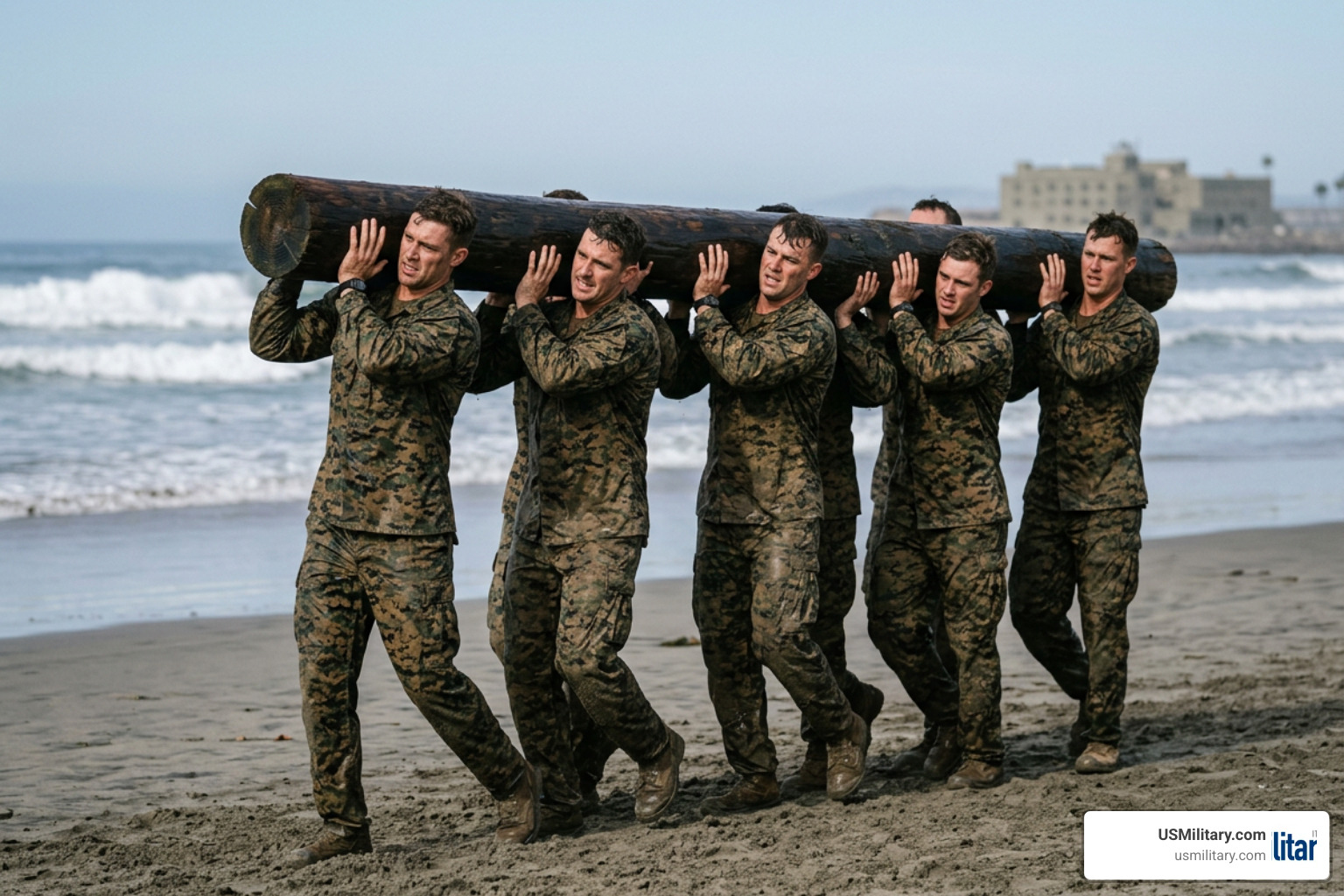
Log PT and IBS (Inflatable Boat Small) carries are the ultimate tests of teamwork. A 150-pound candidate cannot carry a 300-pound log alone. If one member of the seven-man crew slacks off, the other six must carry his weight.
This dynamic forces a delicate balance. You must maintain your own high physical standards, but you must also constantly look out for your teammates. If your boat crew is losing every evolution, you do not get to rest; instead, you get sent to the cold surf for remedial conditioning.
We see this play out in peer dynamics. If a candidate is caught looking out for his own comfort—like the infamous story of a trainee who snuck away to eat in a heated car while his classmates were cleaning gear in the freezing cold—he is immediately ostracized. The community does not tolerate selfishness.
Why Candidates Quit: The Psychology of the Brass Bell
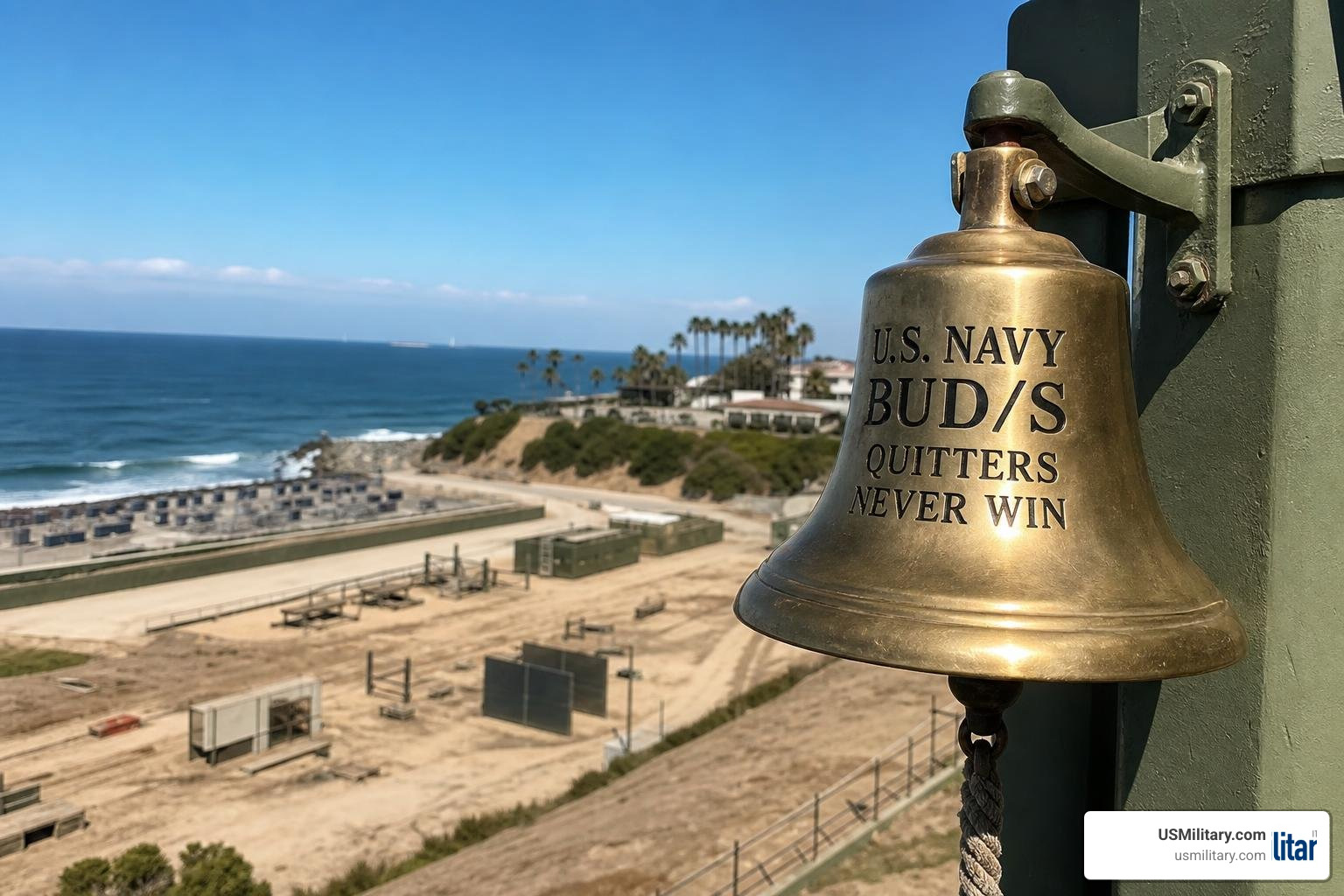
At any point during BUD/S, a candidate can walk up to the green tower, ring the iconic brass bell three times, and instantly end their suffering. It is a completely voluntary program.
The reasons people quit are rarely just physical:
- Instructor Pressure: Instructors are gatekeepers, not coaches. They use relentless verbal pressure to encourage the weak to ring the bell.
- The “Mafia” and Peer Dynamics: In some classes, a toxic subculture of repeat candidates (the “Mafia”) can harass or pressure first-time candidates they deem unworthy.
- The Psychological Toll of the Bell: The bell is always visible. Its ring is deafeningly loud, serving as a constant reminder that comfort is just three rings away.
For families watching their loved ones go through this, understanding these psychological trials is crucial. Resources like the BUD/S Family Preparation guide help parents and spouses understand the intense mental landscape their candidates are navigating.
Evolution of Standards and Identity Transformation
As a candidate progresses through the three phases of BUD/S, the nature of the challenge shifts. The program transitions from a test of raw physical survival to a test of tactical execution under extreme stress.
Physical Progression Across Three Phases
The training philosophy is reflected in how the physical standards evolve across the phases:
- First Phase (Basic Conditioning): Focuses on physical stamina, mental toughness, and water competency. It culminates in Hell Week.
- Second Phase (Diving): Focuses on combat SCUBA. Candidates learn open and closed-circuit diving. The physical standards shift to underwater comfort, culminating in “pool competency,” where instructors systematically sabotage a candidate’s breathing apparatus underwater to test their ability to remain calm and solve problems.
- Third Phase (Land Warfare): Focuses on weapons, demolition, land navigation, and small-unit tactics. It takes place largely on San Clemente Island, where rucking and tactical movement become the primary physical challenges.
This progression, detailed in BUD/S Navy SEAL Training, shows that physical conditioning is merely the baseline. Once you prove you will not quit, you must prove you can think, perform, and lead while exhausted and freezing.
Forging a New Identity and Belonging
Passing through this crucible fundamentally alters how you view yourself. You enter BUD/S as an individual with an ego, athletic achievements, and a civilian identity. You leave as a member of a tight-knit brotherhood.
This transformation is deeply rooted in Mental Toughness and Stoic Philosophy. Instructors and mentors like Master Chief Will Guild historically used Stoic principles to teach candidates about arete—the ancient Greek concept of living with virtue, character, and choosing to be your best self regardless of external circumstances. You learn that your identity is not defined by your comfort, but by your response to adversity.
Life After Coronado: Applying Frogman Lessons to the Civilian World
The lessons learned on the beaches of Coronado do not stay there. They become a permanent operating system for life, translating directly to success in business, relationships, and personal development.
Many of these long-term benefits are detailed in the Navy SEAL Training Success Traits resource.
What Navy SEAL BUD/S Training Taught Me About Myself in Later Life
When you have survived 55-degree water at 3:00 AM while being screamed at by instructors, the daily stresses of the civilian world lose their power over you. You develop a deep, quiet confidence—a “swirling air of confidence” that doesn’t need to boast.
The core Character Traits That BUD/S Training Teaches include:
- Calm in Chaos: The ability to breathe and think rationally when everyone else is panicking.
- Embracing Failure: Viewing setbacks not as personal defeats, but as necessary data points for improvement.
- High Accountability: Taking absolute ownership of your actions and their impact on your team.
- Extreme Resilience: Knowing that no matter how hard today is, “the only easy day was yesterday.”
These traits create individuals who do not run from adversity; instead, they welcome it as the only true vehicle for personal growth.
Frequently Asked Questions About BUD/S Training
What is the attrition rate of Navy SEAL BUD/S training?
The attrition rate of BUD/S training is historically between 70% and 80%. Only about 20% to 30% of the candidates who start the program will successfully graduate and go on to SEAL Qualification Training (SQT). Fewer than 10,000 men have completed the program since its inception in the 1960s.
How long is Hell Week and how much do candidates sleep?
Hell Week lasts for 5.5 days, starting on Sunday evening and ending on Friday afternoon. During this time, candidates are subjected to continuous physical training, running over 200 miles and training for over 20 hours a day. They receive a maximum of four hours of sleep in total across the entire week.
Can you use performance-enhancing drugs (PEDs) in BUD/S?
No. While there have been historical concerns and rumors regarding PED use to cope with the extreme physical demands, the Navy enforces strict, random, WADA-validated drug testing protocols. Using black-market substances is highly dangerous, especially under extreme physical duress, and candidates caught using PEDs are immediately dismissed from the program. For more on the realities of the training environment, check out What Families Should Know About BUD/S.
Conclusion
At its core, Navy SEAL BUD/S training is not just a selection course for the military’s most elite maritime warriors. It is a profound journey of self-discovery. It forces you to look into the mirror of extreme adversity and answer the ultimate question: Who are you when everything else is stripped away?
Whether you are preparing to take the physical screening test or simply looking to apply these principles of resilience to your civilian career, the lessons of BUD/S remain timeless. You have more in you than you think, your team is your greatest asset, and the only easy day was yesterday.
For more resources on military careers, physical preparation, and veteran benefits, explore our comprehensive Navy SEALs Complete Guide here at USMilitary.com.
Free for Service Members & Veterans
Get the military benefits intel no one tells you about.
Weekly updates on VA benefits, pay changes, and money tips — free for service members and veterans.
No spam. Unsubscribe anytime. Your info is never shared.


