What You Need to Know About Military Reserve Pension Rules
Military reserve pension rules determine whether you qualify for retirement pay, how much you’ll receive, and when payments begin. Here’s a quick summary:
| Key Rule | Details |
|---|---|
| Minimum service | 20 qualifying years (at least 50 retirement points per year) |
| Retirement age | Generally age 60 (can be reduced to as low as 50) |
| Pay calculation | Total points ÷ 360 × 2.5% (legacy) or 2.0% (BRS) × retired pay base |
| Minimum points | 1,000 points (20 years × 50 minimum) = 6.94% of basic pay |
| When pay starts | Not automatic — you must request it from your branch |
Unlike active duty retirement, reserve members don’t receive a pension check the day they leave service. There’s often a gap of years — sometimes decades — between when you earn the right to retire and when you receive your first payment. That gap is called the “gray area,” and understanding it is one of the most important parts of reserve retirement planning.
The rules also vary depending on when you joined the military. Your retirement system — whether it’s the legacy High-36 plan or the newer Blended Retirement System (BRS) — is set by your Date of Initial Entry into Military Service (DIEMS).
I’m Larry Fowler, publisher of the USMilitary.com Network and a long-time advocate for helping service members understand their benefits — including military reserve pension rules — since 2007. Whether you’re just starting your reserve career or approaching the 20-year mark, the sections below will walk you through everything you need to know.
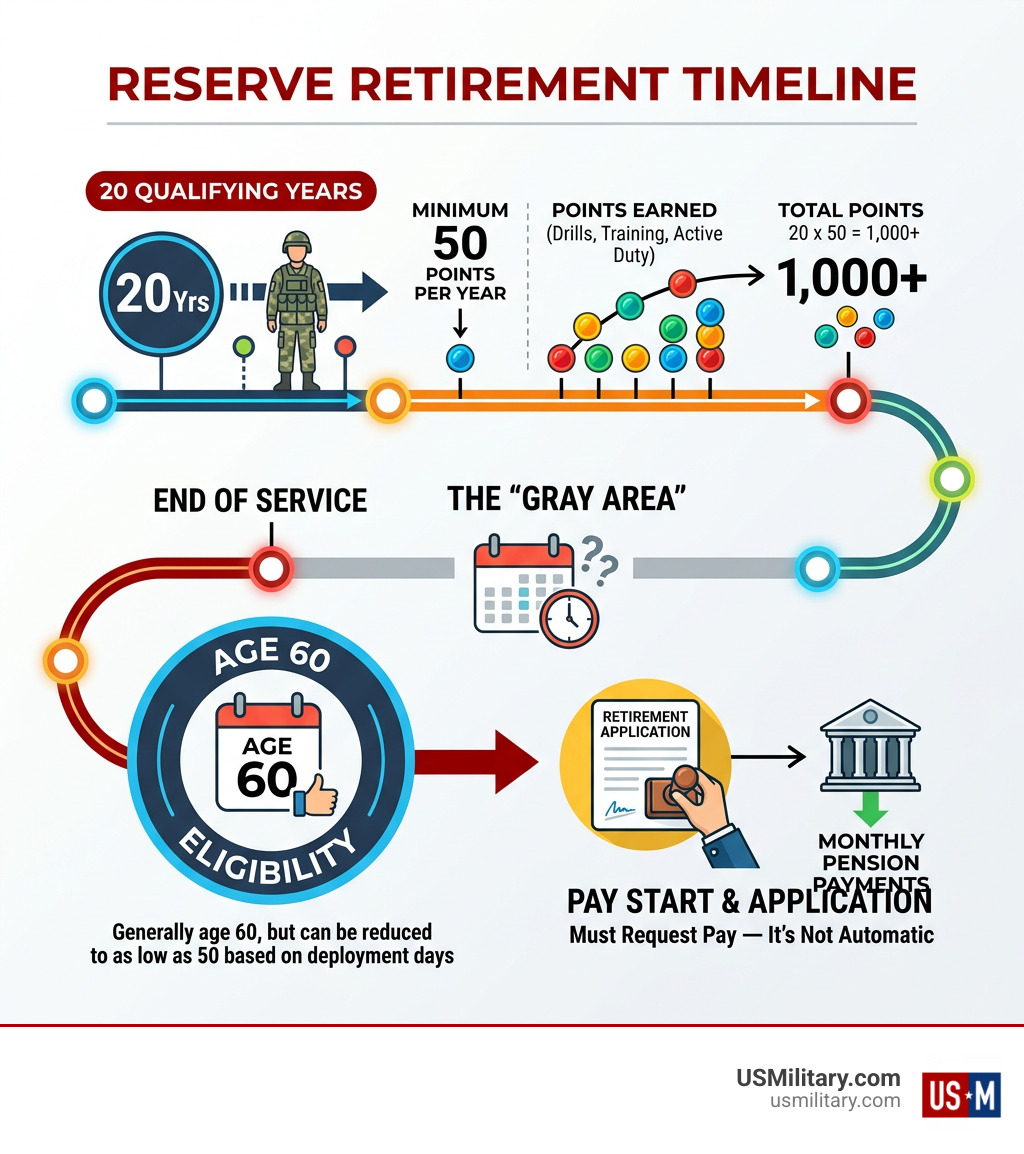
Core Eligibility and Military Reserve Pension Rules

To unlock the door to a military pension as a reservist, you must first master the “Rule of 20.” We often hear about active duty members hitting their 20-year mark and walking straight into a pension, but for those of us in the Reserve Component (RC), the path is a bit more nuanced.
The bedrock of military reserve pension rules is the requirement for 20 qualifying years of service. However, a “year” in the reserves isn’t just 365 days on the calendar; it is a year in which you earn at least 50 retirement points. If you have a year where you only earned 40 points, that year counts toward your total time in uniform, but it does not count as a qualifying year toward your pension.
Once you hit that magic number of 20 qualifying years, you are eligible for what the Department of Defense calls “non-regular retired pay.” While you can technically “retire” from drill at any age after hitting 20 years, you generally won’t see a dime of that pension until you reach age 60. You can learn more about reserve retirement benefits through official channels to see how these timelines affect your specific branch. For a broader look at how these perks stack up against other options, check out more info about retirement benefits on our site.
Qualifying Years of Service
What exactly counts toward those 20 years? It’s a mix of different types of duty. Under military reserve pension rules, qualifying service includes:
- Active Service: Any time spent on full-time active duty.
- Full-time National Guard Duty: This includes AGR (Active Guard Reserve) tours.
- Active Duty for Training (ADT): Your annual training (AT) or initial entry training.
- Inactive Duty Training (IDT): Your typical weekend drills.
The most important document you will ever receive is your “20-Year Letter” (officially the Notification of Eligibility for Retired Pay at Age 60). Once you have this letter in hand, your right to a pension is legally “vested.” Even if you were to leave the reserves the next day, you would still be entitled to pay once you reach the eligibility age.
The “Gray Area” Reservist
We often talk about the “Gray Area,” and no, it’s not just the color of our hair as we get older! In military reserve pension rules, a “Gray Area” reservist is someone who has completed their 20 qualifying years and has been discharged or transferred to the Retired Reserve but is not yet old enough to receive pay.
During this time, you are essentially a “retiree-in-waiting.” You have earned the benefit, but it is deferred. It is vital to keep your contact information updated with the Defense Finance and Accounting Service (DFAS) during this period. The Army retirement services history shows just how long the military has been working to support vets through this transition, ensuring that no one gets left behind in the “gray.”
Calculating Points, Multipliers, and the Retired Pay Base
If you want to know exactly how much your monthly check will be, you have to get comfortable with the math. The reserve pension is a “points-based” system. Unlike active duty, where pay is based strictly on years and months, reservists are paid based on the total number of points they’ve accumulated over their entire career.
Every day of active service earns you 1 point. For a typical drill weekend, you usually earn 4 points (one for each four-hour period). You also get 15 “membership points” just for being in an active status each year. For the fine details on what counts, you can refer to the DoDI 1215.07 Point Guidance. Whether it’s funeral honors duty or correspondence courses, every point adds up to more money in your pocket later. Understanding these enlistment and retirement issues early in your career can make a massive difference in your final payout.
Determining the Retired Pay Multiplier
The formula for your pension starts with your total points. You take that number and divide it by 360 to get your “equivalent years” of service.
- Legacy High-36: Multiply your equivalent years by 2.5%.
- Blended Retirement System (BRS): Multiply your equivalent years by 2.0%.
For example, if you retire with 3,600 points: 3,600 / 360 = 10 equivalent years. Under the legacy system, 10 years x 2.5% = 25%. Your pension would be 25% of your pay base. Under BRS, 10 years x 2.0% = 20%. Your pension would be 20% of your pay base (but remember, BRS includes TSP matching!).
There are limits to how many points you can earn from “inactive” duty (like drills) in a single year. Historically, these limits were 60, 75, or 90 points, but for years ending on or after October 30, 2007, the limit is 130 points per year.
Establishing the Retired Pay Base
Once you have your multiplier (the percentage), you need to know what number to multiply it by. This is your “Retired Pay Base.”
- Final Pay: If you entered service before September 8, 1980, your base is your final basic pay rate.
- High-36: For almost everyone else, the base is the average of the highest 36 months of basic pay for your rank.
A unique quirk of military reserve pension rules is that your pay base is usually calculated using the pay scales in effect when you begin receiving pay, not when you stopped drilling. This means if you stop drilling at age 45 as an E-7 but don’t collect pay until age 60, your pension is calculated using the E-7 pay scale from 15 years in the future! You can find your basic pay amount on the current DFAS tables to start your estimates.
Comparing Retirement Systems: High-3, BRS, and Final Pay
The military retirement landscape changed significantly on January 1, 2018, with the introduction of the Blended Retirement System. Choosing between the legacy system and BRS was a major decision for many, and for new accessions, BRS is now the standard.
| Feature | Legacy (High-36) | Blended Retirement System (BRS) |
|---|---|---|
| Pension Multiplier | 2.5% per equivalent year | 2.0% per equivalent year |
| TSP Matching | None | Up to 5% Government Match |
| Continuation Pay | None | Mid-career cash bonus |
| Lump Sum Option | No | Yes (25% or 50% at retirement) |
The Blended Retirement System (BRS) Details highlight that while the pension multiplier is lower (2.0% vs 2.5%), the addition of government TSP matching means you can take a significant retirement nest egg with you even if you don’t stay for the full 20 years.
The Blended Retirement System (BRS) for Reservists
For reservists under BRS, the government automatically contributes 1% of your basic pay to your Thrift Savings Plan (TSP) after 60 days of service. They will match your contributions dollar-for-dollar up to 3%, and then 50 cents on the dollar for the next 2%. This is essentially a 5% pay raise if you contribute at least 5% of your own pay.
Another “carrot” in the BRS is Continuation Pay. This is a one-time payout offered between your 8th and 12th year of service in exchange for a commitment to serve at least three more years. For reservists, this bonus is usually 0.5 to 6 times your monthly basic pay (as if you were on active duty). You can find more specifics in the Uniformed Services Guide to BRS.
Legacy High-36 and Final Pay Plans
The Legacy Retirement System Overview covers those who entered service before 2018 and did not opt into BRS. These plans are “all or nothing.” If you serve 19 years and 11 months and then leave, you get zero pension. However, if you hit the 20-year mark, the 2.5% multiplier provides a very robust monthly check for life. These plans don’t offer TSP matching, so the responsibility for supplemental saving falls entirely on the service member.
Age Reduction, Recalled Service, and Disability Rules
One of the most common questions we get is: “Do I really have to wait until 60?” Thanks to the National Defense Authorization Act (NDAA) of 2008, many reservists can start collecting their check early.
For every 90 days of “specified duty” (usually deployments or certain mobilizations) performed within a single fiscal year after January 28, 2008, you can reduce your retirement age by three months. For example, if you deployed for a year, you might be able to start collecting your pension at age 59 instead of 60. You cannot reduce your age below 50. You can check the specific Reduced Eligibility Age for Reserve Retirement regulations to see if your orders qualify.
Recalled to Active Duty After Retirement
If you are already retired and get recalled to active duty, your pension stops while you are back on the payroll. However, this can actually benefit you. Under the Active/Reserve Duty After Retirement Rules, if you serve at least two additional years of active status, you may be eligible to have your retired pay recomputed.
This recomputation uses the newer, likely higher, pay scales and accounts for the extra time served. In some cases, the “Tower Amendment” ensures you receive the highest possible rate, even if older pay tables were more favorable. There is also “Heroism Pay”—an extra 10% increase for enlisted members who were cited for extraordinary heroism in the line of duty.
FERS/CSRS Credits and International Comparisons
Many reservists also work as federal civilians. Generally, you cannot “double dip” by using the same years of military service for both a military pension and a federal civilian (FERS/CSRS) pension. However, there is an exception for reserve retirement under Chapter 1223, Title 10. If you retire from the reserves, you can usually receive your reserve pension and still count that military time toward your federal civilian retirement, provided you make a “military deposit” to the civilian retirement fund.
If you are a regular military retiree (active duty) and want to use that time for FERS, you usually have a 60-day window to waive your military pay.
Interestingly, our neighbors to the north have a different approach. The Canadian Reserve Force Pension Plan uses a 1.5% lifetime formula and includes “bridge benefits” that stay in place until the retiree reaches age 65. While the US system is point-based, the Canadian system focuses heavily on total earnings.
Frequently Asked Questions about Military Reserve Pension Rules
How do I apply for reserve retirement pay?
Your pension does not start automatically! You must request your retirement benefits from the military department where you last served. We recommend starting this process about 9 to 12 months before your 60th birthday (or your reduced eligibility age). You will need to submit an application package to your branch’s human resources command (like Army HRC or Navy Personnel Command). Make sure your myPay account has a current non-military email address so you don’t lose access to your tax forms and pay stubs.
What are the Military reserve pension rules for points?
There are a few caps you should know about. While you can earn an unlimited number of points through active duty (up to 365 or 366 in a leap year), there is a limit on “inactive” points. Currently, you can only count up to 130 inactive points per year toward your pension calculation. These inactive points include your 15 membership points, weekend drills, and funeral honors duty.
How does COLA affect my reserve pension?
Military pensions are protected against inflation through Cost-of-Living Adjustments (COLA). These are typically based on the Consumer Price Index (CPI-W). Every year, usually in December, your pension amount is adjusted to keep up with the rising cost of goods. If you were under the REDUX plan (which is rare for reservists), your COLA would be slightly lower, but for High-3 and BRS, you receive full CPI protection.
Conclusion
At USMilitary.com, we know that navigating military reserve pension rules can feel like trying to read a map in a dark Humvee. But taking the time to understand your points, your DIEMS date, and your eligibility age is the best way to ensure your financial readiness for the future.
Whether you are a “Gray Area” reservist or just starting your journey in the National Guard, your service has earned you a valuable benefit. Don’t leave money on the table—stay informed and explore your military retirement benefits to make the most of what you’ve earned. We are here to help you every step of the way as you march toward a secure and well-deserved retirement.
Free for Service Members & Veterans
Get the military benefits intel no one tells you about.
Weekly updates on VA benefits, pay changes, and money tips — free for service members and veterans.
No spam. Unsubscribe anytime. Your info is never shared.


