Understanding Military Enlistment Age: What the Numbers Tell Us
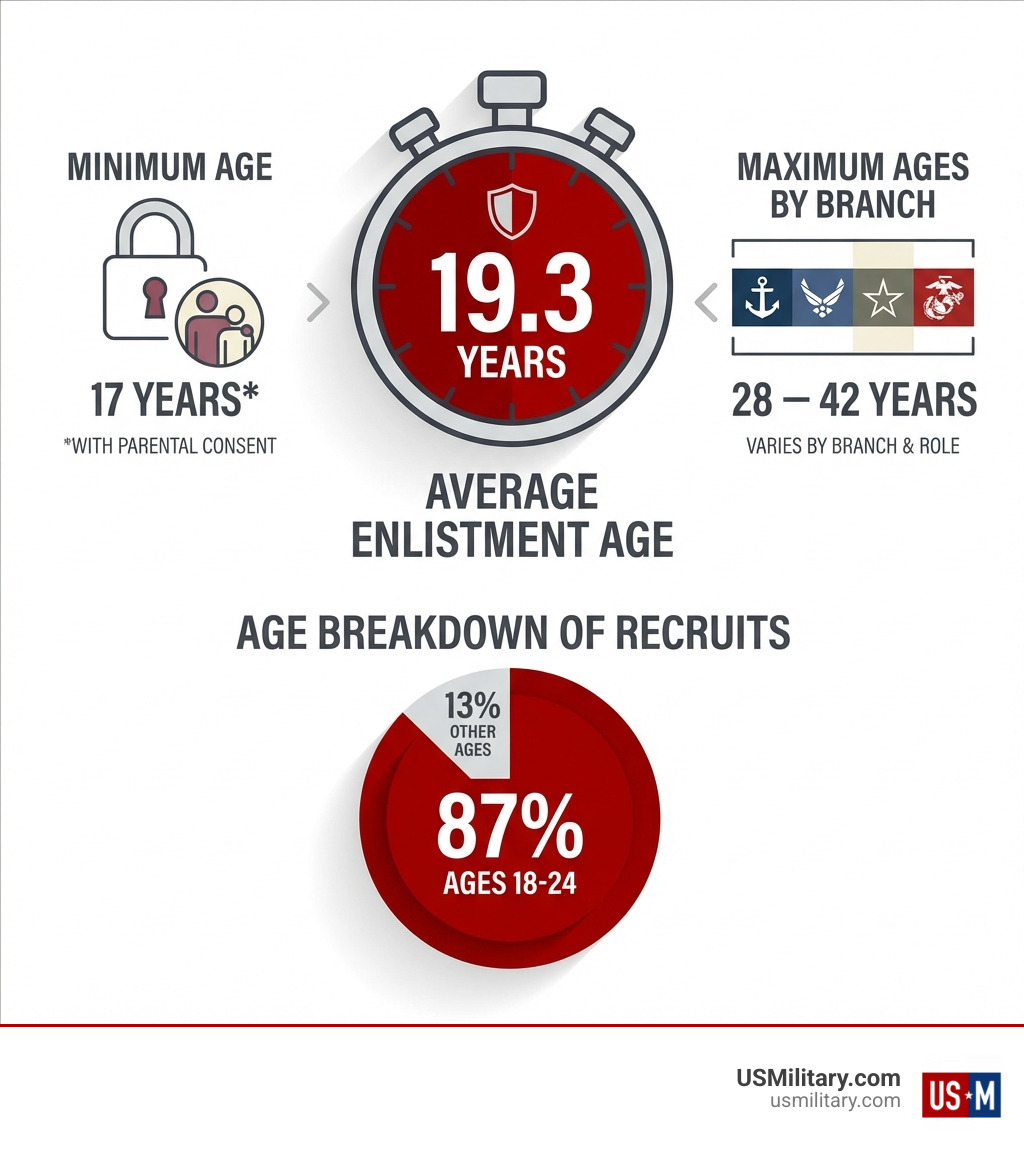
The average age to join the military is 19.3 years old across all branches, though this varies from 18.5 years for the Marine Corps to 19.7 years for the Army. Here is what you need to know:
Quick Facts:
- Minimum Age: 17 years old (with parental consent)
- Maximum Age: Varies by branch (28-42 years old)
- Most Common Age Range: 18-24 years old (87% of recruits)
- Marine Corps: Youngest recruits (51% are 17-18 years old)
- Army: Most older recruits (23% are over 21)
Many people assume there is only a narrow window to join the military, right after high school or not at all. That is not true. As one former Navy SEAL notes, “The age to join the military is not a tight window but a broad range, extending to 42 in some branches.”
The reality is far more flexible than most people think. Whether you are 17 or 39, there may be a path for you to serve. The key is understanding how age requirements differ between branches, between enlisted and officer positions, and for specialized programs.
Some recruits join straight out of high school, eager to start their military careers early. Others wait until their late twenties or thirties, bringing valuable life experience and education to the table. Both paths have distinct advantages, and neither is “too late” or “too early.” Your situation, goals, and readiness matter more than matching an average.
Your age is just one factor among many, including physical fitness, education level, medical history, and character qualifications, that determines your eligibility to serve.
What Is the Average Age to Join the Military?
When people ask about the average age to join the military, they are really asking when most Americans decide they are ready to serve. Based on Department of Defense data, the average age of enlisted accessions across all services is about 19.3 years. This single figure, however, hides important differences between the branches and between individual paths into the military.
Roughly 87 percent of all new recruits fall within the 18- to 24-year-old bracket, indicating a strong trend of younger individuals entering military service. This demographic typically includes recent high school graduates and those in their early years of college or vocational training. That said, you should not assume you are “too old” if you are past your early twenties; the military is large and has room for recruits with a wide range of ages and backgrounds.
Understanding the Average Age to Join the Military by Branch
The average age to join the military is not a one-size-fits-all number. Each branch has its own recruiting patterns and, consequently, its own average enlistment age.
The Marine Corps tends to attract the youngest demographic, with an average enlisted accession age of 18.5 years. A significant 51 percent of their recruits are 17- and 18-year-olds, often joining right after high school. This youthful entry aligns with the Marine Corps reputation for intense physical training and a strong emphasis on foundational discipline.
The Army sees a slightly older average, at 19.7 years for enlisted accessions. The Army also has the greatest proportion of recruits older than age 21, accounting for 23 percent of their new enlistees. This might be due to the wider variety of roles and career paths available in the Army, which can appeal to individuals with some prior work or life experience.
Other branches fall within this range. For instance, the Navy average enlisted age is around 20.3 years, and the Air Force average enlisted age is about 20.4 years. The Coast Guard primarily enlists individuals between 18 and 27 for active duty, though their Reserve component can go up to age 39. These slight differences reflect the diverse needs and opportunities within each service.
While these are averages for initial enlistment, it is also useful to consider how age progresses through the ranks. For enlisted personnel, assuming an 18-year-old joins and progresses normally, they might reach Sergeant (E-5) by about age 22, Staff Sergeant (E-6) by about 27, and Sergeant Major (E-9) by about 39. For officers, starting around age 23 after college, they might become a Captain (O-3) by about 27, a Lieutenant Colonel (O-5) by around 39, and a Colonel (O-6) by about 45. These are general estimates, and actual promotion timelines can vary.
How Does the Average Age to Join the Military Compare to Civilian Demographics?
The age demographics of military recruits differ from the broader civilian population. While approximately 87 percent of new military recruits are 18- to 24-year-olds, only about 36 percent of the comparable civilian population falls within this age bracket. This difference shows that military service attracts a higher concentration of young adults than the general workforce.

This concentration of youth in the military population has several implications. Recruiters are often engaging with individuals who are at a formative stage of their lives, making crucial decisions about their future. The military also provides a structured pathway for many young Americans who might be seeking purpose, career development, or educational benefits right after high school.
However, a recent update on the female military recruiting market presented to the Defense Advisory Committee on Women in the Services found that many young women aged 16-21 do not know much about the U.S. military. What they do know often comes from television or popular media, leading to misconceptions. This suggests that while youth are a primary target, there is a need for more direct and accurate information to counter popular narratives and help potential recruits make informed choices.
Military Age Requirements: Enlisted vs. Officer
Understanding the average age to join the military is one thing, but knowing the strict age requirements is another. The U.S. military has specific minimum and maximum age limits that vary depending on the branch and whether you are looking to enlist or become a commissioned officer. These rules are in place to help ensure that individuals are physically and mentally prepared for the demands of military service.
The minimum age for enlisting in any branch of the military is 17 years old. However, for anyone under 18, parental consent is required. This requirement ensures that young recruits have the support of their families when making such a significant life decision.
Maximum age limits are where things get more nuanced. They differ across the branches, reflecting the unique roles and physical requirements of each service.
Enlisted Age Requirements by Branch
Here is a breakdown of the minimum and maximum age limits for enlisted personnel in each branch of the U.S. military:
| Military Branch | Minimum Age | Maximum Age |
|---|---|---|
| Air Force | 17 | 42 |
| Army | 17 | 35 |
| Coast Guard | 17 | 41 |
| Marine Corps | 17 | 28 |
| Navy | 17 | 41 |
| Space Force | 17 | 42 |
(Note: 17-year-olds require parental consent for enlistment.)
These age limits are generally for initial entry and can change if policies are updated, so applicants should always confirm current standards with a recruiter. As you can see, the maximum age can range quite a bit, from the Marine Corps stricter 28 to the Air Force and Space Force more flexible 42. This wide range means that military service is accessible to a broad spectrum of individuals, not just those fresh out of high school.
Officer Age Requirements by Branch
Becoming a commissioned officer typically has slightly different age requirements than enlisting, primarily because it often requires a four-year college degree. While a common guideline is to be at least 18 and no older than the mid-30s to become a commissioned officer, these limits vary by branch and by commissioning program.
Here are the maximum age limits for many standard officer programs:
- Army: Up to 35
- Navy: Up to 29
- Air Force: Up to 28
- Marine Corps: Up to 28
- Coast Guard: Up to 27
These are general guidelines, and certain officer programs, especially those for specialized fields like medical or legal professions, might have different age cutoffs. Programs like Officer Candidate School (OCS) or direct commissions often have their own specific age criteria. Service academies, such as West Point or the Naval Academy, are generally more restrictive, typically requiring applicants to be between 17 and 23 years old upon enrollment as a freshman.
Beyond the Standard: Waivers and Special Opportunities
While age limits provide a clear framework, the military recognizes that life does not always follow a simple pattern. That is where waivers come into play. Waivers can offer flexibility for individuals who do not meet standard age, medical, or moral requirements but still possess the qualities and skills the military needs. They are granted on a case-by-case basis, reflecting both the needs of the service and the applicant overall qualifications.
For example, Department of Defense Instruction 1304.26 (Qualification Standards for Enlistment, Appointment, and Induction) states that age waivers are possible. The maximum age for a prior service enlistee, for instance, can be determined by adding the individual years of prior service to age 42. This shows that the military is willing to be flexible for those with valuable experience.
Age Cutoffs for Specialized Military Programs
When it comes to specialized military programs, especially elite forces and special operations units, the age cutoffs can be more stringent due to the extreme physical and mental demands. These roles require peak performance, and age can be a significant factor.
Here is a look at some of the age ranges for these demanding programs:
- Air Force Special Warfare (for roles such as Pararescue or Combat Controller): While the general Air Force age limit is 42, some special warfare roles have an age limit of 39.
- Navy SEALs: For civilians, the age range without waivers is typically 17-28 years old. For SWCC (Special Warfare Combatant-craft Crewmen), it is 17-31 years old.
- Army Special Forces: The age range for joining and attending the Special Forces training pipeline is 20-36.
- Army Rangers: For selection and Ranger School, the age range is often listed as 17-34. Some sources indicate that Army Rangers can begin certain training at older ages, typically with waivers or prior service considerations.
- Marine Reconnaissance: The age range is 17 to 28.
- Marine Raider (MARSOC): While there is no single fixed age limit for Marines attending the Assessment and Selection phase, the average age of most attendees and graduates is 25-27 years old.
- Coast Guard Deployable Specialized Forces (DSF): Applicants must usually be between the ages of 20 and 34.
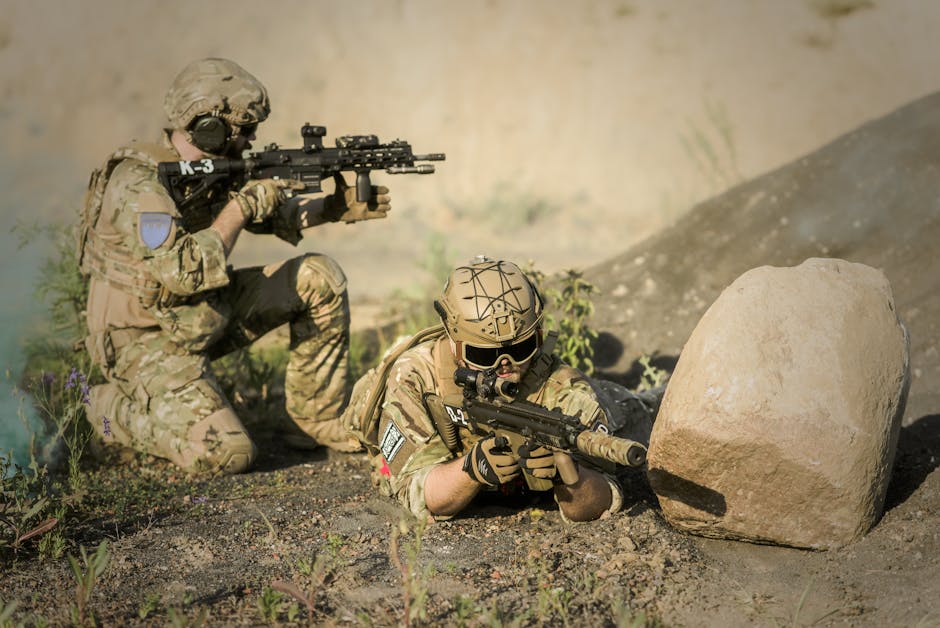
These age limits reflect the intense physical conditioning, mental resilience, and rapid response capabilities required for these roles. They are designed to help ensure that candidates are at an age where they can effectively meet these demanding standards.
Are Age Waivers Available for Specialized Programs?
Age waivers are sometimes available for specialized programs, but they are typically harder to obtain and are granted on a highly selective, case-by-case basis. The key factors usually involve the candidate exceptional qualifications, prior military experience, and the specific needs of the service.
For instance, if you have prior active-duty service, that time can sometimes be subtracted from your current age when determining eligibility for some Navy special operations roles like SEALs or SWCC, effectively extending your window. This can be an advantage for veterans looking to transition into these elite units.
Even for competitive programs, there is often more flexibility than people realize. For example, some highly qualified applicants in their early 30s have been selected for SEAL training, and certain officer entry paths into SEAL programs can extend to older ages, though competition is extremely high.
However, some units, like the 75th Ranger Regiment, are known for having a very strict selection process where age waivers may be less common or simply not available. In these cases, the stated age limits are often firm.
To pursue an age waiver, especially for special operations, you will need to demonstrate strong physical fitness, mental aptitude, and possibly specialized skills that make you a standout candidate. Speaking with a recruiter who works directly with these programs is the best first step, as they can provide the most current information on waiver possibilities and the specific requirements for your desired path.
Joining Young vs. Old: Weighing the Pros and Cons
The decision of when to join the military is a personal one, and both enlisting at a younger age and joining later in life come with their own advantages and potential challenges. There is no single “best” age, as it depends on your goals, readiness, and what you hope to gain from military service.
Advantages of Enlisting at a Younger Age
Many individuals choose to enlist right after high school, often around the average age to join the military. This path offers several benefits:
- Early Career Start: Joining young means you can begin your military career sooner, gaining valuable experience and skills that can set you up for success both in and out of uniform. You will be building your resume and professional network while many of your peers are still in college.
- Faster Promotion Potential: With more time in service, younger recruits often have the opportunity to rise through the ranks over a longer career, leading to increased responsibility, better pay, and more leadership opportunities earlier in life.
- Physical Peak: For many, the late teens and early twenties are their physical prime. This can be an advantage during the rigorous demands of basic training and physically demanding job roles. Adapting to military life and its physical challenges may feel more natural.
- Retirement Benefits: Starting earlier means you can accrue years of service towards retirement benefits sooner. For those who make the military a full career, this can mean retiring in their late 30s or early 40s with a pension and benefits, setting them up for a second career or earlier retirement.
Advantages of Enlisting at an Older Age
While younger recruits often dominate the statistics, joining the military later in life brings a set of strengths that are highly valued:
- Maturity and Life Experience: Older recruits often bring a level of maturity, self-discipline, and a broader life perspective to the military. They may have already faced personal challenges, held civilian jobs, or pursued higher education, which can translate into better decision-making and leadership potential.
- Diverse Skill Sets: Many older enlistees have acquired professional skills and knowledge from previous careers or advanced education. These skills can be valuable to the military, potentially opening doors to specialized roles or leading to faster promotions because of existing expertise.
- Clearer Goals: Individuals who join later often have a more defined sense of purpose and commitment. They have had more time to reflect on their career aspirations and are typically more focused on achieving their military objectives.
- Leadership Potential: With life experience comes an understanding of teamwork, responsibility, and problem-solving. Older recruits may naturally step into leadership roles, serving as mentors to younger service members. This is particularly true for officer candidates, who typically join after earning a college degree and often have more life experience.
The military values dedication, capability, and a willingness to serve, whether you are 18 or in your 30s. Both young and older recruits contribute to the strength and diversity of the armed forces.
Frequently Asked Questions about Military Enlistment Age
This section answers common questions about age and military service.
What is the mandatory retirement age for military personnel?
The mandatory retirement age in the military varies based on rank and years of service, particularly for officers. For general officers (O-7 and above), the mandatory retirement age is often 62. In some situations this can be deferred to 64, or in rare cases extended further with high-level approval.
For O-7 (Brigadier General/Rear Admiral lower half) officers, they generally must retire five years after their promotion to that rank or after 30 years of active duty, whichever comes later. For O-8 (Major General/Rear Admiral upper half) officers, the rule is five years after promotion to O-8 or after 35 years of service, whichever is greater. These rules help maintain a steady flow of promotion opportunities and leadership turnover within the ranks.
Can I get an age waiver to join the military?
Age waivers are sometimes available, but they are not guaranteed and are granted on a case-by-case basis. The military is generally more willing to consider waivers if you possess critical skills, have prior military service, or if the service has specific recruitment needs that your profile helps to fill.
Department of Defense Instruction 1304.26 outlines the process for age waivers. If you have prior service, that time can often be factored into your age calculation, effectively extending your eligibility window. The key is to speak directly with a recruiter from your desired branch. They can assess your individual circumstances, explain the waiver process, and advise you on the likelihood of approval based on current policies.
Does being older give you a higher rank when you join?
Your age alone does not automatically grant you a higher rank upon initial enlistment. Most new recruits, regardless of age, start at entry-level ranks such as Private (E-1), Private First Class (E-2), or Airman Basic (E-1).
However, there are several factors that can lead to a higher entry rank:
- Education: Having a college degree (associate or bachelor) or a certain number of college credits can qualify you for an accelerated entry rank, often starting as an E-3 (for example, Lance Corporal, Airman First Class, or Private First Class in the Army).
- Prior Service: If you have previously served in the military, you may be able to re-enter at your previous rank or a similar level, depending on the time elapsed and the needs of the service.
- Specific Skills: Certain in-demand skills, certifications, or vocational training might also qualify you for a higher entry rank.
- Officer Programs: If you have a four-year degree, you can pursue a commission as an officer through programs such as Officer Candidate School (OCS) or ROTC. Officers start at O-1 (Second Lieutenant/Ensign), which is a higher pay grade and leadership position than any enlisted entry rank.
- ASVAB Score: A high score on the Armed Services Vocational Aptitude Battery (ASVAB) can open doors to more specialized jobs and, in some cases, higher entry ranks.
So, while simply being older does not mean you bypass the entry ranks, the life experiences and educational achievements that often come with age can help you start your military career at a higher standing.
Conclusion
The average age to join the military is a helpful reference point, but what truly stands out is the military broad and inclusive approach to recruitment. While the typical recruit may be in their late teens or early twenties, the age limits for enlistment and commissioning span decades, with opportunities extending into the 30s and even 40s for many branches and specialized roles.
Whether you are a young adult eager to start your career or an older individual looking for a new challenge and an opportunity to serve, the door to military service is often much wider than people realize. Age is just one piece of the puzzle; your fitness, education, character, and determination are equally important.
If you are considering service, it is worth taking time to explore all your options and think about how your background, goals, and current stage of life align with different roles in the armed forces.
To learn more about the specific age limits to join the military, visit our comprehensive guide: Learn more about the specific age limits to join the military.
Free for Service Members & Veterans
Get the military benefits intel no one tells you about.
Weekly updates on VA benefits, pay changes, and money tips — free for service members and veterans.
No spam. Unsubscribe anytime. Your info is never shared.


