Understanding Your Military Medical School Options
Will The Military Pay My Medical School Costs is a question thousands of pre-med students ask every year. The short answer is yes—the U.S. military offers several programs that cover medical school expenses in exchange for service commitment.
Here are your main options:
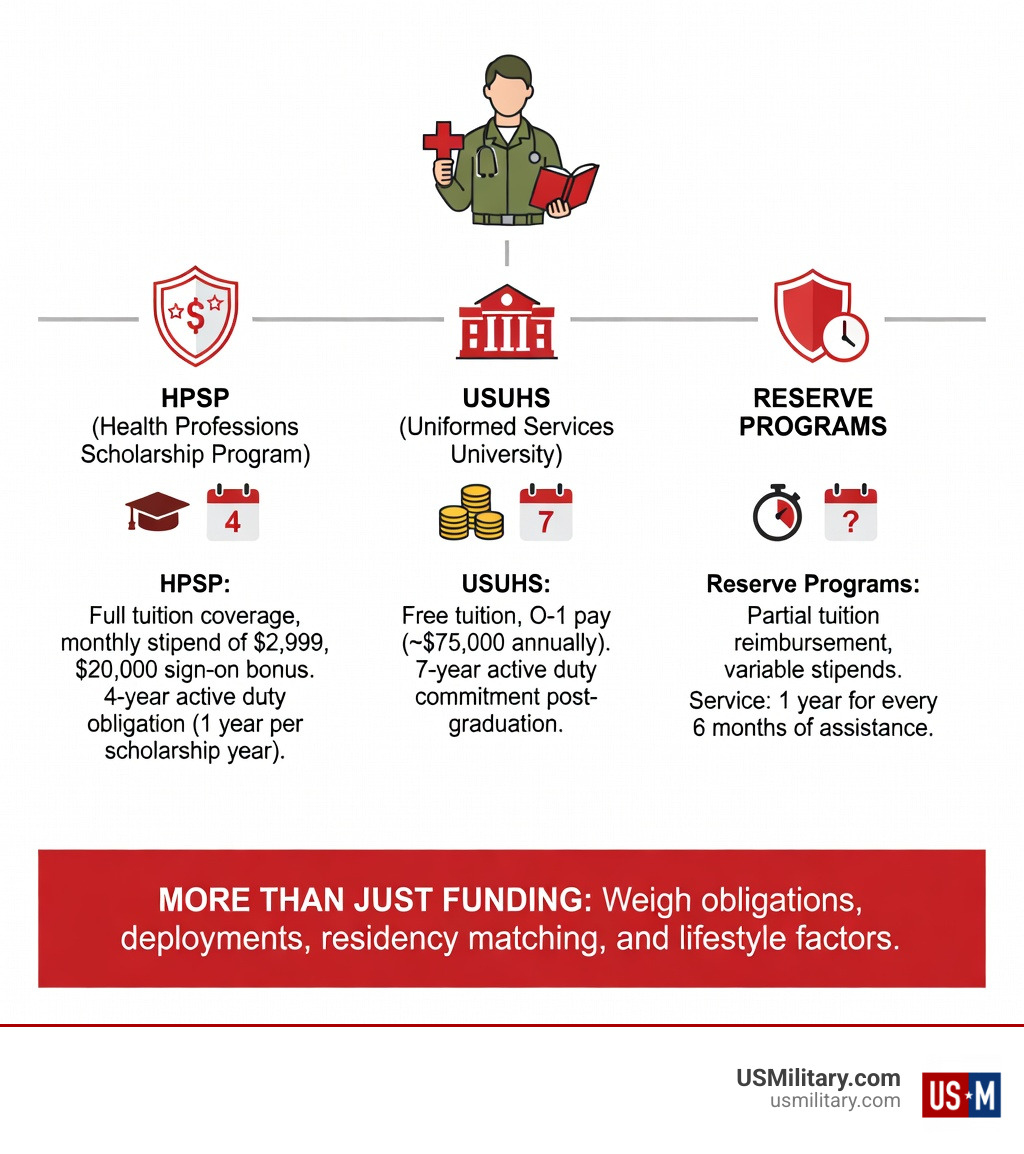
| Program | Coverage | Service Obligation |
|---|---|---|
| HPSP (Health Professions Scholarship Program) | Full tuition, fees, books, $2,999/month stipend, $20,000 bonus | 1 year per scholarship year (typically 4 years) |
| USUHS (Uniformed Services University) | Full tuition plus O-1 salary (~$75,000/year) | 7 years active duty |
| Reserve Programs | Partial tuition assistance and stipends | 1 year service per 6 months assistance |
Medical school is expensive. The median educational debt for medical school graduates in 2019 reached $200,000, with private schools averaging $290,756 over four years. Public medical schools cost state residents around $170,672 for a complete medical education. These numbers drive many talented students to explore military-funded options.
But this decision involves more than just money. You’ll face service obligations, potential deployments, military residency matching processes, and lifestyle factors that differ significantly from civilian medical careers. Some physicians report the financial benefits roughly equal civilian paths over time, while others value the unique patient care experience and leadership opportunities.
I’m Larry Fowler, publisher of USMilitary.com, and since 2007 I’ve helped thousands of prospective service members understand whether Will The Military Pay My Medical School Costs programs align with their career goals. This guide breaks down every program option, financial consideration, and hidden factor you need to know before signing on the dotted line.
Will The Military Pay My Medical School Costs terms you need:
- active duty military benefits
- which military branch offers the most education opportunities
- Top 10 Military Jobs That Pay Six Figures In Civilian Life
The Health Professions Scholarship Program (HPSP)
When students wonder, “Will The Military Pay My Medical School Costs?” the Health Professions Scholarship Program (HPSP) is usually the first answer they find. Established in 1972, this is the primary pipeline for the U.S. military to recruit physicians, dentists, and other healthcare experts.
The HPSP is essentially a “full-ride” plus a paycheck. The Army, Navy, and Air Force each offer their own version of the program, though the core benefits are identical across all branches. If you are accepted into an accredited U.S. medical school (MD or DO), the military will pay 100% of your tuition and required academic fees. They also cover the cost of books, specialized equipment, and even licensing exam fees.
One of the biggest perks for many is the $20,000 taxable signing bonus typically offered with a four-year scholarship. This provides an immediate financial cushion as you start your medical journey. While you are in school, you aren’t just a student; you are a commissioned officer in the reserves (at the O-1 rank). However, your primary “job” is to study. You won’t wear a uniform to class every day, and you won’t be deployed while you are a student.
For more details on specific branch offerings, you can explore the Army HPSP details or read more about the Army HPSP on our site.
Financial Benefits and Monthly Stipends
Living in a medical school hub can be expensive, which is why the HPSP stipend is such a game-changer. As of July 2025, the monthly stipend is $2,999. This stipend is paid for 10.5 months of the year. For the remaining 45 days, you are on “Active Duty Training” (ADT), where you receive the full pay and allowances of a Second Lieutenant (Army/Air Force) or Ensign (Navy).
When you combine the stipend and the ADT pay, your annual “salary” as a medical student is approximately $37,500. It is important to remember that the stipend is considered taxable income, so you’ll need to account for federal and state taxes. Still, having a guaranteed income while your civilian peers are living entirely on high-interest loans is a massive psychological and financial relief.
For more on branch-specific pay scales, check out the Air Force HPSP benefits page.

Is it Financially Worth It? Will The Military Pay My Medical School Costs and Save Me Money?
To determine if the military route is “worth it,” we have to look at the long-term math. According to the AAMC physician debt report, over 70% of graduates carry debt. If you take out $200,000 in loans at a 6% or 7% interest rate, you could easily end up paying back over $400,000 over a ten-year period.
HPSP saves you that $400,000. Additionally, military residents often earn more than civilian residents. A military resident might earn ~$75,000 per year (including housing allowances), while a civilian resident might average ~$56,000.
However, the “opportunity cost” comes after residency. In the civilian world, a specialist like an orthopedic surgeon or a cardiologist can earn $400,000 to $700,000+ per year. In the military, that same specialist is paid according to their rank and years of service, plus some specialty bonuses, often totaling between $150,000 and $250,000.
If you choose a lower-paying specialty like Pediatrics or Family Medicine, the military path is a financial slam dunk. If you choose a high-paying surgical specialty, you might actually “lose” money over a 10-year career compared to the private sector. But don’t forget: military doctors don’t pay for malpractice insurance, which can cost civilian surgeons tens of thousands of dollars annually.
Will The Military Pay My Medical School Costs Through USUHS or Reserves?
If the HPSP doesn’t sound like the right fit, you might consider the Uniformed Services University of the Health Sciences (USUHS), often called “America’s Medical School.” Located in Bethesda, Maryland, USUHS is a fully integrated military medical school.
Unlike HPSP students who attend civilian schools, USUHS students are on active duty from day one. You wear a uniform to class, you receive the full salary and benefits of an O-1 (roughly $75,000/year depending on housing allowances), and your time in school actually counts toward military retirement. The trade-off? A much longer service commitment. While HPSP usually requires 4 years of service after residency, USUHS requires 7 years.
✉ Get updates like this in your inbox
Weekly VA benefit changes, pay updates, and money tips for service members, veterans, and military families. Free, no spam.
If you want to immerse yourself in military culture and learn specifically about battlefield medicine and tropical diseases, this is the place. You can learn more about becoming an Army Medical Corps Officer to see if the active-duty student life appeals to you.
Part-Time Service and Reserve Options
Not everyone wants to go full-time. There are several part-time options for medical students to serve in the Reserves or National Guard. These programs allow you to balance a civilian medical career with a military commitment.
Key reserve programs include:
- Medical Student Stipend Program (MDSSP): Provides a monthly stipend in exchange for service in the Select Reserve.
- Specialized Training Assistance Program (STRAP): Offers a stipend for residents in specific “critically short” specialties.
- Health Professional Loan Repayment Program (HPLRP): Can pay off up to $40,000 per year in existing student loans (minus taxes).
Generally, reserve obligations follow a 1:1 or 2:1 ratio (e.g., one year of service for every six months of assistance). For those interested in serving their local community, National Guard nursing careers and medical roles offer a unique way to help during state emergencies. You can also explore part-time military medical service options to see how they fit into a civilian career.
Will The Military Pay My Medical School Costs if I Choose the Reserves?
Yes, but the coverage is usually partial rather than total. While HPSP covers 100% of tuition, reserve programs like MDSSP typically offer a stipend to help with living costs while you use other methods (like loans or personal savings) to pay tuition.
The advantage of the Reserves is that you generally do not “drill” (serve your one weekend a month) while you are in medical school. Your focus remains on your education. This is a great middle-ground for students who want to serve but want more control over where they live and practice long-term. Programs like Navy field medic and nursing education options highlight the diversity of training available even in specialized reserve roles.
Service Obligations and Career Realities
The military doesn’t give away $300,000 for free. There is always a “payback” period. For the HPSP, the standard obligation is one year of active duty service for every year you received the scholarship, with a minimum of two years (though most medical scholarships are for 3 or 4 years).
During medical school, you will participate in 45 days of Active Duty Training (ADT) each year. Your first ADT is usually Officer Training School (OTS) or the Basic Officer Leadership Course (BOLC), where you learn how to salute, wear the uniform, and lead troops. Subsequent ADTs are often clinical rotations at military hospitals.
| Feature | HPSP | USUHS |
|---|---|---|
| Tuition Cost | $0 | $0 |
| Income in School | ~$37,500 (Stipend + ADT) | ~$75,000 (Full O-1 Salary) |
| Service Payback | 4 Years (typical) | 7 Years |
| Retirement Credit | No (unless in Reserves) | Yes (counts from day 1) |
Military Residency Matching vs. Civilian Match
This is one of the most misunderstood parts of military medicine. As a fourth-year student, you will participate in the Joint Graduate Medical Education Selection Board (JGMESB). The military has its own residency programs at world-class facilities like Walter Reed or San Antonio Military Medical Center.
The “risk” is that the military’s needs come first. If you want to be a dermatologist but the military only needs family physicians that year, you might not get your first choice. If you don’t match into a full residency, you might be placed into a “Transitional Internship” followed by a General Medical Officer (GMO) tour. During a GMO tour, you serve as a primary care doc for a unit or on a ship for 2-3 years before returning to finish your residency.
While this can delay your career, it provides incredible leadership experience. For example, Navy dental career opportunities and medical roles often involve these unique operational assignments that you simply can’t find in the civilian world.
Potential Downsides and Risks
We want to be honest: military medicine isn’t for everyone. You will deal with bureaucracy. You will have to pass physical fitness tests (yes, even after a 24-hour shift). You won’t always have control over where you live; the military might send you to a base in a rural area or overseas.
Then there is the possibility of deployment. Military doctors are officers first. You could be sent to a combat zone, a humanitarian mission, or a disaster relief site. For many, this is the reason they joined—to provide “total care” to those in harm’s way. For others, the lack of autonomy is a dealbreaker. Understanding the importance of the U.S. Navy Nurse and physician roles helps clarify the weight of this commitment.
Eligibility and the Application Process
To qualify for the HPSP or USUHS, you must meet several strict requirements:
- Citizenship: You must be a U.S. citizen.
- Academic: Minimum 3.2 GPA and 500 MCAT (though averages for winners are usually 3.6+ and 505-510+).
- Health: You must pass a rigorous military physical.
- Security: You must be able to obtain a secret security clearance.
The Air Force HPSP selection criteria even offer “automatic selection” for students with a 3.4 GPA and 504 MCAT, which can take some of the stress out of the process.
How to Apply for Military Medical Funding
The application process for the HPSP runs parallel to your medical school applications. We recommend contacting a recruiter in the summer before you apply to med school. You will fill out a standard military application, go through an interview with a military physician, and wait for a selection board to review your file.
If you are applying to USUHS, you use the standard AMCAS application just like any other school. Just remember that the timeline is tight—scholarships are limited (usually 600-900 per year across all branches), so applying early is key. Even specialized paths like Army veterinary medicine paths follow similar competitive structures.
Frequently Asked Questions about Military Medical Costs
What is the minimum MCAT score for HPSP?
While the technical minimum is often a 500 (with at least a 124 in each subsection), the program is competitive. Most successful applicants have scores comparable to the national average for medical school admissions, typically 505 or higher.
Does the military pay for housing during medical school?
Under the HPSP, your monthly stipend (~$2,999) is intended to cover your living expenses, including housing. Under the USUHS or during your 45-day ADT periods, you receive a Basic Allowance for Housing (BAH) based on your location and zip code.
Can I choose my specialty in the military?
You can apply for any specialty, but the military decides how many slots are available based on the needs of the force. If you are dead-set on an extremely niche specialty, you should know that the military may have very few (or zero) openings for it in a given year.
Conclusion
So, Will The Military Pay My Medical School Costs? Absolutely—and they’ll pay you a salary while they’re at it. But the decision to join should never be only about the money. The most successful military doctors are those who have a genuine desire to serve their country and care for our service members and their families.
If you want to graduate debt-free, gain unparalleled leadership experience, and practice medicine without worrying about insurance billing or malpractice costs, the military path is incredible. If you value total autonomy and want to maximize your income in a high-paying specialty, you might be better off with traditional loans.
At USMilitary.com, we are here to help you navigate these big life decisions. We encourage you to explore the benefits of military service further to see if this path is the right one for your future medical career. Ready to take the next step? Reach out to a health professions recruiter today and start the conversation.
Free for Service Members & Veterans
Get the military benefits intel no one tells you about.
Weekly updates on VA benefits, pay changes, and money tips — free for service members and veterans.
No spam. Unsubscribe anytime. Your info is never shared.


