Understanding the VA Aid and Attendance Form
The aid and attendance form (VA Form 21-2680) is a medical examination document used to determine if veterans or surviving spouses qualify for additional monthly payments to help cover the cost of in-home care, assisted living, or nursing home expenses.
Quick Answer: What You Need to Know About the Aid and Attendance Form
| Key Information | Details |
|---|---|
| Form Name | VA Form 21-2680: Examination for Housebound Status or Permanent Need for Regular Aid and Attendance |
| Purpose | To document medical need for aid and attendance or housebound benefits |
| Who Completes It | A licensed physician, physician assistant, or advanced practice registered nurse |
| Monthly Benefit Amounts | $1,515 to $2,795 depending on veteran status and marital situation |
| Processing Time | Approximately 9 months from submission to approval |
| Where to Submit | VA Pension Management Centers (by state) or online at VA.gov |
Many veterans and surviving spouses don’t realize they may qualify for up to $2,795 per month in additional VA benefits to help pay for care. The aid and attendance form is the key document your doctor must complete to prove you need this assistance.
The form requires a medical professional to document your functional limitations—whether you need help bathing, dressing, eating, or managing medications. It’s also used to verify if you’re bedridden, living in a nursing home, or have severe vision impairment.
Who needs to complete this form? Anyone applying for Aid and Attendance benefits who already receives (or is applying for) a VA pension. If you’re in a nursing home, you’ll also need VA Form 21-0779 to provide additional supporting information.
I’m Larry Fowler, publisher of the USMilitary.com Network. Since 2007, I’ve helped thousands of veterans steer the VA benefits system to secure financial assistance. We provide up-to-date guidance on VA disability trends and Aid and Attendance benefits for military members, veterans, and their families.
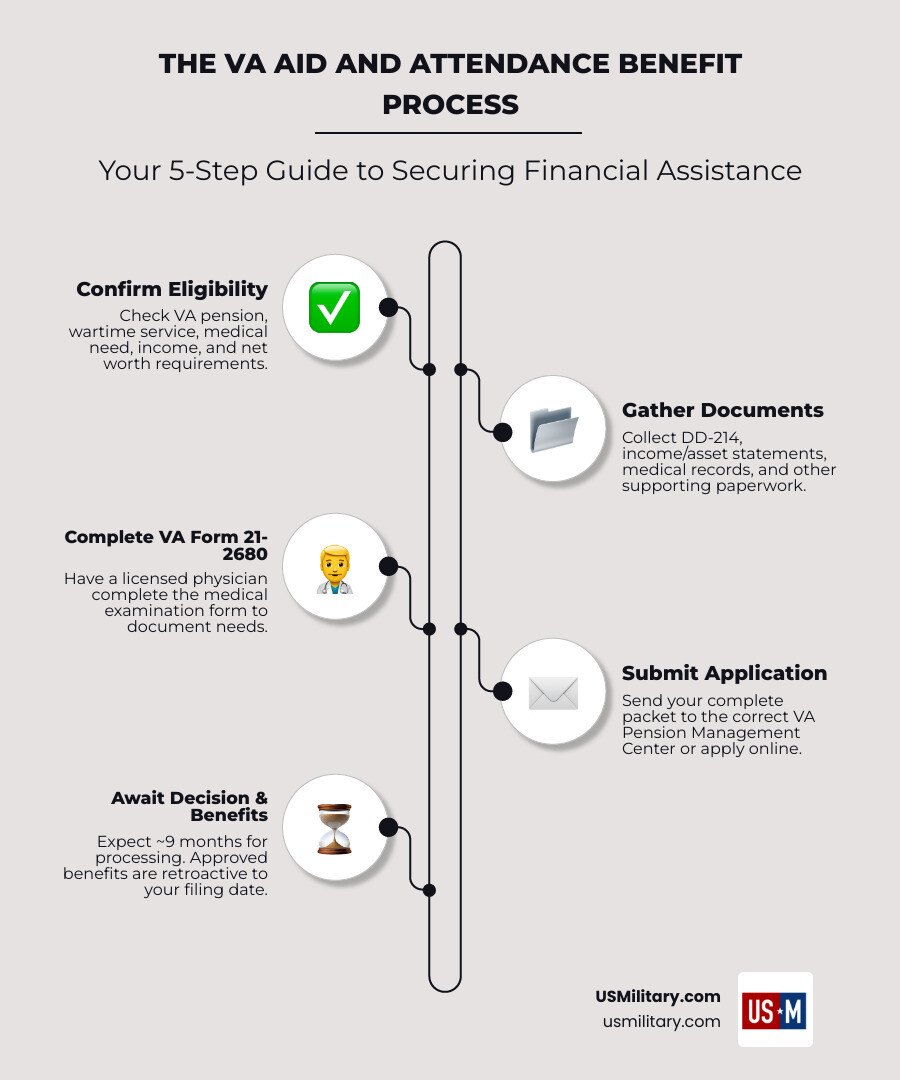
This guide will walk you through the entire process in five straightforward steps—from confirming your eligibility to submitting your application and understanding what happens next.
Step 1: Confirm Your Eligibility for Aid and Attendance or Housebound Benefits
Before filling out the aid and attendance form, you must first confirm you meet the basic eligibility requirements for VA Pension. Aid and Attendance and Housebound benefits are additions to this pension, so you must meet the service, medical, and financial criteria for the pension itself.
We’ll start by outlining the general requirements for the VA Pension, then dive into the specific criteria for Aid and Attendance and Housebound allowances. You cannot receive both Aid and Attendance and Housebound benefits simultaneously; the VA will award the higher benefit if you qualify for both.
Who Qualifies for the VA Pension?
To be eligible for the basic Veterans Pension, you must satisfy all three categories: service, age/disability, and financial.
- Wartime Service: Generally, a veteran must have at least 90 days of active duty service, with at least one day during a wartime period. If you entered active duty after September 7, 1980, you generally must have served at least 24 months or the full period for which you were called or ordered to active duty, with at least one day during a wartime period. Periods of war that qualify for these benefits can be found on the VA’s website. You can learn more about VA pension eligibility rules and the specific Periods of War.
- Age or Disability Requirements: You must be age 65 or older, OR be totally and permanently disabled, OR be a patient in a nursing home for long-term care due to a disability, OR be receiving Social Security Disability Insurance or Supplemental Security Income.
- Financial Thresholds: Your yearly family income and net worth must fall below limits set by Congress. The VA calculates your pension by subtracting unreimbursed medical expenses from your income. Your net worth is also a factor. The VA uses specific definitions for income and net worth, which you can learn more about on their site. Find more information about VA pension rates and how the VA calculates these figures.
Specific Criteria for Aid and Attendance
Aid and Attendance benefits are for those who need regular help from another person for daily functions. The aid and attendance form (VA Form 21-2680) is the critical document for proving this medical need. You may be eligible if you meet at least one of these conditions:
- Activities of Daily Living (ADLs): You require the aid of another person to perform personal functions required in everyday living, such as bathing, dressing, eating, toileting, or adjusting prosthetic devices. This doesn’t mean you need constant care, but rather regular assistance.
- Bedridden Status: You are confined to bed as a result of a disability, meaning your illness or disability requires you to remain in bed for a substantial portion of the day.
- Nursing Home Residency: You are a patient in a nursing home due to the loss of mental or physical capacities.
- Vision Impairment: Your corrected visual acuity is 5/200 or less in both eyes, or your concentric contraction of the visual field is 5 degrees or less.
Specific Criteria for Housebound Benefits
The Housebound allowance is for veterans or surviving spouses who are substantially confined to their immediate premises due to a permanent disability. While similar to Aid and Attendance in its purpose of providing additional financial support, the criteria are different. You cannot receive both benefits.
You may be eligible for Housebound benefits if you meet one of these conditions:
- Permanent Disability: You have a single permanent disability evaluated as 100% disabling, and due to this disability, you are permanently and substantially confined to your immediate premises.
- Multiple Disability Ratings: You have a 100% disabling permanent condition and another disability or disabilities evaluated as 60% or more disabling. This combination results in you being substantially confined to your home.
Understanding these eligibility requirements is the cornerstone of a successful application. If you meet these criteria, we can move on to preparing for the application process.
Step 2: Gather All Required Supporting Documents
Once you’ve confirmed eligibility, gather all required supporting documents. An incomplete application is a primary cause of delays or denials, so this step is crucial for building a strong case for your claim.

We’ll need to collect personal, military, medical, and financial records. Having everything organized before you fill out the aid and attendance form will make the entire process smoother.
Essential Paperwork for Your Claim
Here’s a list of the core documents you’ll need for almost any VA pension application, including those requesting Aid and Attendance or Housebound benefits:
- Military Discharge Papers (DD-214 or equivalent): This document proves your honorable service and qualifying wartime periods. If you don’t have an original, we recommend requesting an official replacement from the National Archives. Do not send originals to the VA; always send copies.
- Social Security Award Letter: This letter, typically for the current year, confirms your Social Security income, which the VA considers when calculating your pension.
- Proof of All Assets: This includes statements for all bank accounts (checking, savings), investment accounts (stocks, bonds, mutual funds), retirement accounts (IRAs, 401ks), and any other significant assets. The VA will assess your net worth.
- Proof of All Income: Beyond Social Security, this includes any other sources of income such as private pensions, annuities, interest, dividends, and wages.
- Marriage Certificate(s): If you are a married veteran or a surviving spouse, this proves your marital status.
- Death Certificate (for surviving spouses): This is required to prove the veteran’s passing.
- Birth Certificates: For you and any dependents, to verify age and relationship.
- Bank Account Information: For direct deposit of benefits, if approved.
Documenting Medical and Care Expenses
Documenting medical costs is vital for Aid and Attendance claims, as these benefits help offset care expenses. The more thorough your documentation, the better.
- Doctor’s Reports: This is paramount. While the aid and attendance form (VA Form 21-2680) will be completed by your physician, having additional medical records that support the need for care can strengthen your claim. These should detail diagnoses, prognoses, and the specific functional limitations that necessitate aid or confinement.
- In-Home Care Invoices: If you receive care at home, provide invoices or receipts from caregivers (even family members who are paid caregivers) detailing the services provided and their cost.
- Assisted Living or Nursing Home Contracts: If you reside in such a facility, submit the contract outlining the monthly costs and the types of care included.
- Prescription Receipts: Keep records of all prescription medications and their costs.
- Insurance Premium Statements: Include premiums paid for health insurance, Medicare, and supplemental insurance.
- Other Unreimbursed Medical Expenses: This can include co-pays, deductibles, medical supplies, special equipment, and transportation to medical appointments, provided they are not covered by insurance or other programs.
The VA uses these expenses to reduce your countable income, helping you meet financial eligibility thresholds. Careful organization of these documents prevents delays and gives the VA a complete picture of your needs.
Step 3: How to Fill Out the Aid and Attendance Form (VA Form 21-2680)
With eligibility confirmed and documents gathered, it’s time to focus on VA Form 21-2680, the “Examination for Housebound Status or Permanent Need for Regular Aid and Attendance.” This form is the medical core of your Aid and Attendance or Housebound claim.
This form is typically completed by a medical professional, and their detailed input is critical to your success. We’ll guide you through its purpose, the physician’s role, and related forms. You can Download VA Form 21-2680 directly from the VA website.
Understanding the Purpose of the Aid and Attendance Form
VA Form 21-2680 provides the medical evidence for a claimant’s need for Aid and Attendance or Housebound benefits. These are not standalone benefits but are added to a qualifying VA Pension or Special Monthly Compensation (SMC). The increased payment is often called Special Monthly Pension (SMP).
The form asks for detailed information about the claimant’s medical conditions, functional limitations, and ability to perform daily activities. It helps the VA determine if the individual:
- Requires the aid of another person to perform personal functions (Aid and Attendance).
- Is confined to their home due to a permanent disability (Housebound status).
- Is bedridden, a patient in a nursing home, or has severe vision impairment (Aid and Attendance).
Essentially, this form translates your medical reality into the specific criteria the VA uses to grant these vital benefits.
The Physician’s Role in Completing the Form
The medical professional’s role in completing VA Form 21-2680 is critical, as the VA relies on their expert assessment. A licensed Medical Doctor (MD), Doctor of Osteopathic (DO) medicine, physician assistant, or advanced practice registered nurse must complete the form.
Here’s what your physician needs to focus on:
- Detailed Diagnoses and Symptoms: They must provide complete diagnoses for all relevant conditions, along with significant symptoms.
- Functional Limitations: The form requires a description of disabilities that restrict the claimant’s ability to perform daily activities. This includes physical measurements, gait assessment, and notation of any aids used (canes, braces, crutches).
- Assistance with Daily Activities: The physician must check boxes and provide explanations for the claimant’s need for assistance with basic personal functions such as:
- Bathing
- Dressing
- Eating
- Toileting
- Transferring (e.g., from bed to chair)
- Medication management
- Personal hygiene
- Ambulating (walking)
- Mental Capacity: The form also assesses mental capacity, including whether the claimant has a mental disorder requiring regular supervision or is unable to manage their benefit payments.
- Confinement and Care: They will need to indicate if the claimant is confined to bed, requires nursing home care, or is legally blind.
- Ability to Leave Home: For Housebound claims, the physician must describe how often and under what circumstances the claimant can leave their home.
The physician must provide detailed descriptions connecting medical conditions to the need for aid or confinement, as generic statements are insufficient. Talk with your physician beforehand to ensure they understand the importance of their comprehensive input.
Related Forms: VA Form 21-0779 for Nursing Home Residents
If the claimant is a resident of a nursing home, there’s an additional form that needs to be submitted alongside VA Form 21-2680: VA Form 21-0779, titled “Request for Nursing Home Information in Connection with Claim for Aid and Attendance.”
This form specifically gathers information about the nursing home stay. It confirms the facility’s name and address, the date of admission, and the level of care being provided. It also asks for details about the cost of care and whether the claimant’s stay is temporary or permanent.
✉ Get updates like this in your inbox
Weekly VA benefit changes, pay updates, and money tips for service members, veterans, and military families. Free, no spam.
We use this form to provide the VA with official confirmation of nursing home residency, which is one of the direct criteria for Aid and Attendance eligibility. It also helps the VA confirm the unreimbursed medical expenses for nursing home care. You can find the Request for Nursing Home Information (VA Form 21-0779) on the VA website.
Step 4: Submitting Your Completed Application Packet
With your documents gathered and the aid and attendance form (VA Form 21-2680) completed, you are ready for submission. This step requires careful attention to detail to ensure your application is processed efficiently.
While some preliminary steps can be done online, the full application packet with all supporting documents, especially the physician’s signed forms, typically needs to be mailed.
Where to Mail Your Application
The VA processes pension benefit applications through specific Pension Management Centers (PMCs), which are assigned based on the applicant’s state of residence. It’s crucial to send your application to the correct PMC. Sending it to the wrong location can cause significant delays.
The VA has three regional processing centers:
- Eastern PMC: For residents of CT, DC, DE, FL, GA, MA, MD, ME, NC, NH, NJ, NY, PA, PR, RI, SC, VA, VT, WV, or any other foreign country not served by the St. Paul Pension Center.
- Central PMC: For residents of AL, AR, IL, IN, KY, LA, MI, MO, MS, OH, TN, or WI.
- Western PMC: For residents of AK, AZ, CA, CO, HI, IA, ID, KS, MN, MT, ND, NE, NM, NV, OK, OR, SD, TX, UT, WA, WY, Central America, Mexico, South America, or the Caribbean.
You can find the specific mailing addresses for these centers on the VA’s website, or by visiting the VA Pension Management Centers page.
While some initial applications or intents to file can be submitted online through VA.gov, the comprehensive packet with all medical documentation and supporting evidence is usually mailed. We recommend printing all forms and documents, making copies for your records, and mailing the complete package.
Final Checklist Before Submission
Before sealing that envelope and sending it off, let’s run through a quick checklist to ensure everything is in order:
- All Forms Signed: Double-check that all required forms, including VA Form 21P-527EZ (Basic Pension Form for Veterans) or VA Form 21P-534EZ (Basic Pension Form for Surviving Spouses), VA Form 21-2680, and VA Form 21-0779 (if applicable), are signed by the appropriate individuals (claimant, physician, nursing home administrator).
- All Documents Copied: Never send original documents to the VA. Make clear, legible copies of everything you are submitting. Keep a complete set of these copies for your own records. This is vital for tracking and any future inquiries.
- Correct Mailing Address: Verify that the address for the Pension Management Center matches your state of residence.
- Using Certified Mail for Tracking: We strongly advise using USPS Certified Mail with Return Receipt Requested. This provides proof of mailing and delivery, which can prevent issues regarding your submission date.
- Intent to File: If you haven’t already, consider submitting an “Intent to File” (VA Form 21-0966) before you send your full application. This form protects your effective date for benefits, meaning if your claim is approved, your benefits will be retroactive to the date the VA received your Intent to File, not necessarily the date of your full application.
Submitting a complete and accurate application package is your best bet for a smooth and timely process.
Step 5: What to Expect After You Apply
After submitting your application, the waiting period begins. It’s important to have realistic expectations about the processing timeline, which can be lengthy. Knowing what to anticipate can help reduce anxiety.
VA Processing Times and Claim Status
The VA processes claims in the order they are received. While some claims might be processed faster, in most cases, you can expect it to take around nine months from the date you submit your application until approval. This estimate can vary depending on the complexity of your claim and the VA’s current workload.
During this period, the VA may contact you for additional information or clarification. It’s crucial to respond promptly to any requests to avoid further delays.
You can often check the status of your claim online through the VA.gov website, or by calling the VA directly. If there are circumstances requiring “priority processing” (e.g., extreme financial hardship, homelessness), you may be able to request an expedited review, but this is granted on a case-by-case basis.
Understanding Retroactive Payments
One important aspect of VA Aid and Attendance or Housebound benefits is that they are often retroactive. This means that if your claim is approved, the VA will pay you benefits dating back to your “effective date of claim.”
The effective date is usually the date the VA received your initial application or, if you filed an “Intent to File,” the date the VA received that form. This is why we emphasized filing an Intent to File earlier – it protects your potential start date for benefits.
If approved, you will receive a lump-sum payment for all the months between your effective date and the approval date. This can be a significant amount and can help offset the care costs incurred while waiting for the claim to be processed. The VA calculates the retroactive benefits based on the monthly rates applicable during that period.
While waiting is frustrating, retroactive payments mean every day counts. Navigating the VA system is challenging, and denials can happen. If your claim is denied, don’t despair. Our article on Common Reasons Aid and Attendance is Denied: Key Insights can help you understand the next steps.
Frequently Asked Questions about the Aid and Attendance Form
Here are answers to common questions about the Aid and Attendance application process.
Can I apply for VA benefits directly without using a third-party service?
Yes, you can and should apply for VA benefits directly through the VA. All forms and instructions are available for free on the VA.gov website, or you can call the VA at 1-800-827-1000. For personalized help, connect with an accredited Veterans Service Officer (VSO), attorney, or claims agent. These experts can assist you, often at no cost, to ensure your application is complete and accurate. You can Find a local VA office for in-person assistance.
What are the penalties for submitting false information on VA forms?
Submitting false information on any VA form, including the aid and attendance form, is a federal offense with severe penalties, which can include:
- Fines: Significant monetary penalties.
- Imprisonment: Up to five years in prison.
- Forfeiture of Benefits: You will lose any current or future VA benefits you might be entitled to, and you may be required to repay any benefits you falsely received.
The VA regularly cross-references information to ensure accuracy. Always provide truthful and complete information on your application. If you are unsure about something, seek clarification from the VA or an accredited professional.
What are the current monthly benefit amounts?
Monthly benefit amounts are set by Congress and vary based on the claimant’s veteran status, marital status, and dependents. These amounts are added to your basic VA Pension.
Based on recent statistics, the benefit typically pays between $1,515 to $2,795 monthly. Here are some approximate monthly benefit amounts:
- Surviving Spouse needs care: $1,515 monthly.
- Single Veteran needs care: $2,358 monthly.
- Married Veteran needs care: $2,795 monthly.
- Veteran with Spouse who needs care: $1,851 monthly.
- Veteran and Spouse both need care: $2,795 monthly.
Please note that these figures are subject to change annually based on cost-of-living adjustments. For the most up-to-date figures, we always recommend checking the official VA website on Current Veterans Pension rates.
What types of care qualify for Aid and Attendance benefits?
A wide range of care services can qualify for Aid and Attendance benefits, as long as they address the claimant’s need for assistance with daily living activities or supervision. This includes:
- In-home care: Services provided by a professional caregiver or even a family member (if paid) that assist with ADLs, medication management, or supervision.
- Assisted living facilities: The cost of residency in an assisted living community that provides personal care services.
- Memory care facilities: Specialized care for individuals with Alzheimer’s or other dementias.
- Nursing home care: Costs associated with skilled nursing facilities.
- Adult day care: Programs that provide supervised care in a community setting.
The key is that the care must be provided to help with the conditions documented on the aid and attendance form (VA Form 21-2680) and other medical evidence.
Where can individuals find the VA forms and additional information?
All official VA forms, including VA Form 21-2680 and VA Form 21-0779, are available for download at VA.gov. The VA website is the most reliable source for information on Aid and Attendance benefits. We also encourage you to explore the comprehensive resources at USMilitary.com for understandable guides on complex VA topics.
Your Guide to Securing VA Benefits
Navigating the complexities of VA benefits can feel like a daunting task, but with a clear understanding of the process and careful preparation, securing the Aid and Attendance or Housebound benefits you deserve is achievable. We’ve walked through the five essential steps: confirming eligibility, gathering documents, accurately completing the aid and attendance form, submitting your packet, and understanding the post-submission phase.
The financial relief these benefits provide can significantly impact the quality of life for veterans and surviving spouses needing care, helping to cover the rising costs of assisted living, in-home care, and other vital services. Our commitment at USMilitary.com is to empower you with the knowledge and resources to successfully steer these processes.
Accuracy and thoroughness are your greatest allies in this journey. If you need further assistance or want to dive deeper into specific aspects of these benefits, we encourage you to explore our comprehensive resources.
For a deeper dive into the Aid and Attendance benefit, explore our complete guide to VA Aid and Attendance. We’re here to help you every step of the way.
Free for Service Members & Veterans
Get the military benefits intel no one tells you about.
Weekly updates on VA benefits, pay changes, and money tips — free for service members and veterans.
No spam. Unsubscribe anytime. Your info is never shared.


