The 3.8% Military Pay Raise for 2026

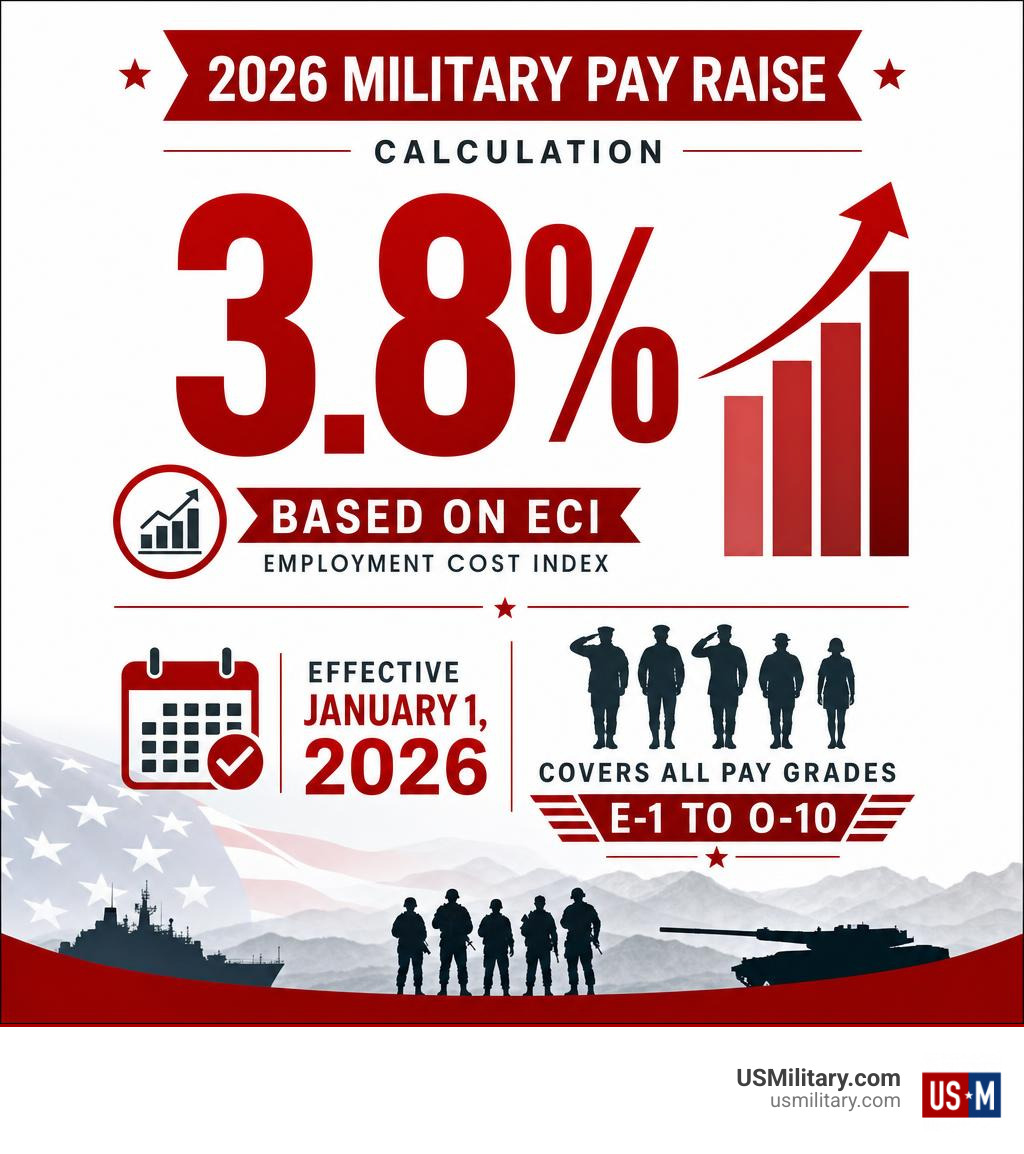
The military pay chart 2026 reflects a 3.8% pay raise for all active duty, National Guard, and Reserve service members, effective January 1, 2026. Here’s a quick snapshot of key 2026 basic pay rates:
| Rank | Years of Service | Monthly Basic Pay (2026) |
|---|---|---|
| E-1 | Less than 4 months | $2,226.00 |
| E-1 | More than 4 months | $2,407.20 |
| E-6 | More than 10 years | $4,759.50 |
| O-1 | Less than 2 years | $4,150.20 |
| O-4 | More than 10 years | $9,420.00 |
This raise was signed into law on December 18, 2025, when President Trump signed the National Defense Authorization Act (NDAA) for Fiscal Year 2026. The 3.8% figure was set using the Employment Cost Index (ECI) released by the Department of Labor on October 31, 2024 — the standard formula used to align military pay with private-sector wage growth.
Whether you’re a new recruit trying to understand your first paycheck, a current service member planning your budget, or a family member trying to make sense of the numbers — this guide breaks it all down clearly.
I’m Larry Fowler, publisher of the USMilitary.com Network since 2007, and I’ve spent nearly two decades helping active duty members, veterans, and recruits navigate military compensation topics including the military pay chart 2026. Read on for the complete pay tables, allowance updates, and tools to verify your own pay.
Know your military pay chart 2026 terms:
The annual adjustment to our nation’s military pay isn’t just pulled out of thin air. By law (specifically U.S.C. Title 37 Chapter 19 §1009), the statutory increase in basic pay is tied directly to the Employment Cost Index (ECI). The ECI measures the growth of private-sector wages and salaries across the United States.
For the military pay chart 2026, the rate was anchored to the year-over-year ECI change recorded on October 31, 2024. This calculated benchmark of 3.8% was subsequently codified in the National Defense Authorization Act (NDAA) for Fiscal Year 2026. Because Congress and the President approved this baseline, every branch of the Armed Forces—including the Army, Navy, Air Force, Marine Corps, Space Force, and Coast Guard—implemented the adjustment simultaneously.
This 3.8% raise officially took effect on January 1, 2026. Unlike other federal programs that may experience mid-year adjustments or depend entirely on Cost of Living Adjustments (COLA), military basic pay scales are locked in for the calendar year. To see how these changes are structured year-over-year, you can review the 2026 Military Pay Chart.
How the 2026 Military Pay Chart Affects Enlisted Ranks
For enlisted personnel (ranks E-1 through E-9), the 3.8% increase represents a steady, reliable boost to monthly take-home pay. For our junior enlisted members, the bump is crucial for handling everyday expenses.
- E-1 Pay Milestones: An E-1 with less than 4 months of active service receives $2,226.00 in monthly basic pay. Once an E-1 crosses the 4-month threshold, their basic pay rises to $2,407.20 per month.
- Mid-Career NCOs: An E-6 (Staff Sergeant/Technical Sergeant) with more than 10 years of service now earns $4,759.50 monthly.
- Senior Enlisted Leaders: An E-9 (Sergeant Major/Master Chief) with over 30 years of service receives $9,175.00 per month, which equates to an annual basic pay of $110,100.
Because basic pay is determined by a matrix of rank and cumulative years of service, your location does not impact this specific base rate. You can dive deeper into the enlisted pay structures by visiting All About 2026 Military Pay Chart for Enlisted Officers.
How the 2026 Military Pay Chart Affects Officers and Warrant Officers
Commissioned officers (O-1 to O-10) and warrant officers (W-1 to W-5) also see their pay scales adjusted upward by the 3.8% mandate.
- Company Grade Officers: A newly commissioned Second Lieutenant or Ensign (O-1) starts with $4,150.20 in monthly basic pay.
- Field Grade Officers: A Major or Lieutenant Commander (O-4) with more than 10 years of service earns $9,420.00 per month.
- Senior Officers: A Colonel or Captain (O-6) with over 30 years of service brings in $17,120.00 per month ($205,440 annually).
- Warrant Officers: Highly specialized Chief Warrant Officers also see competitive rates. For example, a W-5 with maximum years of service can earn up to $9,211.00 monthly.
These pay scales reflect the high level of responsibility placed on our military leaders. For a detailed breakdown of how these changes apply to maritime and naval service structures, check out the Navy Pay Chart 2026.
Official Military Pay Chart 2026: Active Duty Rates
To ensure you are calculating your household budget with absolute accuracy, you should always reference the official figures published by the Defense Finance and Accounting Service (DFAS). You can access the complete, verified datasets directly via the Official DFAS Pay Tables.
To help visualize how the 3.8% raise impacts standard career milestones, we have compiled a comparison table showing the change from 2025 to 2026:
| Rank & Years of Service | 2025 Monthly Base Pay | 2026 Monthly Base Pay | Monthly Increase | Annual Increase |
|---|---|---|---|---|
| E-3 (with 2 years) | $2,516.00 | $2,611.00 | +$95.00 | +$1,140.00 |
| E-5 (with 6 years) | $3,347.00 | $3,474.00 | +$127.00 | +$1,524.00 |
| E-6 (with 6 years) | $3,765.00 | $3,908.00 | +$143.00 | +$1,716.00 |
| E-7 (with 14 years) | $4,783.00 | $4,965.00 | +$182.00 | +$2,184.00 |
| O-3 (with 6 years) | $7,110.00 | $7,380.00 | +$270.00 | +$3,240.00 |
These increases represent real, tangible dollars that help ease the burden of inflation. Let’s look closer at how active duty pay scales break down for both enlisted and officer tracks.
Enlisted Basic Pay Rates
The active duty enlisted pay scale spans from E-1 to E-9. As you gain cumulative active duty time, your pay automatically increases at specific milestones (typically every two years after the initial career marks).
For example, an E-5 with 6 years of service makes $3,474.00 per month in basic pay alone. When combined with tax-free allowances and standard healthcare benefits, the total compensation package for mid-grade noncommissioned officers often exceeds $80,000 to $100,000 annually. For a complete guide on how to read these tables and map out your career earnings, refer to The Ultimate Guide to 2026 Military Pay Chart.
Officer and Warrant Officer Basic Pay Rates
For officers, the base salary is designed to remain competitive with corporate management and civilian sector opportunities. A Captain (O-3) with 6 years of service enjoys a strong financial foundation, which increases substantially as they promote into field grade ranks.
Warrant officers, who serve as the technical experts of the military, also see generous adjustments under the 2026 Military Pay Tables with 3.8% Raise. These rates reward technical proficiency and leadership without requiring individuals to transition into broader administrative officer roles.
National Guard and Reserve Drill Pay in 2026

If you serve in the National Guard or Reserve components, your compensation structure is calculated differently than full-time active duty pay. Instead of a monthly salary, you are paid based on “drill periods.”
The military calculates drill pay using the 1/30th rule. This means that for every single drill period you complete, you receive 1/30th of the monthly active duty basic pay rate for your specific rank and years of service.
Because a standard drill weekend consists of four drill periods (two periods on Saturday and two on Sunday), a typical drill weekend payout is equivalent to 4/30ths (or roughly 13.3%) of a full month’s active duty basic pay.
- O-1 Drill Pay Example: An O-1 with less than 2 years of service has an active duty monthly base pay of $4,150.34. Under the 1/30th rule, a single drill period is worth $138.34. For a standard four-drill weekend, the payout is $553.38.
- O-3 Drill Pay Example: An O-3 with less than 2 years of service earns $5,534.20 monthly on active duty. A single drill is worth $184.47, resulting in a four-drill weekend payment of $737.89.
These increases ensure that part-time service members are fairly compensated for their readiness and training hours. For more information on legislative initiatives surrounding reserve component compensation, read about Marching Toward Fairer Pay with Military Pay Equity in 2026.
Beyond Basic Pay: Allowances and Special Compensation
While basic pay is the foundation of your military paycheck, it is only one piece of the puzzle. In fact, looking solely at base pay can make military compensation seem lower than civilian corporate salaries. The real value lies in the tax-free allowances and special pays.

Two of the most significant allowances are:
- Basic Allowance for Housing (BAH): This allowance is designed to cover out-of-pocket housing costs for service members living off-base. In 2026, BAH rates increased by an average of 4.2% nationwide. Crucially, BAH is completely excluded from gross income for federal and state tax purposes, providing a massive tax advantage.
- Basic Allowance for Subsistence (BAS): This allowance offsets the cost of meals for service members. For 2026, BAS rates increased by 2.4%. Like BAH, BAS is entirely tax-free.
Additionally, the FY 2026 NDAA authorized a one-time, tax-free Warrior Dividend payment of $1,776 to all active and reserve service members before the end of 2025, providing an extra financial cushion heading into the new year.
When you add up basic pay, tax-free allowances, special pays (such as sea pay, hazard pay, or flight pay), and comprehensive medical coverage, the total compensation package is highly competitive. To calculate your total active duty compensation package, read more about 2026 Military Basic Pay and Allowances.
Senior Officer Pay Caps and Executive Schedule Limits
It is worth noting that not all senior officers receive the full 3.8% raise in their actual take-home pay. By law, military basic pay is capped so that it cannot exceed Level II of the Executive Schedule.
This pay cap primarily affects extremely senior officers (typically general and flag officers at ranks O-7 through O-10 with extensive years of service). When the Executive Schedule limits are reached, any legislated percentage increase is reduced or capped to prevent military salaries from exceeding statutory maximums for federal leadership.
Frequently Asked Questions about Military Pay
When does the 2026 military pay raise take effect?
The 3.8% military pay raise officially took effect on January 1, 2026. Service members saw this increase reflected in their first pay cycle of the year (typically the mid-month paycheck on January 15, 2026). You can verify your updated pay rates by logging into your DFAS myPay account.
How does the 2026 pay raise impact VA loan qualification?
Because basic pay is considered highly stable and predictable income, lenders view it favorably. A higher base pay directly improves your debt-to-income (DTI) ratio. For example, an E-6 with 6 years of service who receives an extra $143 per month can potentially qualify for approximately $25,000 more in a VA home loan purchase price without changing any other financial variables.
Where can I find my official 2026 Leave and Earnings Statement (LES)?
Your official monthly LES is hosted securely on the DFAS myPay portal. We highly recommend logging in each pay period to verify your entitlements, tax withholdings, allotments, and TSP contributions. Always review the “Remarks” section at the bottom of your statement, as this is where DFAS publishes notifications regarding overflow entitlements, deductions, or changes to your pay status.
Conclusion
Understanding the military pay chart 2026 is essential for effective financial planning, whether you are managing a household budget, saving for retirement, or preparing to buy a home. The combination of a 3.8% basic pay raise, a 4.2% average increase in BAH, and a 2.4% bump in BAS provides service members with robust support.
At USMilitary.com, we are committed to providing the resources, guides, and tools you need to maximize your benefits. From VA home loan eligibility to career transition planning, we serve as your central hub for military life.
For more help decyphering reserve payouts without the headache, check out our guide on How to Read the National Guard Pay Chart.
Free for Service Members & Veterans
Get the military benefits intel no one tells you about.
Weekly updates on VA benefits, pay changes, and money tips — free for service members and veterans.
No spam. Unsubscribe anytime. Your info is never shared.


