
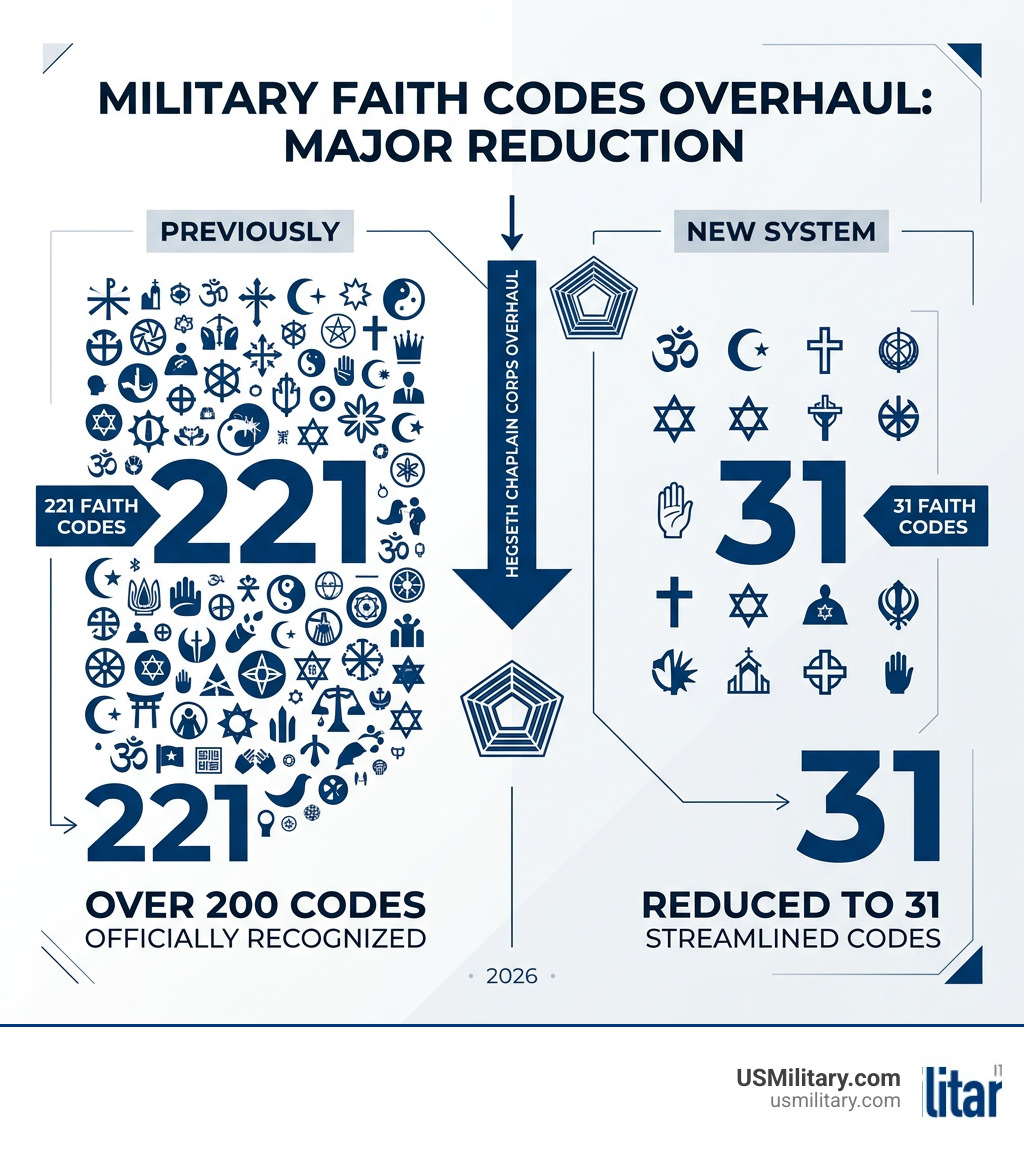
The Pentagon drops 180 faiths from the military’s recognized religions list, cutting the total number of officially recognized faith codes from over 200 down to just 31. Here is what you need to know right away:
- What changed: The Faith and Belief Coding System was reduced from 221 faith codes to 31
- Who ordered it: Defense Secretary Pete Hegseth directed the overhaul as part of a broader Chaplain Corps reform
- Why it happened: The vast majority of service members used only six of the codes, making most of the list practically unused
- Who is affected: Service members practicing minority faiths like Wicca, Druidism, or other non-mainstream religions that were removed from the list
- What stays the same: Chaplains are still required to support service members of all faiths, regardless of whether their religion appears on the official list
This change is part of a larger Pentagon effort to refocus the Chaplain Corps on traditional religious ministry rather than the therapeutic and wellness roles it had expanded into in recent years.
I’m Larry Fowler, publisher of the USMilitary.com Network since 2007 and a longtime resource for active-duty members, veterans, and those navigating military policy changes. Tracking developments like the Pentagon drops 180 faiths from military’s recognized religions list story is exactly the kind of policy shift that directly affects service members’ day-to-day lives — and that is why we are breaking it down clearly here.
Relevant articles related to Pentagon drops 180 faiths from the military’s recognized religions list:
- How Does The Military Celebrate Easter When Overseas
- How Massive is the US Military
- Is The US Military Becoming More Confident & Stronger With President Trump
Why the Pentagon Drops 180 Faiths from the Military’s Recognized Religions List
At the heart of this sweeping policy change is a push for administrative streamlining and a return to the traditional roots of the military chaplaincy. Under the direction of Defense Secretary Pete Hegseth, the Pentagon has launched a major Chaplain Corps overhaul.
For years, the military’s Faith and Belief Coding System grew increasingly complex, ballooning to a massive 221 recognized faith and belief codes. These codes allowed service members to formally register highly specific religious affiliations. However, defense officials discovered that this highly fragmented system had become administratively impractical and largely unusable in the field.
According to military data, the vast majority of personnel identify with just six primary faith classifications. The remaining 200+ codes were rarely selected, creating unnecessary bureaucratic overhead for chaplains trying to coordinate spiritual care. As reported by Fox News, the decision to slash these codes down to 31 is designed to make the system highly practical, ensuring that chaplain resources are aligned with actual troop demographics.
To help visualize how this consolidation impacts the administrative landscape, here is a comparison of the previous classification structure versus the newly streamlined model:
| Previous System (221 Faith Codes) | New System (31 Streamlined Codes) |
|---|---|
| Highly fragmented denominations (e.g., individual sub-sects of Paganism, Wicca, Druidism, and specific Protestant denominations) | Consolidated major world religions and broad denominational groupings (e.g., Protestant, Catholic, Orthodox, Jewish, Muslim, Buddhist, Hindu, and broad categories) |
| Over 180 rarely utilized codes with zero or single-digit service member registrations | 31 highly active, standardized codes representing the vast majority of active-duty personnel |
| Administrative complexity in tracking niche preferences across global databases | Simplified tracking to coordinate chaplain coverage and religious resources efficiently |
The Purpose of Administrative Faith Codes in the Armed Forces
To understand why the Pentagon drops 180 faiths from the military’s recognized religions list, it helps to understand why the military tracks religious preferences in the first place. When a service member enlists or commissions, their declared religious preference is recorded as part of their official personnel data.
This designation, historically guided by the military’s Faith and Belief Codes, serves several critical functions:
- Dog Tags: A service member’s religious preference is stamped on their official identification tags (dog tags) to ensure proper rites can be administered in the event of an emergency.
- Casualty Reporting: In the tragic event of a service member’s death, these codes guide military morticians and casualty officers in honoring the individual’s religious wishes during funeral services.
- Chaplain Support: The data helps the Chaplain Corps distribute personnel and resources to bases worldwide, matching chaplains of specific faiths with the units that need them most.
- Religious Accommodations: It provides a baseline for commanders evaluating requests for religious apparel, grooming standards, or dietary requirements.
How the Pentagon drops 180 faiths from the military’s recognized religions list to Simplify Chaplain Support
Under the new directive, the Pentagon is shifting its chaplaincy model away from what critics have called a “therapeutic” or “emotional support” model and returning it to a traditional preaching and ministry focus. As detailed by When In Your State, the Pentagon recently scrapped the 112-page Army Spiritual Fitness Guide, which had been criticized for promoting secular humanism and focusing heavily on “feelings” and “playfulness” rather than traditional spiritual development.

By reducing the faith codes from over 200 to 31, the Pentagon aims to free chaplains from navigating endless administrative classifications. Instead of acting as generalist counselors or therapists, chaplains are being directed back to their core calling: providing robust, faith-specific preaching, administering sacraments, and serving as the moral anchors of the fighting force.
Tracking Religious Demographics Under the New 31-Code System
As of June 2026, the military is transitioning to this streamlined 31-code system to track religious demographics more efficiently. While some worry that this consolidation hides the true diversity of the armed forces, defense officials emphasize that the vast majority of service members are still fully represented.
By focusing data collection on the most widely practiced faiths, the military can allocate chaplains, chapel spaces, and religious materials far more effectively, ensuring that the spiritual needs of the largest cohorts of service members are met without administrative delay.
Impact on Service Members of Removed Faiths
The decision to drop 180 faiths has naturally raised concerns among service members who practice minority or non-traditional religions, such as Wicca, Paganism, Druidism, and other smaller belief systems. For these troops, their specific faith will no longer appear as a distinct option on official military databases.
Many service members from these communities worry that losing their dedicated faith code could make it harder to secure formal religious accommodation requests. The Military Times highlights that this overhaul represents a significant shift in how the military approaches spiritual fitness and diverse belief systems, leaving minority faith groups to navigate a newly consolidated system.
Accommodating Worship, Dietary Needs, and Grooming Standards
Despite the reduction in official codes, the U.S. military’s core commitment to religious accommodation remains intact. Service members can still request waivers for practices that conflict with standard military uniform or grooming policies, regardless of whether their specific religion is one of the 31 recognized codes.
Common types of religious accommodations include:
- Grooming and Uniform Waivers: Allowing the wear of hijabs, turbans, or maintaining neat beards for religious reasons.
- Religious Markings: Approvals like the landmark waiver allowing a Hindu airman to wear the Tilak Chandlo symbol while in uniform.
- Dietary Accommodations: Access to Halal meals, Kosher rations, or vegetarian options during field training and deployments.
- Worship Time: Scheduled time off to observe holy days, sabbaths, or daily prayer requirements when mission parameters allow.
What Happens When the Pentagon drops 180 faiths from military’s recognized religions list for Minority Faiths?
For service members whose specific religions have been removed, their official administrative designation will likely revert to a broader category, such as “Other” or “No Religious Preference.”
While this change is administrative, some minority faith practitioners express concern over potential discrimination risks or a perceived lack of institutional validation. Without a dedicated code, these groups may no longer have formal avenues to establish recognized lay-led worship groups on base or receive specialized chapel space. However, the military’s pluralistic chaplaincy model guarantees that all service members, regardless of their administrative code, still have full access to chaplains for confidential counseling and spiritual support.
Historical Context: Chaplain Insignia and Religious Symbolism
The U.S. Military Chaplain Corps has a rich history dating back to its establishment by George Washington in 1775 during the Revolutionary War. Over the past 250 years, the symbols worn by chaplains have evolved to reflect the growing diversity of the nation they serve.
Traditionally, chaplains wore insignia representing their specific faith groups on their uniforms—such as the Latin cross for Christian chaplains, the tablets of the Ten Commandments and Star of David for Jewish chaplains (introduced during the World Wars), the crescent for Muslim chaplains (approved in 1993), and the dharmacakra for Buddhist chaplains (approved in 1990).
In a historic and highly symbolic shift accompanying the faith code reduction, Defense Secretary Hegseth ordered a major change to chaplain uniforms. As reported by 19FortyFive, chaplains will no longer display standard military rank insignia on their uniforms. Instead, they will exclusively wear their religious faith insignia.
This change is designed to visually reinforce that a chaplain’s primary calling is to God and the spiritual care of troops, placing their role as religious leaders above their status as military officers.
Frequently Asked Questions About the Military Faith Code Overhaul
Which faiths remain on the Pentagon’s recognized list?
The streamlined list of 31 codes focuses on major world religions and broad denominational categories. This includes Protestantism, Catholicism, Eastern Orthodoxy, Judaism, Islam, Buddhism, and Hinduism, alongside consolidated categories designed to capture the vast majority of active-duty service members’ beliefs.
How do service members update their religious preference?
Service members can update their religious preference electronically through the milConnect portal or by visiting their unit’s personnel officer to update their Defense Enrollment Eligibility Reporting System (DEERS) record.
Will chaplains still support service members of removed faiths?
Yes. Military chaplains take an oath to provide pluralistic ministry. Even if a service member’s specific religion is no longer officially coded, chaplains are duty-bound to facilitate their worship, assist with accommodation requests, and offer non-denominational spiritual counseling.
Conclusion
The Pentagon drops 180 faiths from the military’s recognized religions list, marking a major turning point in how the military manages religious demographics and chaplain services. While the consolidation from 221 to 31 faith codes streamlines administration and refocuses chaplains on traditional ministry, the military’s commitment to protecting the religious freedom of all who serve remains a core value.
At USMilitary.com, we are dedicated to keeping you informed about the latest policy shifts, career opportunities, and benefits updates. Whether you are navigating changes to active-duty regulations, exploring VA home loans, or planning your military retirement, we are here to support you every step of the way.
Explore military career paths and benefits at USMilitary.com
Free for Service Members & Veterans
Get the military benefits intel no one tells you about.
Weekly updates on VA benefits, pay changes, and money tips — free for service members and veterans.
No spam. Unsubscribe anytime. Your info is never shared.


