The Question Every Service Member and Veteran Is Asking Right Now

Will the new socialist Democrats defund the US Military and the Department of War? The short answer: a full defunding is unlikely in the near term — but significant budget cuts are a real and stated goal for a growing wing of the Democratic Party.
Here is what you need to know quickly:
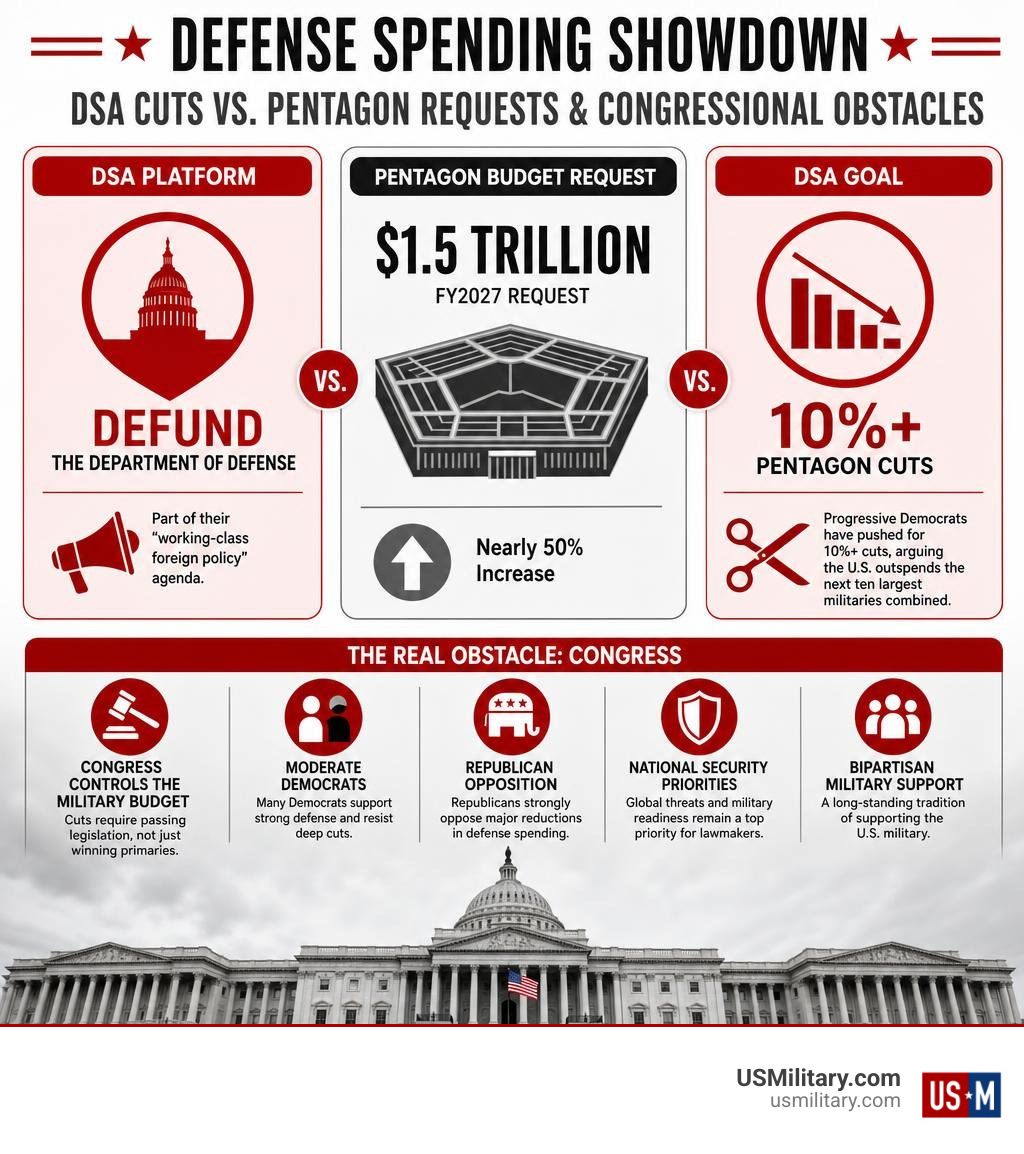
- The DSA’s platform explicitly calls for defunding the Department of Defense as part of its “working-class foreign policy” agenda
- DSA-backed candidates are winning primaries — Claire Valdez, Melat Kiros, and Zohran Mamdani all scored major victories in June 2026
- Progressive Democrats have already pushed for 10%+ Pentagon cuts, arguing the U.S. still outspends the next ten largest militaries combined
- Congress controls the military budget — any cuts require passing legislation, not just winning primaries
- Moderate Democrats and Republicans remain strong obstacles to any dramatic reduction in defense funding
This matters directly to active-duty service members, military families, and veterans. Cuts to the Pentagon budget can affect pay, benefits, readiness, and the VA programs millions of veterans depend on.
As the Trump administration pushes a staggering $1.5 trillion defense budget request for FY2027 — a nearly 50% increase — the political fight over military spending is reaching a fever pitch from both directions.
I’m Larry Fowler, publisher of USMilitary.com since 2007 and a longtime advocate for active-duty troops and veterans navigating VA benefits and military career decisions. The question of will the new socialist Democrats defund the US Military and the Department of War hits close to home for our community, and I want to give you the clearest, most honest picture possible.
Handy Will The New Socialist Democrats Defund The US Military and the Department Of War? terms:
- How Massive is the US Military
- Is The US Military Becoming More Confident & Stronger With President Trump
- What is the Department of War
Will The New Socialist Democrats Defund The US Military and the Department Of War?
To truly understand the political landscape in July 2026, we have to look closely at the organizations and candidates driving this progressive shift. The Democratic Socialists of America (DSA) have steadily grown from a modest group of 5,000 members to a national force of over 100,000 members across 200 chapters. This massive expansion has given them the leverage to reshape local and national political conversations.
At the heart of their agenda is a comprehensive strategy to redirect federal priorities. The official DSA Platform – Workers Deserve More! outlines a vision that challenges the traditional assumptions of American global power. Rather than viewing national security through the lens of military dominance, the DSA advocates for what they call a “working-class foreign policy.” This policy explicitly calls for ending the “U.S. war machine,” which includes defunding the Department of Defense and halting military aid to foreign nations.
This is not just academic theory. In the June 2026 primaries, we witnessed a series of historic victories that sent shockwaves through the political establishment. In New York, Claire Valdez won her congressional primary after running a campaign that openly criticized American military spending and called for the abolition of ICE. In Colorado, Melat Kiros pulled off a stunning upset by defeating 15-term incumbent Diana DeGette. Meanwhile, Zohran Mamdani’s rising influence in New York politics has proved that democratic socialist ideas are finding a receptive audience among voters who feel left behind by the traditional system.
These primary victories have raised the stakes for the upcoming legislative sessions. Mainstream commentators are beginning to debate whether these new congressional socialists will successfully target the defense budget. While some conservative critics argue that This New Batch Of Congressional Socialists Make AOC Look Like Jack Kennedy – CDM – Human Reporters • Not Machines due to their uncompromising stances on borders and the military, the reality is that their policy goals face a steep uphill battle in Washington. Even with these primary wins, the overall structure of the US Military Budget 2024 and subsequent years remains heavily protected by both moderate Democrats and Republicans.
Why Will The New Socialist Democrats Defund The US Military and the Department Of War?
The driving force behind the progressive push to cut defense spending is a fundamental disagreement over how tax dollars should be used to support American families. Progressive and socialist-leaning Democrats argue that the federal budget is a reflection of a nation’s moral priorities. From their perspective, spending hundreds of billions of dollars on foreign interventions and defense contractors directly deprives domestic programs of the funding they need to thrive.
The DSA and its allies want to reallocate military funding toward massive social initiatives. These include:
- Medicare for All: Establishing a single-payer healthcare system to cover every American.
- The Green New Deal: Investing trillions of dollars into clean energy infrastructure to combat climate change.
- College for All: Eliminating tuition fees at public colleges and universities while canceling existing student debt.
- Universal Housing: Investing in affordable public housing to end homelessness.
As highlighted in the reporting on how Socialists draft an aggressive new agenda for the Democratic Party , these politicians view the military budget as an untapped reservoir of capital. They argue that by scaling back the U.S. global military footprint, the government can easily fund these sweeping domestic reforms without raising taxes on middle-class families. Additionally, deep-seated anti-war sentiment—amplified by recent costly overseas engagements—has made the idea of limiting the “U.S. war machine” highly popular among younger, progressive voters.
Debating the Question: Will The New Socialist Democrats Defund The US Military and the Department Of War?
When we move past the campaign rhetoric and look at the actual levers of power in Washington, the question of whether progressives can actually defund the military becomes much more complicated. The United States Constitution explicitly divides war-making and funding powers between the Executive and Legislative branches. Article I grants Congress the “power of the purse,” meaning that any attempt to restructure, reduce, or defund the military must pass through the grueling congressional appropriations process.
Furthermore, mechanisms like the War Powers Resolution of 1973 are designed to limit the President’s ability to commit U.S. forces to unauthorized conflicts. Progressive lawmakers often attempt to use these legislative tools to block funding for specific operations. For example, a coalition of House Democrats recently introduced the “No Funds for Iran War Act” to prevent any additional taxpayer dollars from being spent on the conflict in Iran without explicit congressional authorization.
However, completely defunding the military is a far cry from blocking specific war supplementals. The defense industry is one of the nation’s largest employers, with manufacturing facilities spread across nearly every congressional district. This geographic distribution creates a powerful bipartisan coalition of lawmakers who will fight to protect local defense jobs, regardless of their party’s national platform.
While some experts debate the overall strength of our armed forces—with publications analyzing why the US Military Rated Weak in certain strategic areas—others point out that maintaining robust defense funding is essential for global stability. Those who argue against defense cuts emphasize that a strong military is a vital deterrent against adversaries like China. For a deeper look at how leadership style impacts military readiness, you can read our analysis on Why Experts Are Wrong About US Military Confidence With Trump.
Historical Spending Trends: Democrats vs. Republicans
To put the current debate into perspective, we have to look at how military spending has actually behaved under different administrations. There is a common assumption that Republicans always increase the defense budget while Democrats always slash it. While there is some truth to this trend, the historical data reveals a more nuanced reality where global events and economic conditions often override party ideology.
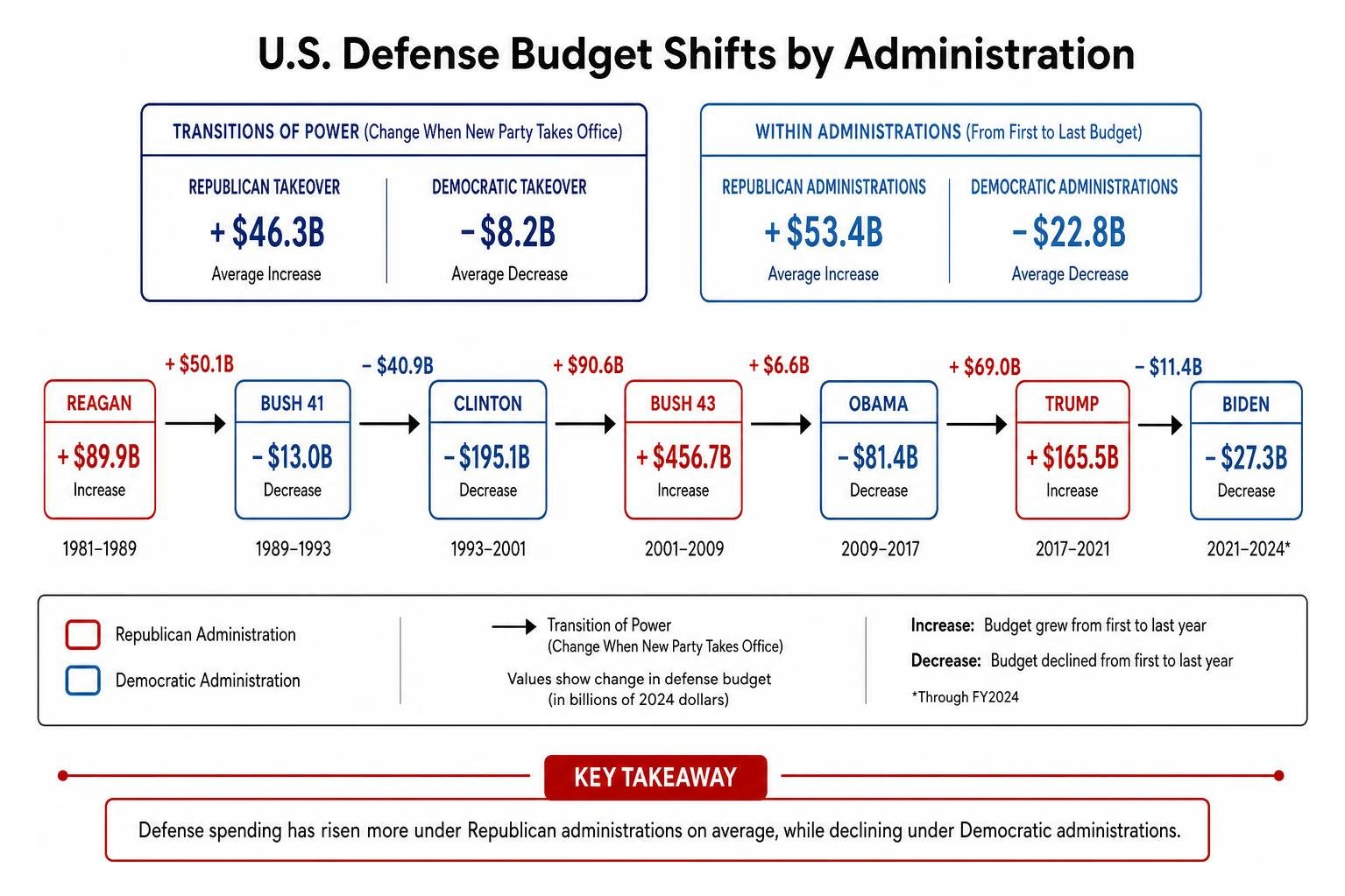
On average, Republican administrations increase defense spending by $46.3 billion when they take power, whereas Democratic administrations decrease it by an average of $8.2 billion during transitions of power. However, looking at the shifts within administrations paints an even clearer picture. The average shift within a Democratic administration over their term is a decline of $22.8 billion. Conversely, the shift within Republican administrations averages an increase of $53.4 billion from their first to their last defense budget.
Let’s look at the historical breakdown of how different presidents handled the defense budget:
| Administration | Party | Average Budget Trend | Key Driving Factors |
|---|---|---|---|
| Jimmy Carter | Democratic | Initial cuts, later increases | Soviet invasion of Afghanistan, Cold War tensions |
| Bill Clinton | Democratic | Significant post-Cold War reductions | The “Peace Dividend” after the collapse of the USSR |
| George W. Bush | Republican | Massive budget increases | Post-9/11 War on Terror, invasions of Iraq and Afghanistan |
| Barack Obama | Democratic | Initial troop surge, later cuts | Inherited conflicts, Budget Control Act (Sequestration) |
| Donald Trump | Republican | Significant budget growth | Focus on modernization, space capabilities, and rebuilding readiness |
| Joe Biden | Democratic | Flat in real terms, slight cyber/space increases | Focus on domestic infrastructure, climate change, and strategic competition |
As we can see, global crises often force a president’s hand. For instance, despite being a Democrat, Barack Obama presided over some of the largest defense budgets in history during the early years of his administration to support the troop surge in Afghanistan. Similarly, the current Trump administration has requested a massive $1.5 trillion defense budget for Fiscal Year 2027, representing a nearly 50% increase designed to modernize our forces and address rising global threats.
For more historical context on how different commanders-in-chief have approached the care and protection of our armed forces, check out our guide on the Top 10 United States Presidents Who Truly Cared and Protected the US Military.
The Cost of Modern Conflict and the Defense Industrial Base
The cost of maintaining a modern military is staggering, especially when the nation is actively engaged in regional conflicts. The ongoing war in Iran has already cost American taxpayers at least $25 billion (with some estimates tracking the total cost of the conflict closer to $72 billion when accounting for broader economic disruptions and rising consumer prices). These massive expenditures are a primary target for progressives, who argue that these funds would be better spent at home.
At the same time, the Pentagon’s standard Fiscal Year 2027 defense budget request of $1.5 trillion does not even include a reported $200 billion supplemental funding request specifically for the Iran conflict. This brings the total projected military spending to unprecedented levels. Progressive groups highlight these numbers to show the massive trade-offs required to sustain overseas operations.
However, defense planners argue that these high costs are necessary to maintain the defense industrial base and prepare for future strategic challenges. We are currently facing a period of intense global competition, particularly with China’s rapid naval and technological modernization. To counter this, the U.S. military must invest heavily in:
- Nuclear Modernization: Upgrading our aging nuclear triad to maintain a credible deterrent.
- Advanced Technologies: Developing hypersonic weapons, artificial intelligence, and space-based defense assets.
- Industrial Capacity: Rebuilding our domestic manufacturing base to ensure we can produce critical munitions, such as Tomahawk cruise missiles, which cost $3.6 million each and can take up to two years to build.
Some moderate Democrats are pushing for A New Approach to National Security that balances these defense realities with smart diplomatic investments. They argue that we must streamline our defense acquisitions and support our service members’ quality of life while remaining focused on the strategic threat posed by China.
Political Obstacles and Public Opinion on Defense Cuts
Despite the growing momentum of democratic socialists in local primaries, their plans to drastically cut the defense budget face massive political and structural barriers. First and foremost, moderate Democrats in swing districts are highly resistant to cutting defense spending. These lawmakers know that voting to cut the military budget can easily be framed by opponents as being “weak on national security,” which is often a political death sentence in purple states.
Furthermore, there is a major gap between what progressive voters say they want and what the general public is willing to support. While many Americans favor the idea of expanded social programs, research shows they are highly resistant to the middle-class tax increases required to pay for them. As analyzed in the piece Socialists keep winning Democratic primaries. But their agenda is doomed. | Vox , Scandinavian-style social democracies require tax revenues exceeding 40% of GDP, whereas the U.S. currently collects around 25%. Without raising taxes on the middle class, defunding the military alone would not generate enough revenue to fund programs like Medicare for All.
Additionally, public opinion on taxes is shifting. The percentage of Americans who feel their federal tax burden is “too high” rose from 46% in 2020 to 59% in 2025. This makes any platform that relies on tax increases a tough sell for mainstream voters.
There is also a lively debate about how the media portrays these issues. Some commentators argue that progressive messaging is often misunderstood or misrepresented by mainstream outlets. To explore this dynamic further, you can read our take on How Liberal Fake News Is Dumbing Down America Even With Big Wins in Iran and Why It’s Winning.
Frequently Asked Questions About Socialist Democrats and Military Spending
What is the DSA’s official stance on the Department of Defense?
The official DSA platform calls for a complete overhaul of American foreign policy, which includes defunding the Department of Defense. They advocate for dismantling what they refer to as the “U.S. empire” by closing overseas military bases, ending unilateral economic sanctions, and redirecting the military budget toward domestic programs like the Green New Deal and Medicare for All.
How much has the conflict in Iran cost the US?
The war in Iran has already cost taxpayers at least $25 billion in direct military costs, with some cost-tracking organizations placing the total impact closer to $72 billion when factoring in regional instability, rising oil prices, and long-term care for wounded service members. This is in addition to the Pentagon’s standard $1.5 trillion budget request.
Can Congress block funding for unauthorized military actions?
Yes. Under Article I of the Constitution, Congress holds the “power of the purse.” This means Congress can pass legislation that explicitly prohibits federal funds from being used for specific military operations unless a formal declaration of war or authorization for use of military force (AUMF) is approved.
Conclusion

While the rise of the new socialist Democrats has undoubtedly shifted the political conversation, the likelihood of them fully defunding the military remains extremely low. The constitutional design of our government, combined with strong bipartisan support for national defense and the practical realities of global competition, ensures that the U.S. military will remain well-funded for the foreseeable future.
At USMilitary.com, we are dedicated to keeping our service members, veterans, and military families informed about the political and economic shifts that affect their lives. Whether you are looking for information on Project 2025 Attack on Veterans or trying to understand the details of Trump’s Big Beautiful Bill Military, we are here to provide clear, unbiased guidance.
If you are considering a career in the armed forces, we encourage you to explore our comprehensive resources on Navy Jobs and other branch career paths. For those looking for personal inspiration and strength during challenging times, we also highly recommend reading Dare to Live Greatly, a powerful guide to living a life of purpose and faith.
Free for Service Members & Veterans
Get the military benefits intel no one tells you about.
Weekly updates on VA benefits, pay changes, and money tips — free for service members and veterans.
No spam. Unsubscribe anytime. Your info is never shared.


