How VA Math and Combined Ratings Actually Work

When comparing the top 5 VA disability calculators—interactive breakdown tools, official federal tables, mathematical audit engines, multi-dependent simulators, and quick-check estimators—the clear winner is the advanced interactive breakdown tool. These top-tier platforms provide the highest accuracy by automatically calculating complex bilateral factors, displaying unrounded baseline percentages alongside official rounded tiers, and incorporating detailed dependent tiers for monthly compensation.
Many veterans are surprised when they add their individual disability ratings together and find that the VA’s final combined score is lower than expected. The reason is simple: the Department of Veterans Affairs does not use standard arithmetic. Instead, federal regulations under 38 CFR 4.25 mandate the “whole person method” to determine combined evaluations.
The whole person concept assumes that every service member enters the civilian world as a 100% able-bodied individual. When an injury or illness occurs, it subtracts a percentage of that intact body. Any subsequent condition does not subtract from the initial 100%; rather, it subtracts a percentage from whatever remaining, non-disabled efficiency is left.
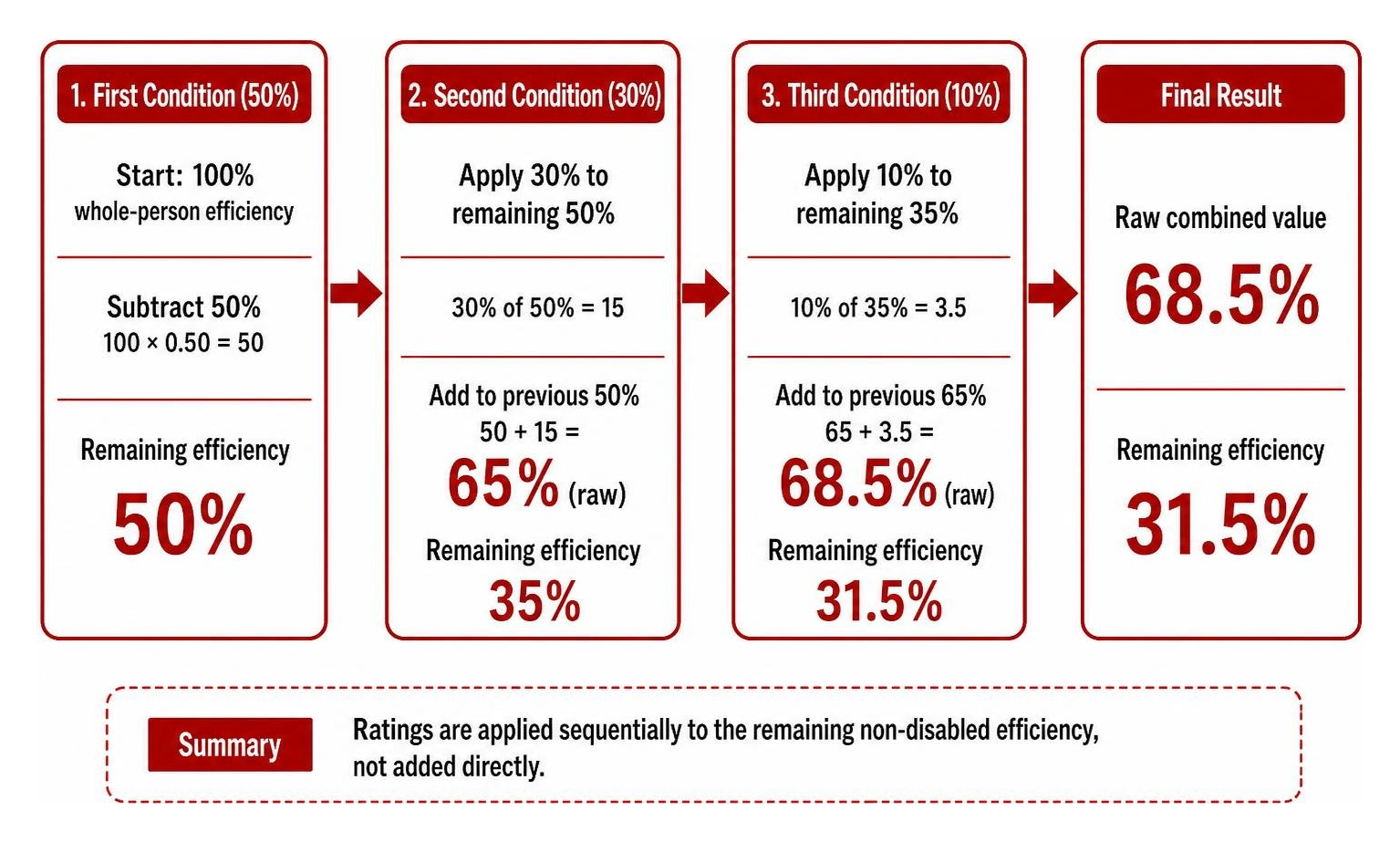
To see how this works in practice, imagine a veteran with three distinct service-connected conditions:
- First Condition (50%): The veteran starts at 100% whole-person efficiency. A 50% rating reduces overall efficiency by 50 points ($100 \times 0.50 = 50$), leaving 50% remaining non-disabled capacity.
- Second Condition (30%): The 30% rating applies only to the remaining 50% efficiency ($50 \times 0.30 = 15$). Adding this 15% impairment to the initial 50% yields a raw combined value of 65%.
- Third Condition (10%): The remaining efficiency is now 35% ($100 – 65 = 35$). The 10% disability takes 10% of that remaining 35% ($35 \times 0.10 = 3.5$). Adding 3.5% to 65% results in a raw value of 68.5%.
Once all service-connected conditions are calculated, the VA applies its strict 10% rounding boundary. Any raw combined score ending in 1 through 4 rounds down to the nearest 10%, while any value ending in 5 through 9 rounds up. In our example, 68.5% rounds up to a final combined rating of 70%.
The official rules for evaluating multiple conditions are detailed in the federal guidelines About Disability Ratings | Veterans Affairs. When reviewing your VA disability ratings for 2026, understanding this non-additive formula is critical to avoiding surprises.
Another essential variable is the bilateral factor governed by 38 CFR 4.26. When a veteran has qualifying service-connected disabilities affecting paired extremities (such as both knees, both shoulders, or both ankles), the VA combines those specific ratings first, adds an extra 10% boost of that combined value to the subtotal, and then combines that boosted number with the rest of the veteran’s non-bilateral conditions.
Key Features to Evaluate in the Top 5 VA Disability Calculators

Not all calculation engines are built the same. While some platforms provide a bare-bones percentage lookup, comprehensive tools allow you to model complex real-world claims accurately. When evaluating digital rating tools, look for these vital capabilities:
- Raw Combined Value Visibility: A reliable calculator shows both your raw mathematical percentage (e.g., 84% or 95%) and your final rounded tier (e.g., 80% or 100%). Knowing your unrounded baseline reveals exactly how close you are to crossing into the next compensation bracket.
- Automated Bilateral Factor Logic: High-quality engines allow you to designate body parts (left arm, right arm, left leg, right leg, body/systemic) and automatically apply the 10% bilateral factor under 38 CFR 4.26 without requiring manual side calculations.
- Comprehensive Dependent Tiering: Monthly VA compensation increases for qualifying dependents once you reach a 30% combined rating. A complete calculator must account for spouses, dependent parents (0, 1, or 2), minor children under 18, and adult children ages 18 to 23 attending an approved school.
- Special Monthly Compensation (SMC-K) Add-ons: Certain anatomical losses or loss of use (such as erectile dysfunction or loss of a creative organ) qualify for SMC-K. An advanced tool lets you add these flat-rate monthly stipends directly to your total.
- Current Cost-of-Living Adjustment (COLA) Rates: The tool must incorporate the latest benefit adjustments. You can cross-reference updated compensation figures using our VA disability pay chart 2026 to confirm baseline accuracy. For a detailed look at how annual adjustments impact your wallet, explore understanding VA disability rates and COLA in 2026.
Comparing the Top 5 VA Disability Calculators for Accuracy and Usability
To help you choose the right resource, we evaluated the primary categories of online rating tools available to veterans in 2026. The table below outlines how these five tool designs compare across essential features:
| Calculator Type / Model | Raw Score Display | Bilateral Automation | Dependent Breakdown (30%+) | SMC(k) Support | Best Use Case |
|---|---|---|---|---|---|
| 1. Interactive Breakdown Tools | Yes | Yes (Full Body Mapping) | Yes (Children, Spouse, Parents) | Yes | Comprehensive claim auditing and benefit planning |
| 2. Official Federal Tables | No (Lookup Only) | Manual Only | Basic Tier Schedules | No | Official baseline verification |
| 3. Mathematical Audit Engines | Yes | Yes (Formulaic) | Variable | Limited | Verifying strict decimal and table arithmetic |
| 4. Multi-Dependent Simulators | No | Basic | Advanced (Detailed Family Tiers) | No | Modeling family budget changes |
| 5. Quick-Check Estimators | No | No | Minimal | No | Fast rough estimates |
1. Advanced Interactive Breakdown Tools Among the Top 5 VA Disability Calculators
Advanced interactive platforms represent the gold standard for veterans seeking clarity on their ratings. These tools guide you through a step-by-step visual interface where you can assign percentages directly to specific limbs or body systems.
By separating conditions anatomically, an advanced VA Disability Calculator 2 automatically identifies qualifying paired extremities and incorporates the required bilateral factor boost. In addition, these comprehensive tools display your unrounded score alongside the rounded benefit tier, helping you see whether a new 10% secondary claim will shift your final compensation or simply absorb remaining whole-person efficiency without changing your monthly check.
2. Official Federal Tables and Algorithmic Simulators Among the Top 5 VA Disability Calculators
Official federal calculation engines and published lookup tables offer direct insight into how government rating specialists review your claim. The VA Combined Ratings Table cross-references percentages in 10% increments across a two-dimensional matrix.
While these official lookup tables do not offer fancy animations or dynamic sliders, they represent the binding legal framework for every claim decision. Using federal baseline simulators ensures that your numbers align perfectly with the standard adjudication rules used by regional offices.
3. Pure Mathematical and Bilateral Factor Audit Engines
Mathematical audit tools are designed specifically to eliminate rounding confusion and demystify “VA fuzzy math.” These calculators focus heavily on displaying the exact decimal calculations behind complex multi-condition claims.
Under 38 CFR 4.26, paired extremity ratings are combined first, an additional 10% of that value is added, and the resulting figure is rounded to the nearest whole number before being factored into non-bilateral conditions. A dedicated mathematical audit engine proves invaluable when checking a rating decision letter to ensure the adjudicator did not miss a bilateral pairing.
4. Multi-Dependent and Secondary Condition Modeling Tools
When your service-connected disability rating reaches 30% or higher, the VA adds monthly allowances for eligible family members. Multi-dependent modeling tools specialize in calculating these tiered payment structures.
These calculators allow veterans to model distinct family circumstances, such as:
- Having a spouse who qualifies for Aid and Attendance
- Supporting children under 18 versus adult children enrolled in college (ages 18 to 23)
- Claiming one or two dependent parents who rely on the veteran for financial support
Because dependent additions can increase a monthly check by hundreds of dollars, family-focused modeling engines are essential for long-term household financial planning.
5. Simplified Quick-Check Rating Estimators
Simplified rating estimators are designed for speed. If you have only one or two static ratings and want an immediate estimate of your monthly compensation, a quick-check tool provides an answer in seconds.
While these tools are convenient for a rapid sanity check, they have notable limitations. Most simplified estimators omit bilateral factor calculations, fail to show the unrounded raw score, and cannot handle complex staged ratings (where ratings change across multiple effective dates). They are best used as an initial ballpark figure before conducting a comprehensive audit.
How to Use Calculator Results to Audit Claims and Model Increases

A disability calculator is a powerful strategic asset when preparing a new filing or reviewing a recent rating decision. Here is a practical framework for putting calculator results to work:
- Audit Your Decision Letter: Pull your official rating decision and list every service-connected percentage. Enter them into a calculator that supports bilateral factors. If your calculated combined percentage differs from the VA’s final number, check whether the adjudicator properly paired bilateral limbs or applied the correct rounding rule.
- Model Secondary Conditions: If you plan to file a secondary claim (such as radiculopathy in both legs secondary to a service-connected lumbar spine condition), model those anticipated ratings first. This reveals whether winning a 10% or 20% secondary grant will actually elevate your overall rounded compensation bracket.
- Account for 0% Noncompensable Ratings: Even though a 0% rating provides no monthly cash payout, it establishes service connection. Entering 0% conditions into your personal tracking helps you monitor issues that could worsen and warrant an increased rating claim later.
- Prepare for Professional Guidance: Armed with your raw combined score and payment estimates, you can have a far more productive discussion with an accredited Veterans Service Officer (VSO), claims agent, or attorney. To explore your baseline benefits and options, review our resources on VA Disability Rates 2026 2.
Frequently Asked Questions About VA Disability Calculators
Why does simple addition differ from VA combined math?
The VA uses the “whole person theory,” which assumes no person can be more than 100% disabled. Each disability rating is applied in descending order against the remaining non-disabled percentage of your body, rather than being added directly together. For example, a 50% rating leaves 50% efficiency; a subsequent 30% rating takes 30% of that remaining 50% (which equals 15%), resulting in an unrounded combined score of 65% (rounding up to 70%).
Can a bilateral factor ever reduce my total VA rating?
No. Federal regulations under 38 CFR 4.26 require that the bilateral factor provide a beneficial adjustment for qualifying paired conditions. In the rare arithmetic edge case where applying the bilateral formula would mathematically result in a lower final rating than standard combination, VA adjudication rules dictate using the calculation method most favorable to the veteran.
When do dependents affect my monthly disability payout?
Dependents only increase your monthly compensation if your final rounded combined disability rating is 30% or higher. Veterans rated at 10% or 20% receive standard flat-rate compensation regardless of marital status, children, or dependent parents.
Conclusion
Navigating the Department of Veterans Affairs rating system requires precision. Because standard arithmetic does not apply, relying on gut feeling or simple addition can lead to unrealistic expectations or missed benefits.
Whether you are auditing an existing decision, tracking the progression of service-connected injuries, or planning a secondary claim, utilizing a comprehensive rating tool provides clarity. To model your combined percentages, apply bilateral factors, and estimate your 2026 tax-free monthly compensation, run your numbers through our interactive VA Disability Calculator 2 today.
Free for Service Members & Veterans
Get the military benefits intel no one tells you about.
Weekly updates on VA benefits, pay changes, and money tips — free for service members and veterans.
No spam. Unsubscribe anytime. Your info is never shared.


