Why the VA Starts GLP-1 Trials for Alcohol Use Disorder
The decision by the Department of Veterans Affairs to launch the CRAVE trial comes at a pivotal moment in addiction science. For years, clinicians and researchers have noticed an intriguing trend: patients taking GLP-1 receptor agonists like semaglutide for type 2 diabetes or chronic weight management frequently reported a sudden, unprompted drop in their desire to consume alcohol.
To determine whether these reports were more than just coincidence, researchers began analyzing massive healthcare databases. A landmark 2026 observational study published in The BMJ, which examined health records from over 600,000 U.S. Veterans, revealed that individuals prescribed GLP-1 medications exhibited significantly lower rates of alcohol use disorder and fewer substance-related emergency room visits compared to those taking non-GLP-1 diabetes drugs. You can read more about these initial findings through the official VA announcement on GLP-1 trials for alcohol use disorder.
While observational analyses show a strong association, they cannot prove direct cause and effect. That distinction requires rigorous, prospective testing. By launching a formal Phase 3 trial, the VA aims to move from observational curiosity to clinical certainty.
How the VA Starts GLP-1 Trials for Alcohol Use Disorder to Address Treatment Gaps
To understand why this trial is so urgent, one must look at the staggering treatment gap within the veteran community. More than 400,000 Veterans nationwide carry an official diagnosis of Alcohol Use Disorder (AUD). Across the entire United States, AUD affects nearly 11% of adults. Yet, despite the vast scope of this health crisis, less than 2% of adults with AUD receive medication-assisted treatment in any given year. Within the VA system, only about 40,000 of the 400,000 diagnosed Veterans actively receive pharmacotherapy.
This immense care gap stems partly from the limitations of current medical options. It has been nearly two decades since the FDA approved a new medication for AUD. The most widely prescribed oral medication, naltrexone, offers modest efficacy—it has a Number Needed to Treat (NNT) of 12 to prevent a return to heavy drinking. Many Veterans stop taking daily pills due to side effects, lack of noticeable craving suppression, or daily medication fatigue.
| Feature | Current Standard (Oral Naltrexone) | CRAVE Trial Objective (Semaglutide) |
|---|---|---|
| Administration | Daily oral pill | Once-weekly subcutaneous injection |
| Primary Target | Opioid receptors (blocks alcohol high) | GLP-1 receptors (modulates reward & satiety) |
| Real-World Efficacy | NNT = 12 to prevent heavy drinking | Aiming for superior craving reduction |
| FDA Approval Status | Approved (1994) | Investigational for AUD (Phase 3 Trial) |
Biological Mechanisms Behind GLP-1 and Reward Pathways
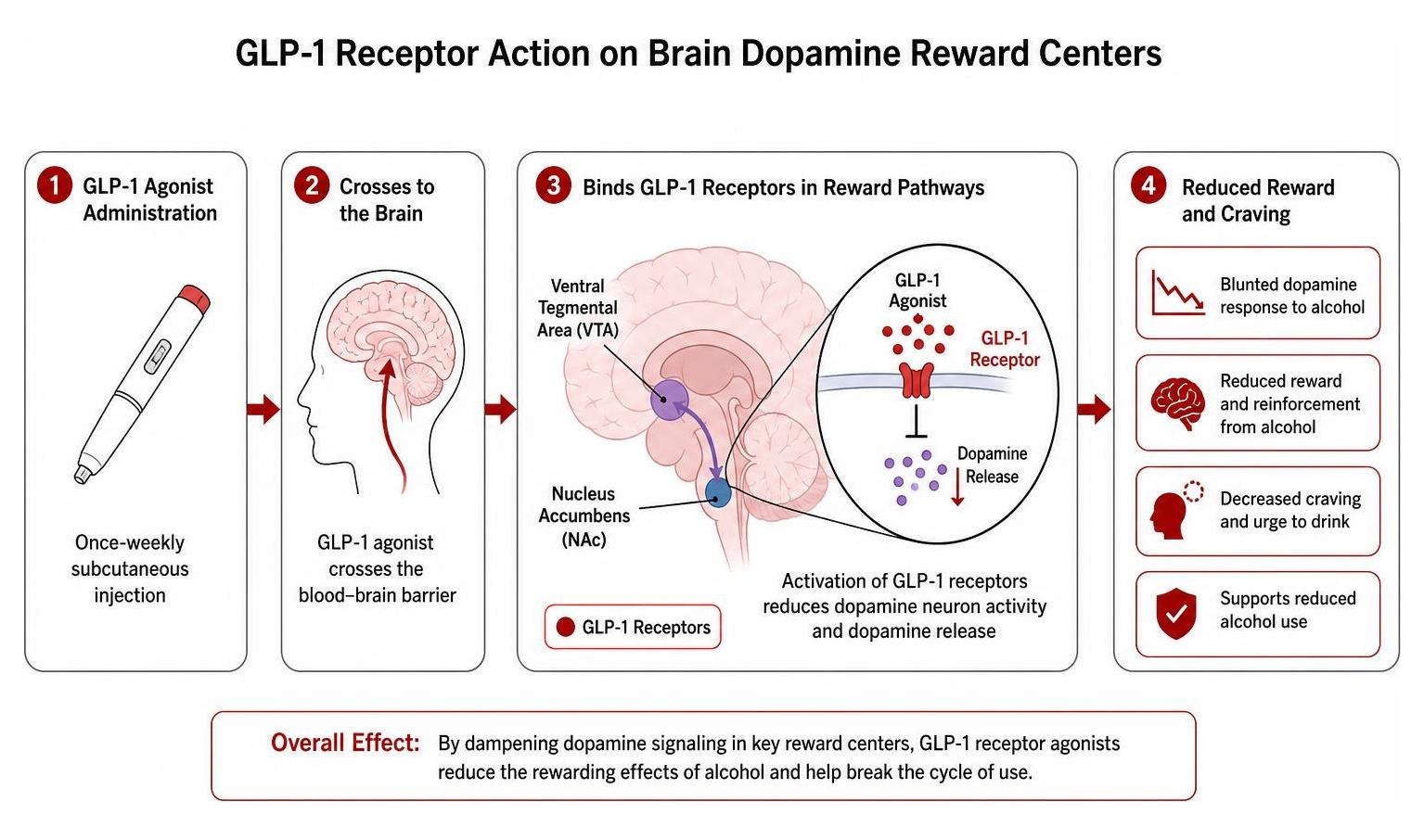
How can a medication designed for gut hormones and blood sugar regulation alter alcohol consumption? The answer lies in the complex neurobiology of reward. GLP-1 (glucagon-like peptide-1) receptors are not only located in the pancreas and gastrointestinal tract—they are also densely distributed across brain regions that control reward processing, impulse control, and appetite, including the ventral tegmental area and nucleus accumbens.
When a person drinks alcohol, the brain releases dopamine, triggering feelings of pleasure and reinforcing the urge to drink again. Semaglutide mimics natural GLP-1 hormones, crossing the blood-brain barrier to bind with brain reward pathways. By dampening the surge of dopamine typically prompted by alcohol, GLP-1 receptor agonists reduce both the psychological craving for alcohol and the rewarding sensation derived from drinking it. Much like how the medication signals fullness to the brain to stop overeating, it appears to send a biological signal of satiety that quiets the neurological impulse to drink.
Understanding the CRAVE Trial: Design, Eligibility, and Scope
Formally designated as CSP #2041 (Cooperative Studies Program), the CRAVE trial is a randomized, double-blind, placebo-controlled Phase 3 study sponsored by the VA Office of Research and Development. Designed to establish definitive scientific proof, neither the participating Veterans nor their treating clinicians will know who receives the active medication and who receives a placebo. Veterans can review full technical details on the Official CRAVE study clinical protocol.

Trial Structure and Participant Criteria
The study plans to randomize 622 Veterans across 18 participating VA medical centers nationwide (including major centers like the Minneapolis VA Health Care System). Recruitment officially opened on July 28, 2026.
To protect participant safety and ensure clear data, the trial enforces specific eligibility parameters:
- Inclusion Criteria: Veterans aged 18 to 80 with a confirmed diagnosis of moderate to severe AUD who exhibit high World Health Organization (WHO) risk drinking levels and express a sincere goal to cease or significantly reduce their alcohol consumption.
- Dosing Schedule: Participants will undergo a 28-week protocol. This includes a 4-week gradual dose titration (starting at 0.25 mg weekly and stepping up every 4 weeks to a target dose of 2.4 mg) to minimize gastrointestinal side effects, followed by 24 weeks at the maximum tolerable dose and a final safety follow-up assessment.
- Key Exclusion Criteria: Individuals with a history of acute or chronic pancreatitis, medullary thyroid carcinoma, severe liver disease (such as decompensated cirrhosis), Type 1 diabetes, or recent major cardiovascular events are excluded from enrollment.
What Veterans Should Know as the VA Starts GLP-1 Trials for Alcohol Use Disorder
If you or a fellow Veteran are considering applying for the trial, it is crucial to understand the enrollment steps and safety protocols:
- Work Through Official Channels: Enrollment takes place strictly through participating VA healthcare sites. Interested Veterans should consult their primary care provider or mental health team to request a referral or verify if their regional VA site is participating.
- Avoid Unprescribed GLP-1 Products: The VA strongly cautions against buying semaglutide from unverified online vendors or compounding pharmacies. Compounded “off-label” versions may contain improper dosages or impurities.
- Do Not Abruptly Stop Alcohol Unsupervised: Suddenly quitting alcohol if you are dependent can lead to severe, life-threatening withdrawal symptoms such as seizures or delirium tremens. Medical supervision is essential.
Current AUD Treatments, Mental Health, and VA Benefits
While the CRAVE trial represents an exciting future possibility, Veterans battling alcohol reliance do not need to wait for 2030 to get help. The VA currently offers a robust spectrum of evidence-based medical and behavioral treatments.

Existing Medications vs. Repurposed Therapies
Currently, three medications hold FDA approval for treating Alcohol Use Disorder:
- Oral Naltrexone & Injectable Vivitrol: Blocks opioid receptors in the brain to reduce the pleasurable effects of alcohol and quiet daily cravings.
- Acamprosate: Helps stabilize chemical messaging in brain pathways damaged by long-term alcohol exposure, proving especially helpful for maintaining abstinence.
- Disulfiram: Works as a deterrent by causing uncomfortable physical reactions (such as nausea and flushing) if alcohol is ingested.
These medications are most effective when paired with behavioral therapies, such as Cognitive Behavioral Therapy (CBT), Motivational Enhancement Therapy, or peer support groups. Veterans seeking comprehensive wellness care can also explore Mental Health Resources for Military Veterans.
Connecting Substance Use to PTSD, Depression, and Disability Ratings
In the military community, alcohol use disorder rarely exists in isolation. It frequently develops as an attempt to self-medicate underlying psychological trauma, physical pain, or service-connected mental health conditions.
If your reliance on alcohol developed as a direct coping mechanism for a service-connected disability—such as Post-Traumatic Stress Disorder or major depression—you may be eligible for secondary service connection. For instance, if you hold a primary rating under the VA Disability Rating for PTSD or receive benefits for VA Disability for Depression, any medical complications or secondary disabilities arising from AUD can be linked to your primary rating during a VA disability claim evaluation. Establishing a clear medical link between service trauma and subsequent substance use is a critical step in securing the full disability rating and healthcare coverage you deserve.
Frequently Asked Questions About the VA GLP-1 AUD Trial
Is semaglutide approved to treat alcohol use disorder?
No. Semaglutide is currently approved by the FDA only for Type 2 diabetes management and chronic weight management. Its application for alcohol use disorder remains strictly investigational until clinical trials like the VA’s CRAVE study are completed and reviewed by regulatory agencies.
Can Veterans self-medicate with off-label GLP-1 medications?
No, the VA strongly advises against self-medicating with off-label or unprescribed GLP-1 drugs for alcohol reduction. Taking these medications without strict medical monitoring carries risks of severe gastrointestinal distress, pancreatitis, unexpected drug interactions, and dangerous alcohol withdrawal complications.
When will the CRAVE trial results be available?
Primary completion for participant tracking in the CRAVE trial is targeted for 2028, with final study analysis and full data publication expected by March 30, 2030. Clinical guidance will remain focused on existing FDA-approved AUD therapies until final peer-reviewed results are published.
Conclusion

The launch of the CRAVE trial demonstrates the VA’s ongoing commitment to leading cuting-edge medical research that directly targets the unique health challenges of American Veterans. While we must await the final data before semaglutide can be prescribed as a standard treatment for alcohol use disorder, this study opens an encouraging new front in addiction medicine.
If you are struggling with alcohol use, do not wait for future research to take the first step toward recovery. Reach out to your local VA care team today to explore existing, proven medications and counseling programs. Additionally, if your substance use or mental health challenges stem from your military service, ensure you are receiving all the compensation and medical support you earned by applying for VA disability benefits through USMilitary.com.
Free for Service Members & Veterans
Get the military benefits intel no one tells you about.
Weekly updates on VA benefits, pay changes, and money tips — free for service members and veterans.
No spam. Unsubscribe anytime. Your info is never shared.