Understanding VA Aid & Attendance: Financial Help for Veterans Who Need Care
Aid & Attendance is a monthly, tax-free benefit from the Department of Veterans Affairs that provides extra financial support to wartime veterans and surviving spouses who need help with daily living activities. This benefit improves the basic VA pension and can pay for in-home care, assisted living, memory care, or nursing home costs.
Quick Answer: Aid & Attendance Eligibility Requirements
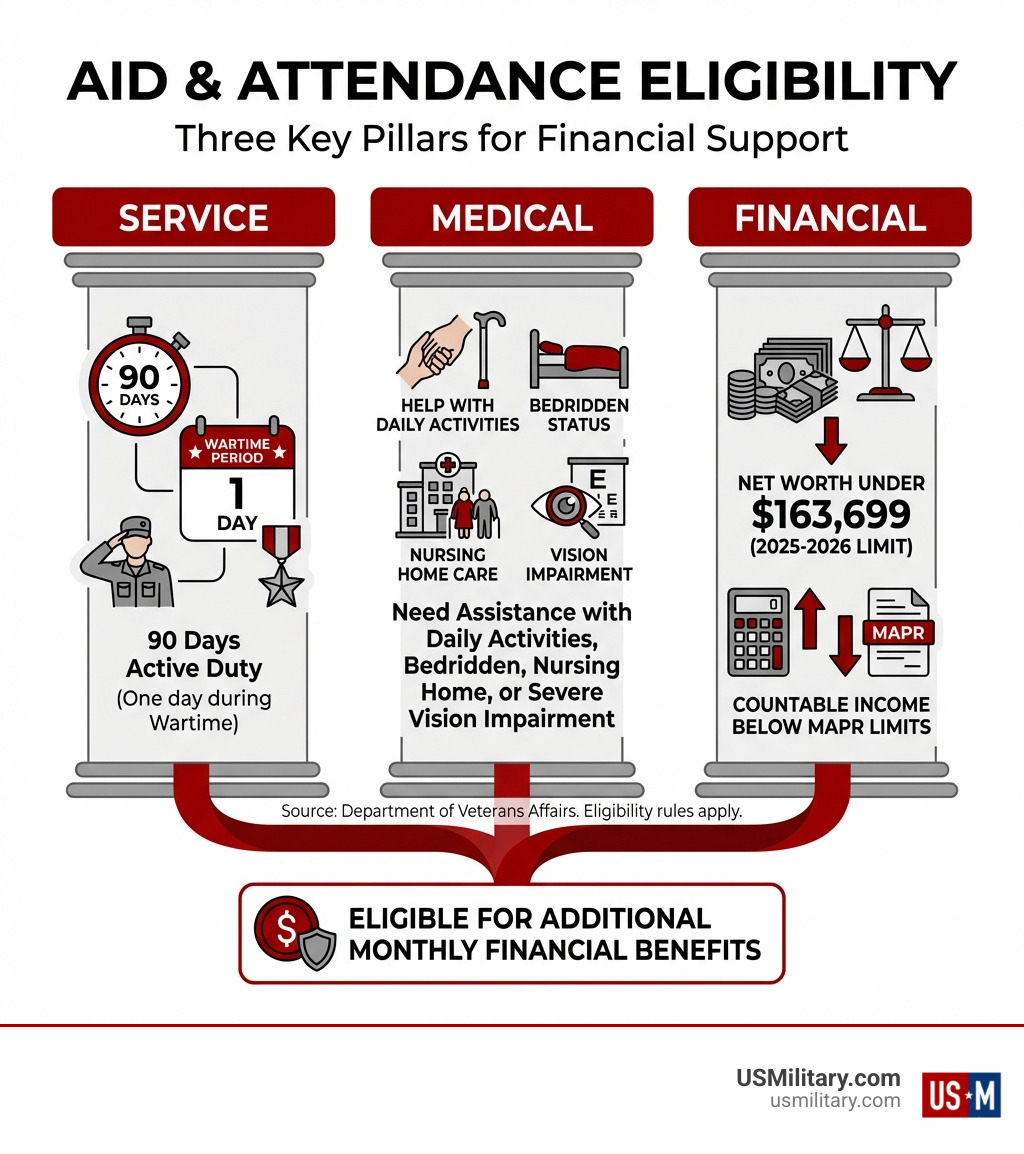
To qualify for Aid & Attendance, you must meet three key criteria:
- Service Requirement – You must be a wartime veteran with at least 90 days of active duty (with at least one day during a wartime period) and an honorable discharge, or be the surviving spouse of a qualifying veteran.
- Medical Requirement – You must need assistance with daily activities (bathing, dressing, eating), be bedridden, live in a nursing home due to incapacity, or have severe vision impairment.
- Financial Requirement – Your net worth must be below $163,699 (2025-2026 limit), and your countable income must be below the Maximum Annual Pension Rate (MAPR) for your situation.
Current Monthly Benefit Amounts (Dec 2025 – Nov 2026):
- Single Veteran: $2,424/month ($29,091/year)
- Married Veteran: $2,873/month ($34,486/year)
- Surviving Spouse: $1,558/month ($18,696/year)
If you’re a wartime veteran or surviving spouse struggling with care costs, this benefit could provide crucial financial relief. Many eligible veterans don’t know about Aid & Attendance or assume they don’t qualify—but the rules are more flexible than you might think.
I’m Larry Fowler, publisher of the USMilitary.com Network, where we’ve helped veterans understand and access Aid & Attendance benefits since 2007. Through our platform, we’ve assisted thousands of veterans and families in navigating the VA benefits system to secure the financial support they’ve earned through service.
What is the VA Aid & Attendance Benefit?
The Aid & Attendance benefit is a special monthly pension paid by the U.S. Department of Veterans Affairs (VA) to eligible wartime veterans and their surviving spouses. It’s not a standalone benefit but rather an improvement to the basic VA pension. This means that to qualify for Aid & Attendance, you must first be eligible for the underlying VA pension.
The primary purpose of the Aid & Attendance benefit is to provide financial assistance to those who need the regular aid and attendance of another person to perform daily functions, or who are largely confined to their homes due to permanent disability. Essentially, it helps offset the significant costs associated with long-term care, whether that’s in-home care, assisted living, memory care, or a nursing home. We’ve seen how this benefit can make a profound difference, allowing veterans and their families to afford the quality care they deserve without depleting their life savings.
This tax-free benefit recognizes that as we age, or face health challenges, the need for assistance can become a substantial financial burden. The VA steps in to help shoulder that burden for those who served our nation.

Aid & Attendance vs. Housebound Benefits
It’s common for veterans and their families to confuse Aid & Attendance with Housebound benefits, or to wonder if they can receive both. Let’s clear this up: both are special monthly payments added to a VA pension, but they have distinct eligibility criteria, and you cannot receive both simultaneously. The VA will award the higher of the two benefits if you qualify for both.
Here’s a breakdown of their differences:
| Feature | Aid & Attendance Benefit | Housebound Benefit |
|---|---|---|
| Purpose | Provides additional financial support for veterans or surviving spouses who need regular assistance with daily living activities (ADLs), are bedridden, are patients in a nursing home due to mental or physical incapacity, or have severe vision impairment. It helps pay for costs associated with higher levels of care. | Provides additional financial support for veterans or surviving spouses who are permanently disabled and substantially confined to their immediate premises, making it difficult to leave home. It recognizes a significant limitation in mobility and self-sufficiency. |
| Medical Requirements | Must meet at least one of these: | Must meet at least one of these: |
| – Requires assistance with Activities of Daily Living (e.g., bathing, dressing, eating, using the toilet, maintaining hygiene). | – Has a single permanent disability evaluated as 100% disabling AND, due to such disability, is permanently and substantially confined to their immediate premises. | |
| – Is bedridden (meaning the disability requires remaining in bed, excluding periods of convalescence or treatment in a medical facility). | – Has a single permanent disability evaluated as 100% disabling AND another disability, or disabilities, evaluated as 60% or more disabling. | |
| – Is a patient in a nursing home due to mental or physical incapacity. | – Is severely limited in correcting vision to 5/200 or less in both eyes, or has a concentric contraction of the visual field to 5 degrees or less. | |
| Exclusivity | Cannot receive Housebound benefits at the same time. | Cannot receive Aid & Attendance benefits at the same time. |
| Prequalification | Must be eligible for a basic VA pension. | Must be eligible for a basic VA pension. |
For more information, we recommend visiting the official VA pages on Aid & Attendance and Housebound benefits.
What Types of Care Can the Benefit Cover?
The financial assistance provided by Aid & Attendance is incredibly versatile, designed to help cover a wide range of care services that enable veterans and surviving spouses to live as comfortably and safely as possible. We often highlight this flexibility because it empowers families to choose the care setting that best fits their needs.
Here are the primary types of care and related expenses that the Aid & Attendance benefit can be used for:
- In-Home Care Services: This includes assistance from professional caregivers or home health aides for Activities of Daily Living (ADLs) such as bathing, dressing, eating, mobility, and medication management. It can also cover companionship services.
- Assisted Living Facilities: These communities provide a supportive environment for seniors who need help with daily tasks but still desire a level of independence. The benefit can contribute significantly to the monthly costs of room, board, and care services. We understand that finding the right assisted living community can be a challenge, and resources like A Place for Mom and SeniorAdvisor.com can help families explore options and read reviews for assisted living in top cities.
- Memory Care Units: For individuals with Alzheimer’s disease or other forms of dementia, specialized memory care facilities offer a secure environment with custom programs and trained staff. Aid & Attendance can help cover these specialized, often higher, costs.
- Nursing Home Care: When a higher level of medical care and supervision is required, the benefit can be applied towards the costs of skilled nursing facilities.
- Home Modifications: In some cases, the funds can assist with necessary home improvements to accommodate a veteran’s disability, such as installing wheelchair ramps, grab bars, or widening doorways.
- Medical Expenses: While the benefit primarily addresses care costs, unreimbursed medical expenses can also play a role in determining financial eligibility, and the benefit indirectly frees up funds for such costs.
The goal is to ensure that veterans and their surviving spouses receive the care they need to maintain their quality of life, wherever they choose to receive it.
Eligibility for Aid & Attendance: Who Qualifies?
Understanding who qualifies for the Aid & Attendance benefit can feel like navigating a maze, but we’re here to simplify it. Eligibility hinges on three main pillars: your military service history, your medical needs, and your financial situation. All three must be met for a successful claim.
Military Service Requirements
The Aid & Attendance benefit is an improvement to the VA pension, which is specifically for wartime veterans. This means that your service history is a critical first step. It’s not just about serving; it’s about when and how long you served.
Here’s what we look for:
- Wartime Service: You must have served at least 90 days of active duty, with at least one day having occurred during a designated wartime period. “Wartime” for VA purposes extends beyond active combat. For example, the Gulf War period is defined from August 2, 1990, and continues to the present day. You can find detailed information on official VA wartime periods.
- Minimum Service Duration:
- If you entered active duty on or before September 7, 1980, you generally need 90 days of active service.
- If you entered active duty after September 7, 1980, you generally must have served at least 24 months of active duty or the full period for which you were called or ordered to active duty, with at least one day during a wartime period.
- Honorable Discharge: You must have received an honorable discharge.
Surviving spouses can also qualify if their deceased veteran spouse met these service requirements. We’ve often seen families surprised to learn that a veteran who never saw combat might still meet the wartime service criteria, so it’s always worth checking.
Medical and Clinical Needs for Aid & Attendance
Beyond military service, your current medical condition is paramount to qualifying for Aid & Attendance. The VA looks for a clear medical need for assistance in your daily life. This isn’t about having a specific diagnosis, but rather how your health impacts your ability to function independently.
You must meet at least one of the following medical criteria, as determined by a physician:
- Need for Assistance with Activities of Daily Living (ADLs): This is the most common criterion. It means you require help from another person to perform basic self-care tasks. These can include:
- Bathing: Needing help getting in and out of the shower or tub, washing.
- Dressing: Difficulty putting on or taking off clothes.
- Eating: Needing assistance with feeding yourself (e.g., cutting food, bringing food to mouth).
- Toileting: Needing help with using the toilet or managing incontinence.
- Grooming/Hygiene: Assistance with brushing teeth, combing hair, shaving.
- Being Bedridden: Your disability requires you to remain in bed for a significant portion of the day, regardless of any treatment or convalescence in a medical facility.
- Residency in a Nursing Home: You are a patient in a nursing home due to mental or physical incapacity, and this placement is medically necessary for your care.
- Severe Vision Impairment: Your corrected vision is 5/200 or less in both eyes, or your visual field is concentrically contracted to 5 degrees or less.
- Need for Protection: Due to your mental or physical incapacity, you require ongoing protection from daily environmental hazards. For example, if you frequently forget to turn off appliances, wander, or are at high risk of falls.
A physician’s assessment is crucial here. They will need to provide detailed documentation describing your physical or mental limitations and how they necessitate the aid and attendance of another person.
Financial Requirements: Income and Net Worth Limits
Even if you meet the service and medical criteria, the VA also considers your financial situation, as Aid & Attendance is a needs-based benefit. The VA has specific income and net worth limitations that you must meet. These rules can be complex, and we’ve helped countless families steer them.
- Net Worth Limit: As of December 1, 2025, to November 30, 2026, the net worth limit for VA pension eligibility (including Aid & Attendance) is $163,699. This limit includes your countable assets and your annual income after certain deductions.
- Countable Assets: This includes things like savings accounts, investments, and non-primary residences.
- Excluded Assets: Importantly, your primary residence and one vehicle are generally not counted towards your net worth. We know this is a relief for many veterans who have worked hard to own their homes.
- Countable Income: The VA calculates your countable income by taking your gross annual income and subtracting certain unreimbursed medical expenses. Your countable income must be below the Maximum Annual Pension Rate (MAPR) for your specific situation (e.g., single veteran, married veteran, surviving spouse). The Aid & Attendance benefit essentially makes up the difference between your countable income and the MAPR for your category, up to the maximum benefit amount.
- 3-Year Look-Back Period: The VA has a 3-year “look-back” period for asset transfers immediately preceding your application. This means they will review any significant transfers of assets (e.g., gifting money or property) made within the 36 months before you apply. If assets were transferred to qualify for the benefit, it could result in a period of ineligibility, potentially up to 5 years. It’s crucial to consult with a benefits planner if you’re considering asset adjustments.
For the most up-to-date information on income and net worth limitations, we always refer families to the VA pension eligibility rates page.
How to Apply for Aid & Attendance
Applying for Aid & Attendance can seem daunting, but we’ve streamlined the process for many veterans and their families. The key is thoroughness and understanding each step. If approved, benefits are often paid retroactively to your original filing date, so getting the application in is important!
The application process generally involves submitting forms and supporting documentation to your Pension Management Center (PMC).
Required Documentation and Forms
Gathering the correct documentation is a critical step in a successful Aid & Attendance application. Incomplete applications are a common reason for delays or denials.
Here’s a checklist of what you’ll typically need:
- Proof of Military Service: A copy of your DD-214 (Certificate of Release or Discharge from Active Duty) or other service records.
- Application Forms:
- Veterans: VA Form 21P-527EZ, Application for Pension
- Surviving Spouses: VA Form 21P-534EZ, Application for Dependency and Indemnity Compensation, Survivors Pension, and Accrued Benefits (though the link for 21P-534EZ is provided, the specific form for survivors pension is 21P-534EZ)
- Medical Examination Forms:
- VA Form 21-2680, Examination for Housebound Status or Permanent Need for Regular Aid and Attendance: This form is crucial. Your physician must complete it, detailing your medical condition, how it affects your ability to perform ADLs, and why you need assistance. The more specific and descriptive your doctor is, the better.
- VA Form 21-0779, Request for Nursing Home Information in Connection with Claim for Aid and Attendance: If you are currently residing in a nursing home, this form must also be completed by the facility.
- Financial Records: Detailed documentation of all income and assets for both the veteran and spouse (if applicable). This includes bank statements, investment statements, and proof of other income.
- Proof of Marriage/Death: If applying as a married veteran, a marriage certificate. If applying as a surviving spouse, a marriage certificate and the veteran’s death certificate.
- Unreimbursed Medical Expense Receipts: Keep meticulous records of all medical expenses not covered by insurance, such as doctor visits, prescriptions, in-home care costs, assisted living fees, and medical equipment. These can significantly impact your countable income.
- Caregiver Affidavits: If you receive care from a family member or private caregiver, a sworn statement from them detailing the type and frequency of care provided can be beneficial.
The Application and Approval Process
Once you’ve gathered all your documents, the next step is to submit your claim. We encourage accuracy and completeness to avoid unnecessary delays.
- Completing Forms: Fill out all required forms accurately and completely. Ensure your physician provides a detailed statement on VA Form 21-2680, specifically addressing your need for assistance with ADLs, bedridden status, or other qualifying medical criteria.
- Submitting the Claim: You have a few options for submission:
- Online: You can submit your application and supporting documents electronically through the VA QuickSubmit portal.
- Mail: Send all original or certified copies of your documents to the Pension Management Center (PMC) that serves your state.
- In-Person: Visit your local VA regional office to submit your application.
- Processing Time: This is often where patience is required. On average, the VA takes between 9 to 12 months to process an Aid & Attendance claim from the time it’s filed. We understand this can be a long wait, but if your claim is approved, the benefits are typically paid retroactively to your original application date. This means you could receive a substantial lump sum payment covering the months your application was under review.
- Approval Notice: If your claim is approved, you will receive an official notice from the VA detailing your benefit amount and when payments will begin.
Common Mistakes and What to Do If Denied
We’ve seen many veterans and their families make common mistakes that lead to delays or denials. Understanding these pitfalls can significantly improve your chances of approval.
Common Mistakes:
- Incomplete Applications: Missing forms, signatures, or required information. The VA cannot process what isn’t there.
- Insufficient Medical Evidence: A doctor’s note simply stating “needs help” isn’t enough. VA Form 21-2680 needs detailed descriptions of how the medical condition impacts daily life and the specific type of assistance required.
- Not Reporting Unreimbursed Medical Expenses: Failing to include all eligible medical expenses can make your countable income appear higher than it is, potentially pushing you over the financial limit.
- Asset Transfer Issues: Transferring assets (e.g., to children) within the 3-year look-back period without proper planning can trigger a penalty period of ineligibility.
- Lack of Understanding of Eligibility: Many assume they don’t qualify without fully understanding the criteria, especially the broad definition of “wartime veteran” or how medical expenses can reduce countable income.
What to Do If Denied:
Receiving a denial can be frustrating, but it’s not always the end of the road. You have several options for appealing the decision:
- Supplemental Claim: If you believe you have new, relevant evidence that wasn’t included in your original application, you can file a Supplemental Claim. This allows the VA to re-evaluate your case with the additional information.
- Higher-Level Review: If you believe the VA made an error based on the evidence already submitted, you can request a Higher-Level Review. A more senior reviewer will examine your case without new evidence.
- Board of Veterans’ Appeals: For a more formal review, you can appeal to the Board of Veterans’ Appeals. This can involve a hearing with a Veterans Law Judge.
We always advise seeking assistance from an accredited Veterans Service Officer (VSO) or a qualified legal professional specializing in VA benefits if your claim is denied. They can help you understand the denial reason and prepare a strong appeal.
Understanding the Financials: Payment Rates
The financial assistance provided by Aid & Attendance is a significant boost to a veteran’s or surviving spouse’s ability to afford necessary care. These payments are tax-free and are adjusted annually to account for cost-of-living increases. The exact amount you receive depends on your specific circumstances, including your marital status, whether you have dependents, and your countable income.
As of December 1, 2025, to November 30, 2026, here are the Maximum Annual Pension Rates (MAPR) for Aid & Attendance benefits:
- Veteran with no spouse or dependent child: $29,091 per year ($2,424 per month)
- Veteran with a spouse or dependent child: $34,486 per year ($2,873 per month)
- Surviving spouse with no dependent child: $18,696 per year ($1,558 per month)
- Surviving spouse with a dependent child: $22,302 per year ($1,858 per month)
- Two Veterans married to each other (one qualifies for A&A): $34,486 per year ($2,873 per month)
- Two Veterans married to each other (one qualifies for A&A, the other for Housebound): $38,350 per year ($3,195 per month)
- Two Veterans married to each other (both qualify for A&A): $46,143 per year ($3,845 per month)
These are maximum amounts. Your actual benefit will be calculated by subtracting your countable income from the applicable MAPR. The VA’s goal is to ensure your income, combined with the benefit, meets the necessary threshold to cover care costs.
Frequently Asked Questions about Aid & Attendance
We often hear similar questions from veterans and their families about the Aid & Attendance benefit. Here are some of the most common ones we address:
Can I apply for Aid and Attendance without using a third-party service?
Absolutely, yes! You can apply for Aid & Attendance directly with the VA for free. You do not need to use any third-party websites or services to submit your application. While services like ours at USMilitary.com offer guidance and information, the official application process is managed by the Department of Veterans Affairs.
You can submit your application in several ways:
- Online: Use the VA QuickSubmit portal to upload your forms and documents.
- By Mail: Send your completed application forms and supporting documents to the Pension Management Center (PMC) that serves your state.
- In Person: Visit your local VA regional office to submit your application with the help of a VA representative or a Veterans Service Officer (VSO).
How long does the VA take to process an Aid and Attendance claim?
The processing time for an Aid & Attendance claim can vary. On average, the VA takes between 9 to 12 months from the time the application is filed to make a decision. However, some claims may be processed faster, while others, particularly complex cases, might take longer.
If your claim is approved, your benefits are typically paid retroactively to the original date the VA received your application. This means that even with a waiting period, you will receive the full amount you were entitled to during that time.
Can I receive Aid and Attendance if I already get VA disability compensation?
Yes, you absolutely can! If you are already receiving VA disability compensation, including 100% disability, you may still be eligible for Aid & Attendance. In this scenario, Aid & Attendance is added as a Special Monthly Compensation (SMC) if you meet the clinical requirements.
This is a crucial point because it means the Aid & Attendance benefit can increase your monthly payments beyond the standard 100% disability rate, providing additional funds specifically for your care needs. The VA recognizes that even with a high disability rating, the need for daily assistance incurs extra costs, and SMC-L (the entry level for Aid & Attendance-related compensation) is designed to address this.
Conclusion
The Aid & Attendance benefit is a vital resource for wartime veterans and their surviving spouses who require assistance with daily living. We’ve explored its core purpose, the critical differences between it and Housebound benefits, and the various types of care it can cover. Understanding the military service, medical, and financial eligibility requirements is key, as is navigating the application process with diligence.
At USMilitary.com, we are dedicated to empowering veterans and their families with the knowledge and resources needed to access the benefits they’ve rightfully earned. While the VA system can seem complex, we believe that with the right information and a clear understanding of the steps involved, securing this crucial financial support is entirely achievable.
We encourage you to use the information and links provided in this guide to assess your eligibility and begin your application journey. Don’t let the complexity deter you; your service has earned you this right. For a deeper dive, review our complete guide on VA benefits.
Free for Service Members & Veterans
Get the military benefits intel no one tells you about.
Weekly updates on VA benefits, pay changes, and money tips — free for service members and veterans.
No spam. Unsubscribe anytime. Your info is never shared.


