Why Concurrent Receipt CRSC & CRDP Matters for Military Retirees

Understanding concurrent receipt CRSC & CRDP: get both retirement & VA pay is one of the most important financial decisions a military retiree can make — and most people don’t know they have options.
Here is the quick answer:
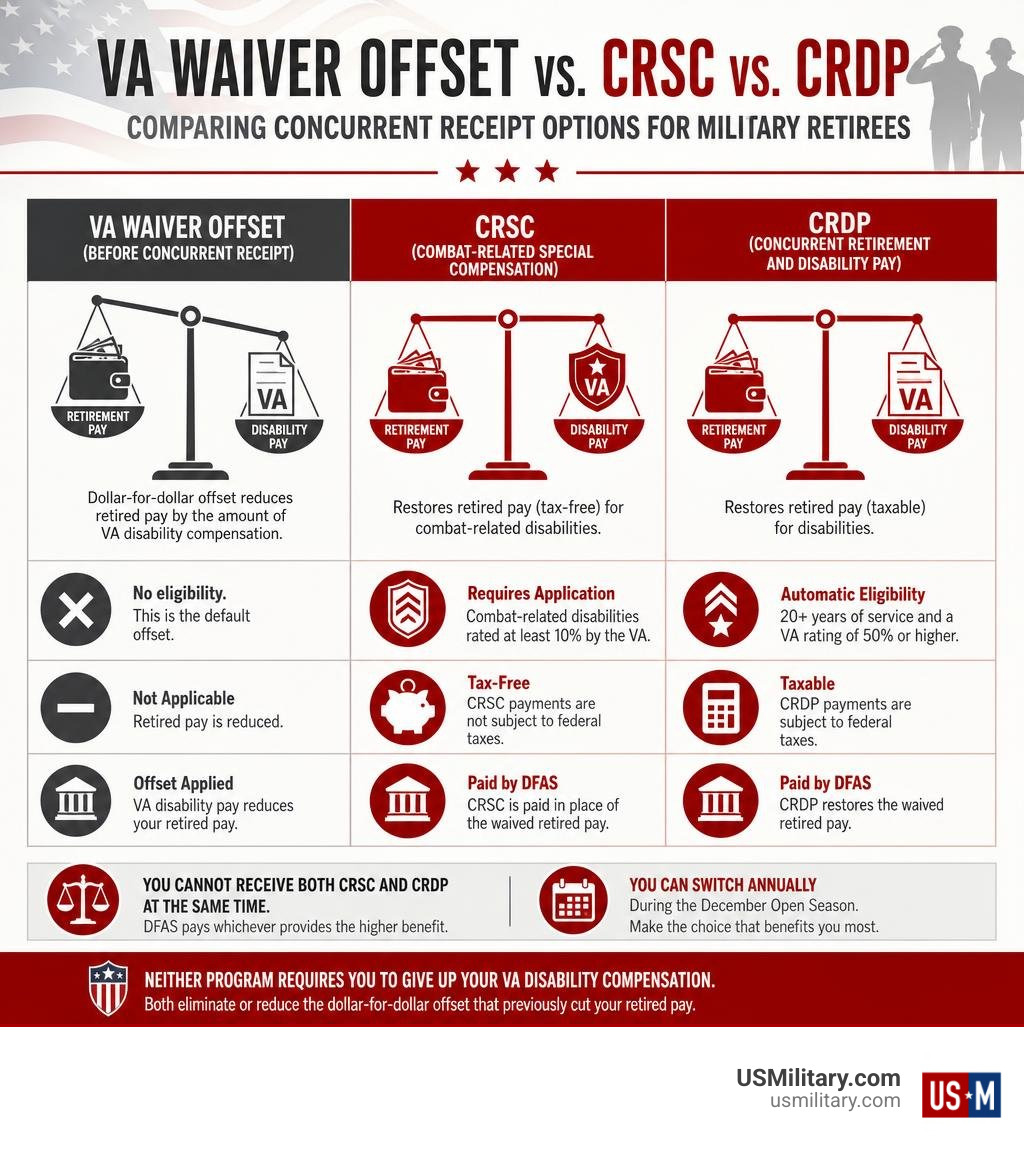
- CRDP (Concurrent Retirement and Disability Pay): Automatic for retirees with 20+ years of service and a VA rating of 50% or higher. Taxable. Restores retired pay reduced by the VA offset.
- CRSC (Combat-Related Special Compensation): Requires an application. Available for combat-related disabilities rated at least 10% by the VA. Tax-free.
- You cannot receive both at the same time. DFAS pays whichever produces the higher benefit. You can switch annually during the December Open Season.
- Neither program requires you to give up your VA disability compensation. Both eliminate or reduce the dollar-for-dollar offset that previously cut your retired pay.
Before 2004, federal law was straightforward — and brutal. Under Title 38 U.S.C. §§ 5304 and 5305, military retirees who received VA disability compensation had their retired pay reduced dollar-for-dollar by the same amount. Every dollar of tax-free VA pay came at the cost of one dollar of taxable retired pay. Veterans called it “double-dipping” prevention, but critics called it a penalty on those who served and were wounded doing it.
The 2004 National Defense Authorization Act (NDAA) changed everything. It created CRDP and expanded CRSC — two programs that allow qualifying retirees to receive both their full military retirement and their VA disability compensation, either partially or in full.
As of September 2022, nearly 47% of all military retirees — about 894,614 people — were receiving either CRSC or CRDP, at a combined annual cost of roughly $21 billion. That is how significant these programs are.
Yet many eligible veterans still miss out, either because they don’t know CRSC requires a separate application, or because they don’t realize which program pays more after taxes.
I’m Larry Fowler, publisher of the USMilitary.com Network, and I’ve spent nearly two decades helping active-duty servicemembers and veterans cut through exactly this kind of complex benefit information. Navigating concurrent receipt CRSC & CRDP to get both retirement & VA pay is one of the most common questions I see — and this guide gives you the clear, step-by-step breakdown you need to make the right call.
Concurrent receipt crsc & crdp: get both retirement & VA pay word guide:
- financial advisor for active duty military
- military financial advisor
Understanding the VA Waiver and Concurrent Receipt
To truly grasp how we got to this point in 2026, we have to look at the mechanics of the old system. The concept of “concurrent receipt” simply means receiving two federal benefits at the same time without one reducing the other. For decades, the federal government operated under a strict anti-duplication policy.
If you want a deep dive into the legislative background of these rules, the Defense Primer: Concurrent Receipt of Military Retirement and VA Disability provides an excellent statutory overview of how these programs are authorized and funded.
At its core, military retirement pay is paid by the Department of Defense (DoD) to compensate for a career of service. VA disability compensation is paid by the Department of Veterans Affairs to compensate for injuries or illnesses sustained during that service. However, because both are paid out of the federal treasury, Congress historically viewed receiving both in full as “double-dipping.” This led to the creation of the infamous VA waiver.
For a comprehensive breakdown of standard retirement benefits before factoring in disability offsets, check out our guide on Military Retirement Pay.
What is the VA Waiver?
The VA waiver is a legal mechanism that requires military retirees to waive a portion of their taxable DoD retirement pay in order to receive an equivalent amount of tax-free VA disability compensation.
Let’s look at a quick example of how this offset works in practice:
- The Scenario: You retire from the Army and are entitled to $2,500 per month in taxable Military Retirement Pay.
- The VA Rating: The VA awards you a 40% disability rating, which qualifies you for $1,000 per month in tax-free disability pay.
- The Offset: Under the standard VA waiver rules, you must waive $1,000 of your retirement pay to receive your $1,000 VA payment.
- The Result: Your DoD retirement pay drops to $1,500 (taxable), and your VA pay is $1,000 (tax-free). Your total gross income remains $2,500, but you save money on taxes because $1,000 of it is now tax-free.
While the tax savings are nice, the frustrating reality is that your overall gross monthly income did not increase by a single penny despite your service-connected disabilities. You were essentially paying for your own disability compensation out of your hard-earned retirement pension.
How to Qualify for Concurrent Receipt CRSC & CRDP: Get Both Retirement & VA Pay
Concurrent receipt programs were designed to eliminate or reduce this painful dollar-for-dollar offset. By qualifying for either CRDP or CRSC, you are essentially “restoring” the retired pay that was waived. This allows you to receive your full VA disability payment and your restored military retirement pay simultaneously.
To qualify for this financial restoration, you must meet specific eligibility pathways. The Defense Finance and Accounting Service (DFAS) and the VA coordinate automatically behind the scenes to track your status, but the exact path depends on your years of service, your disability rating, and whether your injuries are combat-related.
If you are aiming for the maximum possible compensation, you might wonder: Can You Receive 100 VA Disability and Military Retirement Pay? The answer is a resounding yes, provided you meet the 20-year service requirement for CRDP or have qualifying combat-related conditions for CRSC.
Comparing Concurrent Receipt CRSC & CRDP: Get Both Retirement & VA Pay
Choosing between these two programs requires understanding their differences in tax treatment, application processes, and eligibility rules. The statutory mechanisms of both programs are analyzed in depth in the Congressional Research Service report, Concurrent Receipt of Military Retired Pay and Veteran Disability: Background and Issues for Congress.
To help you visualize the core differences, we have put together this comparison table:
| Feature | CRDP (Concurrent Retirement & Disability Pay) | CRSC (Combat-Related Special Compensation) |
|---|---|---|
| Type of Benefit | Restoration of waived retired pay | Special non-taxable compensation |
| Tax Status | Taxable (same as regular retired pay) | 100% Tax-Free |
| Minimum VA Rating | 50% combined service-connected rating | 10% rating for combat-related conditions |
| Service Requirement | Generally 20+ years of service | Available to all retirees (including <20 years) |
| Application Process | Automatic (no application needed) | Manual application (requires DD Form 2860) |
| Divisible in Divorce? | Yes (subject to USFSPA) | No (classified as special compensation) |
| Retroactive Limits | Up to 6 years (Barring Act) | Up to 6 years (Barring Act) |
CRDP Eligibility and Requirements
Concurrent Retirement and Disability Pay (CRDP) is the more common of the two programs. In FY2022, 800,325 retirees received CRDP, compared to just 94,289 who received CRSC.
To qualify for CRDP, you must meet the following criteria:
- You must be a military retiree entitled to regular retired pay, a Reserve/National Guard retiree drawing pay at retirement age (usually 60), or a TERA (Temporary Early Retirement Authority) retiree.
- You must have a combined VA disability rating of 50% or higher. If your rating is 40% or lower, you are completely ineligible for CRDP, and the standard dollar-for-dollar offset will still apply to your pay.
The beauty of CRDP is that enrollment is entirely automatic. Once the VA awards you a rating of 50% or higher, they share this data with DFAS. DFAS will audit your account, eliminate the VA waiver offset, and begin paying your restored retirement pay.
To see what your base disability pay looks like before concurrent receipt is applied, refer to the VA Disability Pay Chart 2026.
CRSC Eligibility and Combat-Related Criteria
Combat-Related Special Compensation (CRSC) is a separate, tax-free monthly payment designed to replace the VA waiver offset specifically for combat-related injuries. Unlike CRDP, CRSC is not automatic. You must actively apply to your specific branch of service (Army, Navy, Air Force, Marines, Space Force, or Coast Guard) using DD Form 2860.
To qualify for CRSC, you must:
- Be entitled to or receiving military retired pay.
- Have a VA disability rating of at least 10% that is officially designated as “combat-related.”
Your service branch’s CRSC board makes the final determination on what qualifies as combat-related. To be approved, your medical records and service history must prove the injury or illness resulted from one of the following:
- Armed Conflict: Direct combat, firefights, or being wounded by enemy action (such as receiving a Purple Heart).
- Hazardous Duty: Demolitions, parachuting, diving, flight duty, or carrier operations.
- Conditions Simulating War: Tactical training, live-fire exercises, war games, or maneuvers that mimic actual combat conditions.
- Instrumentalities of War: Injuries caused by military-specific equipment, vehicles, weapons, or toxic exposures (such as Agent Orange, burn pits, or combat vehicles).
Because CRSC has no minimum overall rating requirement (only a 10% combat-related rating), it is often the only concurrent receipt option available to veterans with ratings between 10% and 40%.
Financial Comparison of Concurrent Receipt CRSC & CRDP: Get Both Retirement & VA Pay
When a retiree qualifies for both CRDP and CRSC, DFAS will calculate both options and automatically pay the one that yields the highest monthly net payment. However, DFAS makes this decision based on gross dollar amounts, not after-tax values. This means you must do the math yourself to ensure you are keeping as much money as possible.
Because CRSC is 100% tax-free and CRDP is taxable, a lower gross CRSC payment can often result in a higher net, take-home payment.
Let’s look at how the math plays out for a veteran in the 22% federal tax bracket:
- CRDP Option: Restores $2,000 of taxable retirement pay. After a 22% tax hit ($440), the veteran nets $1,560.
- CRSC Option: Pays $1,700 of tax-free special compensation. Because it is completely tax-free, the veteran nets the full $1,700.
In this scenario, even though the gross CRDP payment is $300 higher, the tax-free CRSC option puts an extra $140 in the veteran’s pocket every single month. To keep up with current cost-of-living adjustments and how they impact these calculations, check out our guide on Understanding VA Disability Rates and COLA in 2026.
Special Rules for Chapter 61 Medical Retirees and Reservists
If you did not retire under a standard 20-year active-duty longevity plan, navigating concurrent receipt gets a bit more complicated. Medical retirees and Guard/Reserve members face distinct statutory hurdles.

Chapter 61 Disability Retirees and the Longevity Cap
Chapter 61 refers to the section of Title 10 governing military disability retirements. If you were medically retired due to a service-connected disability before reaching 20 years of service, you are a Chapter 61 medical retiree.
While Chapter 61 medical retirees can qualify for CRSC, they are completely ineligible for CRDP if they have fewer than 20 years of service.
If you do have 20 or more years of service and are a Chapter 61 retiree, you can receive CRDP, but your payment is subject to a strict “longevity cap.” Under this rule, your CRDP or CRSC payment cannot exceed the amount of retired pay you would have received based strictly on your years of service (longevity). Any “excess” retired pay calculated from your high disability retirement percentage remains subject to the standard VA waiver and cannot be restored.
For official updates and detailed calculators regarding these caps, you can visit the DFAS CRDP Guidance page.
Reserve and National Guard Component Rules
Reserve and National Guard retirees are fully eligible for both CRDP and CRSC, but they must navigate the “gray zone.”
Even if you have earned 20 qualifying years (reflected in your 20-year letter), you cannot actually receive CRDP or CRSC payments until you reach your retirement pay age (typically age 60, though this can be reduced by qualifying active-duty deployments). Once you begin drawing your military retired pay and are receiving VA disability, concurrent receipt rules will apply.
To learn more about how reserve retirement points translate into monthly disability benefits, see our resource on VA Disability Pay.
Financial, Tax, Divorce, and VA Loan Implications
Concurrent receipt programs do not just impact your monthly bank deposits; they have massive ripple effects on family law, tax planning, and home financing.

Tax Treatment and Divorce Division Under USFSPA
Under the Uniformed Services Former Spouses’ Protection Act (USFSPA), state courts can treat disposable military retired pay as community property and divide it during a divorce. However, because CRSC is legally classified as “special compensation” rather than retired pay, CRSC is completely exempt from division in a divorce. It cannot be awarded to a former spouse as property.
CRDP, on the other hand, is restored retired pay. This means it remains fully taxable and is subject to division with a former spouse.
The U.S. Supreme Court ruled on this dynamic in the landmark case Howell v. Supreme Court. The court held that state courts cannot order a veteran to “indemnify” or make up for lost retirement pay if the veteran subsequently waives that pay to receive tax-free VA disability. This makes choosing CRSC over CRDP highly advantageous for veterans seeking to protect their benefits during a divorce, though state courts may still adjust alimony or child support payments based on the veteran’s total net income.
VA Loan Qualification and Mortgage Gross-Up Benefits
If you are planning to buy a home, concurrent receipt benefits can significantly boost your purchasing power. Because CRSC is tax-free, mortgage lenders are allowed to “gross-up” this income when calculating your debt-to-income (DTI) ratio.
Typically, lenders will gross-up tax-free veteran income by 25%. This means if you receive $2,000 per month in tax-free CRSC, a lender will calculate your qualifying monthly income as $2,500. This higher calculated income can help you qualify for a larger home loan or secure a better interest rate.
Additionally, because you have a service-connected disability rating, you are completely exempt from the standard VA loan funding fee, saving you thousands of dollars in upfront closing costs.
Frequently Asked Questions about CRSC and CRDP
Navigating the intersection of DoD and VA benefits is notoriously confusing. Here are the answers to some of the most common questions we receive from veterans.
Can Chapter 61 medical retirees with less than 20 years of service qualify for CRDP?
No. By law, Chapter 61 medical retirees with fewer than 20 years of service are completely excluded from the CRDP program. If you have a high VA rating (50% or more) but were medically retired with, for example, 10 years of service, your only pathway to concurrent receipt is applying for CRSC. If your injuries are combat-related, CRSC can restore a portion of your waived pay based on your active-duty years of service.
Why would someone choose CRDP over CRSC if CRSC is tax-free?
While tax-free income is almost always preferred, CRDP can sometimes yield a higher net benefit if only a small portion of your disability rating is designated as combat-related.
For example, if you have a 90% overall VA rating (qualifying you for CRDP) but only 10% of that rating is approved as combat-related by your service branch’s CRSC board, your CRSC payment will be calculated using only that 10% combat-related portion. In this case, receiving the full, taxable 90% CRDP restoration will put far more money in your bank account than the tiny 10% tax-free CRSC payment, even after you pay taxes on the CRDP.
How far back can retroactive concurrent receipt payments go?
Retroactive payments for both CRDP and CRSC are subject to a strict 6-year statute of limitations under the federal Barring Act (31 U.S.C. § 3702). If you are awarded a retroactive VA disability increase that makes you eligible for concurrent receipt, DFAS will audit your account and pay back-benefits. However, they cannot pay retroactive benefits dating back more than 6 years from the date your claim was filed or your eligibility was established.
Conclusion
Maximizing your hard-earned benefits requires understanding how concurrent receipt CRSC & CRDP: get both retirement & VA pay works in practice. Whether you qualify for the automatic restoration of CRDP or need to compile your combat records to apply for CRSC, taking action can secure thousands of dollars in additional annual income for you and your family.
At USMilitary.com, we are committed to providing veterans with the clear, unbiased guidance they need to navigate retirement, disability ratings, and financial planning.
To explore more ways to safeguard your financial future, Explore USMilitary.com Enlisted Financial Servicemember Benefits and take control of your military retirement today.
Free for Service Members & Veterans
Get the military benefits intel no one tells you about.
Weekly updates on VA benefits, pay changes, and money tips — free for service members and veterans.
No spam. Unsubscribe anytime. Your info is never shared.


