What You Need to Know About Military Retirement Pay in 2026

Military retirement pay in 2026 sees two major updates every service member and retiree should know about right away.
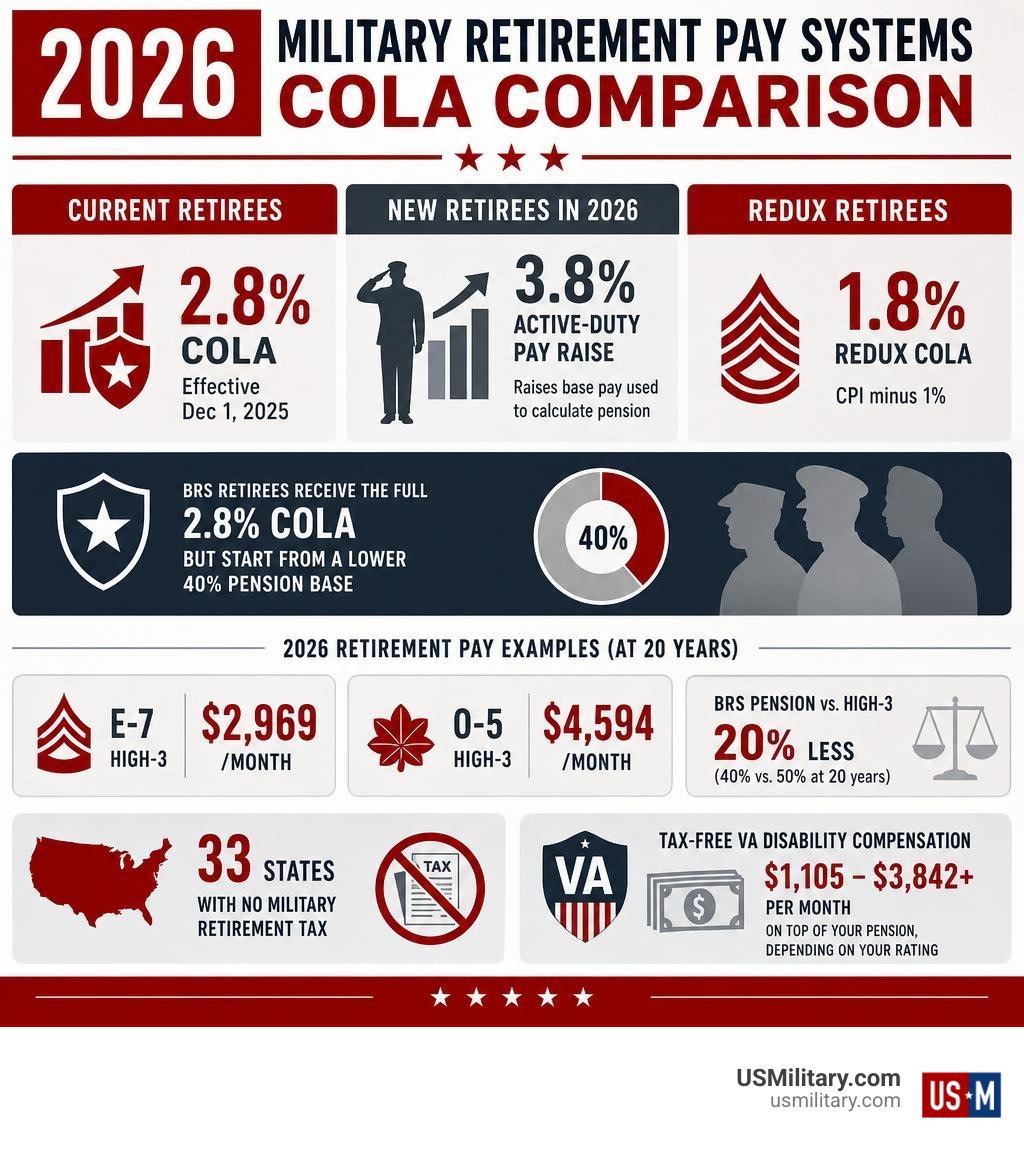
Quick Answer: 2026 Military Retirement Pay at a Glance
| What Changed | Details |
|---|---|
| COLA increase | 2.8% (effective December 1, 2025) |
| Active-duty pay raise | 3.8% (affects new retirees’ base pay) |
| REDUX COLA | 1.8% (CPI minus 1%) |
| E-7 at 20 years (High-3) | $2,969/month |
| O-5 at 20 years (High-3) | $4,594/month |
| BRS pension vs. High-3 | 20% less (40% vs. 50% at 20 years) |
| States with no military retirement tax | 33 states |
Here is what those numbers mean in practice:
- Current retirees receive a 2.8% COLA boost, automatically applied to existing checks
- New retirees in 2026 benefit from the 3.8% active-duty pay raise, which raises the base pay used to calculate their pension
- REDUX retirees receive a smaller 1.8% COLA instead of the full 2.8%
- BRS retirees receive the full 2.8% COLA, but start from a lower 40% pension base
Your total retirement income can also include tax-free VA disability compensation ($1,105 to $3,842+ per month) on top of your pension, depending on your rating.
I’m Larry Fowler, publisher of USMilitary.com since 2007 and a longtime advocate for helping veterans navigate their financial benefits — including the complexities of military retirement pay in 2026. Over nearly two decades, I’ve helped hundreds of thousands of service members cut through confusing pay rules to make smart retirement decisions. Read on for a complete breakdown of every system, calculation, and update that matters this year.
The 2026 COLA Increase and Its Immediate Impact
For millions of veterans, the annual Cost of Living Adjustment (COLA) is the ultimate shield against inflation. For 2026, military retirees received a 2.8% COLA increase, which officially went into effect on December 1, 2025. This boost ensures that our retired service members maintain their purchasing power as the costs of housing, groceries, and fuel fluctuate.
This 2.8% increase is tied directly to the Consumer Price Index for Urban Wage Earners and Clerical Workers (CPI-W). When consumer prices rise, our retirement checks follow suit. The Defense Finance and Accounting Service (DFAS) automatically applies this adjustment, meaning there is no paperwork or extra hassle required on your end.
If you want to keep up with the latest payment schedules and official administrative announcements, we highly recommend checking out the Retired Military & Annuitants portal.
How the 2.8% COLA Affects Your MILITARY RETIREMENT PAY 2026
So, how does a 2.8% increase translate into actual dollars? Let’s look at some real-world examples.
For a retired E-7 who completed 20 years of honorable service under the High-3 system, their base pension in 2026 is $2,969 per month (which translates to $35,628 per year). The 2.8% COLA increase means an extra $81 per month in their pocket compared to last year.
For a retired O-5 who retired with 20 years of service under the High-3 system, the 2026 pension is $4,594 per month ($55,128 per year), yielding a monthly increase of approximately $125.
If you are currently serving and want to see how the active-duty pay adjustments affect future retirement, you can explore the Military Pay Chart 2026 to map out your long-term career progression.
Prorated COLA Rules for 2025 Retirees
A common point of confusion is how the COLA applies to service members who retired in the middle of the previous calendar year. If you hung up your uniform in 2025, you might not receive the full 2.8% increase on your very first adjustment. Instead, the government applies a prorated COLA based on the quarter in which you retired:
- First Quarter (Jan–Mar 2025): You receive 75% of the full COLA.
- Second Quarter (Apr–Jun 2025): You receive 50% of the full COLA.
- Third Quarter (Jul–Sep 2025): You receive 25% of the full COLA.
- Fourth Quarter (Oct–Dec 2025): You receive 0% of the full COLA for the first cycle.
This proration only applies to your first year of retirement. In all subsequent years, you will receive the full, unprorated COLA adjustment automatically.
Comparing the Four Military Retirement Systems
To understand your MILITARY RETIREMENT PAY 2026, you must first identify which system governs your service. Your system is determined by your Date of Initial Entry into Military Service (DIEMS). The military has transitioned through several retirement frameworks over the decades, and each calculates benefits differently.
For a comprehensive high-level review of these systems, you can visit the official Retirement – Military Compensation and Financial Readiness resource page. Below is a quick comparison of how multipliers scale based on your years of service:
| Years of Service | Final Pay / High-3 Multiplier | BRS Multiplier | REDUX Multiplier |
|---|---|---|---|
| 20 Years | 50.0% | 40.0% | 40.0% |
| 25 Years | 62.5% | 50.0% | 57.5% |
| 30 Years | 75.0% | 60.0% | 75.0% |
| 40 Years | 100.0% | 80.0% | 100.0% |
Let’s take a closer look at each of these systems and how they operate in 2026.
The Legacy High-3 (High-36) Retirement System
The High-36 (commonly called High-3) system applies to service members who entered active duty after September 8, 1980, but before January 1, 2018. This remains the most common system for current retirees.
The math is simple: you receive 2.5% of your highest 36 months of basic pay for each year of service. If you retire at the 20-year mark, your pension multiplier is 50% (20 years x 2.5%). If you stay for 30 years, your multiplier climbs to 75%.
To check if you have met the minimum active duty requirements to secure this lifetime benefit, read our guide on Military Pension Eligibility 101.
The Blended Retirement System (BRS)
Introduced on January 1, 2018, the Blended Retirement System (BRS) is the modern standard. Anyone entering the military after this date is automatically enrolled, while those with fewer than 12 years of service in 2018 had the option to opt-in.
The BRS blends a traditional pension with a portable, civilian-style 401(k) benefit. Under BRS:
- The pension multiplier is reduced to 2.0% per year of service (meaning a 20-year career yields a 40% pension instead of 50%).
- The government provides an automatic 1% contribution to your Thrift Savings Plan (TSP) after 60 days of service.
- The government will match your TSP contributions up to an additional 4%, giving you a total of 5% in “free money” if you contribute at least 5% of your basic pay.
- At the mid-career mark (usually 12 years), you receive Continuation Pay, a one-time cash bonus ranging from 2.5 to 13 times your monthly basic pay in exchange for an additional 4-year service commitment.
- Retirees are also offered a Lump-Sum Option, allowing them to receive 25% or 50% of their future pension upfront in exchange for reduced monthly payments until they reach full Social Security age.
To weigh the pros and cons of these options, check out The Golden Years: Navigating Your Active Duty Retirement Options.
The REDUX Retirement System and Its COLA Penalty
The REDUX system was an alternative option offered to members who entered service between August 1, 1986, and December 31, 2017. At their 15-year mark, service members could elect to receive a $30,000 Career Status Bonus (CSB) in exchange for agreeing to retire under the REDUX pay system.
However, REDUX comes with two massive financial penalties:
- Reduced Multiplier: Your retirement pay is reduced by 1% for each year under 30 years of service. At 20 years, your multiplier is only 40% (compared to 50% under High-3).
- COLA Penalty: REDUX retirees receive a reduced COLA of CPI minus 1%. In 2026, while standard retirees receive a 2.8% boost, REDUX retirees receive only 1.8%.
While REDUX features a one-time “catch-up” adjustment at age 62 to realign the pension with inflation, the long-term reduction makes it the least lucrative system for most career veterans.
Step-by-Step Guide to Calculating Your MILITARY RETIREMENT PAY 2026
Calculating your pension doesn’t require an advanced degree in mathematics. It boils down to three variables: your retirement system’s multiplier, your total years of service, and your retired pay base (the average of your highest 36 months of basic pay).
For a detailed breakdown of the exact pay rates and ranks, we recommend viewing the 2026 Military Retirement Pay Chart by Rank (3.8% Raise) .

High-3 vs. BRS Pension Calculation Examples
To illustrate the difference between the two primary systems, let’s compare an E-7 and an O-5 retiring in 2026 with exactly 20 years of service.
Example 1: Enlisted E-7 with 20 Years of Service
- High-36 Monthly Average: $5,938
- High-3 Pension (50%): $2,969 per month ($35,628/year)
- BRS Pension (40%): $2,375 per month ($28,500/year)
- The BRS Difference: The BRS pension is $594 less per month, but the member likely has a substantial TSP balance built up from years of government matching.
Example 2: Officer O-5 with 20 Years of Service
- High-36 Monthly Average: $9,188
- High-3 Pension (50%): $4,594 per month ($55,128/year)
- BRS Pension (40%): $3,675 per month ($44,100/year)
For active duty members who want to see how promotional timelines impact these averages, take a look at our deep dive into All About 2026 Military Pay Chart for Enlisted Officers.
Estimating Reserve and National Guard Retirement Pay
Retirement for the Reserve and National Guard components is calculated using a point system rather than straight calendar years. To qualify for a non-regular retirement, you must accumulate at least 20 “good years” (years in which you earned at least 50 retirement points).
Your total points are divided by 360 to determine your “equivalent active duty service years.” This figure is then plugged into the standard High-3 or BRS formulas. While you can earn retirement eligibility early, Guard and Reserve pension payments typically do not begin until you reach age 60 (though certain active deployments can lower this age requirement).
If you are transitioning from active duty or trying to maximize your drill points, read The Crossover: Maximizing Your Retirement Benefits When Moving From Active Duty to Reserves.
Tax Implications and Disability Stacking for Retirees
Earning your pension is only half the battle; keeping it is the other. Your military retirement pay is subject to federal income taxes. However, the state-level tax treatment of your pension depends entirely on where you choose to establish residency.
As of 2026, 33 states do not tax military retirement pay at all, allowing veterans to keep a significantly larger portion of their hard-earned money.

Tax-Free VA Disability and the MILITARY RETIREMENT PAY 2026 Stack
One of the most valuable financial benefits available to military retirees is the ability to stack VA disability compensation on top of their retirement pay. VA disability pay is 100% tax-free at both the federal and state levels, and in 2026, these tax-free payments can range from $180 to more than $4,600 per month depending on your rating and dependents.
Historically, the “VA Waiver” required retirees to give up a dollar of their retirement pay for every dollar of disability pay they received. Fortunately, two programs allow eligible veterans to bypass this offset:
- Concurrent Retirement and Disability Pay (CRDP): If you have a VA disability rating of 50% or higher and retired under a regular (20-year) retirement, CRDP automatically restores your full retirement pay alongside your full VA disability pay.
- Combat-Related Special Compensation (CRSC): If your disabilities are directly tied to combat, combat training, or hazardous duty, you can apply for CRSC to receive a monthly tax-free payment that compensates for the VA waiver offset.
To see how these programs impact your bottom line, review the resource From E-1 to O-4: A Deep Dive Into Active Duty Military Pay and Benefits.
Survivor Benefit Plan (SBP) Annuities and COLA
The Survivor Benefit Plan (SBP) is an insurance-like program that allows retirees to pass on up to 55% of their retirement pay to an eligible spouse or child after their death.
The cost of SBP is typically 6.5% of your gross retired pay, which is deducted before federal income taxes are calculated. Best of all, SBP annuities receive the exact same annual COLA increases as standard retirement pay. Thanks to historic legislation, the SBP-DIC offset has been completely eliminated, meaning surviving spouses can receive both their full SBP annuity and their Dependency and Indemnity Compensation (DIC) from the VA without penalty.
Frequently Asked Questions About Military Retirement Pay
When will I see the 2026 COLA increase in my pay?
The 2.8% COLA increase took effect on December 1, 2025. Standard military retirees saw this adjustment in their December 31, 2025 payment. SBP annuitants saw their adjusted payments on January 2, 2026. For a complete look at the exact dates you will receive your money throughout the year, refer to the official Defense Finance and Accounting Service > RetiredMilitary > manage > payschedule calendar.
Can I change my retirement system from REDUX to High-3?
No. Once you make the choice to accept the $30,000 Career Status Bonus and retire under the REDUX system at your 15-year mark, that decision is legally binding and irrevocable. You cannot change your retirement system after you retire.
Does the 2026 COLA apply to my Thrift Savings Plan (TSP)?
No. The annual COLA only applies to defined-benefit pensions (like the High-3 and BRS monthly retired pay) and VA benefits. The TSP is a defined-contribution account. Your TSP balance grows based on your personal contributions, government matching, and market investment performance, not government inflation adjustments.
Conclusion
Navigating your MILITARY RETIREMENT PAY 2026 is all about understanding how the puzzle pieces fit together. Whether you are tracking the 2.8% COLA boost, planning a transition under the Blended Retirement System, or maximizing your tax-free VA disability stack, staying informed is the best way to secure your financial future.
At USMilitary.com, we are dedicated to helping our nation’s heroes transition smoothly into civilian life with the financial security they deserve. To explore your options further, we invite you to check out https://usmilitary.com/retirement-military-benefits/ or visit our main hub at https://usmilitary.com/ for up-to-date military news and resources. If you are looking for an inspiring read on leadership and resilience during your transition, consider picking up a copy of Dare to Live Greatly. Thank you for your service, and here’s to a prosperous retirement!
Free for Service Members & Veterans
Get the military benefits intel no one tells you about.
Weekly updates on VA benefits, pay changes, and money tips — free for service members and veterans.
No spam. Unsubscribe anytime. Your info is never shared.


