What Are the Air Force Ranks? A Quick Reference Guide

Air Force Ranks span from the entry-level Airman Basic (E-1) all the way up to General of the Air Force (five-star). Here is the full list at a glance:
Enlisted Ranks (E-1 to E-9):
| Pay Grade | Rank | Abbreviation |
|---|---|---|
| E-1 | Airman Basic | AB |
| E-2 | Airman | Amn |
| E-3 | Airman First Class | A1C |
| E-4 | Senior Airman | SrA |
| E-5 | Staff Sergeant | SSgt |
| E-6 | Technical Sergeant | TSgt |
| E-7 | Master Sergeant | MSgt |
| E-8 | Senior Master Sergeant | SMSgt |
| E-9 | Chief Master Sergeant | CMSgt |
Officer Ranks (O-1 to O-10):
| Pay Grade | Rank | Abbreviation |
|---|---|---|
| O-1 | Second Lieutenant | 2d Lt |
| O-2 | First Lieutenant | 1st Lt |
| O-3 | Captain | Capt |
| O-4 | Major | Maj |
| O-5 | Lieutenant Colonel | Lt Col |
| O-6 | Colonel | Col |
| O-7 | Brigadier General | Brig Gen |
| O-8 | Major General | Maj Gen |
| O-9 | Lieutenant General | Lt Gen |
| O-10 | General | Gen |
There is also a rare five-star rank — General of the Air Force — reserved for wartime only. Only one person has ever held it: Henry H. Arnold.
The Air Force splits its personnel into two main groups: enlisted airmen and commissioned officers. Each rank comes with its own pay grade, responsibilities, and promotion requirements. Understanding where each rank fits helps you plan a realistic military career path — or simply make sense of the structure if you’re researching from the outside.
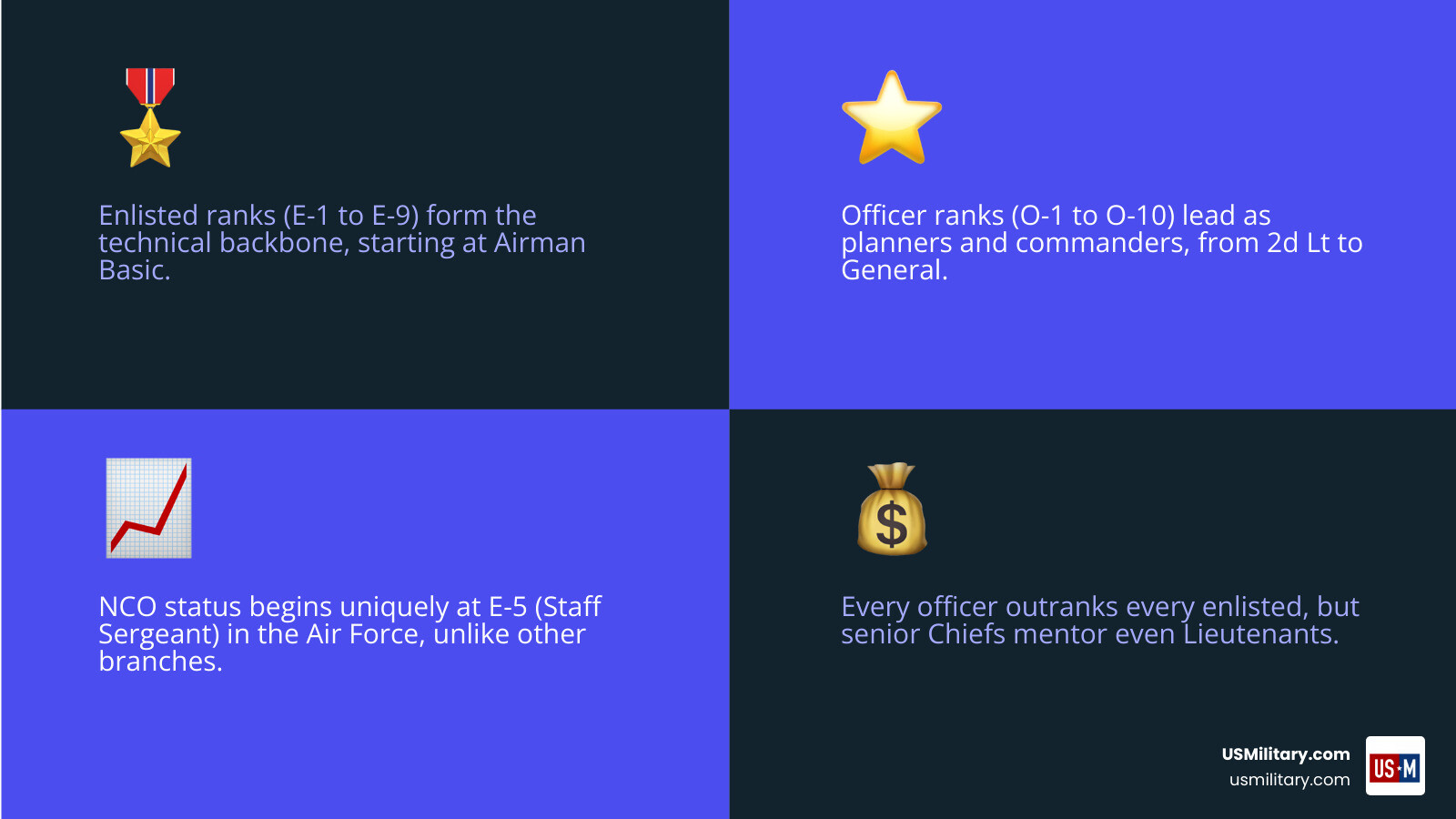
One thing that sets the Air Force apart: it is the only U.S. military branch where NCO (Noncommissioned Officer) status begins at E-5, not E-4 like in the Army, Marines, Navy, or Coast Guard.
I’m Larry Fowler, publisher of the USMilitary.com Network, and since 2007 I’ve helped hundreds of thousands of active-duty members, veterans, and recruits navigate Air Force Ranks and career progression. Let’s break down what each rank actually means for your career and your paycheck.
Understanding the Air Force Ranks Hierarchy
When we look at the Air Force Ranks structure in April 2026, we see a system designed for technical precision and clear leadership. Unlike the Army or Marines, which focus heavily on ground combat maneuvers, the Air Force is built around technical expertise, cyber warfare, and aerospace dominance. In fact, less than 25% of Air Force personnel are actually involved in aviation. The rest of us are the engine that keeps the mission flying, from Air Force Enlisted Weather Apprentice roles to high-level intelligence.
The hierarchy is divided into pay grades: “E” for Enlisted and “O” for Commissioned Officers. While the Enlisted Ranks focus on mastering a specific Air Force Specialty Code (AFSC), officers are the planners and commanders. A key part of the Air Force Recruiting Office mission is explaining that every officer outranks every enlisted member, regardless of years of service. However, a wise young Lieutenant quickly learns that a Chief Master Sergeant with 25 years of experience is a mentor worth their weight in gold.

Junior Enlisted: The Foundation of Air Force Ranks
The journey begins at the Tier 1 level: the Junior Enlisted Airmen (E-1 through E-4). These individuals are the “doers.”
- Airman Basic (E-1): The entry point. Interestingly, an AB wears no insignia at all. The blank sleeve represents a clean slate during Basic Military Training.
- Airman (E-2) & Airman First Class (E-3): These are the apprenticeship years. Most Airmen reach E-2 after six months and E-3 after another ten months. If you’re looking at Your Guide To Air Force Age Requirements, those with college credits or JROTC experience can sometimes enter as an E-3 on day one.
- Senior Airman (E-4): This is a critical transition rank. While still technically “Junior Enlisted,” E-4s are expected to begin showing leadership potential.
The 15% Rule: One of the most exciting opportunities for high-performers is the “Below-the-Zone” (BTZ) promotion. Unit commanders can promote up to 15% of exemplary Airmen First Class to Senior Airman six months ahead of the normal schedule. It’s the first real “race” in an Airman’s career.
Noncommissioned Officers (NCOs) and Leadership
In the Air Force, you don’t become an NCO until you hit E-5. This tier (E-5 and E-6) represents the “Craftsman” level.
- Staff Sergeant (E-5): On average, it takes more than 4 years of active-duty time to reach this rank. This is where you move from being a technician to a supervisor. You’ll likely be overseeing a team of junior Airmen, perhaps even managing Air Force Military Jobs Drone Pilots or maintenance crews.
- Technical Sergeant (E-6): Reaching Tech Sergeant takes an average of 12 years. These are the technical experts of the flight. They are often the ones who ensure that complex operations meet the Air Force’s exacting standards.
Promotions to these ranks are competitive and governed by the Weighted Airman Promotion System (WAPS). This system factors in your specialty knowledge tests, promotion fitness examinations, time-in-grade (TIG), time-in-service (TIS), and decorations.
The 10 Most Significant Air Force Ranks for Career Growth
As we move through 2026, certain ranks stand out as major milestones. These aren’t just pay raises; they are shifts in identity and authority.
- Senior Airman (E-4): The peak of the junior tier and the gateway to leadership.
- Staff Sergeant (E-5): The first NCO rank, where you first hold the power to sign performance reports.
- Master Sergeant (E-7): The first step into the Senior NCO (SNCO) tier.
- Chief Master Sergeant (E-9): The highest standard enlisted rank.
- Chief Master Sergeant of the Air Force (CMSAF): The single highest enlisted position in the entire branch.
- Captain (O-3): The most common rank for flight commanders and senior pilots.
- Major (O-4): The first Field Grade Officer rank, moving into mission planning.
- Colonel (O-6): The “Bird Colonel,” typically commanding an entire wing of 1,000 to 4,000 personnel.
- Brigadier General (O-7): The first “star” rank, where leadership becomes strategic rather than tactical.
- First Sergeant: Not a permanent rank, but a vital “lateral” position (indicated by a diamond on the chevron) responsible for the morale and welfare of the unit.
For those looking to jump from enlisted to officer, the Air Force Seeks Enlisted Nurse Commissioning Program Applicants is a fantastic example of how the Air Force invests in its people to help them climb these ranks.
Senior NCOs and the Pinnacle of Enlisted Air Force Ranks
The Senior NCO tier (E-7 to E-9) is where the “Top Three” reside. These leaders are the primary advisors to commanders.
- Master Sergeant (E-7): Reaching this level takes an average of 17 years. MSgts transition from being technical experts to being operational managers.
- Senior Master Sergeant (E-8): This rank is incredibly exclusive. By public law, only 2% of the enlisted workforce can hold the grade of E-8 at any time. It usually takes over 20 years of service to get here.
- Chief Master Sergeant (E-9): The “Chief.” Only 1% of the enlisted force can be E-9s. These individuals serve as Superintendents and advisors at the highest levels of the wing and major commands. It takes an average of 22 years to earn these stripes.
Special roles at this level include the Command Chief Master Sergeant, who serves as the senior enlisted advisor to a general, and the Chief Master Sergeant of the Air Force, who advises the Chief of Staff of the Air Force and the Secretary of the Air Force. You can see the distinct United States Air Force enlisted rank insignia – Wikipedia to understand how the “wreath” and “stars” change for these specific roles. Whether you are an Air Force Enlisted Weather Specialist or a mechanic, the Chief is your ultimate representative.
Officer Ranks, Pay Grades, and Promotion Timelines
Officers are the “management” of the Air Force. They are divided into three groups: Company Grade (O-1 to O-3), Field Grade (O-4 to O-6), and General Officers (O-7 to O-10).
Promotion for officers is generally “up or out.” Most officers promote to O-2 and O-3 automatically after two years at each previous grade. However, reaching Major (O-4) and beyond requires a competitive board process.
2025/2026 Monthly Base Pay Estimates
Note: These are base pay figures. Total compensation is much higher when adding housing (BAH) and subsistence (BAS) allowances.
| Pay Grade | < 2 Years Service | 6 Years Service | 20 Years Service |
|---|---|---|---|
| E-1 | $2,407.20 | $2,407.20 | $2,407.20 |
| E-5 | $3,100.00* | $3,850.00* | $4,534.00* |
| E-7 | $3,932.10 | $4,843.80 | $6,300.00* |
| O-1 | $4,200.00* | $5,300.00* | $5,300.00* |
| O-3 | $5,500.00* | $7,800.00* | $8,900.00* |
| O-6 | $8,200.00* | $9,100.00* | $13,500.00* |
*Estimates based on projected 2026 3.8% pay increases and 2025 tables.
If you are considering a commission, Talking To An Air Force Recruiter Ask The Right Questions is essential. You can enter through the Air Force Academy, ROTC at a civilian college, or Officer Training School (OTS) if you already have a degree.
How Air Force Ranks Compare to Other Branches
While the pay grades (E-1, O-3, etc.) are standardized across the Department of Defense, the titles and insignias vary wildly.
- NCO Status: As mentioned, the Air Force is unique because NCO status starts at E-5. In the U.S. Army Ranks, a Corporal (E-4) is already considered an NCO. In the Air Force, an E-4 is still a Senior Airman.
- Warrant Officers: Historically, the Air Force did away with Warrant Officers in the late 1950s. However, in a major 2024 shift, the Air Force began reintroducing Warrant Officers specifically for Cyber and IT specialties to retain high-level technical talent.
- Insignia: Air Force chevrons are “curved” and feature a star in the center, whereas Army chevrons are pointed and Marine insignias feature crossed rifles for NCOs.
Understanding these differences is helpful if you are trying to Your Air Force Journey Locate Recruiters In Your Area and deciding which branch fits your personality. The Air Force is often cited as having the highest “quality of life” and a more “business-like” atmosphere compared to the more traditional military branches.
Frequently Asked Questions about Air Force Ranks
What is the highest rank in the Air Force?
The highest active rank is General (O-10), a four-star position. However, the absolute highest rank is the five-star General of the Air Force. This rank is only used during massive wartime efforts to ensure American commanders have equal rank to foreign allies. Henry “Hap” Arnold is the only person to have ever held it.
How do promotions work in the Air Force?
For junior enlisted (E-1 to E-4), promotions are mostly based on time-in-service and meeting basic standards. For NCOs (E-5 and E-6), the Air Force uses the WAPS system. For Senior NCOs (E-7 to E-9) and Officers (O-4 to O-10), a Central Evaluation Board reviews the individual’s entire “record of performance.” Your Air Force Recruiter can explain the current points needed for your specific job.
What are the special senior enlisted ranks?
- First Sergeant: A “Diamond” wearer who handles unit discipline and welfare.
- Command Chief Master Sergeant: The top enlisted leader at a Wing or higher level.
- Chief Master Sergeant of the Air Force (CMSAF): The highest-ranking enlisted person in the branch.
- Senior Enlisted Advisor to the Chairman (SEAC): An E-9 who advises the Chairman of the Joint Chiefs of Staff.
Conclusion
Advancing through the Air Force Ranks is about more than just a bigger paycheck—though with the 2026 pay raises and benefits like 30 days of paid vacation and 100% tuition assistance, the financial perks are excellent. It is about growing as a leader and a technical expert in the world’s most advanced aerospace force.
Whether you are just starting as an Airman Basic or aiming for the stars as a General, the path is clearly defined. We at USMilitary.com are here to support that journey with resources on everything from VA loans to this Guide to military ranks in order. The Air Force is the backbone of our national defense, and its rank structure ensures that the best-trained, most capable individuals are always leading the way. Ready to start your journey? Reach out to a recruiter today and see where your wings can take you.
Free for Service Members & Veterans
Get the military benefits intel no one tells you about.
Weekly updates on VA benefits, pay changes, and money tips — free for service members and veterans.
No spam. Unsubscribe anytime. Your info is never shared.



More Than 90% Of Clients Have Increased Ratings! Why Settle For Less Than You Deserve? Expert Priority Help With Your VA Claim Today! Free Evaluation Call!
The mission of Veteran Services United is to support veterans in filing and winning disability claims by offering expert guidance, advocacy, and personalized assistance. Through dedicated service, Veteran Services United empowers veterans to secure the benefits they have earned, ensuring they receive the care and support they deserve.