Understanding the Age to Enlist in Marines
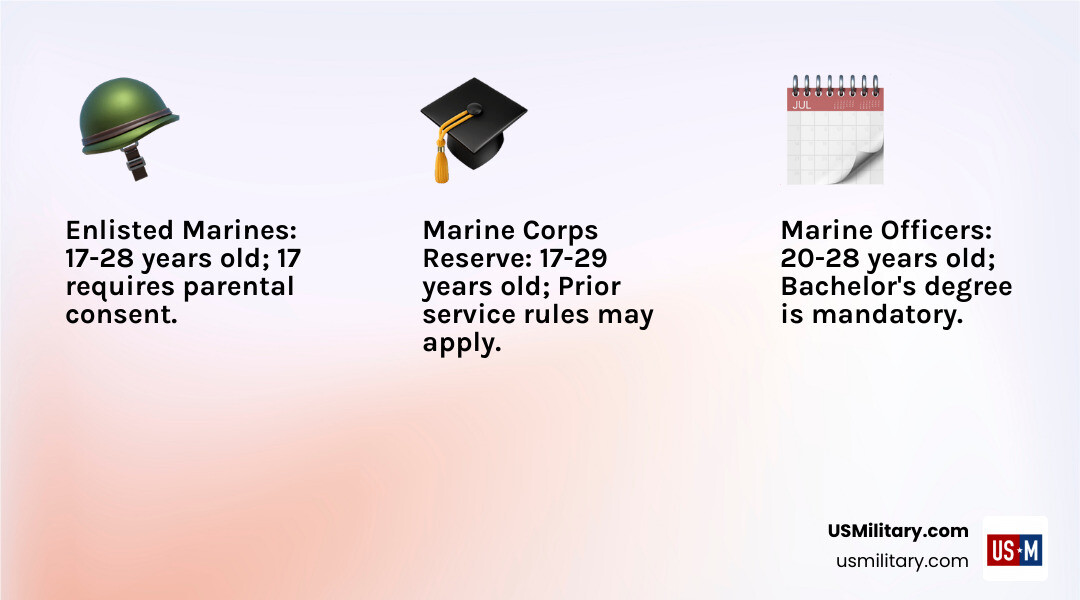
The age to enlist in marines ranges from 17 to 28 years old for enlisted personnel, with 17-year-olds requiring parental consent. For Marine Officers, candidates must be at least 20 years old and no older than 28. These are among the strictest age requirements across all U.S. military branches.
Quick Reference: Marine Corps Age Requirements
| Category | Minimum Age | Maximum Age | Special Notes |
|---|---|---|---|
| Enlisted Marines | 17 | 28 | Parental consent required at 17 |
| Marine Officers | 20 | 28 | Bachelor’s degree required |
| Marine Corps Reserve | 17 | 29 | Prior service limits differ |
Thinking about joining the U.S. Marine Corps? Your age is one of the first factors that determines your eligibility. The Marines maintain some of the most rigorous standards in the U.S. military, and age requirements are no exception.
Whether you’re a high school student considering your future or someone in your late twenties exploring a military career, understanding these age limits is critical. The Marine Corps offers two primary paths: enlisted service and officer commissioning, each with distinct age requirements.
While the standard age ranges are clearly defined, waivers may be available in certain circumstances. Prior military service can also affect how your age is calculated for eligibility purposes. The Marine Corps Reserve has slightly different age limits than active duty service.
In this guide, we’ll break down exactly what you need to know about age requirements for every path into the Marine Corps, including special programs like the Delayed Entry Program and how the Marines compare to other military branches.
Enlisted Marine Age Requirements

The path to becoming an enlisted Marine is demanding, focusing on physical ability, mental toughness, and commitment to service. It starts with meeting specific eligibility criteria, and age is one of the first factors a recruiter will review. Understanding these rules helps you know where you stand before you ever step into a recruiting office.
The Marine Corps is known for its elite fighting force, and it seeks individuals who can meet high standards from day one. Part of that is ensuring recruits are within an age range that matches the intensity of training and the needs of the service. The enlistment process includes meeting with a recruiter, taking the ASVAB, passing medical exams at MEPS, and finally taking the Oath of Enlistment.
What is the minimum age to enlist in the Marines?
To begin your journey as an enlisted Marine, you must be at least 17 years old. This is the same minimum age used across the U.S. military. However, if you are 17, you must have parental or legal guardian consent. A consent form is required, and your parent or guardian will need to review and sign the enlistment paperwork with you.
Many high school students who are 17 choose to start the enlistment process through the Delayed Entry Program (DEP). This allows you to sign an enlistment contract, reserve a spot, and often select a Military Occupational Specialty (MOS) while you finish high school. You typically will not ship to basic training until after you graduate and turn 18, unless your parents or guardians approve shipping at 17. This program can be a helpful way to plan ahead and create a smoother transition from high school to military service. Regardless of your exact age (as long as you are at least 17), the first step is contacting a Marine recruiter for up-to-date, personalized guidance.
Understanding the maximum age to enlist in the Marines
When it comes to the maximum age to enlist in marines, the Marine Corps has one of the strictest limits in the U.S. military. For active duty enlisted service, the standard maximum age is 28 years old. In practice, that means you generally need to be between 17 and 28 years old to enlist without needing an age waiver.
The relatively young maximum age is tied to the physical demands of Marine Corps service. The Corps is known for rigorous recruit training and physically challenging combat and support roles. The 13-week boot camp and follow-on training require a high level of endurance, strength, and resilience. By focusing on a younger age range, the Marine Corps aims to maintain a force that can handle these demands and develop over a full career if a Marine chooses to stay in.
It is also important to distinguish between law and service policy. Federal law allows for higher maximum enlistment ages in some situations, but each branch sets its own recruiting standards based on its mission and needs. The Marine Corps has chosen 28 as its standard operational limit, which is lower than many other branches that accept new recruits into their mid-thirties or beyond. This makes the age to enlist in marines especially important to understand if you are considering this branch and are in your mid- or late twenties.
Are Age Waivers Available for Enlisted Marines?
Yes, age waivers may be available for enlisted Marines, but they are not automatic and are reviewed individually. If you are older than the standard maximum age to enlist in marines (28 years old), you would need an approved age waiver to enlist.
These waivers are typically reserved for well-qualified applicants who bring valuable skills, experience, or backgrounds to the Marine Corps. The decision to grant a waiver is always based on the “needs of the Corps” at that time. Even if you meet all other eligibility standards, an age waiver might not be approved if there are enough younger, fully qualified applicants or if recruiting priorities do not support granting additional waivers.
A recruiter is the person who can best evaluate whether an age waiver is realistic in your case. They can review your test scores, physical fitness, education, work history, and any special skills you may have. If a waiver is pursued, you must still meet all other physical, mental, and moral standards. The process is competitive, and each part of your application is reviewed carefully.
Officer Commissioning Age Requirements

Becoming a Marine Officer is a unique path focused on leadership, strategic thinking, and guiding the Corps’ most valuable asset: its Marines. This track often requires a higher level of education, typically a bachelor’s degree, and involves different training programs like Officer Candidates School (OCS). Just like enlisted service, there are specific age requirements to commission as an officer, reflecting the long-term commitment and career progression inherent in officer roles.
What is the age requirement to become a commissioned Marine Officer?
To commission as a Marine Officer, you must be a United States citizen and meet specific age criteria. The minimum age to begin the commissioning process is generally 20 years old. This ensures that officer candidates have a certain level of maturity and life experience before undertaking leadership responsibilities.
The maximum age for commissioned officers in the Marine Corps is 28 years old. This means that, without a waiver, you should typically be between 20 and 28 when you commission. In addition to age, a crucial requirement for officers is the completion of a bachelor’s degree. You can start the process while working towards your degree, but you must have it before commissioning. Officer training programs, such as Officer Candidates School (OCS), Platoon Leaders Class (PLC), NROTC, or the Naval Academy, are designed to develop leadership skills and prepare you for the responsibilities of a Marine Officer.
It’s a demanding path, but one that offers immense rewards and opportunities for personal and professional growth. Meeting these age and educational requirements is the first step toward leading Marines.
Are there age waivers available for commissioning as a Marine Officer?
Yes, age waivers may also be available for commissioning as a Marine Officer, similar to enlisted waivers, but they are also granted on a case-by-case basis. If you are over the eligible Marine officer age of 28, you would need to explore the possibility of an age waiver.
These waivers are typically considered for individuals with exceptional qualifications, specialized skills, or prior military experience that the Marine Corps deems particularly valuable. Just like with enlisted waivers, the decision heavily relies on the “needs of the Corps” and the overall strength of your application. An outstanding academic record, leadership experience, or unique professional expertise could strengthen your case.
To discuss your personal qualifications and the potential for an age waiver, your best course of action is to contact a Marine Corps Officer Selection Officer (OSO). An OSO specializes in officer recruitment and can provide detailed information about the commissioning process, different officer programs, and the specific criteria for age waivers. They will help you understand if your background and aspirations align with the Corps’ current needs and guide you through the application process. While waivers are possible, they are not guaranteed, and the competition for officer slots is often intense.
Special Considerations for the Age to Enlist in Marines
While the standard age limits provide a clear framework, there are unique situations and entry paths that can affect how the age to enlist in marines is applied. These include prior service members, applicants interested in the Marine Corps Reserve, and high school students planning ahead through special programs.
How does prior military service affect the age requirements?
If you have prior military service, the standard age requirements for both enlisted and officer opportunities in the Marine Corps can sometimes be adjusted using what is often called a “prior service” calculation. In general terms, time already served on active duty may be subtracted from your current age to find an “effective age” for eligibility.
For example, if the maximum age for enlistment is 28, and you are 30 years old with two years of prior active duty service, your effective age for eligibility purposes may be considered 28 (30 minus 2). That can place you within the normal age window and reduce the likelihood that you will need an age waiver. Prior service Marines and veterans from other branches may benefit from this when re-enlisting or making an inter-service move to the Marine Corps.
However, if your effective age is still above the standard maximum, you may still need an age waiver. The specific rules and calculations can vary based on your type of prior service, your discharge status, and current Marine Corps needs. Because of this, it is essential to speak directly with a Marine recruiter. They can review your service record, calculate your effective age, and explain your options for re-enlistment, reserve service, or possible waiver requests.
What are the age requirements for joining the Marine Corps Reserve?
Joining the Marine Corps Reserve offers a way to serve part-time while maintaining a civilian job, attending college, or pursuing other goals. The age requirements for the Marine Corps Reserve are slightly different from active duty and give some applicants a bit more flexibility.
To enlist in the Marine Corps Reserve, you generally must be between 17 and 29 years old. As with active duty, 17-year-old applicants must have parental or guardian consent. This expanded upper age limit gives some individuals who are slightly older than the active duty maximum a path to earn the title of Marine.
Marine Corps Reservists usually drill one weekend per month and complete about two weeks of annual training each year. They can be called to active duty during wars, national emergencies, or other operations. For those with prior service, the age rules can be different, and prior service time may affect how eligibility is calculated.
For more detailed information on the Marine Corps Reserve, including current policies and opportunities, visit the official page: More info about the Marine Corps Reserve.
What is the age limit for the Delayed Entry Program (DEP)?
The Delayed Entry Program (DEP) is designed for applicants who meet initial eligibility criteria but are not ready to ship to recruit training right away. This is especially common for high school students who want to secure their future plans in the Marine Corps while they finish school.
The age rules for entering the DEP match the standard enlisted age to enlist in marines requirements. You must be at least 17 years old (with parental consent) and generally no older than 28. High school juniors and seniors often work with recruiters to join the DEP, sign their enlistment contracts, and lock in an MOS and ship date after graduation.
Being in the DEP can offer several benefits:
- Time to focus on physical preparation and learn more about Marine Corps life
- A reserved spot and planned ship date to recruit training
- A smoother transition from civilian life or high school into active service
If you meet the age requirements but need time before leaving for basic training, discuss the DEP with a Marine recruiter to see how it can fit into your timeline.
How Marine Corps Age Requirements Stand Out
The Marine Corps’ age requirements are often a point of discussion because they are noticeably stricter than those of other branches of the U.S. military. This difference reflects the Corps’ unique standards and its expeditionary mission.
When we compare the Marine Corps to its sister services, the distinction becomes clear:
- Air Force: Age limit typically 17 – 42
- Army: Age limit typically 17 – 35
- Coast Guard: Age limit typically 17 – 41
- Marine Corps: Age limit typically 17 – 28
- Navy: Age limit typically 17 – 41
- Space Force: Age limit typically 17 – 42
Among these, the Marine Corps has the youngest standard maximum age for many applicants at 28. The same upper limit applies to most officer candidates as well.
These limits are tied to the Marine Corps’ role as the nation’s expeditionary force in readiness. Marines are expected to deploy quickly, often to demanding environments, and maintain a high level of physical and mental readiness. By focusing on a younger age range, the Corps supports that mission and helps ensure that Marines have enough time in service to grow, advance, and take on leadership roles.
While age does not define an individual’s character or motivation, setting clear age brackets is one way the Marine Corps manages its overall force structure. For people who want to serve in the most age-restrictive branch, understanding these requirements early helps them make informed choices about timing and career planning.
Conclusion
Understanding the age to enlist in marines is an important first step for anyone considering this demanding and rewarding path. Knowing where you fit within the age rules can save you time and help you plan a realistic path into the Corps.
To recap the key points:
- For enlisted Marines, the standard age range is 17 to 28 years old, with parental consent required at 17.
- For commissioned Marine Officers, you generally must be at least 20 and no older than 28 at the time of commissioning, and you need a bachelor’s degree.
- The Marine Corps Reserve provides a slightly broader window, usually accepting recruits between 17 and 29 years old.
Age waivers can be possible for both enlisted and officer applicants, especially for those with strong qualifications or prior military experience, but they are never guaranteed and always depend on the needs of the Corps. Prior service may also allow part of your active duty time to be counted in a way that can extend your eligibility.
Because policies can change and every applicant’s situation is different, speaking directly with a Marine recruiter is the most reliable way to confirm your options. They can explain current age limits, check whether a waiver is realistic, and walk you through each step of the enlistment or commissioning process.
For a broader look at age limits across all branches of the U.S. military, visit our detailed guide: More info about age limits to join the military.
Free for Service Members & Veterans
Get the military benefits intel no one tells you about.
Weekly updates on VA benefits, pay changes, and money tips — free for service members and veterans.
No spam. Unsubscribe anytime. Your info is never shared.


