
What are the military branches of the United States? Here’s the quick answer:
| Branch | Domain | Founded |
|---|---|---|
| Army | Land | June 14, 1775 |
| Navy | Sea | October 13, 1775 |
| Marine Corps | Amphibious (land & sea) | November 10, 1775 |
| Coast Guard | Maritime law & rescue | August 4, 1790 |
| Air Force | Air | September 18, 1947 |
| Space Force | Space | December 20, 2019 |
The U.S. Armed Forces comprise six branches, each with its own mission, culture, and career paths. Together, they protect the country on land, at sea, in the air, and now in space — with around 1.3 million active-duty service members and nearly 800,000 in reserve.
Whether you’re thinking about enlisting, exploring career options, or just trying to understand how the military is organized, knowing the difference between each branch is the right place to start.
I’m Larry Fowler, publisher of USMilitary.com, and since 2007, I’ve helped hundreds of thousands of active-duty members, veterans, and recruits navigate the military branches and find the right path for their service goals. In this guide, I’ll break down everything you need to know in plain, simple terms.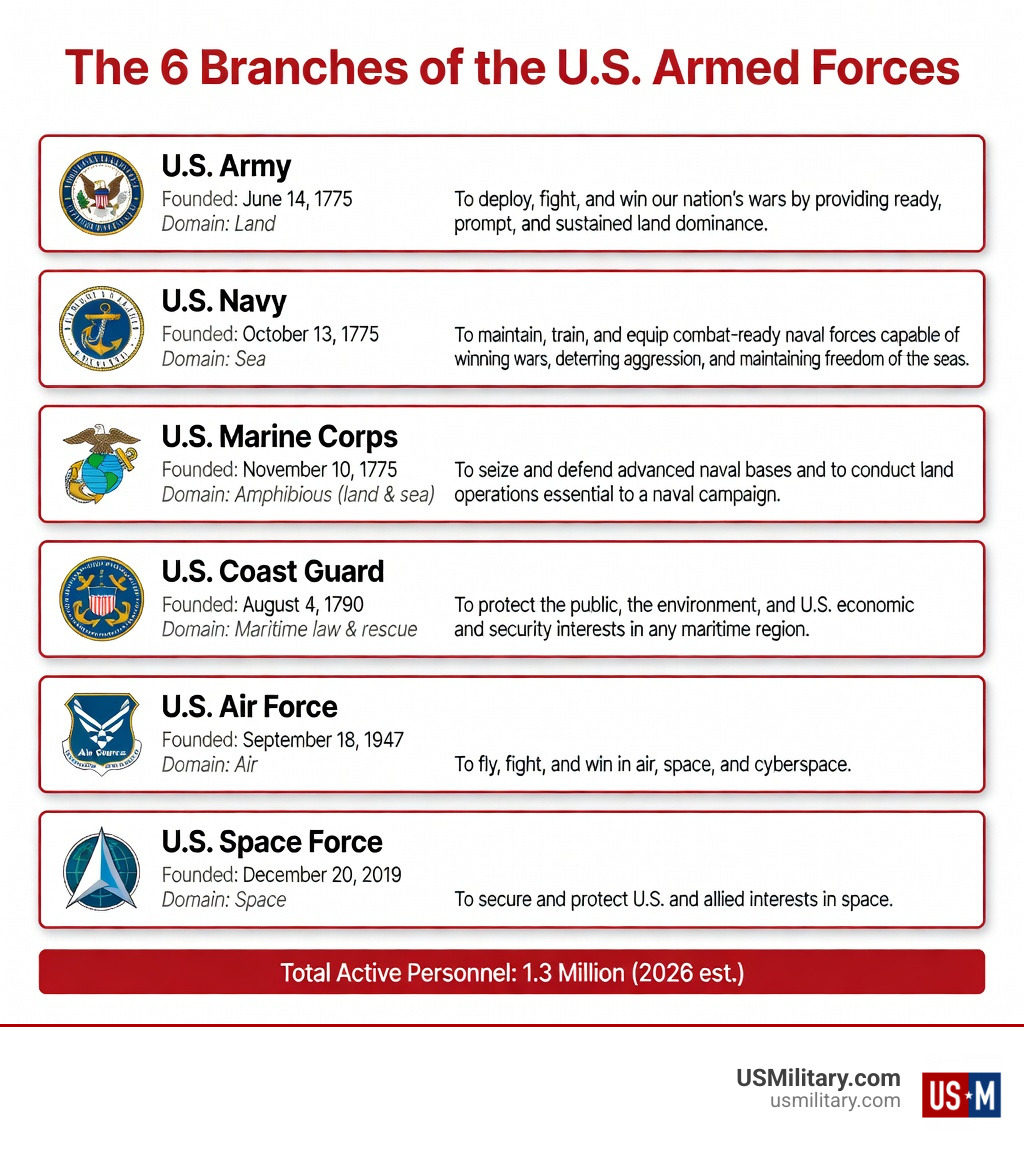
Understanding What Are the Military Branches
When we talk about the U.S. military, we are referring to a massive organization—the world’s largest “company,” if you will—with over 2 million civilian and military employees. But it isn’t just one giant block of people. It is divided into six distinct branches, each with a specific statutory role and domain.
The history of the U.S. military dates back to the nation’s founding. In fact, the Army, Navy, and Marine Corps were all established in 1775, before the Declaration of Independence was even signed! Over the centuries, these services have evolved. The Air Force was originally part of the Army before becoming its own branch in 1947, and the Space Force was spun off from the Air Force as recently as 2019.
To understand what the military branches are today, we have to look at their missions. While they all share the goal of national defense, their “office” might be a muddy trench, a nuclear-powered submarine, or a high-tech satellite control center.
What are the military branches’ primary missions?
Every branch has a specific job. If you’re trying to figure out which military branch you should join, understanding these missions is step one.
- U.S. Army: The Army is the oldest and largest branch. Its primary mission is land combat. When the nation needs to seize and hold territory, the Army sends in the Soldiers. Interestingly, the Army also has a significant water presence; they have “Army mariners” who operate a fleet of watercraft for logistics and transport.
- U.S. Navy: The Navy’s domain is the sea. They protect international waterways, maintain sea power, and provide “floating runways” via aircraft carriers, enabling the U.S. to project power anywhere in the world.
- U.S. Marine Corps: Often called the world’s fiercest warriors, the Marines specialize in amphibious operations. While they are technically part of the Department of the Navy, they are a separate branch. They are the “first to fight,” capable of attacking from the sea to secure a beachhead.
- U.S. Air Force: The Air Force focuses on air superiority, global reach, and rapid response. They fly everything from fighter jets to massive cargo planes and are responsible for the nation’s land-based nuclear missiles.
- U.S. Space Force: The newest branch organizes, trains, and equips “Guardians” to conduct global space operations. They protect U.S. and allied interests in space and provide vital satellite capabilities (like GPS) that all other branches rely on.
- U.S. Coast Guard: The Coast Guard is unique. It is both a military branch and a federal law enforcement agency. Their mission involves maritime law, search and rescue, and the security of our nation’s coasts and waterways.
How to choose what are the military branches for your career?
Choosing a branch is a big decision. We often tell people to start with a skills assessment. Do you want to work with your hands on heavy machinery? The Army or Marines might be for you. Do you love high-tech computers and data? The Air Force or Space Force could be the winner.
When you look at what-is-the-right-branch-of-the-military-for-you/, consider your personal goals. Some branches offer more travel (Navy), while others might offer more stability in certain technical roles. Each branch has its own culture—the Marines are known for their intense “warrior” ethos, while the Air Force is often viewed as more “corporate” or technical.
Service commitment is also a factor. Most active-duty contracts are for 4 years, but some specialized roles may require longer terms. You should also check which military branch offers the highest cash recruitment bonuses in 2026, as these incentives can change based on each service’s needs.
Leadership and Command Structure
The U.S. military operates under strict civilian control, a cornerstone of American democracy. This ensures that the military remains an instrument of the people’s will.
At the very top is the Commander-in-Chief, the President of the United States. The President has the final authority over all military decisions. Working directly under the President is the Secretary of Defense (SECDEF), who leads the Department of Defense (DoD).
Five of the six branches—the Army, Navy, Marine Corps, Air Force, and Space Force—reside within the DoD. The Coast Guard is the exception; it normally operates under the Department of Homeland Security (DHS) during peacetime. However, during a time of war or at the President’s direction, the Coast Guard can be transferred to the Department of the Navy.
To coordinate all these moving parts, we have the Joint Chiefs of Staff. This is a body of senior uniformed leaders who advise the President and SECDEF. While they don’t have direct operational command of the forces in the field, they are responsible for the readiness and planning of their respective branches.
Service Components and Special Operations
When asking about the military branches, it’s important to realize that each branch is divided into distinct “components.” You aren’t just “in the military”; you are either Active Duty, in the Reserves, or in the National Guard.
- Active Duty: Full-time service members. It is their 24/7 job. There are currently about 1.3 million active-duty personnel, ranking the U.S. third globally in terms of manpower.
- Reserves: Reservists typically serve “one weekend a month and two weeks a year.” They have civilian jobs but train regularly so they can be “activated” if the country needs more boots on the ground. There are nearly 800,000 reserve personnel across the branches.
- National Guard: It’s a bit different. It consists of the Army National Guard and the Air National Guard. They have a dual mission: they can be called up by their State Governor for local emergencies (like floods or civil unrest) or by the President for federal missions. If you’re comparing options, check out our guide on army-reserve-vs-national-guard/ or the-basics-of-the-national-guard/.
Elite Units: The Special Forces
Within these branches are elite groups that receive specialized training for high-risk missions. These are often the “household names” of the military:
- Army Green Berets & Rangers: Experts in unconventional warfare and direct action.
- Navy SEALs: Sea, Air, and Land teams known for some of the most difficult training in the world.
- Marine Raiders: The Marine Corps’ contribution to special operations.
- Air Force Special Warfare: Airmen who specialize in combat rescue and controlling air power from the ground.
Global Presence and Service Benefits
The U.S. military isn’t just stationed at home. We operate in more than 100 countries with approximately 800 military bases worldwide. Whether in Germany, Japan, South Korea, or Bahrain, American service members are stationed around the globe to maintain stability and protect U.S. interests.
Joining the military is a significant commitment, but it comes with world-class benefits that start the moment you put on the uniform.
- Education: Through the GI Bill and Tuition Assistance, the military can pay for your college degree or vocational training.
- Healthcare: Service members and their families have access to comprehensive healthcare.
- VA Benefits: After service, veterans can access VA home loans, disability compensation, and specialized healthcare. At USMilitary.com, we provide extensive resources on VA disability information to help you get the support you earned.
- Competitive Pay: While starting pay is modest, when you add in housing allowances and food stipends, the total compensation package is very competitive.
If you are ready to take the next step, you can sign up now to speak with a recruiter and explore your options.
Frequently Asked Questions about the Military
Which is the newest military branch?
The U.S. Space Force is the newest branch of the U.S. military. It was signed into law on December 20, 2019. It is the first new military service created since the Air Force was established in 1947.
Is the Coast Guard part of the Department of Defense?
No, the Coast Guard is part of the Department of Homeland Security during peacetime. However, it is a recognized military branch at all times and can be transferred to the Department of the Navy during wartime.
What is the difference between the Air Force and the Space Force?
While the Air Force defends the nation in the air (the atmosphere), the Space Force protects U.S. interests in space (above the atmosphere). The Space Force took over many missions previously handled by Air Force Space Command, including satellite operations and space debris tracking.
Conclusion
Understanding the military branches is the first step in appreciating the complexity and dedication of the U.S. Armed Forces. From the Soldiers on the ground to the Guardians in space, each branch plays a vital role in our national security.
The legacy of service in this country is long and proud. If you’re looking to join a branch of the military, know that you are considering a path that offers unique challenges, lifelong benefits, and the chance to be part of something much larger than yourself. We are here to support you every step of the way—from your first day of recruitment to your transition back into civilian life as a veteran.
Free for Service Members & Veterans
Get the military benefits intel no one tells you about.
Weekly updates on VA benefits, pay changes, and money tips — free for service members and veterans.
No spam. Unsubscribe anytime. Your info is never shared.


