Understanding Why the Navy Unveiled the AIM-424 MALICE Missile

The U.S. Navy has officially introduced its newest air-to-air weapon: the AIM-424 “Malice”. Developed by Raytheon, this long-range interceptor is built to destroy hostile aircraft at distances exceeding 250 nautical miles (463 kilometers).
Here are the key facts you need to know:
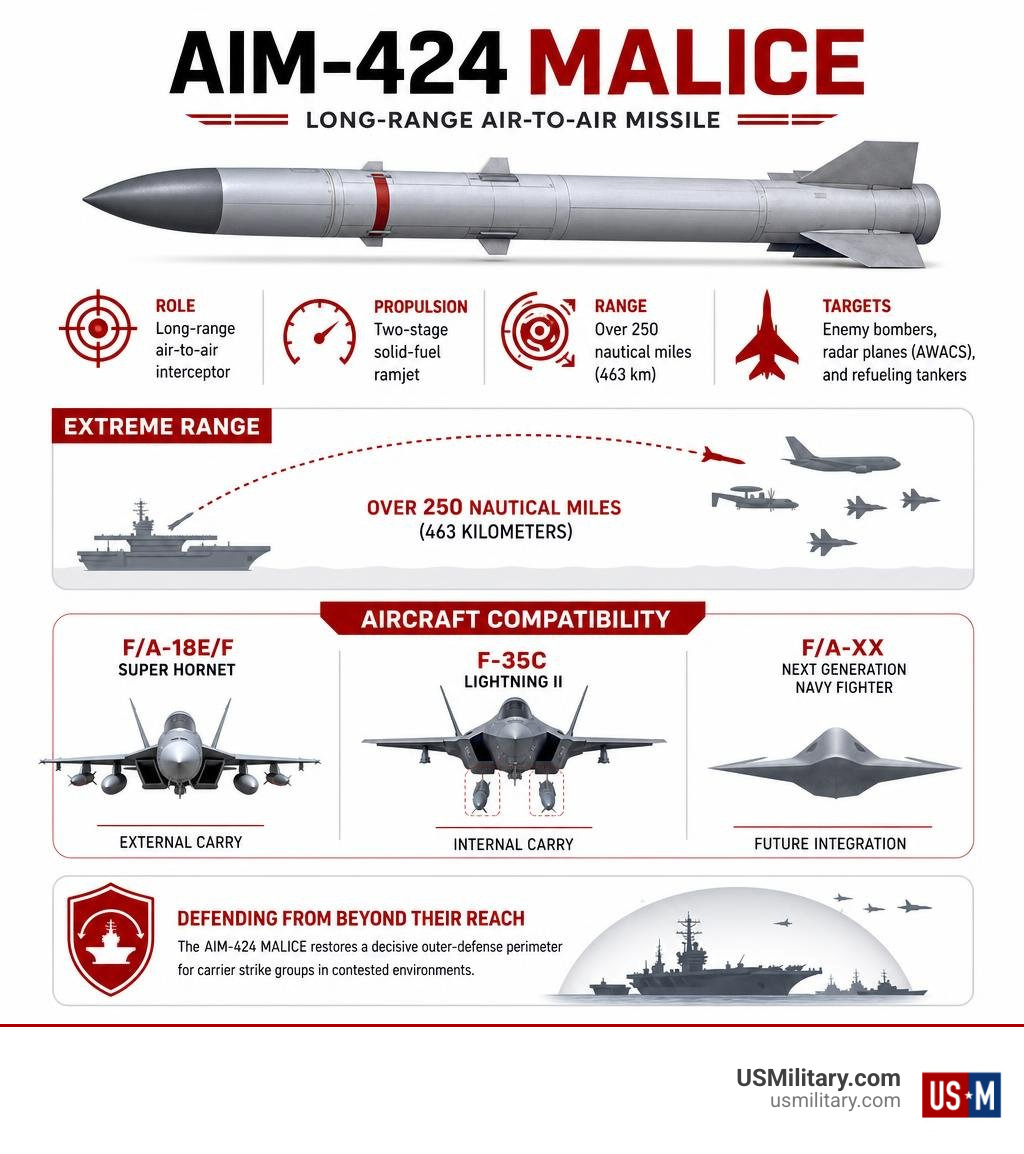
- Extreme Reach: The missile flies over 250 nautical miles using a two-stage propulsion system with a solid-fuel ramjet.
- Multi-Jet Compatibility: It mounts externally on the F/A-18E/F Super Hornet and fits internally inside the stealth weapons bay of the F-35C Lightning II, with future integration planned for the F/A-XX.
- High-Value Target Focus: It is designed to take out enemy bombers, radar planes (AWACS), and refueling tankers before they can threaten American aircraft carriers.
As the Navy unveils ‘MALICE’ missile built to strike enemy aircraft from extreme range, it restores a decisive outer-defense perimeter for carrier strike groups in contested regions like the Indo-Pacific.
I’m Larry Fowler, publisher of the USMilitary.com Network since 2007, where I help future recruits, active personnel, and veterans understand major defense milestones like when the Navy unveils ‘MALICE’ missile built to strike enemy aircraft from extreme range. For nearly two decades, I have analyzed tactical weapon systems to show our community how new technology impacts everyday service members.
Related content about Navy unveils ‘MALICE’ missile built to strike enemy aircraft from extreme range:
- What is the Army new helicopter S-97 Raider
- How Massive is the US Military
- What is the Department of War
Navy Unveils ‘MALICE’ Missile Built to Strike Enemy Aircraft from Extreme Range: Overview and Origins
The public introduction of the AIM-424 Long-Range Air-to-Air Missile (LRAAM), officially nicknamed “Malice,” signals a significant shift in American naval aviation doctrine. For decades, the fleet relied heavily on medium-range engagement envelopes dominated by variants of the AIM-120 AMRAAM. However, expanding operational theaters and advancing near-peer capabilities made an ultra-long-range interceptor necessary.
Developed quietly by Raytheon’s Advanced Technology division for nearly a decade, the AIM-424 was formalized before the defense aerospace community as detailed in breaking defense coverage of the Malice missile reveal. The program modernizes the classic Outer Air Battle concept, originally pioneered during the Cold War by the F-14 Tomcat and the AIM-54 Phoenix missile, which retired in 2004. The modern battlefield demands intercepting hostile platforms far beyond the horizon before they can unleash high-speed anti-ship weapons against carrier strike groups.
Navy Unveils ‘MALICE’ Missile Built to Strike Enemy Aircraft from Extreme Range at Tailhook 2026
The weapon made its formal public debut at the Tailhook Naval Aviation Symposium in Reno, Nevada, on August 22, 2026. Prior to this event, defense observers caught glimpses of the system during developmental captive-carry flight tests. Aircraft from Air Test and Evaluation Squadron 23 (VX-23), operating out of Naval Air Station Patuxent River, conducted extensive trials carrying CATM-424 (Captive Air Training Missile) units throughout April and August 2026.
These test flights provided the public with initial visual evidence of the missile mounted on carrier strike fighters. For our service members tracking everything you need to know about current military deployments and equipment, the transition from a classified development program to an open fleet asset demonstrates how rapidly tactical doctrine is shifting to meet Pacific operational challenges.
Engineering Architecture and Stated Flight Performance
The physical and propulsion architecture of the AIM-424 Malice reflects significant engineering refinement:
- Stated Operational Range: In excess of 250 nautical miles (approx. 463 km).
- Length: 13.5 feet (4.11 meters).
- Diameter: 13.5 inches (0.34 meters).
- Launch Mass: Approximately 1,500 pounds (680 kg).
- Warhead: High-explosive blast-fragmentation.
- Propulsion System: Two-stage propulsion architecture featuring a solid-propellant boost motor coupled with a solid-fuel dual-mode ramjet sustainer.
The missile incorporates aerodynamic body strakes along its fuselage to balance lift, mass, and aerodynamic drag. The dual-mode ramjet maintains supersonic velocity into the terminal engagement phase, ensuring the weapon retains sufficient kinetic energy to defeat evasive targets at extreme distances.
Multi-Platform Integration: 4th, 5th, and 6th Generation Fighters
The Navy prioritized cross-generational backward and forward compatibility for the AIM-424. As highlighted in detailed analysis of the AIM-424 LRAAM, the weapon integrates across current operational carrier wings and future combat airframes.
- F/A-18E/F Super Hornet: Serves as the primary heavy-ordnance strike platform, capable of carrying up to four AIM-424 missiles on heavy-duty underwing stations alongside standard AIM-120 AMRAAMs and AIM-9X Sidewinders.
- F-35C Lightning II: Operates as the carrier fleet’s premier 5th-generation stealth platform, fielding the missile within its internal weapons bays to preserve low-observable profiles.
- F/A-XX & Next-Generation Systems: Designed from inception to equip planned 6th-generation manned carrier fighters and high-performance collaborative combat aircraft (CCA).
| Missile System | Operational Range | Length | Body Diameter | Launch Weight | Internal Stealth Fit |
|---|---|---|---|---|---|
| AIM-424 Malice | >250 nm (463 km) | 13.5 ft (4.11 m) | 13.5 in (0.34 m) | ~1,500 lbs (680 kg) | Yes (F-35C Bay) |
| AIM-174B Gunslinger | >200 nm (370 km) | 15.5–16.5 ft (5.0 m) | 13.5 in (0.34 m) | ~1,900 lbs (861 kg) | No (External Only) |
| AIM-120D AMRAAM | ~86 nm (160 km) | 12.0 ft (3.65 m) | 7.0 in (0.18 m) | ~335 lbs (152 kg) | Yes (Standard Fit) |
Internal Weapons Bay Fit on Stealth Aircraft
A major engineering milestone of the AIM-424 is its compact aerodynamic surface profile. With a wingspan of only 26.2 inches (0.67 meters) and folding control fins, the missile fits cleanly inside the internal weapons bay of the F-35C Lightning II.
Carrying the missile internally allows the F-35C to maintain its radar-evading stealth profile while penetrating contested airspace. Internal bay fit checks conducted in August 2026 confirmed that an F-35C can carry an AIM-424 alongside a medium-range AIM-120 AMRAAM, giving stealth pilots layered kinetic options without sacrificing low observability.

How the AIM-424 Compares to the Interim AIM-174B Gunslinger
In 2024, the Navy introduced the AIM-174B Gunslinger—an air-launched adaptation of the shipboard Standard Missile 6 (SM-6)—to quickly provide carrier wings with extended standoff reach. While the AIM-174B met an immediate operational need, its ship-defense heritage made it heavy (roughly 1,900 pounds) and long (15.5 to 16.5 feet). These dimensions limited it to external carriage on the F/A-18E/F Super Hornet.
By contrast, the AIM-424 is a purpose-built air-to-air interceptor. It is 2 feet shorter and 400 pounds lighter than the AIM-174B, while extending operational range beyond 250 nautical miles. When defense analysts study how strong is the US military, the transition from heavy interim modifications like the AIM-174B to optimized munitions like the AIM-424 highlights the nation’s ability to refine and modernize its front-line combat systems.
Strategic Role in the Indo-Pacific: Disruption of Adversary Kill Chains
In maritime environments across the Western Pacific, carrier strike groups face sophisticated Anti-Access/Area-Denial (A2/AD) networks. Adversaries have fielded long-range air-to-air weapons, such as China’s PL-17 (reported range around 402 km / 217 nm) and Russia’s R-37M, designed to target American support aircraft from standoff ranges.
The AIM-424 Malice alters this tactical balance by outranging these threats and targeting the surveillance and strike assets that enable anti-ship missile attacks.
Operational Implications as Navy Unveils ‘MALICE’ Missile Built to Strike Enemy Aircraft from Extreme Range
Rather than focusing solely on intercepting incoming supersonic anti-ship missiles near the carrier, the Malice disrupts the adversary’s targeting sequence at the source:
- Eliminating Airborne Early Warning & Control (AEW&C): Target platforms like the Chinese KJ-500 are forced to operate hundreds of miles further back, blinding forward hostile fighters.
- Neutralizing Maritime Strike Bombers: Heavily armed strike bombers (such as the H-6J) can be destroyed before reaching release points for supersonic YJ-12 anti-ship cruise missiles.
- Degrading Aerial Tanker Tracks: Forcing refueling aircraft away from forward zones constrains the combat radius of enemy fighter sweeps.
- Countering Ballistic Targeting Networks: Neutralizing airborne targeting relays degrades the over-the-horizon guidance required by land-based anti-ship ballistic missiles like the DF-21D.
By striking the command, control, and sensing nodes of an enemy force, the weapon supports the broader doctrine of precision strikes: how tactical air control shapes the battlefield across large maritime theaters.
Targeting Network Architecture and Technical Challenges
Engaging targets at ranges exceeding 250 nautical miles introduces technical complexities:
- Off-Board Sensor Integration: Because a firing fighter’s onboard radar cannot maintain continuous track fidelity at extreme distances, the AIM-424 relies on the Naval Integrated Fire Control-Counter Air (NIFC-CA) network. Targeting tracks are updated mid-flight using data from E-2D Advanced Hawkeye radar planes, Aegis-equipped destroyers, and forward-deployed stealth aircraft via secure datalinks.
- Terminal Guidance and Electronic Protection: In its final flight phase, the missile uses an active radar seeker with advanced electronic counter-countermeasures (ECCM) to identify and track targets through dense electronic jamming.
- Energy Management: The solid-fuel dual-mode ramjet regulates fuel flow during flight, reserving peak kinetic energy for terminal maneuvers against evasive targets.
Broad Weapon Landscape, Procurement Timelines, and Magazine Depth
The AIM-424 Malice operates alongside other major U.S. air-to-air development programs:
- AIM-260 Joint Advanced Tactical Missile (JATM): A combined Air Force and Navy program designed as a direct physical replacement for the AIM-120 AMRAAM, maintaining the standard 7-inch diameter form factor while extending range past 193 kilometers.
- AIM-174B Gunslinger: Continues to serve as a heavy standoff weapon deployed on Super Hornets.
- AIM-424 Malice: Serves as the Navy’s primary heavy long-range interceptor, offering extended range and internal bay compatibility for the carrier air wing.
Managing multiple complex missile lines requires steady defense industrial base capacity. Expanding production lines for solid rocket motors, ramjet combustors, and microelectronics remains essential to maintaining deep weapons magazines on carrier decks. Parallel investments in uncrewed systems, as explored in the future of drone warfare, will see future Collaborative Combat Aircraft working alongside manned jets to carry and cue these long-range weapons.
Frequently Asked Questions About the AIM-424 Malice Missile
What is the confirmed operational range of the AIM-424 Malice missile?
The U.S. Navy confirms that the AIM-424 Malice has an operational engagement range in excess of 250 nautical miles (approximately 463 kilometers), powered by a two-stage propulsion system with a solid-fuel dual-mode ramjet.
Can the F-35C stealth fighter carry the AIM-424 internally?
Yes. Unlike the larger AIM-174B, the AIM-424 was engineered with a 13.5-foot length, a 13.5-inch diameter, and compact 26.2-inch control surfaces, allowing it to fit inside the internal weapons bays of the F-35C Lightning II alongside an AIM-120 AMRAAM.
How does the AIM-424 differ from the AIM-260 JATM and AIM-174B?
The AIM-260 JATM is a joint Air Force/Navy effort built to standard AMRAAM dimensions (7-inch diameter). The AIM-174B is a heavier (1,900 lb) air-launched adaptation of the shipboard SM-6 missile. The AIM-424 Malice is a purpose-built naval interceptor designed to maximize standoff range while retaining internal carriage compatibility on stealth carrier fighters.
Conclusion
The unveiling of the AIM-424 Malice represents a major advancement in naval air superiority. By pairing an operational range exceeding 250 nautical miles with internal stealth carriage and networked targeting integration, the U.S. Navy has reinforced the defensive and offensive capabilities of its carrier strike groups. As near-peer competitors expand their anti-access envelopes, the Malice ensures American naval aviators maintain standoff reach and tactical air dominance across the globe.
To learn more about serving in naval aviation or exploring careers across the armed forces, visit USMilitary.com and check out our guide to Navy jobs to discover current paths and technical specialties.
Free for Service Members & Veterans
Get the military benefits intel no one tells you about.
Weekly updates on VA benefits, pay changes, and money tips — free for service members and veterans.
No spam. Unsubscribe anytime. Your info is never shared.


