What a Day in the Life of a Navy SEAL Operator Really Looks Like
A day in the life of a Navy SEAL operator is nothing like a typical 9-to-5. Here’s a quick snapshot of what a non-deployed training day looks like:
| Time | Activity |
|---|---|
| 0500-0700 | Wake up, morning rituals, prep for PT |
| 0700-0900 | Team PT: calisthenics, 6-mile run or 1-3 mile ocean swim |
| 0900-1200 | Specialized training block (CQB, diving, marksmanship, etc.) |
| 1200-1300 | Lunch break |
| 1300-1700 | Afternoon training: mission rehearsal, shooting drills, tactics |
| 1800-2000 | Team debrief (often over beers) |
Every day is physically demanding. Every day includes learning. And no two days are exactly the same.
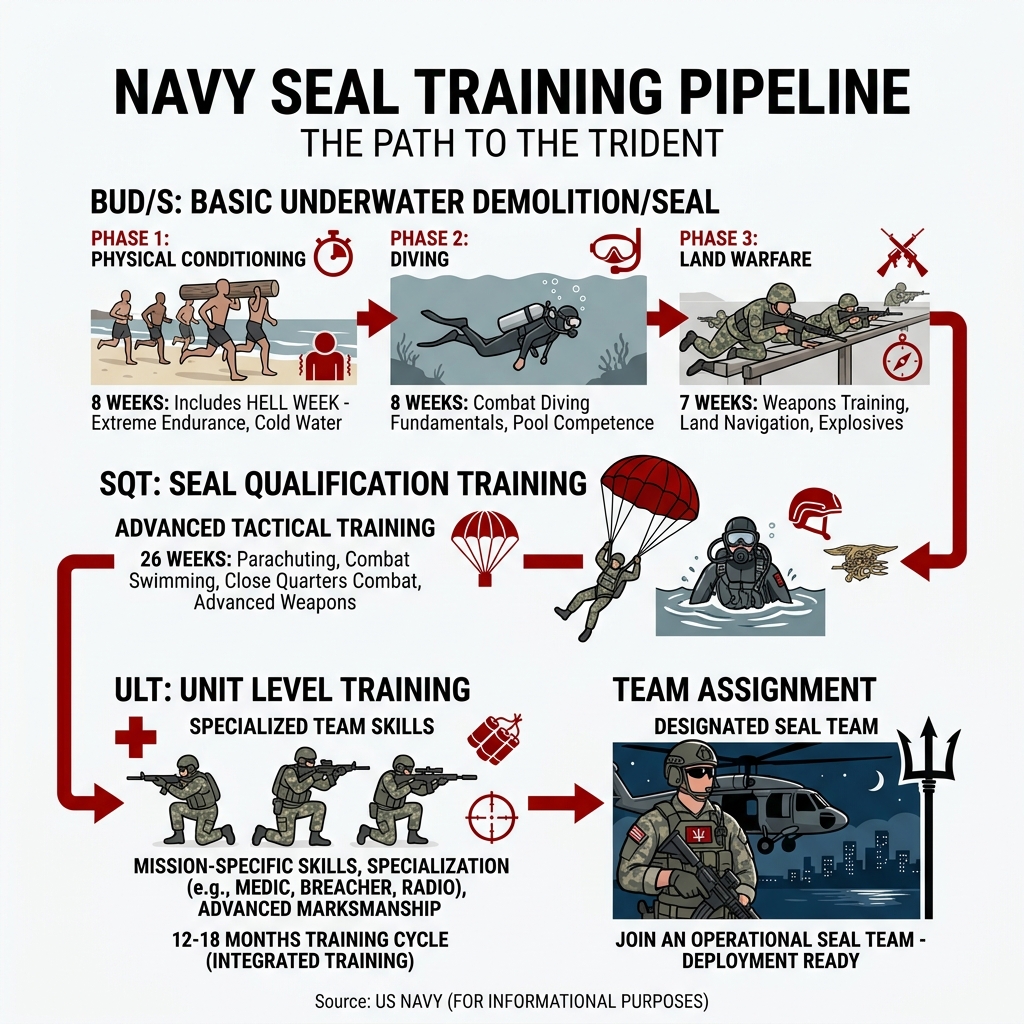
SEALs — short for Sea, Air, and Land — are among the most elite special operations forces in the U.S. military. When they’re not deployed, they follow a structured but intense training rhythm designed to keep them mission-ready at all times. Before ever deploying, a SEAL team works through a 12-18 month training cycle covering everything from close-quarter battle to combat diving to airborne operations.
The path to wearing the Trident is brutal. BUD/S classes often start with 175+ candidates but only around 25 graduate — a 75-80% attrition rate. Hell Week alone runs five and a half days with barely an hour of sleep per day. Those who make it through don’t get to rest — they just start the next phase of preparation.
I’m Larry Fowler, publisher of the USMilitary.com Network since 2007, and my work connecting active military members and veterans with reliable information about service life — including the intense daily demands of roles like Navy SEAL operator — gives me a grounded perspective on what a day in the life of a Navy SEAL operator actually involves. Read on for the full breakdown, from the 0500 wake-up to the late-night debrief.
A Day In The Life Of A Navy SEAL Operator helpful reading:
- Navy SEALs
- Navy SEAL Training
- SEAL Team Six
Morning Rituals and Physical Training (PT)
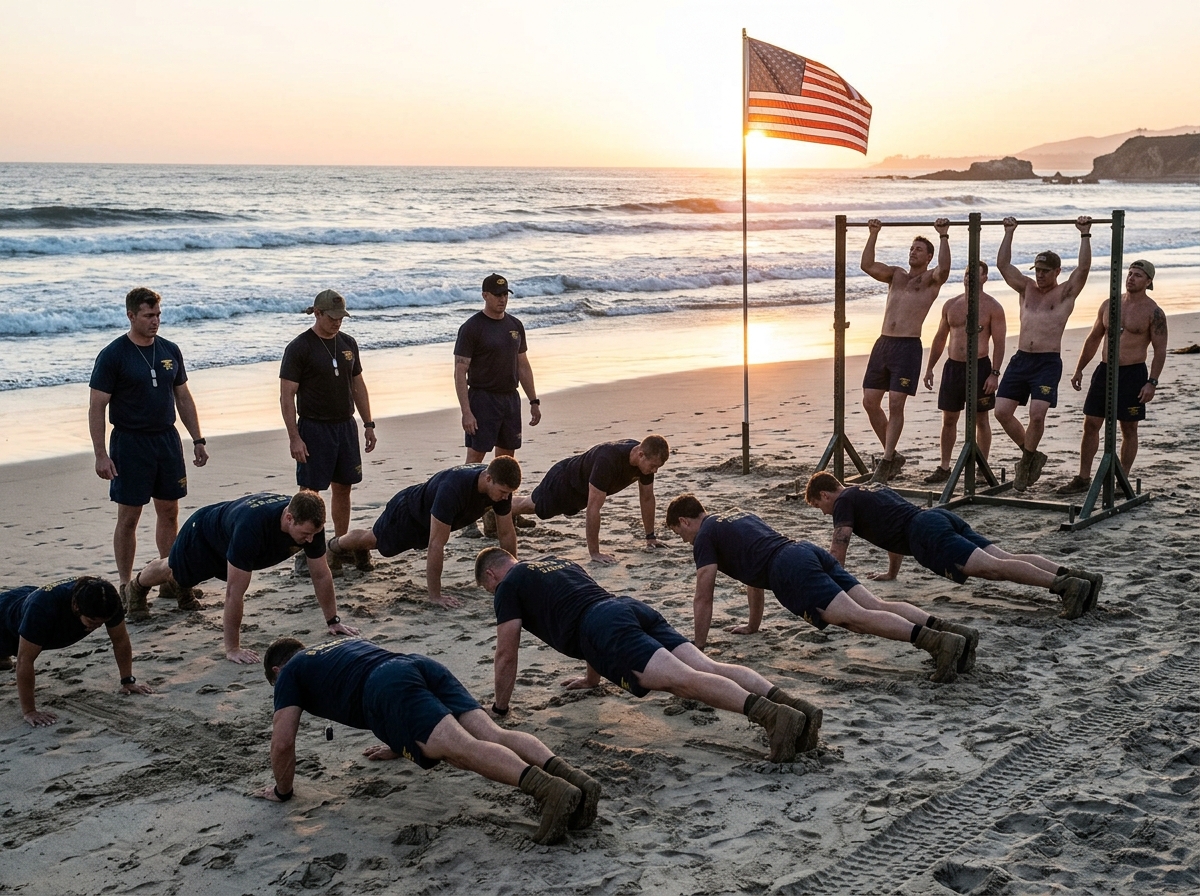
For a SEAL, the day doesn’t begin when they walk into the office; it begins the moment their eyes open, usually well before the sun has climbed over the horizon. While the rest of the world is hitting the snooze button, an operator is already engaging in a mental and physical “priming” process.
The official workday typically kicks off with Team PT at 0700. This isn’t your average gym session. Depending on the day and the team’s focus, this block usually involves high-intensity Navy SEAL workouts that push the limits of human endurance. We’re talking about a grueling mix of full-body calisthenics—think hundreds of push-ups, pull-ups, and air squats—followed immediately by a 6-mile timed run or a 1-to-3 mile ocean swim.
On the East Coast, that might mean braving the Atlantic’s chop; on the West Coast, it’s navigating the Pacific surf zone. The goal isn’t just “fitness” in the aesthetic sense. It’s about functional capacity—ensuring every man in the platoon can carry a teammate, a heavy ruck, or a weapon system for miles without breaking.
Morning Rituals: A Day In The Life Of A Navy SEAL Operator
While the 0700 PT is the official start, many operators utilize the 0500 to 0700 window for personal development. This “Integrated Warrior” approach, championed by veterans like Mark Divine, focuses on winning the internal battle before the external one begins.
A typical personal morning routine might include:
- The Positivity Process: Before even getting out of bed, operators visualize a successful day and affirm their commitment to the SEAL Ethos.
- Hydration and Breathing: Drinking a liter of water followed by 5 to 20 minutes of “Box Breathing” (inhale for 4, hold for 4, exhale for 4, hold for 4) to settle the nervous system.
- Dirt Diving the Day: This is a mental rehearsal. Just as they “dirt dive” a mission before executing it, they visualize every meeting, training evolution, and workout they will face that day.
- Ethos Review: Re-reading the SEAL Ethos to remind themselves that “the character and honor of my team is steadfast.”
The Workday Structure: A Day In The Life Of A Navy SEAL Operator
Once the sand is washed off and the morning PT is complete, the “work” part of the day begins. From 0900 to 1700, the focus shifts to the Navy SEAL training blocks required for the upcoming deployment.
These blocks are highly specialized. One week might be dedicated entirely to Combat Diving, where teams practice clandestine harbor infiltrations using Draeger rebreathers. The next week might be “Land Warfare” phase, involving long-range patrols and live-fire maneuvers.
Lunch usually occurs between 1200 and 1300. In the teams, lunch is rarely a leisurely affair. It’s about refueling. Many operators rely on high-quality, nutrient-dense options like Essential Provisions Field Fuel to maintain energy levels through the afternoon’s high-stress evolutions.
✉ Get updates like this in your inbox
Weekly VA benefit changes, pay updates, and money tips for service members, veterans, and military families. Free, no spam.
Afternoon Evolutions: A Day In The Life Of A Navy SEAL Operator
The afternoon is where the tactical rubber meets the road. If the morning was about physical capacity, the afternoon is about technical proficiency. This often involves:
- Close Quarter Battle (CQB): Clearing rooms in a “kill house” using live ammunition or “simunition.”
- Marksmanship: Extensive time on the range with SIG Sauer firearms, perfecting everything from rapid-fire pistol transitions to long-range sniper engagements.
- Mission Planning: Sitting in the “team room” to pore over satellite imagery, maps, and intelligence reports.
- Equipment Maintenance: A SEAL’s life depends on his gear. Hours are spent cleaning weapons, checking parachutes, testing radios, and prepping dive rigs.
Specialized Training, Monster Mashes, and Debriefs
Beyond the standard platoon training, individual operators are often sent to specialized schools to bring unique capabilities back to the team. A SEAL isn’t just a shooter; he might also be a medic, a lead climber, or a linguist.
Specialized Skills: A Day In The Life Of A Navy SEAL Operator
During a non-deployed cycle, an operator might spend weeks away from the team attending:
- SEAL Sniper School: Learning the art of concealment and long-distance precision.
- Jump Master School: Gaining the certification to lead High Altitude Low Opening (HALO) and High Altitude High Opening (HAHO) operations.
- Breacher Training: Mastering the use of explosives to gain entry into fortified structures.
- Language School: Spending months becoming fluent in a language relevant to their area of responsibility (AOR).
- Medical Training: SEAL Medics often spend time in civilian ERs or trauma centers to keep their life-saving skills sharp.
To support these missions, they utilize world-class tech, including SIG Sauer optics for precision targeting and advanced communication arrays that allow them to call in air support from anywhere on the globe.
The Monster Mash and Evening Debrief
Friday afternoons often culminate in what is known as a “Monster Mash.” This is a grueling, competitive event that tests everything the team has worked on during the week. A typical Monster Mash might look like this:
- A 2-mile ocean swim.
- A 6-mile run in soft sand while carrying a 200lb “Rescue Randy” dummy.
- An obstacle course run while wearing a gas mask.
- A medical station where the operator must assemble a radio and call in a “9-line” medevac while treating a simulated casualty.
- A final precision shot on the range.
Once the “Mash” is over, the team moves into the most critical part of the day: the Debrief. Usually starting around 1800, the platoon gathers—often over a few beers—to conduct an After Action Review (AAR). This is where egos are set aside. Teammates ruthlessly critique each other’s performance. “You were too slow on that entry,” or “You missed your radio check.” This culture of extreme accountability is why SEALs remain at the top of the food chain.
Work-Life Balance and Retired SEAL Perspectives
People often ask about the “work-life balance” in the teams. When deployed, there is no balance—it is 100% mission, 24/7. However, during the 12-to-18-month “work-up” phase at home, there is a semblance of a routine. Operators generally get home in time for dinner with their families, though “night ops” (training that starts at sunset and goes until 0300) frequently disrupt this.
Understanding Navy SEAL ranks is also key to understanding their daily rhythm. A junior SEAL (E-4 or E-5) spends more time on gear maintenance and “humping” heavy loads, while senior enlisted and officers spend more time in the planning room. Regardless of rank, the expectation is the same: be ready to go at a moment’s notice.
Retired Life: Jocko Willink and Mark Divine
Even after they hang up the uniform, many SEALs find it impossible to turn off the “operator” switch. Retired leaders like Jocko Willink have turned their military discipline into a blueprint for civilian success.
Jocko famously wakes up at 4:30 AM every single day—including weekends—to hit the gym. His philosophy of “Discipline Equals Freedom” means that by sticking to a rigorous schedule, he creates the time and mental space to run businesses, record podcasts, and train Brazilian Jiu-Jitsu (BJJ).
Similarly, Mark Divine’s SEALFIT program focuses on “Integrated Warrior Development,” teaching civilians how to use the same mental toughness and “Box Breathing” techniques that SEALs use to survive Hell Week. For these men, the “Day in the Life” isn’t a job—it’s a permanent state of being.
Frequently Asked Questions about Navy SEAL Daily Life
What time do Navy SEALs wake up?
While it varies by team and mission, most SEALs wake up between 0430 and 0530. This allows for personal reflection, meditation, or a “pre-workout” before the official Team PT begins at 0700.
How much does a Navy SEAL operator make per year?
A typical E-5 (Petty Officer 2nd Class) SEAL with four years of service can earn approximately $80,500 annually. This includes base pay plus specialized incentives like Dive Pay ($340/mo), Jump Pay ($225/mo), and Special Duty Assignment Pay ($450/mo).
What is a “Monster Mash” in SEAL training?
A Monster Mash is a high-intensity training triathlon (or “multathlon”) that combines physical endurance events—like swimming and running—with tactical skills like shooting, radio operation, and medical aid. It is designed to test an operator’s ability to perform complex tasks while physically exhausted.
Conclusion
At USMilitary.com, we recognize that the life of a Frogman is one of extreme sacrifice and unparalleled discipline. A day in the life of a Navy SEAL operator is a relentless pursuit of excellence, where “good enough” is never an option. From the early morning Box Breathing to the late-night tactical debriefs, every minute is spent honing the skills necessary to protect our nation in its most dangerous hours.
The legacy of the SEALs is built on mental toughness and the “Only Easy Day Was Yesterday” mindset. Whether you are an aspiring candidate or a civilian looking to inject more discipline into your own life, there is much to learn from the daily rhythm of these elite warriors.
For those who want to dive deeper into the history, requirements, and missions of the Teams, we invite you to explore our More info about Navy SEALs. Stay frosty.
Free for Service Members & Veterans
Get the military benefits intel no one tells you about.
Weekly updates on VA benefits, pay changes, and money tips — free for service members and veterans.
No spam. Unsubscribe anytime. Your info is never shared.


