America’s $500 Million Warship Blasting Across the Ocean at 47 mph — Here’s What You Need to Know
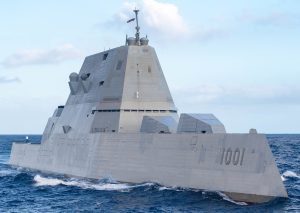
America’s $500 million warship blast across the ocean at 47 mph refers to the U.S. Navy’s Littoral Combat Ship (LCS), a fast, modern surface vessel with a top speed of around 47 mph (roughly 40+ knots) — making it one of the fastest warships afloat today.
Here’s the quick breakdown:
| Detail | Facts |
|---|---|
| Ship | Littoral Combat Ship (LCS) |
| Approximate Cost | ~$500 million per vessel |
| Top Speed | ~47 mph (approx. 40–41 knots) |
| Primary Weapon | Tomahawk cruise missiles and other systems |
| Role | Fast coastal and open-ocean strike missions |
But speed and price are only part of the story. The LCS pairs that velocity with serious firepower — including the ability to carry Tomahawk cruise missiles with a range of up to 1,000 miles and a unit cost of $2.5 million each (FY2026).
And if you want to talk about legendary American naval power, you can’t ignore the USS New Jersey (BB-62) — the most decorated battleship in U.S. history, which set a Guinness World Record as the fastest battleship ever built, and was the first warship in history to launch a Tomahawk cruise missile.
I’m Larry Fowler, publisher of USMilitary.com since 2007, and tracking the stories behind America’s $500 million warship blast across the ocean at 47 mph is exactly the kind of military technology deep-dive I’ve spent nearly two decades covering for active service members and veterans alike. Let’s break down what’s really behind this headline.
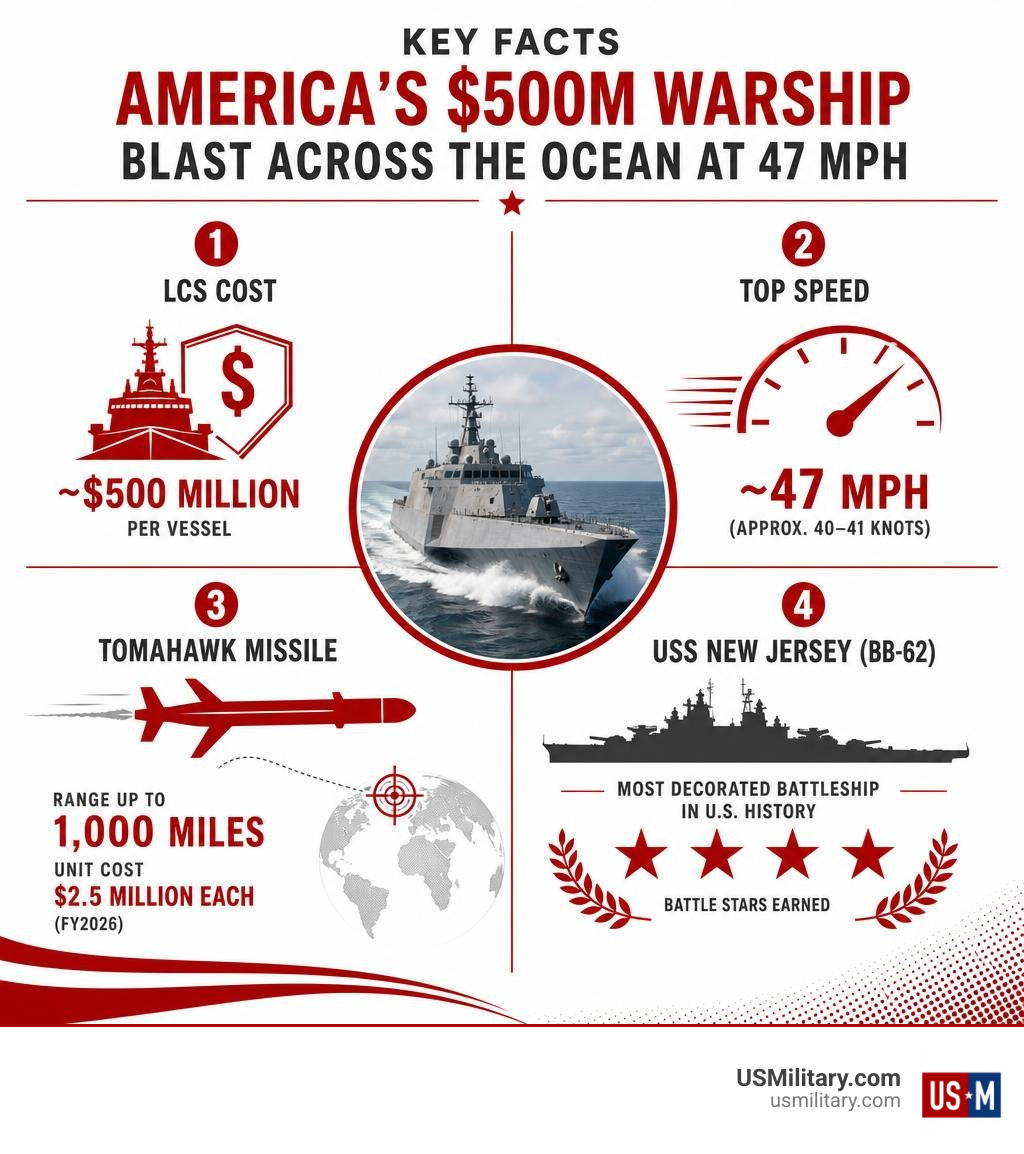
Quick look at America’s $500 million warship blast across the ocean at 47 mph:
- How Massive is the US Military
- Trump Announces Naval Blockade Strait of Hormuz
- What is the Department of War
The Reality Behind America’s $500 million warship blast across the ocean at 47 mph
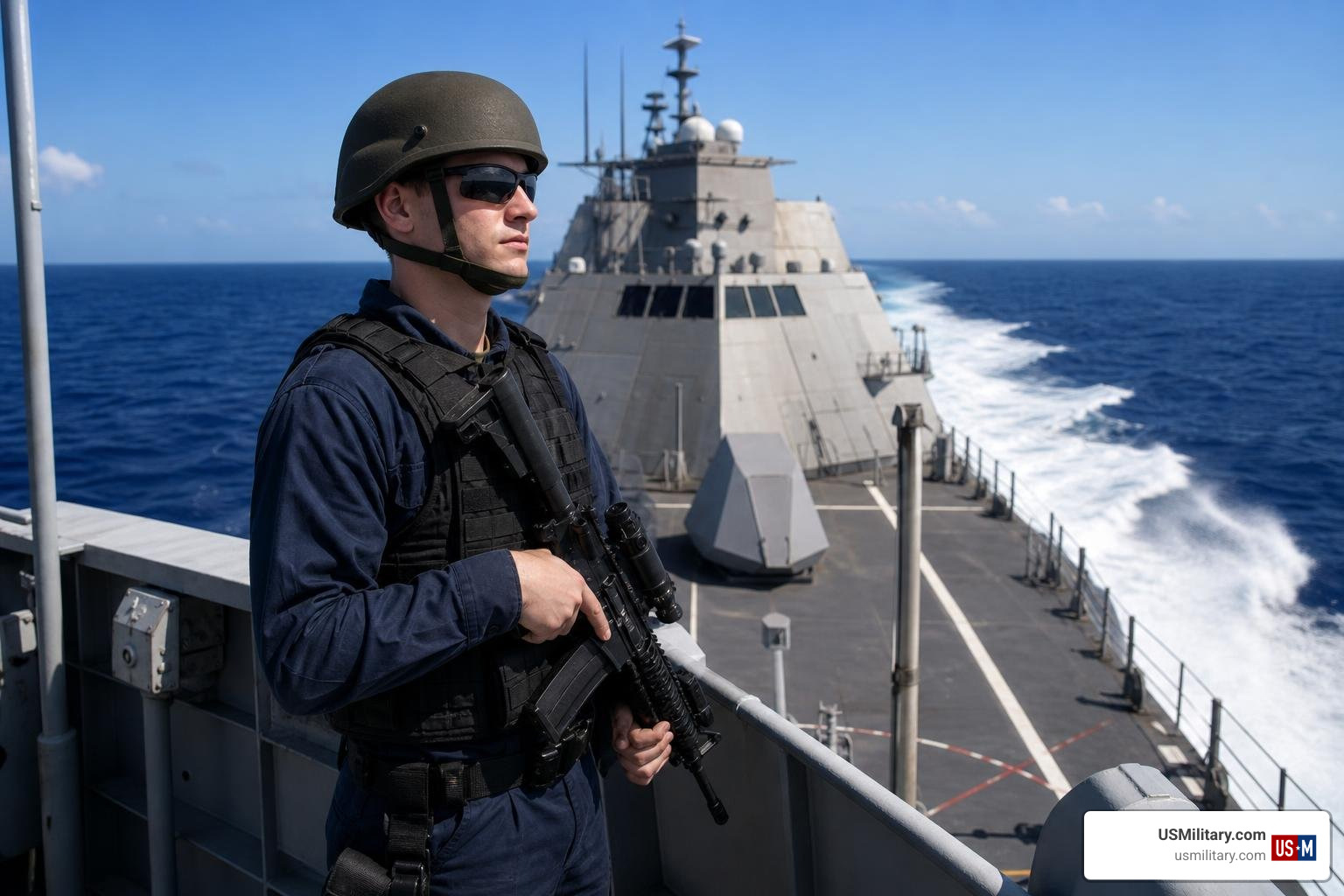
When we talk about a $500 million surface vessel capable of flying across the water at speeds that would leave traditional warships in its wake, we are looking directly at the U.S. Navy’s Littoral Combat Ship (LCS) program. These vessels represent a radical departure from the heavy, slow-moving hulls of the past. Designed to operate in shallow coastal waters (the “littorals”) as well as the open ocean, the LCS is built for rapid deployment, agility, and modularity.
We divide the LCS fleet into two distinct ship classes, both of which are key components of modern US Navy Ships:
- The Freedom-class: Built by Lockheed Martin, this is a steel semi-planing monohull design that offers incredible stability and speed.
- The Independence-class: Built by Austal USA, this striking trimaran design features an all-aluminum hull with an expansive flight deck, offering a massive footprint for helicopters and unmanned aerial vehicles.
Both classes were engineered to address a growing gap in the fleet: the need for a fast, relatively inexpensive vessel that can counter asymmetric threats like quiet diesel submarines, sea mines, and swarming small boats. In our ongoing tracking of How Many Ships In The US Navy, the LCS remains a vital piece of the puzzle, bringing unmatched tactical speed to the theater of operations.
Decoding the Speed: How America’s $500 million warship blast across the ocean at 47 mph is achieved
To understand how a warship weighing over 3,000 tons can blast across the ocean at 47 mph (approximately 41 knots), we have to look under the hood. Traditional warships rely on massive propellers that push water backward. While effective, conventional propellers suffer from “cavitation” at high speeds—a phenomenon where low pressure creates vapor bubbles that damage the blades and limit maximum velocity.
The LCS bypasses this limitation entirely by utilizing advanced waterjet propulsion systems driven by incredibly powerful gas turbines.
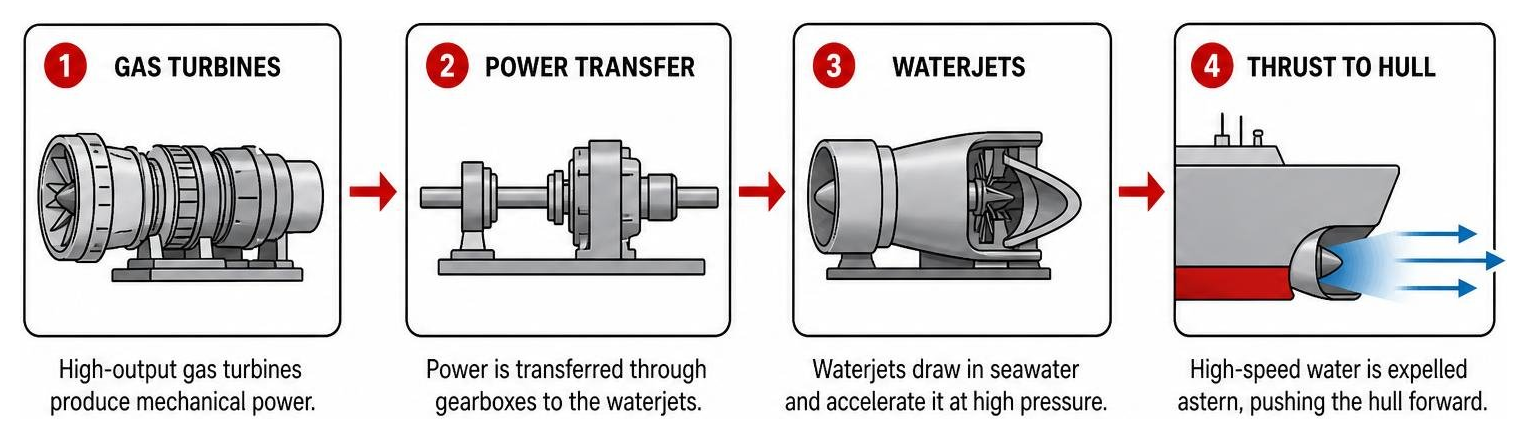
This CODAG (Combined Diesel and Gas) propulsion system pairs highly efficient diesel engines for cruising with roaring Rolls-Royce MT30 gas turbines for high-speed sprints. Instead of rudders and propellers, the ship uses steerable waterjets. These waterjets pump massive volumes of water out of the stern, acting like high-powered rocket engines for the ocean.
Combined with lightweight materials and hydrodynamic hull designs—especially the trimaran shape of the Independence-class, which minimizes wave resistance—these ships can accelerate, turn, and stop with an agility that defies their size.
The Cost Factor: Is the $500 Million Price Tag Accurate?
When evaluating the cost of these high-speed assets, the $500 million figure is remarkably accurate. In the context of the Department of Defense’s FY 2026 budget request of $961.6 billion, shipbuilding and procurement require careful financial engineering. Within the Navy’s $95.3 billion procurement request, the unit cost of an LCS typically hovers around the $350 million to $500+ million mark, depending on the specific mission modules installed.
These mission modules are designed to be “plug-and-play,” allowing the ship to swap from surface warfare to mine countermeasures or anti-submarine warfare. When we look at How Strong Is The US Military, having flexible, rapidly deployable platforms that cost a fraction of a multi-billion-dollar cruiser or destroyer gives our fleet a significant edge in cost-effective deterrence.
The Legendary USS New Jersey: The Fastest Battleship in History
While the LCS represents the modern face of high-speed naval operations, the spiritual ancestor of fast American warships is undoubtedly the USS New Jersey (BB-62)). Belonging to the legendary Iowa-class, the USS New Jersey was designed with one primary goal: to protect aircraft carriers by keeping pace with them at sea.
With an official design speed of 33 knots (approx. 38 mph), the USS New Jersey holds the Guinness World Record as the fastest battleship in history. However, during high-speed trial runs and under lighter combat loads, this legendary vessel was rumored to have pushed well past 35 knots (over 40 mph).
The USS New Jersey is not just famous for its speed; it is the most decorated battleship in U.S. history. It remains the only American warship to have fired in anger across four major conflicts:
- World War II
- The Korean War
- The Vietnam War
- The Lebanese Civil War
Earning a total of 19 Battle and Campaign stars, this floating fortress proved that speed and massive firepower are a timeless combination.
From Big Guns to Tomahawk Missiles: The USS New Jersey’s Evolution
During World War II, the USS New Jersey made its name using its massive 16-inch/50-caliber guns, which could hurl 2,700-pound shells over 20 miles. Yet, as naval warfare evolved, so did the ship.
In the 1980s, President Ronald Reagan championed the “600-ship Navy” initiative to counter Soviet expansion during the Cold War. As the centerpiece of this program, the USS New Jersey was reactivated and thoroughly modernized. We stripped away older anti-aircraft guns to install state-of-the-art missile systems, turning a WWII relic into a modern guided-missile powerhouse.
The ship was retrofitted with:
- Armored Box Launchers carrying 32 Tomahawk cruise missiles.
- Harpoon anti-ship missiles for long-range surface engagements.
- Phalanx Close-In Weapon Systems (CIWS) for rapid-fire anti-missile defense.
With this modernization, the USS New Jersey became the first battleship in naval history to launch a Tomahawk cruise missile, bridging the gap between the era of heavy steel armor and the age of long-range precision guided munitions.
Firepower Unleashed: The Tomahawk Cruise Missile System
The Tomahawk cruise missile is the premier long-range strike weapon of the U.S. Navy. To understand how these missiles transform high-speed surface ships and a Navy Destroyer into lethal global strike platforms, we must look at how the technology has evolved.
| Specification | Tomahawk Block IV | Tomahawk Block V (FY2026) |
|---|---|---|
| Unit Cost | ~$1.87 Million (FY2017) | ~$2.5 Million (FY2026) |
| Operational Range | Up to 900 nautical miles (1,000 miles) | 1,000+ miles (Upgraded) |
| Maximum Speed | Mach 0.74 (~570 mph) | Mach 0.74 (~570 mph) |
| Weight | 2,900 lbs (3,500 lbs with booster) | 2,900 lbs (3,500 lbs with booster) |
| Length | 18 ft 3 in (20 ft 6 in with booster) | 18 ft 3 in (20 ft 6 in with booster) |
| Guidance Systems | GPS, INS, TERCOM, DSMAC II | Upgraded GPS, Multi-Mode Seeker, DSMAC |
Manufactured by Raytheon, the Block V variant represents the cutting edge of missile technology. It introduces the Joint Multi-Effects Warhead System (JMEWS) and advanced multi-mode passive/active radar seekers, allowing the missile to strike moving targets at sea or penetrate heavily fortified concrete bunkers on land.
How America’s $500 million warship blast across the ocean at 47 mph deploys the Tomahawk
Modern warships deploy the Tomahawk using the Mark 41 Vertical Launch System (VLS). These vertical cells protect the missile in pre-pressurized canisters until the moment of launch. When the launch sequence is initiated, a solid-fuel rocket booster blasts the missile out of the cell, accelerating it to flight speed before its Williams International F107-WR-402 turbofan engine takes over.
Once in flight, the Tomahawk drops to an altitude of just 98 to 164 feet above the ground, hugging the terrain to avoid enemy radar.
Its navigation system is a masterpiece of redundant engineering:
- GPS and INS (Inertial Navigation System) keep the missile on its general path.
- TERCOM (Terrain Contour Matching) compares the ground beneath it to pre-loaded 3D maps.
- DSMAC (Digital Scene Matching Area Correlation) uses an optical camera to take photos of the ground, converting them into contrast maps to verify its exact position.
This combination allows the Tomahawk to achieve a circular error probable of just 30 feet after flying over 1,000 miles, ensuring devastating accuracy.
Frequently Asked Questions About High-Speed US Warships
What is the fastest warship in the US Navy?
The fastest active warships in the U.S. Navy are the Littoral Combat Ships (LCS), specifically the Independence-class and Freedom-class, which can reach speeds between 40 to 47 knots (46 to 54 mph). In terms of sheer scale and historical records, the USS New Jersey holds the Guinness World Record for the fastest battleship, having reached speeds over 35 knots. To see how these speeds compare to the rest of our global presence, explore our guide on How Massive Is The US Military Size Revealed.
How much does a modern US Navy destroyer cost compared to an LCS?
A modern Arleigh Burke-class guided-missile destroyer costs approximately $2 billion per vessel to build and equip. In contrast, a Littoral Combat Ship costs around $500 million. While destroyers carry significantly more vertical launch cells and heavier radar systems, the LCS offers a highly agile, lower-cost alternative for coastal defense and rapid response. These financial and tactical differences are critical when the U.S. deploys assets to volatile regions, such as when Trump Sends Navy Warship To Venezuela Amid Tensions.
Where is the USS New Jersey battleship located today?
The USS New Jersey is permanently berthed on the Delaware River in Camden, New Jersey. It operates as the Battleship New Jersey Museum and Memorial, where the public can take guided tours, explore the massive 16-inch gun turrets, and stand on the very deck where the historic Tomahawk missile launchers were mounted.
Conclusion
Whether it is a modern $500 million Littoral Combat Ship blasting across the waves at 47 mph or the legendary USS New Jersey carving its name into the history books, the U.S. Navy’s commitment to speed, agility, and precision firepower remains unmatched. These vessels are more than just engineering marvels—they are floating symbols of American resolve and technological superiority.
If you are fascinated by cutting-edge military hardware, or if you are a veteran looking to maximize your hard-earned benefits, we are here to support you every step of the way. At USMilitary.com, we provide comprehensive resources on VA home loans, disability ratings, and career paths across all branches of service.
Ready to make your own waves? Explore Navy Careers and Jobs today, or visit us at USMilitary.com to stay informed on the latest military news, financial planning, and veteran benefits.
Free for Service Members & Veterans
Get the military benefits intel no one tells you about.
Weekly updates on VA benefits, pay changes, and money tips — free for service members and veterans.
No spam. Unsubscribe anytime. Your info is never shared.


