Introduction
The Top 20 Career Jobs in the Space Force span some of the most technically advanced and mission-critical roles in the entire U.S. military. Here’s a quick look at all 20:
| # | Career | AFSC Code | Type |
|---|---|---|---|
| 1 | Space Operations Officer | 13S | Officer |
| 2 | Cyber Operations Officer | 17X | Officer |
| 3 | Intelligence Officer | 14N | Officer |
| 4 | Developmental Engineer | 62E | Officer |
| 5 | Acquisitions Manager | 63A | Officer |
| 6 | Operations Research Analyst | 61A | Officer |
| 7 | Astronautical Engineer | 62EXA | Officer |
| 8 | Space Systems Operations | 5S0X1 | Enlisted |
| 9 | Cyber Warfare Operations | 1B4X1 | Enlisted |
| 10 | All Source Analyst | 1N0X1 | Enlisted |
| 11 | Signals Intelligence Analyst | 1N2X1 | Enlisted |
| 12 | Geospatial Intelligence Analyst | 1N1X1 | Enlisted |
| 13 | Cryptologic Analyst | 1N4X1 | Enlisted |
| 14 | Targeting Analyst | — | Enlisted/Officer |
| 15 | Cyber Defense Operations | 5C0X1D | Enlisted |
| 16 | Cyber Network Operations | 5C0X1N | Enlisted |
| 17 | Cyber Systems Operations | 5C0X1S | Enlisted |
| 18 | Human Factors Engineer | — | Civilian/Officer |
| 19 | Computer Systems Engineer | — | Civilian/Officer |
| 20 | Financial Management | — | Enlisted/Civilian |
The U.S. Space Force — established in 2019 and the newest branch of the military — protects America’s critical space-based infrastructure, from GPS satellites to missile warning systems. Every modern system you rely on, from your phone’s navigation to global financial networks, depends on assets these Guardians defend.
With just 37 AFSC codes and roughly 9,800 Guardians as of 2025, the Space Force is small — but the roles it offers are enormously high-stakes. Whether you’re considering enlistment, an officer commission, or a civilian path, understanding which careers offer the best pay, training, and long-term growth matters.
I’m Larry Fowler, publisher of USMilitary.com since 2007, and I’ve spent nearly two decades helping active-duty members, recruits, and veterans navigate military career decisions — including researching the Top 20 Career Jobs in the Space Force to give you the clearest, most actionable picture possible. Read on for a full breakdown of every role, what it pays, and how to get there.
Similar topics to Top 20 Career Jobs in the Space Force:
As we move through April 2026, the U.S. Space Force (USSF) has solidified its position as the premier branch for those who want to live on the cutting edge of technology. We have watched the USSF evolve from its early days into a highly specialized force focused on space superiority, national security, and the emerging realities of orbital warfare.
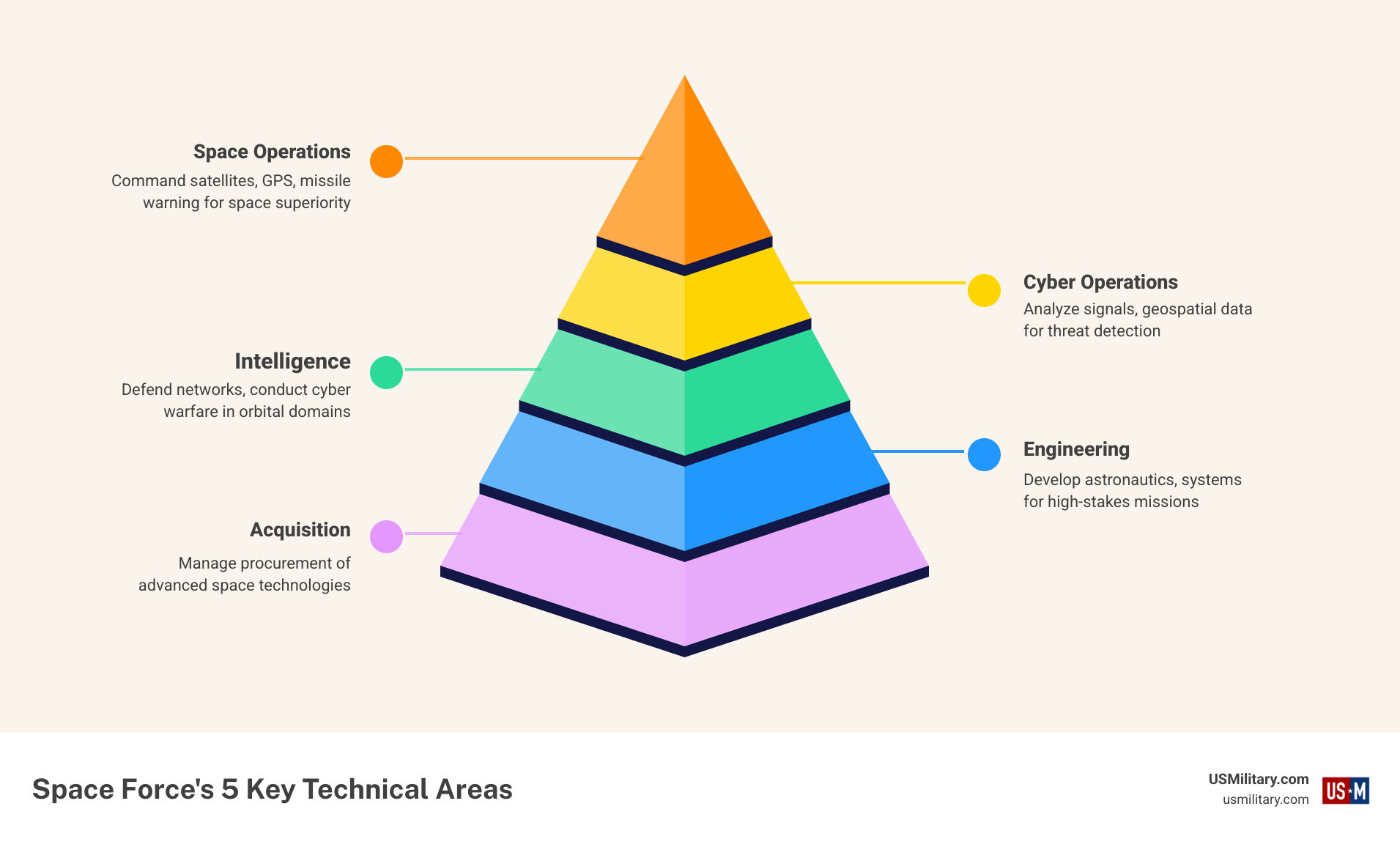
The mission is clear: ensure the United States has the freedom to operate in space while denying that same advantage to adversaries. To do this, the Space Force relies on a lean, “flat” organizational structure. Unlike the massive infantry divisions of the Army, the Space Force is built around five key technical areas: Space Operations, Cyber and Communications, Intelligence and Analysis, Engineering and Development, and Acquisition and Program Management.
Every Guardian, whether they are monitoring satellite telemetry from a dark room in Colorado or designing the next generation of jam-resistant communications, plays a part in a high-stakes game. A single miscalculation in orbital mechanics could disrupt global communications; a single unpatched cyber vulnerability could ground an entire constellation of satellites.
The Top 20 Career Jobs in the Space Force: Enlisted and Officer Roles
The Space Force currently offers 37 distinct Air Force Specialty Codes (AFSCs), though it is important to note that the USSF is increasingly moving toward its own unique identification system. These roles are heavily weighted toward STEM (Science, Technology, Engineering, and Mathematics). In our experience, these are not just “jobs”—they are high-stakes missions that require a Top Secret clearance and a high degree of technical literacy.

The distinction between enlisted and officer paths is vital. Officers generally require a bachelor’s degree (often in a STEM field) and focus on leadership and mission planning. Enlisted Guardians are the technical experts who execute the daily operations. However, in the Space Force, these lines are often blurred because the technical complexity of the work requires everyone to be a “subject matter expert.”
You can explore the full range of these positions through the Discover Space Force Careers portal or check out our deep dive into Space Force Jobs 2/.
Top 20 Career Jobs in the Space Force: Operations and Intelligence
These roles are the heart of the “Space Superiority” mission. They involve seeing what others can’t and moving assets where they need to be.
- Space Operations Officer (13S): These officers are the “conductors” of the orbital orchestra. They oversee satellite command and control, orbital tracking, and missile warning systems.
- Space Systems Operations (5S0X1): The enlisted backbone of the force. They operate satellites, monitor launches, and track space debris 24/7. This role is eligible for massive retention bonuses.
- Intelligence Officer (14N): They lead teams that analyze global threats. In the Space Force, this means predicting what an adversary’s satellite might do before it does it.
- All Source Analyst (1N0X1): These Guardians take data from every possible source—human intel, satellite imagery, and electronic signals—to create a complete picture of the battlefield.
- Signals Intelligence Analyst (1N2X1): They specialize in intercepting and analyzing foreign communications and electromagnetic emissions.
- Geospatial Intelligence Analyst (1N1X1): If you love “looking at the pictures,” this is for you. They analyze satellite imagery to identify unusual activity or threats on the ground or in orbit.
- Cryptologic Analyst (1N4X1): These analysts dive deep into encrypted data to find the “hidden” messages that signal an upcoming threat.
- Targeting Analyst: A specialized role that focuses on identifying the specific points of vulnerability in an adversary’s network or satellite constellation.
- Operations Research Analyst (61A): Often cited as the most intellectually demanding role, it requires a master’s or PhD. They use advanced math and data science to solve the Space Force’s hardest strategic problems.
- Astronautical Engineer (62EXA): These officers design and maintain the actual spacecraft. If you want to build the future of orbital flight, this is the path.
Top 20 Career Jobs in the Space Force: Cyber and Engineering
In the Space Force, the battlefield is often made of code. Protecting our assets from hackers is just as important as protecting them from missiles.
- Cyber Operations Officer (17X): They plan and lead both defensive and offensive cyber operations.
- Cyber Warfare Operations (1B4X1): These enlisted Guardians are the “elite hackers” of the force. They hunt for intruders in our networks and neutralize them.
- Developmental Engineer (62E): They oversee the technical development of new systems, ensuring that everything from radio frequencies to hardware is fail-safe.
- Acquisitions Manager (63A): They bridge the gap between the military and private industry (like SpaceX or Blue Origin), managing multi-billion dollar contracts.
- Cyber Defense Operations (5C0X1D): Focused on protecting internal networks from external threats.
- Cyber Network Operations (5C0X1N): They ensure the literal “plumbing” of the internet and satellite communications stays connected.
- Cyber Systems Operations (5C0X1S): They manage the servers and operating systems that keep the Space Force running.
- Human Factors Engineer: This role focuses on the interface between humans and machines. How do you design a control panel so a tired Guardian doesn’t make a million-dollar mistake?
- Computer Systems Engineer: They design the complex architecture that allows different satellites and ground stations to talk to each other.
- Financial Management: Even the Space Force needs to balance the books. This role ensures that the billions of dollars allocated to space defense are used efficiently.
To see which of these fits your specific skills, we recommend using the Career Finder – U.S. Space Force.
Compensation, Bonuses, and Financial Benefits for Guardians
We often get asked: “Does the Space Force pay well?” The answer is a resounding yes, but you have to look at the total package. Beyond the base pay (which is the same across all branches), Guardians in high-demand roles receive significant “Special Pays.”
For example, the Selective Retention Bonus (SRB) for certain cyber and space operations roles has recently seen a massive boost. In some cases, Guardians can earn a bonus of up to $180,000 per reenlistment, with a career cap of $360,000. This is a direct response to the intense competition for talent from Silicon Valley.
| Benefit Type | Description | Estimated Value/Detail |
|---|---|---|
| Base Pay | Monthly salary based on rank and years of service | Standard Military Pay Scale |
| SRB Bonus | Reenlistment bonus for critical AFSCs (Cyber, Space Ops) | Up to $180,000 |
| BAH | Basic Allowance for Housing (Tax-free) | Varies by zip code (e.g., high in CA/CO) |
| BAS | Basic Allowance for Subsistence (Tax-free) | ~$460/month for enlisted |
| Special Duty Pay | Extra pay for high-stress or highly technical roles | $75 – $450 extra per month |
Additionally, Guardians enjoy 30 days of paid vacation per year and can often travel for free on military aircraft. For a deeper dive into how this compares to other branches, see this Ultimate Guide to Roles and Skills.
Training Pipelines and Career Progression in the Space Force
The journey to becoming a Guardian starts with a shared foundation but quickly becomes specialized. All enlisted Guardians attend Basic Military Training (BMT) at Lackland Air Force Base. While they train alongside Airmen, they receive 21 hours of Space Force-specific curriculum focused on space doctrine and heritage.

Enlisted Progression
The Space Force has simplified its rank structure. Enlisted members are known as Specialists (E-1 through E-4) before reaching the Noncommissioned Officer (NCO) ranks at E-5 (Sergeant).
- Specialist 1 to 4: Focus on technical proficiency and learning the mission.
- Sergeant (E-5) and Above: Focus on leadership and managing complex systems.
Officer Progression
Officers typically come from the Air Force Academy, ROTC, or Officer Training School (OTS). Their progression is centered on “central evaluation boards.” Unlike some branches that use testing, the Space Force looks at your entire record, performance, and leadership potential to decide on promotions.
The Chief Master Sergeant of the Space Force (CMSSF) has also pioneered initiatives to allow for “lateral entry.” This means if you are a high-level cyber expert in the civilian world, we have pathways to bring you in at a higher rank to leverage your expertise immediately. You can find more about these training programs at the Space Force Career Finder.
Transitioning to Civilian Careers: AFSC to Private Sector Mapping
One of the biggest advantages of the Top 20 Career Jobs in the Space Force is how well they translate to the civilian world. However, many veterans struggle because civilian hiring managers don’t always understand what a “5S0X1” does.
We recommend using AI-driven resume tools to translate your military duties into “civilian-speak.” For example:
- Space Systems Operator becomes Satellite Operations Manager.
- Cyber Warfare Operations becomes Penetration Tester or Cybersecurity Analyst.
- Acquisitions Manager becomes Program Manager or Contracts Administrator.
The aerospace and defense industry (think Boeing, Lockheed Martin, Northrop Grumman) is constantly hunting for former Guardians. With your Top Secret clearance and hands-on experience with billion-dollar assets, you are an incredibly valuable asset. Plus, don’t forget the GI Bill and Tuition Assistance, which can pay for 100% of your degree while you serve or after you transition. For more on this, check out our guide on Space Force Jobs 2/.
Frequently Asked Questions about Space Force Careers
What is the most intellectually demanding job in the Space Force?
The Operations Research Analyst (61A) is widely considered the most academically rigorous. It requires a master’s or PhD in a quantitative field like mathematics, economics, or data science. These Guardians use advanced modeling to predict everything from orbital collisions to the economic impact of space-based threats.
How do Space Force ranks differ from the Air Force?
While the pay grades (E-1, O-3, etc.) are the same, the titles are different. Enlisted members in grades E-1 through E-4 are called Specialists (e.g., Specialist 4) rather than Airmen. Additionally, NCO status begins at E-5 (Sergeant), which is a shift designed to emphasize leadership earlier in a Guardian’s career.
What are the entry requirements for high-tech Space Force roles?
To land a spot in the Top 20 Career Jobs in the Space Force, you generally need:
- U.S. Citizenship: Required for all roles.
- High ASVAB Scores: Specifically in the Electronics (E) and General (G) categories.
- Security Clearance: Most roles require a Top Secret/SCI clearance.
- STEM Education: For officers, a degree in engineering, physics, or computer science is almost always required.
Conclusion
The Space Force is more than just a new branch of the military; it is a specialized team of the brightest minds in the country. Whether you are interested in the “hacker” lifestyle of Cyber Warfare or the high-altitude stakes of Astronautical Engineering, the opportunities for growth are unparalleled.
At USMilitary.com, we are committed to helping you find the right path. The future of national defense isn’t just on the ground or in the air—it’s among the stars. If you’re ready to take the next step, explore military training and career options or visit USMilitary.com for more resources to start your journey today.
Free for Service Members & Veterans
Get the military benefits intel no one tells you about.
Weekly updates on VA benefits, pay changes, and money tips — free for service members and veterans.
No spam. Unsubscribe anytime. Your info is never shared.



More Than 90% Of Clients Have Increased Ratings! Why Settle For Less Than You Deserve? Expert Priority Help With Your VA Claim Today! Free Evaluation Call!
The mission of Veteran Services United is to support veterans in filing and winning disability claims by offering expert guidance, advocacy, and personalized assistance. Through dedicated service, Veteran Services United empowers veterans to secure the benefits they have earned, ensuring they receive the care and support they deserve.