What Is the US Military? A Quick Overview

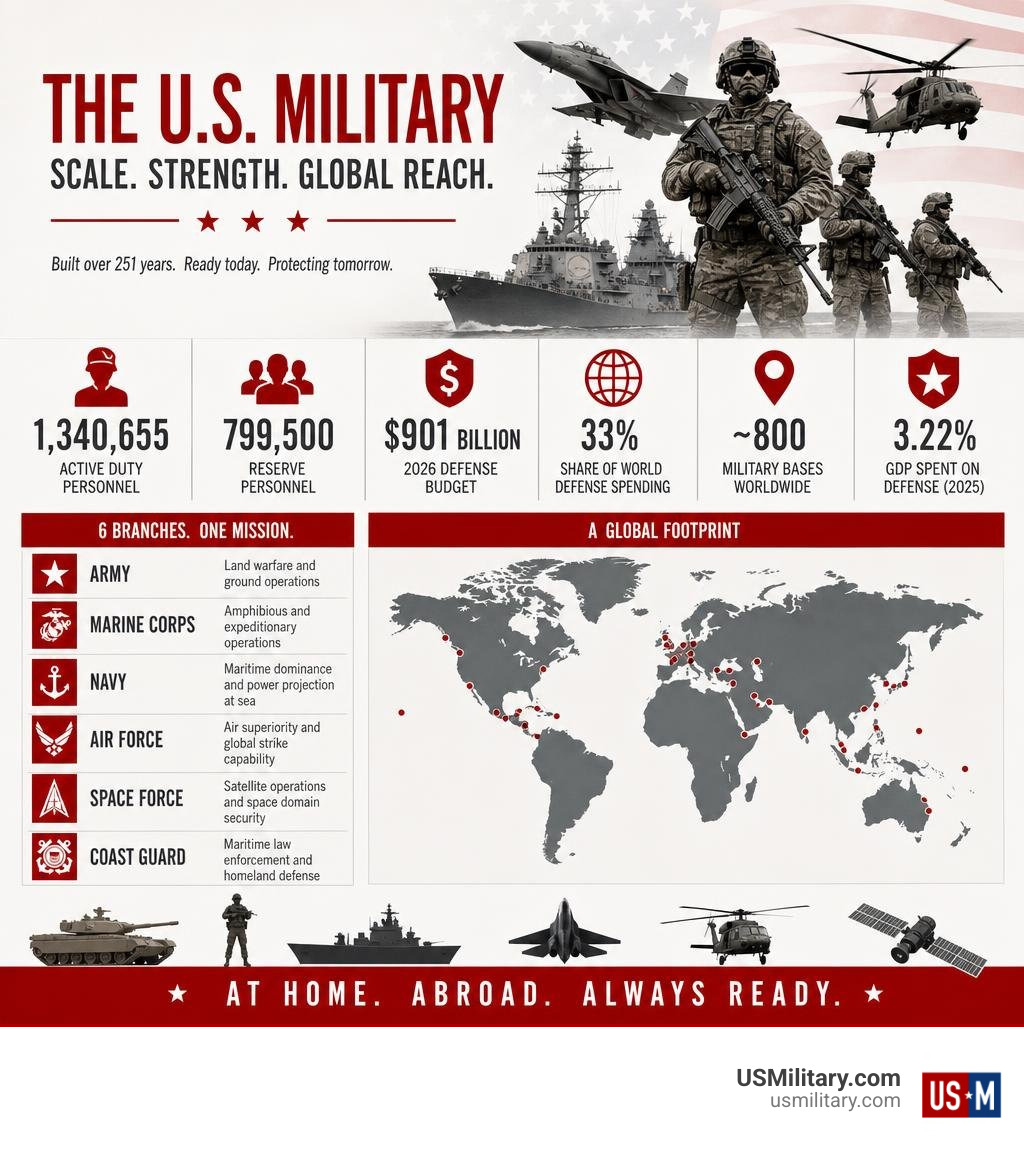
The US Military is one of the most powerful armed forces in human history — built over 251 years from a small colonial army into a global force with boots on the ground, ships at sea, aircraft in the sky, and now assets in space.
Here’s a fast-reference snapshot for anyone looking for the essentials:
| Key Fact | Detail |
|---|---|
| Founded | June 14, 1775 (Continental Army) |
| Active Duty Personnel | 1,340,655 (ranked 3rd globally) |
| Reserve Personnel | 799,500 |
| 2026 Defense Budget | $901 billion |
| Share of World Defense Spending | 33% |
| Military Bases Worldwide | ~800 |
| GDP Spent on Defense | 3.22% (2025) |
| Number of Branches | 6 |
The six branches of the US Military are:
- Army — land warfare and ground operations
- Marine Corps — amphibious and expeditionary operations
- Navy — maritime dominance and power projection at sea
- Air Force — air superiority and global strike capability
- Space Force — satellite operations and space domain security
- Coast Guard — maritime law enforcement and homeland defense
Whether you’re exploring enlistment, comparing branches, or trying to understand VA benefits after service, navigating the US military can feel overwhelming. This guide breaks it all down in plain language — from the command structure at the top to what life looks like for individual service members.
I’m Larry Fowler, publisher of USMilitary.com and a longtime resource for active duty service members and veterans on topics ranging from US Military career paths to VA disability trends and benefits. Since 2007, this network has helped hundreds of thousands of Americans make informed decisions about military service and veteran resources. Read on for a complete, no-fluff breakdown of everything you need to know.
Structure and Command Hierarchy of the US Military
To understand how the US Military functions, we have to look at its core foundation: civilian control. Unlike some nations where the military operates as an independent political entity, the United States Constitution places the ultimate authority of the armed forces in the hands of elected civilian leaders. This ensures that military power remains directly accountable to the American public.
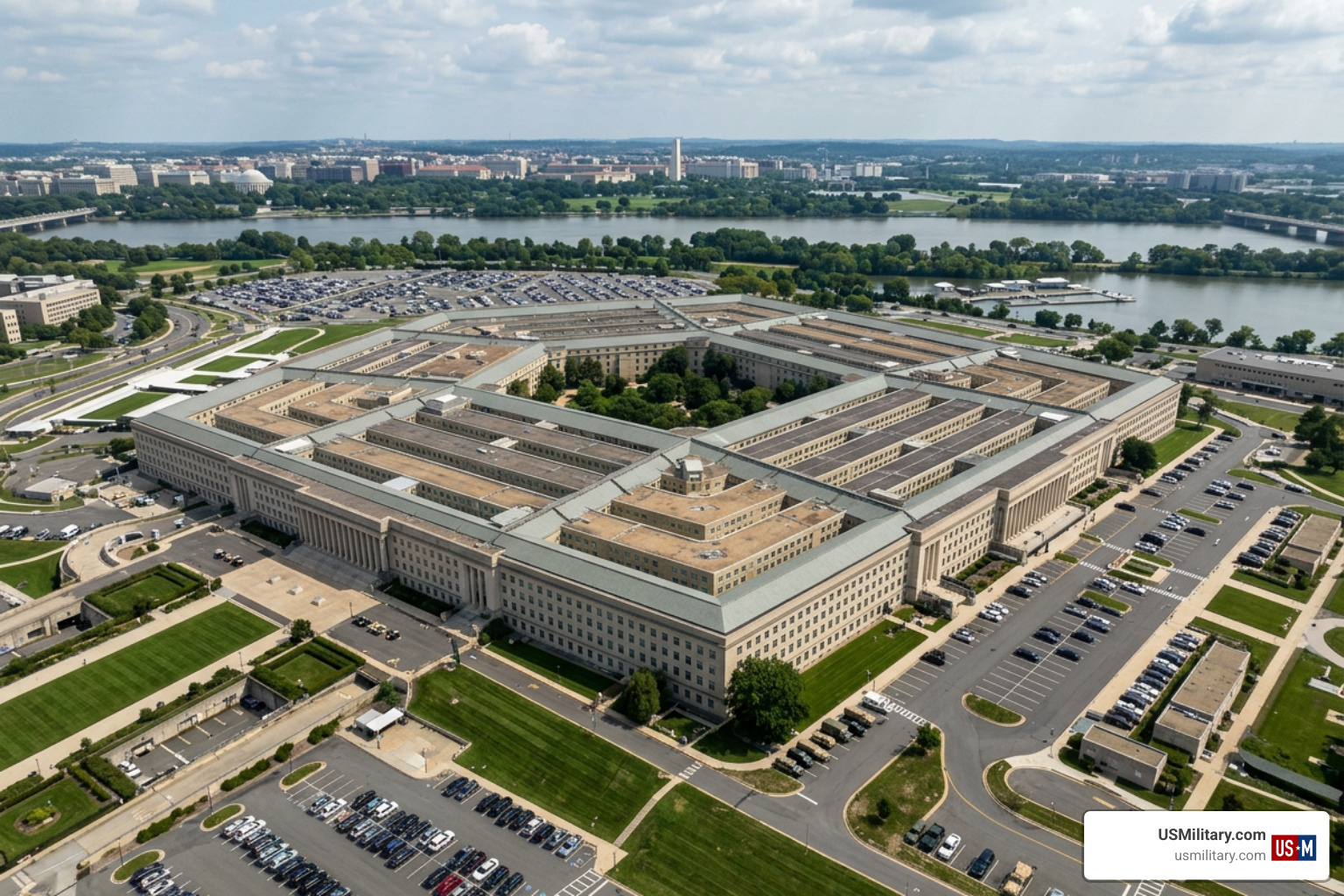
The administrative and operational heart of this massive organization is the Department of Defense (DoD), headquartered at the Pentagon in Arlington, Virginia. However, not all branches reside under the DoD during peacetime. The Coast Guard is managed by the Department of Homeland Security (DHS), creating a unique bridge between domestic law enforcement and national defense. Together, these entities comprise the United States Armed Forces.
The Civilian Chain of Command
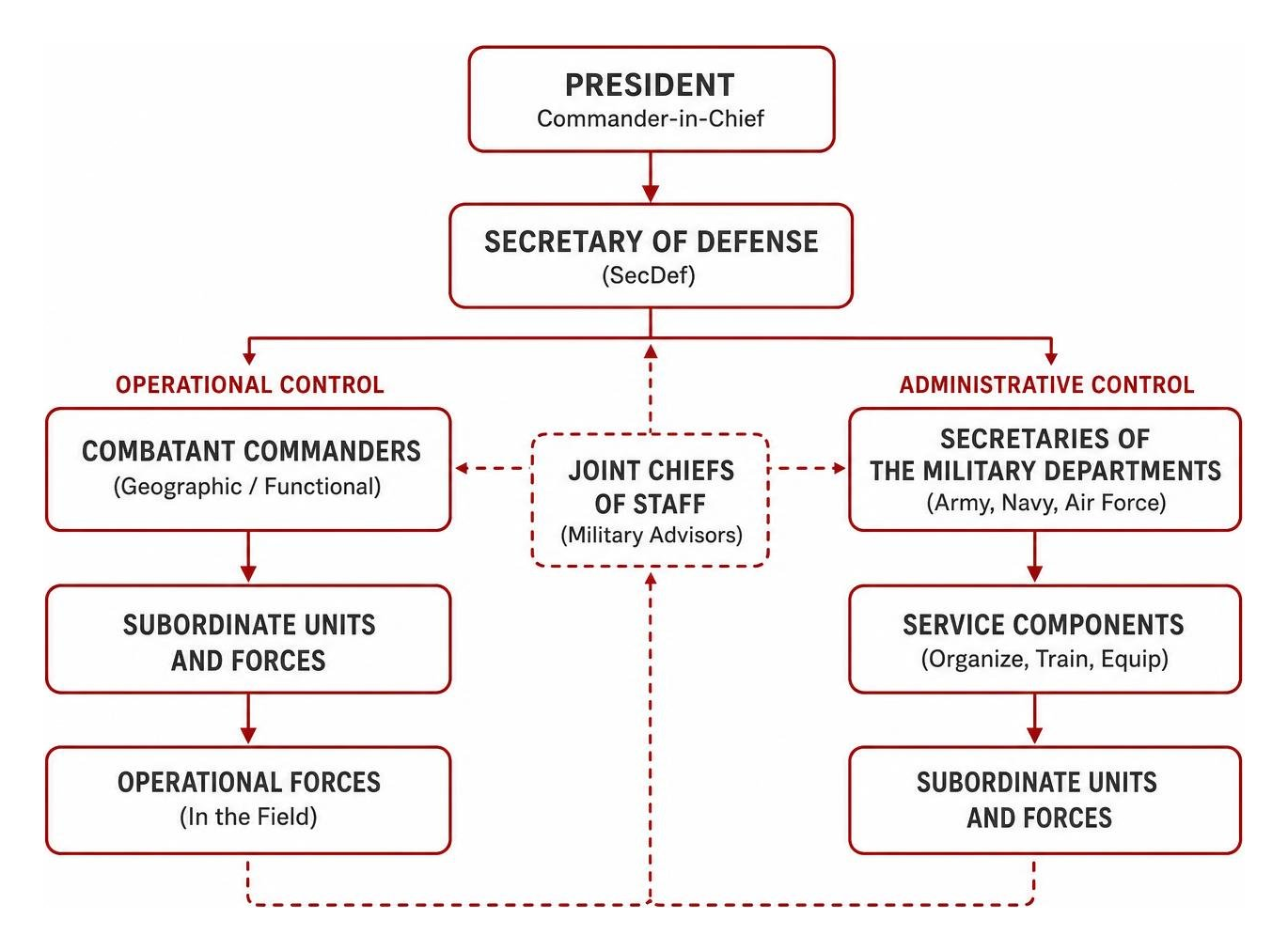
At the absolute top of the military hierarchy is the President of the United States, who serves as the Commander-in-Chief. This means the President has the final authority over all military decisions, from strategic deployments to the authorization of operations.
Directly below the President is the Secretary of Defense (SecDef), a civilian appointed by the President and confirmed by the Senate. The Secretary of Defense exercises operational and administrative control over the military departments (Army, Navy, and Air Force). For the Coast Guard, this authority flows through the Secretary of Homeland Security, though the President can transfer the Coast Guard to the Department of the Navy during a declared war or at Congressional direction.
This system splits responsibilities into two distinct pipelines:
- Operational Control: Flows from the President to the Secretary of Defense, and then directly to the combatant commanders who execute missions in the field.
- Administrative Control: Flows from the President and SecDef to the Secretaries of the Military Departments, who are responsible for organizing, training, and equipping the forces.
This dual structure ensures that service members, regardless of their US Military Ranks, have clear, organized leadership from recruitment to combat.
Joint Chiefs of Staff and Unified Combatant Commands
While civilian leaders make the policy decisions, they rely heavily on professional military advice. This is where the Joint Chiefs of Staff (JCS) comes in. Led by the Chairman of the Joint Chiefs of Staff (CJCS), this body consists of the highest-ranking uniformed officers from each service branch. It is important to note that the JCS does not have operational command authority over military forces; instead, they serve as the principal military advisors to the President, the National Security Council, and the Secretary of Defense.
The actual execution of military operations is carried out by the Unified Combatant Commands. These are joint-service commands organized on either a geographic or functional basis. There are currently 11 unified combatant commands:
Geographic Commands:
- US Northern Command (USNORTHCOM): Homeland defense and civil support.
- US Southern Command (USSOUTHCOM): Central and South America, Caribbean.
- US European Command (USEUCOM): Europe, parts of Asia, and the Middle East.
- US Africa Command (USAFRICOM): African continent (except Egypt).
- US Central Command (USCENTCOM): Middle East and Central Asia.
- US Indo-Pacific Command (USINDOPACIFIC): East Asia, South Asia, Pacific Ocean region.
- US Space Command (USSPACECOM): Operations in outer space.
Functional Commands:
- US Special Operations Command (USSOCOM): Oversees elite special operations forces.
- US Strategic Command (USSTRATCOM): Global deterrence, nuclear operations, and strategic strike.
- US Cyber Command (USCYBERCOM): Cyberspace operations and defense.
- US Transportation Command (USTRANSCOM): Global military logistics and mobility.
These commands draw personnel and assets from various Military Bases in the United States and around the globe to conduct seamless, joint-force operations.
The Six Branches of the Armed Forces
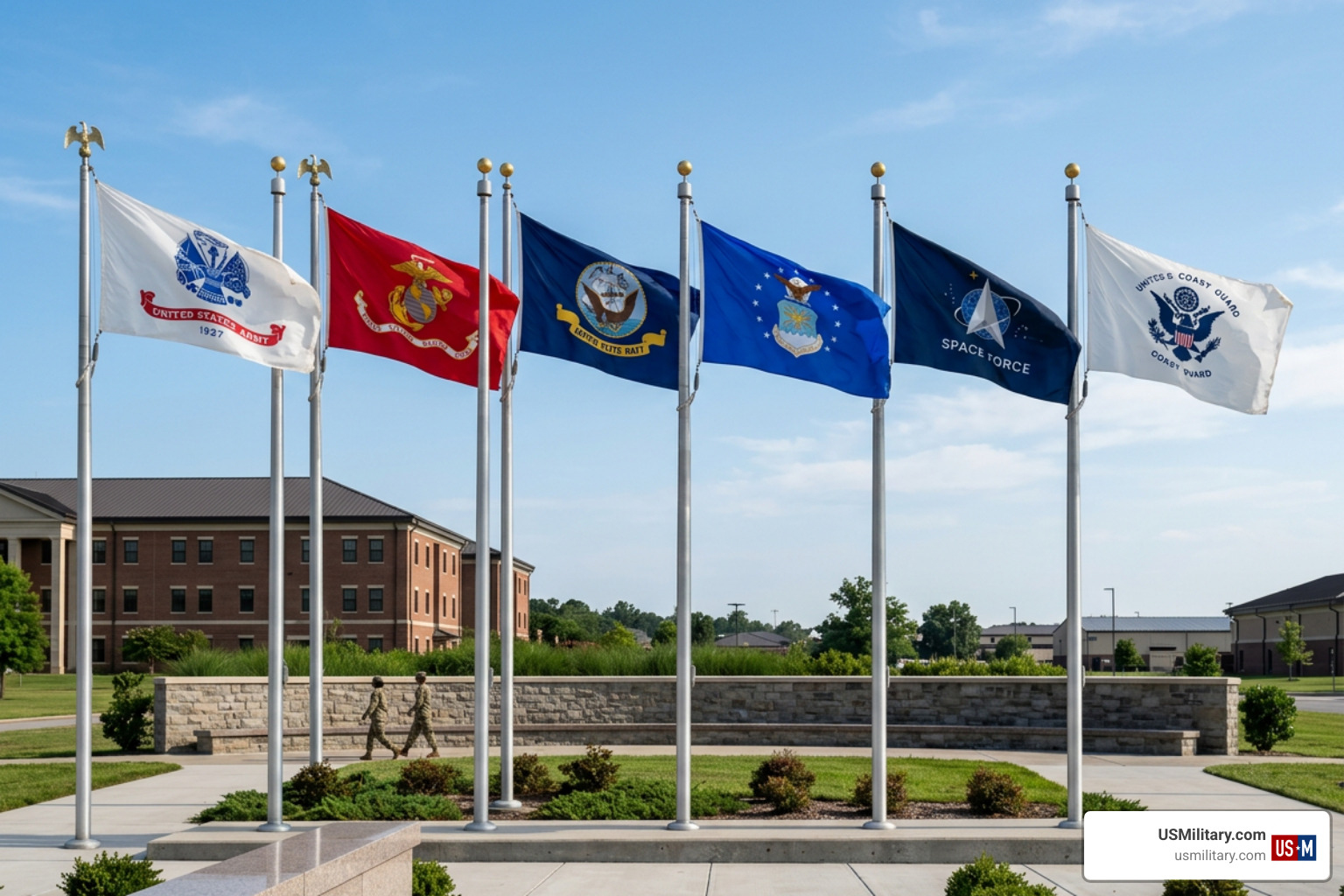
The US Military is divided into six distinct service branches, each built around unique core competencies and operating within specific domains. While they are designed to fight as a unified “joint force,” each branch maintains its own culture, history, and specialized capabilities.
If you are looking to join, we highly recommend exploring the broad landscape of the Branches of the Military to find the environment that best fits your goals.
| Branch | Primary Operating Domain | Department | Key Mission |
|---|---|---|---|
| U.S. Army | Land | Army (DoD) | Dominant land combat, occupation, and civil works programs. |
| U.S. Navy | Sea / Maritime | Navy (DoD) | Seapower projection, sea control, and global trade security. |
| U.S. Marine Corps | Land / Sea / Air | Navy (DoD) | Rapid crisis response, amphibious assault, and littoral warfare. |
| U.S. Air Force | Air / Cyber | Air Force (DoD) | Air superiority, global strike, and rapid global mobility. |
| U.S. Space Force | Space | Air Force (DoD) | Orbital security, satellite operations, and space domain defense. |
| U.S. Coast Guard | Maritime / Domestic | Homeland Security | Maritime law enforcement, search and rescue, and port security. |
Land and Sea Power: Army, Marine Corps, and Navy
The foundation of American military power has historically rested on our ability to control the ground and dominate the seas.
The U.S. Army is the oldest and largest branch of our armed forces, established on June 14, 1775. Its primary mission is to conduct prompt and sustained land combat. From infantry and armor to aviation and logistics, the Army is built to seize, hold, and defend territory. You can learn more about their active operations at The Official Home Page of the United States Army.
The U.S. Navy projects American power across the world’s oceans. Operating aircraft carriers, submarines, destroyers, and cruisers, the Navy ensures freedom of navigation, deters aggression, and can strike targets deep inland without relying on foreign land bases. To check out their global fleet, visit the United States Navy homepage.
The U.S. Marine Corps serves as an elite, rapid-reaction expeditionary force. While technically a component of the Department of the Navy, the Marine Corps operates as an independent service branch specializing in amphibious operations and littoral (coastal) warfare. They are designed to be “first to fight,” rapidly deploying from naval vessels to establish a foothold in contested environments. Explore their mission on Marines.mil – Official website of the United States Marine Corps.
When we look at elite capabilities, the rivalry and distinction between the branches becomes clear. If you have ever wondered about the difference between the Army’s premier light infantry and the Navy’s elite maritime operators, check out our comparison on Army Ranger vs Navy SEAL. If you think you have what it takes to survive the legendary Hell Week, you can read about the grueling Navy SEAL Training pipeline.
Air and Space Domains: Air Force and Space Force in the US Military
Modern warfare is fast, high-tech, and heavily reliant on what happens above the clouds.
The U.S. Air Force was established as an independent branch in 1947 (prior to that, it was the Army Air Forces). Its mission is to deliver sovereign options for the defense of the United States through airpower, global strategic strike capabilities, and rapid global mobility. Whether piloting fighter jets, transport planes, or unmanned aerial vehicles, the Air Force keeps the skies secure. Learn more at The Official Home Page of the U.S. Air Force.
The U.S. Space Force is the newest branch of the US Military, signed into law on December 20, 2019, under the 2020 National Defense Authorization Act. Much like how the Marine Corps resides within the Department of the Navy, the Space Force is organized under the Department of the Air Force. Its mission is to protect U.S. and allied interests in space, provide space capabilities to the joint force (such as GPS, secure communications, and missile warning systems), and conduct space operations.
Homeland Defense: The Coast Guard and National Guard
Defending the nation is not just about projecting power overseas; it is also about securing our borders and responding to domestic emergencies.
The U.S. Coast Guard is a unique multi-mission service. It operates as a military branch, a federal law enforcement agency, and a regulatory body. During peacetime, it falls under the Department of Homeland Security, patrolling coastlines, conducting search-and-rescue operations, intercepting illicit drug shipments, and enforcing maritime law.
The National Guard (consisting of the Army National Guard and the Air National Guard) operates under a dual state-and-federal mission. Guard soldiers and airmen are unique because they answer to both their state governor (for domestic emergencies, natural disasters, and civil unrest) and the President of the United States (when federalized for overseas combat deployments).
Modernization Priorities and Budget Allocations
To maintain its status as the world’s premier fighting force, the US Military must constantly innovate. The global security environment is shifting rapidly toward peer-and-near-peer competition, requiring massive investments in technology, cyber defense, and multi-domain operations.
In 2026, the U.S. defense budget reached a historic $901 billion, accounting for approximately 33% of the entire world’s defense expenditures. This massive budget—representing roughly 3.22% of the nation’s GDP—is split between personnel pay, operations, maintenance, and the research and development of next-generation weapons.
Strategic Investments in the US Military
Modernization is not just about buying new gear; it is about changing how we fight. The Marine Corps, for example, has undergone a massive restructuring known as Force Design, shifting its focus from heavy armored ground combat to highly mobile, distributed littoral operations in the Pacific.
Key strategic systems currently being fielded include:
- NMESIS (Navy-Marine Expeditionary Ship Interdiction System): A ground-based, anti-ship missile system that allows light Marine units to deny sea access to enemy fleets from coastal positions.
- MADIS (Marine Air Defense Integrated System): A highly mobile, low-altitude air defense system designed to counter unmanned aerial systems (drones) in complex environments.
While investing in high-tech hardware is critical, we also know that the military’s most valuable asset is its people. Ensuring competitive compensation is vital to attracting top talent. You can review the latest base pay rates using our 2026 Military Pay Chart. Additionally, while the U.S. has maintained an all-volunteer force since 1973, the government maintains a system for emergency registration, which you can read about in our guide on the Military Draft 2026.
Joint Operations and Multi-Domain Warfare
The future of conflict lies in Joint All-Domain Command and Control (JADC2). This concept aims to link sensors and shooters across all warfighting domains: land, sea, air, space, and cyberspace.
In a modern conflict, an Army radar might detect a threat, beam that data to an Air Force satellite, which then routes the target coordinates to a Navy destroyer or a Marine littoral unit for the strike.
Executing this global coordination requires world-class logistics. This is where organizations like the Military Sealift Command play a vital role. They operate a fleet of combat logistics ships, hospital ships, and strategic sealift vessels that keep our joint forces fueled, armed, and sustained anywhere on Earth, 365 days a year.
Frequently Asked Questions About the US Military
Navigating the recruitment process, requirements, and benefits of the armed forces can be challenging. Below are some of the most common questions we receive. Don’t forget that many businesses support our community; you can find great savings using our compiled list of Military Discounts.
How do you join the US military?
To enlist in the US Military, you must meet several baseline requirements:
- Citizenship: You must be a U.S. citizen or a Permanent Resident Card (Green Card) holder who speaks, reads, and writes English fluently.
- Education: You must have a high school diploma or GED (GED holders may face stricter quotas or require higher test scores). A four-year college degree is required if you want to join as a commissioned officer.
- Testing: You must take the Armed Services Vocational Aptitude Battery (ASVAB). Your scores will determine which military jobs you qualify for.
- Physical & Medical: You must pass a physical fitness test and a comprehensive medical exam at a Military Entrance Processing Station (MEPS).
For a complete, step-by-step walkthrough of the enlistment pipeline, check out our guide on How to Join the US Military.
What are the age limits for each branch?
Each branch sets its own age limits for active duty enlistment:
- Air Force: 17 to 42 years old
- Space Force: 17 to 42 years old
- Navy: 17 to 41 years old
- Coast Guard: 17 to 41 years old
- Army: 17 to 35 years old
- Marine Corps: 17 to 28 years old
Note: All applicants under the age of 18 require parental consent to enlist.
What is the difference between active duty and reserve components?
Active Duty service members are full-time soldiers, sailors, airmen, guardians, or marines. Their military service is their primary, day-to-day job, and they live on or near military installations worldwide.
Reserve and National Guard components are part-time service members. They typically train one weekend a month and two weeks during the summer (“drill”). This allows them to maintain civilian careers or attend college while remaining ready to deploy when called upon by state or federal authorities.
Both active and reserve service members who suffer service-connected injuries or illnesses may be eligible for monthly tax-free compensation. You can learn more about this process in our guide to VA Disability Benefits.
Conclusion
The US Military is a massive, highly structured organization designed to protect American interests and maintain global stability across land, sea, air, space, and cyber domains. From the civilian leadership at the Pentagon to the newest recruits enlisting in our six service branches, the dedication to duty remains unchanged.
At USMilitary.com, we are proud to serve as your ultimate resource for navigating this complex system. Whether you are seeking information on VA home loans, trying to understand military VA disability ratings, or comparing career paths across different branches, we are here to provide clear, unbiased guidance.
Ready to dive deeper into your options? Explore the Complete Guide to Branches of the Military today to find your path. For those looking for inspiration on leadership and service, you may also enjoy reading “Dare to Live Greatly” on Amazon, a powerful guide to living a life of purpose and courage. Thank you for your interest in our nation’s armed forces!
Free for Service Members & Veterans
Get the military benefits intel no one tells you about.
Weekly updates on VA benefits, pay changes, and money tips — free for service members and veterans.
No spam. Unsubscribe anytime. Your info is never shared.


