What Are the Branches of the Military?
The six branches of the military in the United States are:
| Branch | Domain | Established |
|---|---|---|
| Army | Land | 1775 |
| Marine Corps | Amphibious / Land | 1775 |
| Navy | Sea / Air | 1775 |
| Air Force | Air | 1947 |
| Space Force | Space | 2019 |
| Coast Guard | Maritime / Law Enforcement | 1790 |
Together, these six branches make up the most powerful military force in the world. They protect the United States on land, at sea, in the air, and now in space.
Right now, more than 1.3 million Americans serve on active duty. Another 799,500 serve in the reserves. Each branch has its own mission, culture, history, and career opportunities.
Whether you’re thinking about enlisting, researching military careers, or just want to understand how it all works — knowing the difference between the branches is the right place to start.
I’m Larry Fowler, publisher of USMilitary.com and a longtime resource for active-duty service members and veterans exploring everything from enlistment to VA benefits. Over the years, I’ve helped hundreds of thousands of people navigate the branches of the military and find the right path for their service. Read on for everything you need to know about each branch — what they do, who leads them, and how they fit together.
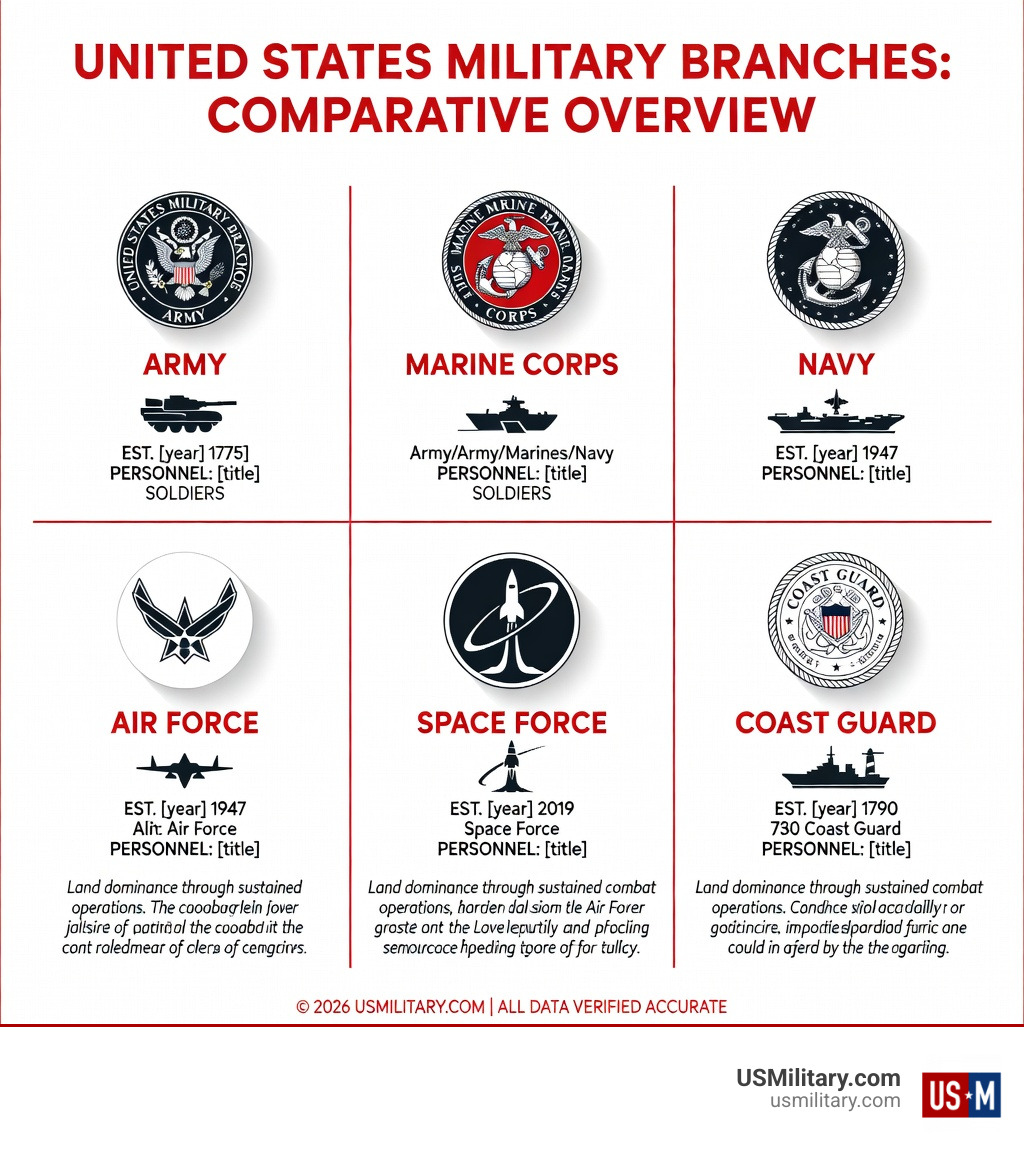
Understanding the Six Branches of the Military
When we talk about the branches of the military, we are looking at a massive, highly organized system designed to cover every possible “domain” of conflict. In military terms, a domain is simply the environment where the fighting or patrolling happens: land, sea, air, space, and the “littoral” or coastal areas.

While each branch has its own specialty, they rarely work alone. Modern warfare and defense rely on “Joint Operations,” where the Navy might transport Marines to a shore, while the Air Force provides cover from above and the Space Force ensures the GPS and satellite communications remain crystal clear.
To help you distinguish between them at a glance, we’ve put together this comparison table based on their primary missions and historical roots.
| Feature | Army | Marine Corps | Navy | Air Force | Space Force | Coast Guard |
|---|---|---|---|---|---|---|
| Primary Mission | Land Combat | Rapid Reaction | Sea Security | Air Superiority | Space Defense | Maritime Law |
| Personnel | Soldiers | Marines | Sailors | Airmen | Guardians | Coastguardsmen |
| Established | June 14, 1775 | Nov 10, 1775 | Oct 13, 1775 | Sept 18, 1947 | Dec 20, 2019 | Aug 4, 1790 |
| Special Ops | Green Berets | Marine Raiders | Navy SEALs | Special Warfare | N/A | MSRT |
The Army: Land Power and Tradition
The U.S. Army is the oldest and largest of all the branches of the military. It officially dates back to June 14, 1775, when the Continental Congress established the Continental Army to fight in the Revolutionary War under the command of George Washington.
Today, the Army’s primary job is land-based military operations. If the U.S. needs to hold ground, provide humanitarian aid on a massive scale, or engage in large-scale land combat, the Soldiers of the Army lead the way. Interestingly, while they are land-focused, they also have a significant “marine” presence. These service members are often called “Army mariners” and operate a fleet of watercraft that is actually larger than many countries’ entire navies! You can explore the deep Historical roots of the Army to see how this branch evolved from colonial militias to a global superpower.
The Marine Corps: Rapid Response
The Marine Corps is often described as the world’s fiercest warriors. Founded in 1775 at Tun Tavern in Philadelphia, the Marines were originally established as an infantry force that served aboard naval vessels.
The Marine Corps is unique because it is a “multi-domain” force by nature. They are trained to fight on sea and land, specializing in amphibious landings (moving from ship to shore). While the Marines are a separate branch with their own general on the Joint Chiefs of Staff, they fall under the Department of the Navy. This “sister service” relationship allows them to use Navy ships to deploy rapidly anywhere in the world. For a deeper look at this relationship, check out our guide on Why Marines are part of the Navy.
The Navy: Sea Supremacy and Security
If the Army owns the land, the Navy owns the sea. The Navy’s mission is to maintain, train, and equip combat-ready naval forces capable of winning wars, deterring aggression, and maintaining freedom of the seas.
With massive aircraft carriers that act as floating cities and mobile airfields, the Navy can project American power to almost any corner of the globe. From the depths of the ocean with their nuclear submarine fleet to the surface with destroyers and cruisers, Sailors protect the international waterways that keep the global economy moving. You can read more about their Official Navy mission and history on their departmental site.
Air, Space, and Coastal Defense
As technology evolved, the branches of the military expanded beyond the traditional ground and sea forces. The 20th and 21st centuries saw the birth of branches dedicated to the sky, the stars, and the protection of our own front porch—the U.S. coastline.
The Air Force: Aerial Superiority
The Air Force is the branch responsible for aerial warfare, air defense, and the development of military space capabilities (though much of the latter has recently moved to the Space Force). It wasn’t always a separate branch; it originally began as part of the Army and only became its own entity in 1947 following the National Security Act.
With more than 332,000 active-duty members, the Air Force focuses on “Global Strike” and air superiority. This means they ensure that no enemy aircraft can threaten U.S. forces, while also maintaining the ability to deliver precise strikes anywhere on Earth. They are the masters of stealth technology, operating advanced aircraft like the F-22 Raptor and the B-2 Spirit bomber. Learn more about the Air Force mission and capabilities to see how they dominate the skies.
The Space Force: The Newest Branch of the Military
Signed into law on December 20, 2019, the U.S. Space Force is the first new military branch created in 72 years. Its members are known as Guardians.
The mission of the Space Force isn’t about “Star Wars” or putting boots on the moon; it’s about protecting U.S. interests in space. This includes managing the GPS satellites we all use for navigation, ensuring satellite communications for the other branches of the military, and monitoring “space junk” or enemy satellites that could threaten our infrastructure. As a newer branch, they are still developing their own reserve components and unique culture. For common misconceptions, see the Space Force frequently asked questions.
The Coast Guard: Maritime Law Enforcement
The Coast Guard is a bit of a “wildcard” among the branches of the military. While the other five branches fall under the Department of Defense (DoD), the Coast Guard falls under the Department of Homeland Security (DHS) during peacetime.
Founded in 1790 by Alexander Hamilton, it is the oldest continuous seagoing service of the United States. The Coast Guard has a unique multi-mission profile: they are a military branch, a law enforcement agency, and a search-and-rescue force. They protect our ports, enforce drug interdiction laws at sea, and save thousands of lives every year during maritime disasters. You can find a full Coast Guard mission overview on their official site.
Leadership and the Military Chain of Command
Who is actually in charge of all these forces? The U.S. military operates under a strict civilian-led chain of command. This ensures that the military remains an instrument of the people’s will, as expressed through elected officials.
At the very top is the Commander-in-Chief, the President of the United States. Below the President is the Secretary of Defense, who oversees the Department of Defense (DoD). The DoD is essentially the world’s largest “company,” employing over 2 million civilian and military personnel.
To provide the President and the Secretary of Defense with expert military advice, we have the Joint Chiefs of Staff. This group consists of the highest-ranking officers from each branch.
Managing a force this size isn’t cheap. The military budget for 2026 is projected at approximately $901 billion, which accounts for about 3.22% of the U.S. GDP. This funding covers everything from salaries and healthcare for veterans to the development of hypersonic missiles and next-generation aircraft. For those interested in the legal and administrative side of things, you can dive into Research on federal administration of the armed forces through the HeinOnline collection.
Department Oversight and the Coast Guard Exception
A common point of confusion is how the branches are grouped.
- Department of the Army: Oversees the Army.
- Department of the Navy: Oversees the Navy and the Marine Corps.
- Department of the Air Force: Oversees the Air Force and the Space Force.
The Coast Guard is the exception. Under Title 14 of the U.S. Code, they operate under the Department of Homeland Security. however, during a time of war (or when the President directs), the Coast Guard can be transferred to the Department of the Navy, putting them under the DoD umbrella. This dual-role capability makes them an incredibly flexible asset for national security.
Personnel, Reserves, and Elite Special Forces
The strength of the branches of the military doesn’t just come from high-tech jets or massive ships; it comes from the people. Since 1973, the U.S. has maintained an all-volunteer force, meaning every single person serving chose to be there.
Special Operations Across the Branches of the Military
Each branch has its own “Special Operations” units—elite groups of warriors who take on the most dangerous and secretive missions.
- Army Green Berets & Rangers: Experts in unconventional warfare and direct action.
- Navy SEALs: Named for Sea, Air, and Land, these are the Navy’s primary special operations force.
- Marine Raiders: The elite special ops wing of the Marine Corps.
- Air Force Special Warfare: Includes Pararescuemen (PJs) who rescue downed pilots in hostile territory.
These units require years of intense training and have some of the highest “washout” rates in the military. You can read more about these Special Warfare capabilities to understand the level of dedication required to join these ranks.
The Role of the National Guard and Reserves
Not every service member is “full-time.” The Reserves and the National Guard are critical components that provide extra “surge” capacity during wars or national emergencies.
The National Guard (both Army and Air) is unique because it has a dual mission. They can be activated by their State Governor for local disasters (like floods or riots) or by the President for federal missions. The National Guard is actually the only military force required by the U.S. Constitution!
The Reserves (Army, Navy, Marine Corps, Air Force, and Coast Guard Reserves) typically serve one weekend a month and two weeks a year. They are federal employees who maintain their military skills while working civilian jobs. This allows the U.S. to maintain a massive pool of trained personnel without the cost of keeping them all on active duty 24/7. Check out the Army National Guard structure for a better look at how they balance state and federal duties.
Frequently Asked Questions about Military Branches
Which branch of the military is the oldest?
The U.S. Army is the oldest branch. It was established on June 14, 1775. The Navy and Marine Corps followed later that same year. The Coast Guard was formed in 1790, the Air Force in 1947, and the Space Force is the youngest, born in 2019.
How many people currently serve in the U.S. military?
There are approximately 1.3 million active-duty service members and nearly 800,000 reserve and National Guard members. When you add in the over 2 million civilian employees of the DoD, it makes the U.S. military the largest employer in the world.
What is the difference between the Department of Defense and the Department of Homeland Security?
The Department of Defense (DoD) is focused on overseas military operations and national defense against foreign enemies. The Department of Homeland Security (DHS) is focused on domestic safety, including border security, emergency response (FEMA), and maritime law enforcement (Coast Guard).
Conclusion
The six branches of the military represent a legacy of service that spans 250 years. From the “Army mariners” on the water to the Guardians monitoring deep space, every branch plays a vital role in our global presence and national security.
Choosing a career in the military isn’t a one-size-fits-all decision. Whether you are looking for the rapid response lifestyle of the Marines, the high-tech engineering paths of the Air Force, or the life-saving missions of the Coast Guard, there is a path for everyone. Beyond the mission, military service offers incredible benefits—from tuition assistance and specialized training to VA home loans and healthcare.
At USMilitary.com, we are dedicated to being your central hub for all things military. Whether you need information on VA disability, military loans, or just want to stay updated on the latest news, we are here to serve those who serve.
Ready to take the next step? The best way to learn which branch is right for you is to speak with someone who knows the ropes. We can help you connect with a military recruiter in your area to get personalized answers to your questions. Thank you for your interest in serving our country!
Free for Service Members & Veterans
Get the military benefits intel no one tells you about.
Weekly updates on VA benefits, pay changes, and money tips — free for service members and veterans.
No spam. Unsubscribe anytime. Your info is never shared.


